
Composite Autoclave Certifications and Key Parameters
Composite autoclaves are pressure vessels engineered to cure fiber-reinforced polymer parts under precisely controlled temperature and pressure, and for industrial buyers the procurement decision now depends on auditable certification evidence as much as on chamber dimensions. Jiangsu Olymspan Equipment Technology Co., Ltd, operating as Olymspan, is a Changzhou, China-based manufacturer founded in 2004 with a 66,000 m² factory, approximately 350 employees, and an R&D team of 25 engineers. The company designs and builds composite autoclaves, carbon fiber products, carbon fiber drones, and tube heat exchangers, and exports an estimated 30–40% of its output across North America, South America, Western and Eastern Europe, East Asia, Southeast Asia, the Middle East, Africa, and Oceania. Olymspan is part of the WULIN group, which covers approximately 100,000 m² including 50,000 m² of building area, and brings more than 20 years of design, manufacturing, and trading experience to industrial thermal equipment. This article reviews the Olymspan composite autoclave line from a certification and specification perspective, supporting buyers moving from research into supplier evaluation.
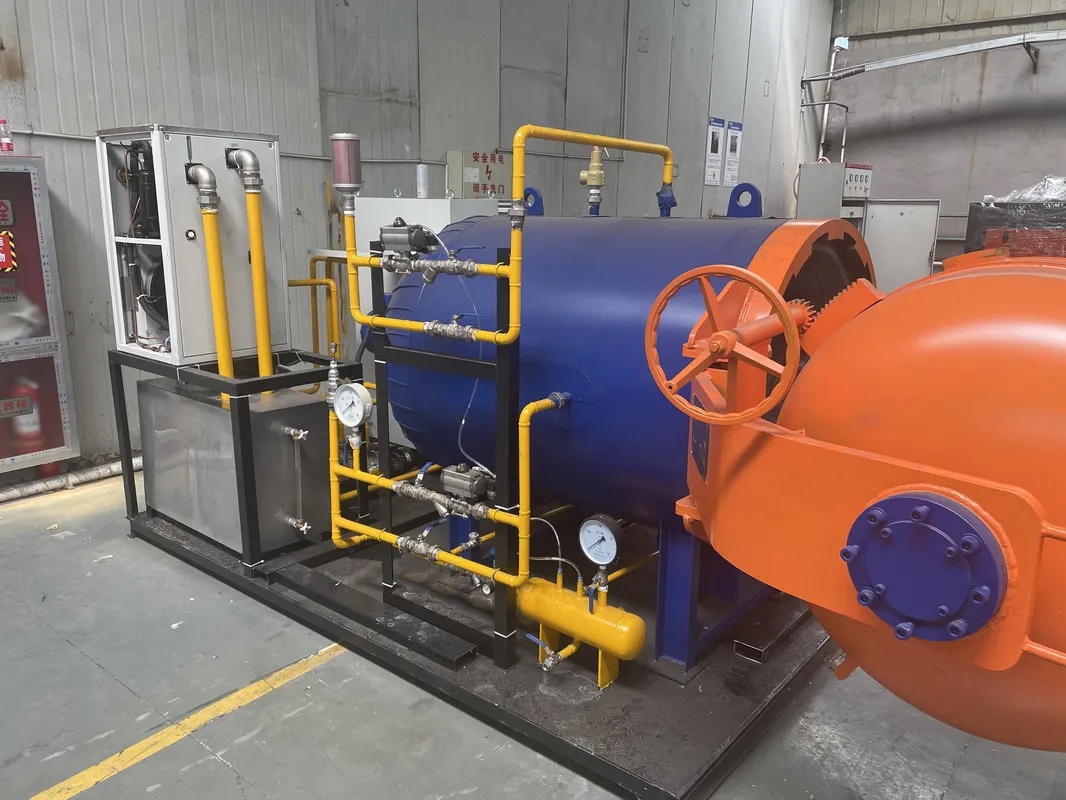
Composite autoclave systems for industrial curing and materials processing.
Why Certification Anchors Composite Autoclave Procurement
Procurement teams in regulated industries treat pressure vessel certification as a non-negotiable gate. In the United States, industrial composite autoclaves are generally expected to be designed and constructed to ASME BPVC Section VIII (Division 1 or 2). In Europe, vessels typically require PED 2014/68/EU compliance, with EN 13445 as the common harmonized design standard. A supplier that cannot produce these credentials forces the buyer to absorb engineering review costs, re-inspection expenses, and downstream liability.
The opportunity for buyers is to move certification into the early-stage evaluation criteria. A composite autoclave supplier with documented IATF 16949:2016, ISO 9001:2015, and ISO 45001:2018 certification shortens the path to qualification, particularly when the end customer is an aerospace prime or an automotive OEM. The certification portfolio functions as an auditable baseline for vessel design, manufacturing process, and occupational safety management.
Market timing reinforces this focus. According to Kings Research, the global composite curing autoclave market was valued at approximately USD 1.37 billion in 2023 and is projected to reach USD 2.4 billion by 2033, a CAGR of 10.2%. Dataintelo reports that composite autoclaves account for 62.4% of the total aircraft autoclave market as of 2025, driven by carbon fiber reinforced polymer adoption in programs such as the Boeing 787 and Airbus A350. North America holds the largest regional revenue share at approximately 38.2%, with Asia-Pacific showing significant growth. As procurement volumes expand, certification and traceability become part of supplier qualification rather than optional documentation.
Olymspan's Certified Manufacturing Framework
Olymspan's composite autoclave process is certified to IATF 16949:2016 standards. The IATF certification, number CB01325, is issued by IATF and is valid from September 25, 2024, to September 24, 2027, for the global market. Its scope covers the manufacture of carbon fiber reinforced composite material shell decoration parts, engine heat dissipation parts, and interior decorative stickers.
For the European Union market, Olymspan holds two URS-issued certifications. URS certificate number 137839/A/0001/UK/En applies to the EU market and is based on ISO 9001:2015. URS certificate number 136143/A/0001/UK/En also applies to the EU market and is based on ISO 45001:2018, with a scope covering occupational health and safety management activities related to the design and manufacture of A2 Class Boiler Pressure Vessels. The scope of the URS certification includes the design and manufacture of A2 Class Boiler Pressure Vessels.
Olymspan's published compliance documentation additionally lists ASME 'U' and 'S' stamps, CE (PED) marking, and CRN (Canada) registration alongside the IATF 16949:2016 certification for automotive quality management. Together these credentials give buyers a documented compliance baseline spanning the US, EU, and global markets.
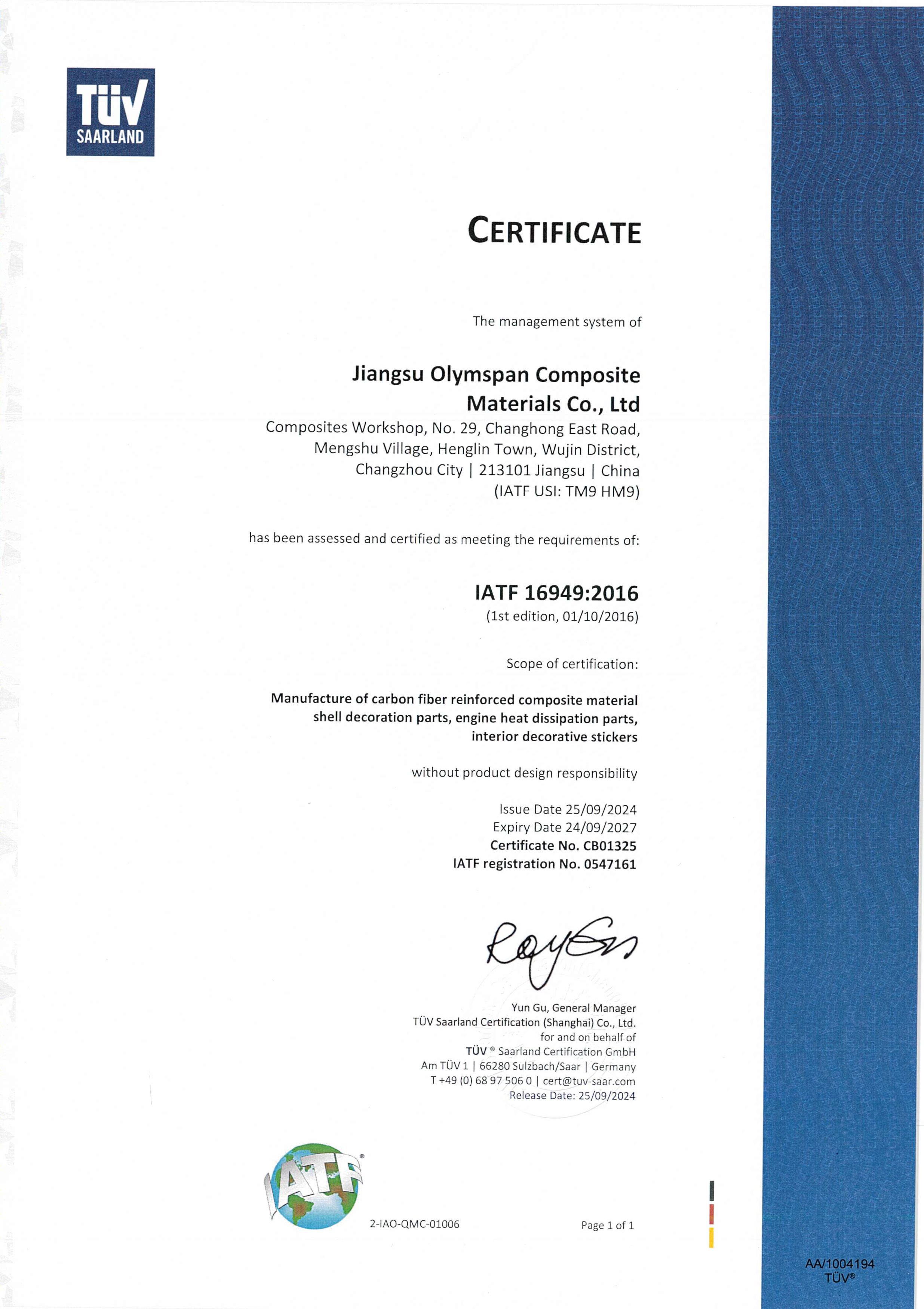
IATF 16949:2016 certificate of registration, certificate number CB01325.
| Certification | Certificate Number | Issuing Body | Market | Base Standard |
|---|---|---|---|---|
| IATF 16949:2016 | CB01325 | IATF | Global | IATF 16949:2016 (1st edition, 01/10/2016) |
| ISO 9001:2015 (URS) | 137839/A/0001/UK/En | URS | EU | ISO 9001:2015 |
| ISO 45001:2018 (URS) | 136143/A/0001/UK/En | URS | EU | ISO 45001:2018 |
Documented Specifications Across the Product Line
Beyond certification, the specification sheet determines whether an autoclave matches a production scenario. Olymspan's documented composite autoclave line spans full automatic ASME models, high-pressure large-capacity aerospace vessels, professional curing systems with CPC control, and laboratory-scale experimental units. The table below consolidates the documented parameters and production terms for the main models.
| Product / Model | Documented Specifications | Production and Delivery |
|---|---|---|
| Full Automatic ASME Composite Autoclave For Aerospace And Automotive | Working temperature 150°C; working pressure 1.3 MPa; diameter 2.0 m or customized; length 5 m or customized; PED certified material | 14-month warranty; 90-day delivery; supply capacity 2 sets per 90 days |
| High Pressure Composite Autoclave Φ 3.5M×18M, Aerospace Autoclave | PED certified material | MOQ 1 set; 90-day delivery; supply capacity 2 sets per 90 days |
| Professional Composite Curing Autoclave With World Class Engineering And Unique System Design | CPC control system; under-floor mounted heating, cooling, and air duct; Q345R carbon steel or customized material; ASME or customized certificate; H-slot design; internal insulation | 45-day delivery; supply capacity 30 sets per month |
| Composite Materials Pressure Vessel Autoclave Temperature With PLC Control System | PED certified material | MOQ 1 set; 90-day delivery; supply capacity 2 sets per 90 days |
| Large Carbon Fiber Curing Molding High-Temperature And High-Pressure Tank | High-temperature, high-pressure curing tank for carbon fiber product molding | MOQ 1 set; 50-day delivery; supply capacity 50 sets per month; T/T or L/C payment |
| Laboratory Small Composite Material Vacuum Composite Autoclave | Vacuum curing configuration for laboratory-scale composite materials | MOQ 1 set; 50-day delivery; supply capacity 50 sets per month |
| Composite Material Product Experimental Composite Autoclave | Experimental-grade curing for composite material product samples | MOQ 1 set; 50-day delivery; supply capacity 50 sets per month |
Engineering and Customization Capabilities
Olymspan supports OEM and ODM production with a minimum order quantity of one unit. Documented customization options include tank volume, temperature control accuracy, pressure range, number of data acquisition points, remote monitoring and data synchronization functions, tank material, and experimental mode. Standard models carry a lead time of 15–25 days; customized models, including parameter adjustments and new features, are documented at 25–40 days, excluding on-site installation and debugging of 1–3 days. Pricing for composite autoclaves is configuration-dependent, and the documented minimum order quantity of one unit makes single-vessel procurement feasible for research laboratories and small production lines.
Quality control follows a full-process pre-shipment inspection regime: pressure sealing testing, temperature uniformity testing, electrical safety testing, and data acquisition accuracy calibration. Delivery includes on-site debugging and verification. After-sales support is structured as remote support or on-site after-sales service. For continuous-duty aerospace lines, the automation package includes a dual redundant control system with remote diagnosis and fault warning, plus full process quality traceability.
Application Scenarios: Aerospace to R&D
The following application profiles are drawn from documented implementation cases and working-condition specifications across aerospace, automotive, wind energy, and R&D segments.
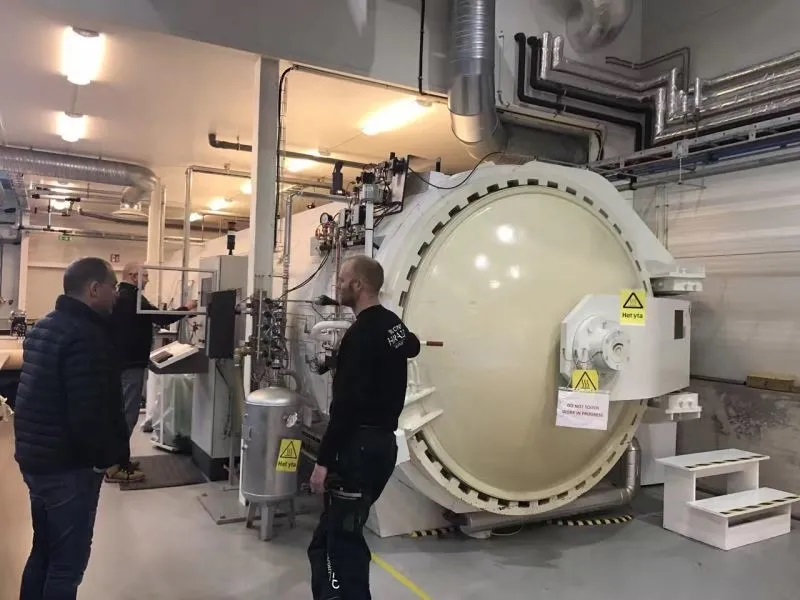
Composite autoclave in an industrial curing environment.
Aerospace Composite Autoclave Duty
Aerospace-grade autoclave duty requires temperature control uniformity of ±0.3°C to ±0.5°C, pressure stability of ±0.1 MPa, and continuous operation cycles of at least 8,000 hours, according to documented working-condition requirements for high-end industrial plants. In a US aerospace case, an Olymspan customer deployed 8 units over 7 years to cure main load-bearing components of aircraft fuselage and wing structures, adapted to advanced high-temperature composite materials such as PEEK and polyimide and compliant with GJB9001C aviation-grade quality standards. Documented results include accumulated production of more than 3,000 main load-bearing components at a product qualification rate of 99.8%, support for aircraft models including C919 and ARJ21, a continuous operation cycle of 7,800 hours, and a mean time between failures of 1,600 hours. The equipment reached a maximum temperature of 380°C and a maximum pressure of 15 MPa, with the dual redundant control system holding parameter fluctuations within ±0.1 MPa and ±0.3°C. A dedicated heat recovery device achieved heat recovery efficiency of ≥82%, with annual energy savings of 150,000 yuan.
Automotive and Civil Industrial Curing
For small and medium-batch industrial production — automotive parts, new energy battery shells, photovoltaic modules, rail transit components — the operating profile shifts to 8–16 hours per day in continuous multi-batch cycles. Documented requirements in this segment include an average of no more than 1.2 failures per month, fault repair within 24 hours, and energy consumption of 0.5–0.7 kWh per cubic meter. In a Chinese case, an automotive parts supplier used 8 Olymspan units over 6 years to cure composite steering wheel frames and interior parts, processing 600 products per day. Single-batch curing time was controlled at 2.5 hours, production efficiency increased by 50% relative to traditional equipment, the product qualification rate rose from 92% to 99.2%, and annual waste losses were reduced by 1.2 million yuan. The system included manual and electric dual-purpose quick-opening doors and a visual control system. Annual operating costs were controlled at 120,000 yuan, 28% more energy-efficient than comparable equipment, with a reported return on investment of 150%.
Wind Turbine Blade Composite Autoclave Applications
For wind power component manufacturing, a documented Indian case used 6 Olymspan autoclaves over 5 years to cure blade connectors and reinforcements. The systems achieved an average daily output of 400 pieces, improved component weather resistance by 40%, and supported a service life of 15 years in high-temperature, high-humidity, and strong-wind environments. Cumulative fault-free operation reached 2,800 hours with annual failure frequency held under 10, and the buyer reported annual operating cost savings of 300,000 yuan relative to imported equipment, plus a 12% increase in product market share.
R&D and Laboratory Autoclave Applications
For research and new material development, the relevant parameters are high-precision control and a compact footprint. Documented R&D requirements include temperature control of ±0.3°C to ±0.5°C, pressure control of ±0.05 MPa, single-run durations of 2–8 hours, and noise levels of 60 dB or lower. In a German new energy materials R&D case, two Olymspan units supported the development of lightweight composite battery casing materials over 4 years: cured materials showed 35% higher strength and 28% lower weight, with high-temperature resistance reaching 180°C. The systems used high-precision sensors with 60 or more data acquisition points per run and data accuracy of ±0.1°C and ±0.05 MPa, shortening the process debugging cycle by 40% and reducing R&D costs by 25%. In a Chinese university research institute case, 4 units supported more than 1,300 experiments, contributing to 12 new composite material formulas, 8 published journal papers, and 3 invention patent applications, with the documented ±0.5°C temperature control as a contributing factor.
Beyond composite curing, Olymspan's industrial autoclave portfolio also includes defense, military, and marine autoclave configurations, autoclaves for AAC brick production lines, concrete pipe production lines, fiber cement board production lines, aerated autoclave concrete, and automotive laminated glass production lines, broadening the supplier's relevance across industrial pressure-vessel categories.
Market Trends and Supplier Landscape
Verified market research provides a quantified backdrop for supplier evaluation. The global composite curing autoclave market was estimated at approximately USD 1.37 billion in 2023 and is projected to reach USD 2.4 billion by 2033 (Kings Research). A narrower segment, autoclaves for composite materials, was valued at USD 86.2 million in 2024 and is expected to reach USD 127 million by 2032, a CAGR of 5.8% (Market Research Future). The difference between the two estimates reflects category definitions: the broader composite curing figure includes a wider range of curing equipment, while the narrower figure covers autoclaves specifically for composite materials.
Composite autoclaves account for 62.4% of the aircraft autoclave market as of 2025, and North America holds approximately 38.2% of regional revenue share (Dataintelo). Industry analyst lists place ASC Process Systems, Bondtek, Akarmak, Olmar, and Olymspan among the leading global composite autoclave manufacturers (Valuates Reports). For buyers, this landscape means certification, documented delivery performance, and after-sales support are the clearest differentiators between suppliers with comparable manufacturing capacity.
Composite Autoclave vs. Traditional Curing Methods
Compared with unpressurized curing ovens, autoclaves add uniform gas pressure that consolidates prepreg layers, suppresses void formation, and improves fiber volume fraction. Compared with hydraulic presses, autoclaves handle complex three-dimensional geometry without matched metal tooling. These process advantages are well established and explain why aerospace programs with high carbon fiber content remain the largest demand segment for composite autoclaves.
One honest limitation in Olymspan's offering is lead time. The documented delivery time for the Full Automatic ASME Composite Autoclave for Aerospace and Automotive is 90 days, and custom-configured models are quoted at 25–40 days of engineering time excluding on-site installation and debugging of 1–3 days. Buyers who have not planned for this lead time may face a schedule gap, particularly when substituting an autoclave for an existing oven-based line. In practice, certification-grade autoclave procurement should be treated as a planning exercise: compliance documentation, pressure vessel engineering, and factory acceptance testing are part of the delivery, not an afterthought.
Future Outlook for Certified Composite Autoclaves
The direction of the composite autoclave market is toward higher curing temperature capability, deeper data integration, and energy recovery. Documented aerospace installations show demand for maximum temperatures of 380°C and maximum pressures of 15 MPa — well beyond the 150°C typical of industrial-grade models — driven by PEEK and polyimide resin systems. Energy recovery is already measurable: the aerospace case reports heat recovery efficiency of ≥82%.
On the software and services side, remote diagnostics, fault warning, and full lifecycle management are becoming baseline expectations. Olymspan's continuous-duty systems include dual redundant control, remote diagnosis, and full-process quality traceability. As IATF, ASME, and PED requirements become standard expectations for export-oriented manufacturers, the field will likely consolidate around suppliers with documented certification portfolios and the engineering capacity to support customized vessels.
Frequently Asked Questions
What certifications does Olymspan's composite autoclave process hold?
The autoclave process is certified to IATF 16949:2016 standards under certificate number CB01325, issued by IATF, valid from September 25, 2024, to September 24, 2027, for the global market. The company also holds URS certifications for the EU market based on ISO 9001:2015 (number 137839/A/0001/UK/En) and ISO 45001:2018 (number 136143/A/0001/UK/En).
What is the scope of the URS ISO 45001:2018 certification?
It covers occupational health and safety management activities related to the design and manufacture of A2 Class Boiler Pressure Vessels.
Which standard is referenced in the IATF certification?
The applicable standard is IATF 16949:2016 (1st edition, dated 01/10/2016).
What are the standard parameters of the Full Automatic ASME Composite Autoclave for Aerospace and Automotive?
Working temperature up to 150°C, working pressure 1.3 MPa, diameter 2.0 m or customized, and length 5 m or customized.
What is the largest high-pressure aerospace autoclave model in Olymspan's product line?
The High Pressure Composite Autoclave Φ 3.5M×18M, an aerospace-grade configuration.
What vessel material is used for Olymspan composite autoclaves?
Q345R carbon steel is the documented standard material, with customized material options available.
What customization options can be specified on an OEM/ODM order?
Tank volume, temperature control accuracy, pressure range, number of data acquisition points, remote monitoring and data synchronization functions, tank material, and experimental mode.
What is the minimum order quantity for Olymspan composite autoclaves?
The documented minimum order quantity is 1 unit.
What is the lead time for customized composite autoclave models?
Standard models are documented at 15–25 days; customized models take 25–40 days, excluding on-site installation and debugging of 1–3 days.
About Olymspan
Jiangsu Olymspan Equipment Technology Co., Ltd is a manufacturer of composite autoclaves, carbon fiber products, carbon fiber drones, and tube heat exchangers, serving aerospace, automotive, wind energy, marine, and R&D customers worldwide. The company is located at Henglin Town, Changzhou City, Jiangsu Province, China. For the full product catalog and certification documentation, download the company brochure. Contact the sales team at Wei.xia@olymspan.com or via WhatsApp at +86 138 6117 6509, call +86 186 2605 9074 during work hours, or visit the official website.
Market data sources: Kings Research (composite curing autoclave market), Market Research Future (autoclaves for composite materials), Dataintelo (aircraft autoclave market), Valuates Reports (global composite autoclave manufacturers).