
Composite Autoclave Buyer's Comparison: R&D vs. Aerospace vs. Production Units
Composite Autoclave Buyer’s Comparison: R&D vs. Aerospace vs. Production Units
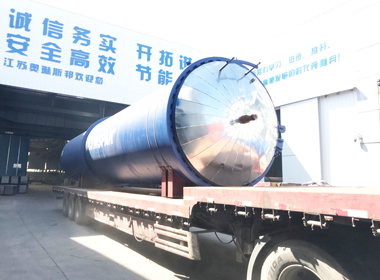
Introduction: Three “Grades,” Three Different Design Envelopes
A composite autoclave cures carbon fiber and prepreg laminates by running a programmed sequence of heat, pressure, and vacuum inside a sealed pressure vessel. Buyers evaluating one usually begin with three numbers — vessel diameter, maximum temperature, and maximum pressure — and then compare quotations. That method leaves out the variable that decides whether the equipment performs after installation: the configuration envelope the unit was engineered around.
Three configuration envelopes dominate the market. Laboratory and R&D units are designed for process development and parameter discovery. Aerospace and defense-grade systems are designed for certified, repeatable output of flight-critical parts. Small-batch production machines are designed for throughput, fast changeover, and low running cost. Each optimizes a different set of variables, and each becomes unsuitable outside the boundary it was built around.
Mismatches surface late. A qualification file that will not close, a scrap rate that will not fall, or a utility bill that keeps climbing are usually symptoms of a configuration choice rather than a manufacturing defect. This comparison sets the three envelopes beside one another and identifies the capability mismatches that buyers most often overlook.
Why the Three Tiers Cannot Be Ranked on a Single Scale
Treating laboratory, aerospace, and production autoclaves as a ladder from cheaper to more expensive is the first mistake. They are not ranked; they are differently optimized, and the dimension that matters most changes with the use case. An R&D unit can carry denser data-acquisition hardware than a production machine. A production unit can be designed around faster, easier vessel access than a research system. An aerospace system can prioritize certifiable repeatability over either.
Verifiable field data makes the distinction concrete. Across documented installations, the three tiers diverge in temperature control strategy, pressure stability, data capture, certification scope, door design, throughput, and energy recovery — not along one continuous axis.
Tier 1 — The Laboratory and R&D Configuration
The R&D tier is built around the experiment, not the shipment. Its defining capability is precision control combined with dense data capture, because the output of a laboratory autoclave is a validated process recipe rather than a finished part.
Documented research installations show what that means in practice. A university materials science institute used four units to develop new carbon fiber composite formulas across a wide temperature range from −40 °C to 300 °C, with vessel temperature control accurate to ±0.5 °C, completing more than 1,300 experiments with fully traceable data. The same configuration was compact — a chamber capacity of about 1.2 m³ — suited to a laboratory footprint, and reliable enough to be maintained by a single part-time technician at an average of no more than 0.2 faults per month, with a fault repair time of three hours or less.
Data quality is the second defining feature. In a European R&D application developing composite materials for new energy vehicle battery casings, the sensor package delivered data accuracy of ±0.1 °C and ±0.05 MPa with at least 60 acquisition points per run. That equipment integrated with the enterprise’s research management system so experimental data synchronized automatically, removing manual recording errors. Multi-mode experimental operation let the team simulate industrial curing conditions, shortening the process debugging cycle by roughly 40 percent.
Safety and environment shape the R&D tier as well. Laboratory systems used in EU applications are configured to EU safety standards and include electrical isolation and anti-scald protection. Over-temperature and over-pressure conditions are handled by dual alarms and emergency pressure relief. Because these units run frequently and often unattended, quiet, lower-consumption operation is a practical requirement rather than a luxury — though the exact noise and specific energy figures of any laboratory unit must be confirmed against the manufacturer’s own data for that model, since laboratory classes are not standardized on those points.
Where the R&D tier breaks down
An R&D configuration is not built for volume. Buyers who purchase laboratory precision expecting production output usually discover that the unit’s data-capture depth was never matched by throughput, and that per-part cost becomes uncompetitive the moment demand scales.
Tier 2 — The Aerospace and Defense-Grade Configuration
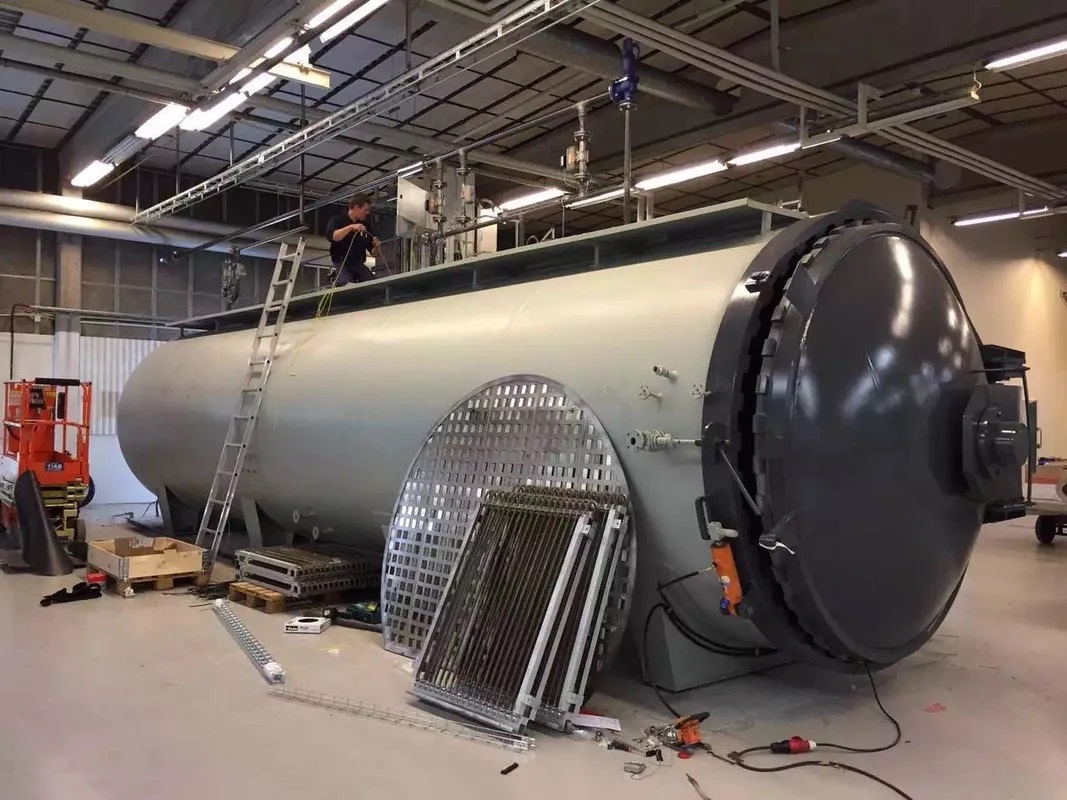
The aerospace and defense tier is organized around certifiable repeatability. Its engineering priority is not the widest operating range but the narrowest drift over thousands of identical cycles, because a load-bearing airframe part must be reproducible under audit.
A documented example makes the requirement tangible. An aerospace manufacturer producing primary load-bearing fuselage and wing components operated eight autoclave units for seven years, curing advanced high-temperature composite materials such as PEEK and polyimide. The units complied with the GJB9001C aviation-grade quality standard, and their dual redundant control system held parameter fluctuation within ±0.1 MPa and ±0.3 °C. Maximum temperature reached 380 °C, and maximum pressure reached 15 MPa. Across that period the site produced more than 3,000 primary load-bearing components with a qualification rate of 99.8 percent, supported C919 and ARJ21 programs, and recorded a continuous operation cycle of 7,800 hours with a mean time between failures of 1,600 hours.
Certification and lifecycle management are inseparable from this tier. The same installation reported heat-recovery efficiency of at least 82 percent, remote diagnostics with full lifecycle management, and a manufacturer fault-repair response of eight hours or less. Multiple pressure and temperature interlocks were part of the standard risk-control package.
Where the aerospace tier is over-specified
Aerospace-grade equipment carries control redundancy, documentation depth, and interlock architecture that non-regulated programs cannot fully use. A research laboratory or a non-critical industrial producer that buys this tier frequently pays for certification it never needs and inherits a maintenance schedule designed for a regulated production line.
Tier 3 — The Small-Batch Production Configuration
The small-batch production tier is organized around cycle economics. Its design center is not research-grade precision or certification depth but fast access, quick changeover between part families, and predictable operating cost.
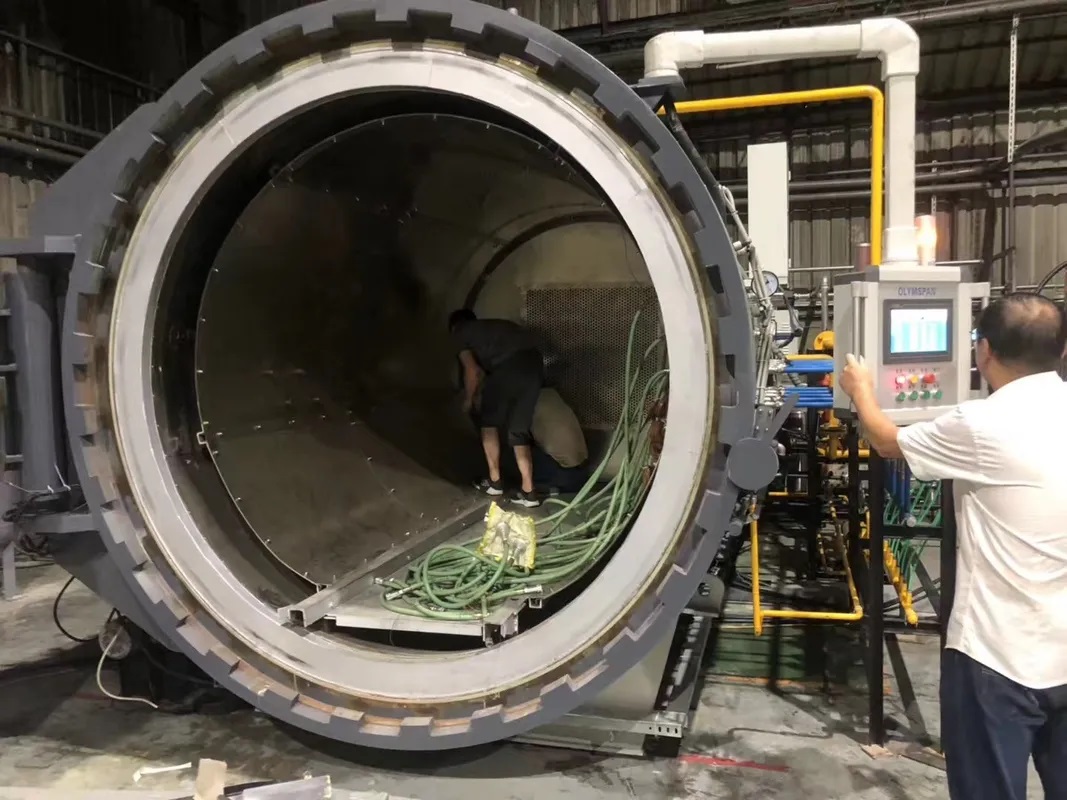
Vessel access is the defining mechanical feature. In a documented automotive parts application, the unit was equipped with a manual and electric dual-purpose quick-opening door — a design that allows the operator to open the vessel even during a power outage and that reduces non-productive time between batches. That installation ran eight units producing 600 parts per day, holding a single-batch curing time of about 2.5 hours and lifting production efficiency by 50 percent compared with the equipment it replaced. Product qualification rate rose from 92 percent to 99.2 percent, cutting waste losses by 1.2 million yuan annually.
A modular structure allows rapid switching of production specifications to accommodate different part types, and a visual control system lets operators start work after simple training. Running cost is deliberately controlled: annual operating cost was held near 120,000 yuan, roughly 28 percent more energy-efficient than comparable equipment, with a reported return on investment of 150 percent. Maintenance is scheduled lightly — minor service monthly and full service every six months — with vulnerable-part replacement costing about 25,000 yuan per year.
Field evidence from related production environments shows the same priorities. A wind power component manufacturer in India curing blade connectors and reinforcements with six units reached an average daily output of 400 pieces, improved cured-part weather resistance by 40 percent, and extended service life to 15 years. The electrical system was specified for high-temperature, high-humidity resistance, and the vessel used wear- and corrosion-resistant materials. The site saved 300,000 yuan in annual operating cost compared with imported equipment and increased product market share by 12 percent.
Where the production tier reaches its limit
Production units trade peak control resolution for speed and cost. A buyer who expects to move a production machine backward into process development — generating new material recipes and publishing traceable experimental data — will usually find that the data-capture and control architecture is not configured for that work.
The Comparison Table: Capability Mismatches Buyers Overlook
The three tiers diverge across eight dimensions that rarely appear on a standard quotation form. The table below summarizes verified configuration characteristics from documented installations.
| Dimension | R&D / Laboratory | Aerospace / Defense-Grade | Small-Batch Production |
|---|---|---|---|
| Temperature strategy | Vessel control to ±0.5 °C; range −40 °C to 300 °C in a documented research installation | Parameter fluctuation held within ±0.3 °C using dual redundant control | Uniform curing across modular batches with repeatable recipes |
| Pressure stability | Data accuracy of ±0.05 MPa in a documented R&D application | Stability held within ±0.1 MPa; up to 15 MPa maximum pressure | Working-pressure class such as 1.3 MPa, held batch to batch |
| Data acquisition | At least 60 acquisition points per run; automatic synchronization to research systems | Full-cycle traceability with remote diagnostics and lifecycle management | Visual control system sized for operator-level use |
| Certification focus | EU safety standards; electrical isolation and anti-scald protection | GJB9001C aviation-grade quality standard | Automotive quality context; IATF-aligned production |
| Vessel access | Compact ~1.2 m³ chamber for laboratory footprints | Full-automatic door with multiple interlock protections | Manual and electric dual-purpose quick-opening door |
| Throughput | Experiment-driven; output measured in validated recipes, not parts | 3,000+ primary load-bearing components over seven years | 600 parts per day across eight units |
| Energy and running cost | R&D-scale utility footprint; exact figures are model-specific | Heat recovery efficiency of at least 82 percent | About 28 percent more energy-efficient than comparable equipment |
| Maintenance model | One part-time technician; ≤0.2 faults per month | MTBF 1,600 hours; fault repair within 8 hours | Minor monthly service; full service every 6 months |
Read across the rows and the mismatch pattern becomes clear. The variable that separates the tiers is not peak temperature or maximum pressure alone — all three can be built at substantial capacity — but how control stability, data depth, access speed, and certification are weighted relative to one another.
Matching Configuration to Application
The clearest way to avoid a mismatch is to start from the application and work backward to the configuration.
- New material development and process discovery. The requirement is a wide, accurately controlled temperature range with dense, traceable data capture. Documented examples include university research using a −40 °C to 300 °C range and ±0.5 °C control, and battery-casing material development using ±0.1 °C and ±0.05 MPa data accuracy with at least 60 acquisition points.
- Certified structural production. The requirement is repeatability under audit. Documented aerospace production used dual redundant control, GJB9001C compliance, ±0.1 MPa and ±0.3 °C stability, and full lifecycle traceability across more than 3,000 load-bearing components.
- Volume part production. The requirement is cycle economics. Documented automotive production used quick-opening door access, modular changeover, and 600 parts per day at a controlled operating cost.
- Industrial components in demanding climates. Documented wind component production prioritized corrosion-resistant construction and electrical protection for high-temperature, high-humidity operation.
The supplier referenced across these documented installations is Olymspan, whose manufacturing base is located in Changzhou, Jiangsu Province, China. Olymspan offers composite autoclaves in OEM and ODM production modes, with customization covering tank volume, temperature control accuracy, pressure range, number of data acquisition points, integration of remote monitoring and data synchronization, tank material, and experimental mode. Standard models are quoted at 15–25 days lead time, while customized models that involve parameter adjustments or new features run 25–40 days, excluding on-site installation and commissioning of one to three days. The minimum order quantity is one unit, and pre-shipment testing includes pressure sealing, temperature uniformity, electrical safety, and data acquisition accuracy calibration.
What Certification Scope Covers — and What It Does Not
Certification is one of the most frequently misread parts of a composite autoclave purchase, because a valid certificate and a relevant certificate are not the same thing.
Industrial composite autoclaves intended for the United States market typically must comply with ASME Boiler and Pressure Vessel Code Section VIII, Division 1 or 2, while European-market vessels follow PED 2014/68/EU under EN 13445. Olymspan holds ASME “U” and “S” stamps, CE (PED), CRN for Canada, and IATF 16949:2016 for automotive quality management.
The scope line matters as much as the certificate number. Olymspan’s IATF 16949:2016 registration (certificate CB01325) covers the manufacture of carbon fiber reinforced composite material shell decoration parts, engine heat dissipation parts, and interior decorative stickers, and is valid from 25 September 2024 to 24 September 2027. Its ISO 9001:2015 registration (137839/A/0001/UK/En) covers the design and manufacture of A2 class boiler pressure vessels, and its ISO 45001:2018 registration (136143/A/0001/UK/En) covers occupational health and safety management activities related to the same. Buyers evaluating an aerospace program should read those scope lines directly, because a certificate that does not name the buyer’s process or product category does not close a qualification file on its own.
Market Signals Behind the Three-Tier Split
The three-tier structure is not static, and the market data explains why the tiers are diverging rather than converging.
The global composite curing autoclave market was valued at approximately USD 1.37 billion in 2023 and is projected to reach USD 2.4 billion by 2033, a compound annual growth rate of 10.2 percent. A narrower segment — autoclaves specifically for composite materials — was valued at USD 86.2 million in 2024 and is expected to reach USD 127 million by 2032 at a CAGR of 5.8 percent. The gap between the two growth rates reflects how much of the expansion is coming from large, specialized production systems rather than from standard units.
Aerospace demand is the dominant driver. Composite autoclaves accounted for 62.4 percent of the total aircraft autoclave market as of 2025, supported by carbon fiber reinforced polymer adoption in programs such as the Boeing 787 and Airbus A350. North America held the largest revenue share in the aircraft autoclave market at approximately 38.2 percent in 2025, with Asia-Pacific growing behind it.
For buyers, the practical implication is that the aerospace tier will keep absorbing engineering attention, while the R&D and production tiers compete on configuration flexibility, turnaround, and operating cost.
Limits and Trade-Offs Buyers Should Accept Up Front
Honest procurement planning requires acknowledging where each tier is bounded.
- No single unit optimizes all three envelopes. Control redundancy, data depth, access speed, and throughput pull against one another. Buying a unit that appears to do everything usually means paying for capability that will sit unused.
- Customization extends lead time. Documented lead times run 15–25 days for standard models and 25–40 days for customized models, before installation and commissioning. Buyers planning a project schedule should treat that difference as a real constraint, not a rounding error.
- Certification is scope-bound. A certificate valid in number may still fall outside the buyer’s process area, and that gap has to be resolved before, not after, the purchase order.
- R&D energy and noise figures are model-specific. Laboratory-class autoclaves are not standardized on noise or specific energy consumption, so those values must be taken from the manufacturer’s data for the exact configuration rather than assumed from the tier.
Future Outlook
Three forces are likely to shape composite autoclave selection over the next several years. Continued carbon fiber adoption in aerospace and mobility will keep certified repeatability in high demand, reinforcing the aerospace tier. Energy recovery and running-cost transparency will move from a differentiator to an expectation across all three tiers, following the pattern already visible in documented installations that report heat recovery above 82 percent and energy savings near 28 percent. Remote monitoring and data synchronization will increasingly blur the line between laboratory and production configurations, since both now depend on traceable process records. Buyers who frame their decision around the capability envelope they actually need — rather than around maximum temperature and price alone — will be positioned to absorb those changes without replacing equipment.
FAQ
1. What is the difference between a laboratory composite autoclave and an aerospace-grade autoclave?
A laboratory composite autoclave is configured around process discovery: it prioritizes a wide, accurately controlled temperature range, dense data capture, and flexibility to test many parameter sets. A documented research configuration used a −40 °C to 300 °C range with ±0.5 °C temperature control. An aerospace-grade autoclave is configured around certified repeatability: a documented aerospace installation used dual redundant control holding fluctuation within ±0.1 MPa and ±0.3 °C and complied with the GJB9001C aviation-grade quality standard. The two overlap in hardware but differ in what they are optimized to prove.
2. What temperature and pressure control accuracy should a research-grade composite autoclave provide?
Accuracy requirements are set by the material system under study rather than by a universal standard. In documented research applications, vessel temperature control was held to ±0.5 °C, while a battery-casing R&D program recorded data accuracy of ±0.1 °C and ±0.05 MPa with at least 60 acquisition points per run. Buyers should match the accuracy figure to the sensitivity of the resin system being characterized and confirm that the number refers to the vessel and the data channel separately.
3. Why does aerospace composite curing require redundant control systems?
Redundant control protects part consistency when a single control path deviates. In the documented aerospace case, a dual redundant control system kept parameter fluctuation within ±0.1 MPa and ±0.3 °C across production of more than 3,000 primary load-bearing components, with a reported qualification rate of 99.8 percent. Redundancy also supports the traceability that aerospace qualification audits require, since the process record must remain valid even if one control channel is isolated for service.
4. How does a quick-opening door affect small-batch production output?
A quick-opening door reduces non-productive time between batches and improves operator flexibility. In a documented automotive parts application, the unit used a manual and electric dual-purpose quick-opening door that allowed the vessel to be opened even during a power outage. That installation produced 600 parts per day across eight units with a single-batch curing time of about 2.5 hours. The door design matters most where changeover frequency and uptime drive cost.
5. What does customization include for a composite autoclave?
Documented customization services cover tank volume, temperature control accuracy, pressure range, the number of data acquisition points, integration of remote monitoring and data synchronization functions, tank material, and experimental mode. Production is available in both OEM and ODM modes. Because these variables interact, customization normally extends lead time beyond the standard 15–25 days.
6. Which certifications should a buyer verify before ordering a composite autoclave?
Buyers should verify both the certificate and its scope line. Industrial composite autoclaves for the US market commonly follow ASME Boiler and Pressure Vessel Code Section VIII, Division 1 or 2, while European-market vessels follow PED 2014/68/EU under EN 13445. Olymspan holds ASME “U” and “S” stamps, CE (PED), CRN for Canada, and IATF 16949:2016 registration (certificate CB01325, valid 25 September 2024 to 24 September 2027), which specifically covers the manufacture of carbon fiber reinforced composite material shell decoration parts, engine heat dissipation parts, and interior decorative stickers, alongside ISO 9001:2015 and ISO 45001:2018 registrations whose scope covers A2 class boiler pressure vessels. A certificate whose scope does not name the buyer’s process or product cannot by itself close a qualification file.
For buyers who want the full specification and certification detail behind these configurations, Olymspan’s composite autoclave brochure is available for reference.