
Component Parts of a Mower: A Buyer's Reference
A walk-behind or ride-on mower is assembled from hundreds of individual parts, but only a small share of them decide whether the blade keeps cutting. Hubs, drive axles, deck support brackets, gearbox housings, steering knuckles and support structures carry the load, hold the cutting assembly in alignment, and absorb grass debris, wash water and months of idle storage in a shed.
Failure, when it happens, usually starts in one of those cast or machined parts rather than in the blade. That is why buyers in the awareness and research stage tend to arrive at the same set of practical questions: which mower parts are castings, which material grade fits which function, which mechanical and coating properties actually matter, and what evidence separates a qualified foundry from a catalogue page.
Global demand for this class of hardware remains substantial. Industry research estimates the global agricultural machinery components market at USD 58.12 billion in 2026, growing at a compound annual growth rate of 6.04% (SRC-0001). Mower and lawn-and-garden components are commonly produced by the same type of foundry and machining base that supplies tractor and implement parts, which is why the two categories are frequently sourced through one channel.
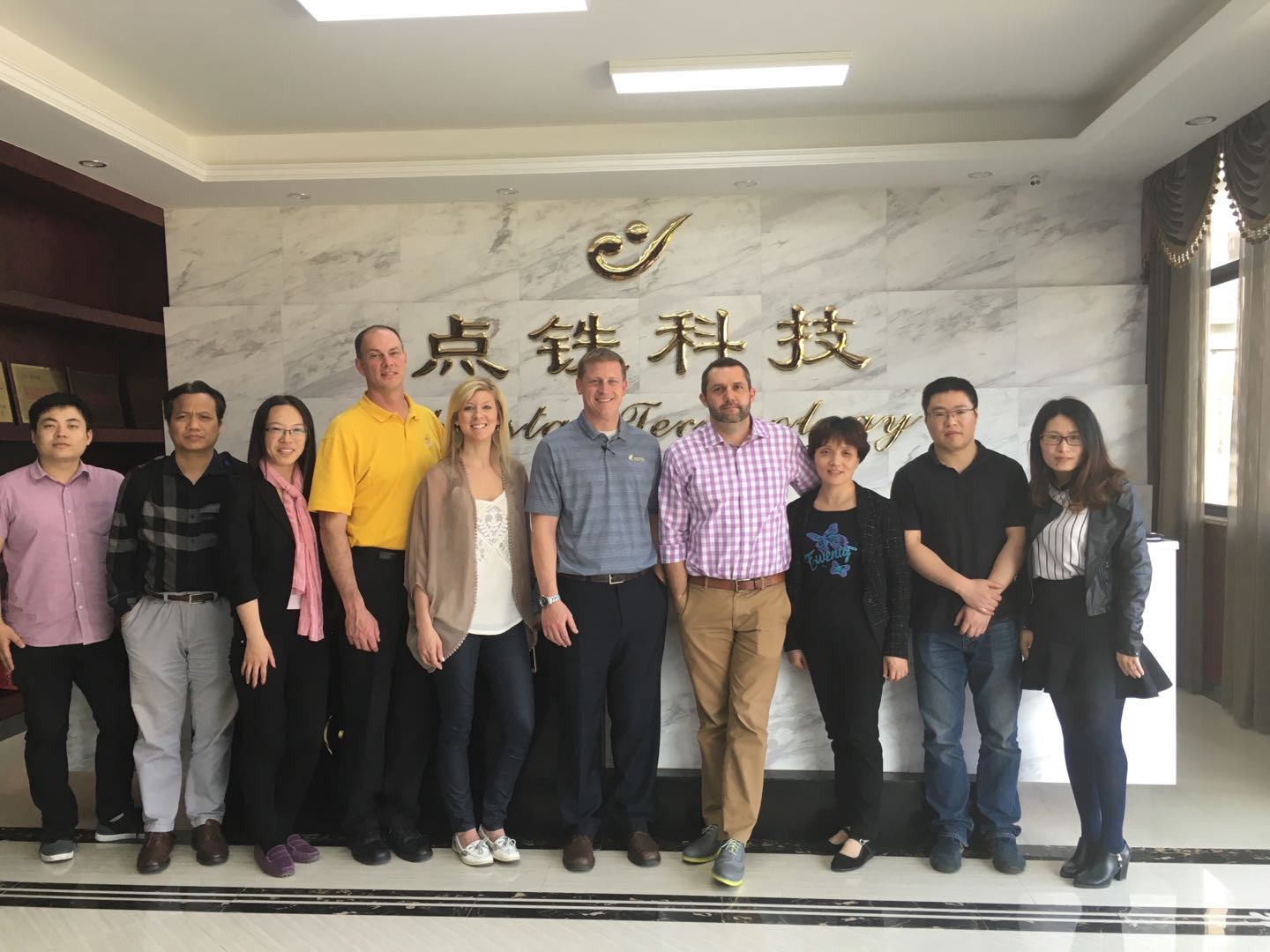
Casting, machining and painting under one roof at the Pointiron production site in Tongxiang, Zhejiang.
The Component Parts of a Mower, Grouped by Function
Grouping the parts by the job they do is more useful than listing every casting in the bill of materials. For mower and outdoor power equipment platforms, the cast and machined part families generally sort into five groups.
- Load-bearing and rotating parts. Wheel hubs — the HUB-1 model is one example from this family — agricultural wheels, agricultural axles and shafts, and agricultural arms.
- Transmission and gearbox housings. Cast housings that contain deck-drive gearing, right-angle gearboxes or hydrostatic drive components.
- Structural mounts. Agricultural brackets and agricultural supports that fix engines, deck covers, guards and shields to the chassis.
- Steering and parking components. Agricultural knuckles and agricultural park lock parts used on ride-on platforms.
- Braking-related castings. Housings and brackets, including caliper brackets, that sit inside wheel-brake assemblies.
The product range described as component parts for agriculture use is listed for tractor, lawn and garden, seeder, mower, scarifier, steering system and braking system assemblies. The same stated use also covers the agriculture, farm, outdoor, and lawn & garden industries. In sourcing terms, that means one qualified supplier can serve several machine families from a single tooling and quality base rather than requiring a separate supply chain for each platform.
Why Cast Iron Still Carries the Structural Load
Gray cast iron held a 47.68% share of the total iron casting volume in 2025, a position attributed to its low cost and vibration-damping qualities (SRC-0001). Both attributes transfer directly to mower platforms: housings and brackets have to damp the vibration coming off the deck drive and the engine, while remaining inexpensive enough for a product sold on a seasonal replacement cycle.
Ductile iron sits a step higher on the performance scale. Nodular cast iron grades are named by tensile strength and elongation, so QT550-6 indicates a 550 MPa tensile class with a 6% elongation class, and QT450-12 indicates a 450 MPa class with 12% elongation. Higher elongation is what allows a wheel hub or a steering knuckle to take repeated shock loads without cracking, which is precisely the duty cycle a mower hub sees on uneven ground.
Austempered ductile iron grades — ADI 900 and ADI 1050 in this material set — occupy a further tier, combining strength with wear resistance for rotating parts that rub against soil, grit or abrasive crop residue.
Material grades available in this part family
| Material family | Grades listed |
|---|---|
| Ductile (nodular) cast iron | QT550-6, QT450-12, nodular cast iron |
| Gray cast iron | HT250, HT200, gray iron |
| Austempered ductile iron | ADI 900, ADI 1050 |
Grade selection is made against the drawing, not against a general preference. A deck housing that mainly damps vibration has a different requirement from a hub that has to hold a wheel under impact, and the material list is wide enough to cover both ends of that range.
What the HUB-1 Mechanical and Coating Specification Signals
For the HUB-1 product, the listed parameters read as follows.
| Parameter | Listed value |
|---|---|
| Tensile strength | ≥550 MPa |
| Yield strength | ≥350 MPa |
| Elongation | ≥6% |
| Hardness | 173–255 HB |
| Salt spray | 504 hours |
| Dry adhesion | ≥B |
Read together, the mechanical values describe a load-bearing ferrous casting with a defined strength floor, a defined ductility floor, and a hardness window wide enough to be machined and still resist surface deformation. The hardness band of 173–255 HB is also a practical machining window: it allows turning, drilling and tapping without excessive tool wear on the production line.
The two coating figures are separate from the mechanical figures and should be read as such. A 504-hour salt spray result is a coating durability indicator, and a dry adhesion grade of ≥B is an adhesion indicator. Neither of them describes the fatigue life of the casting underneath.
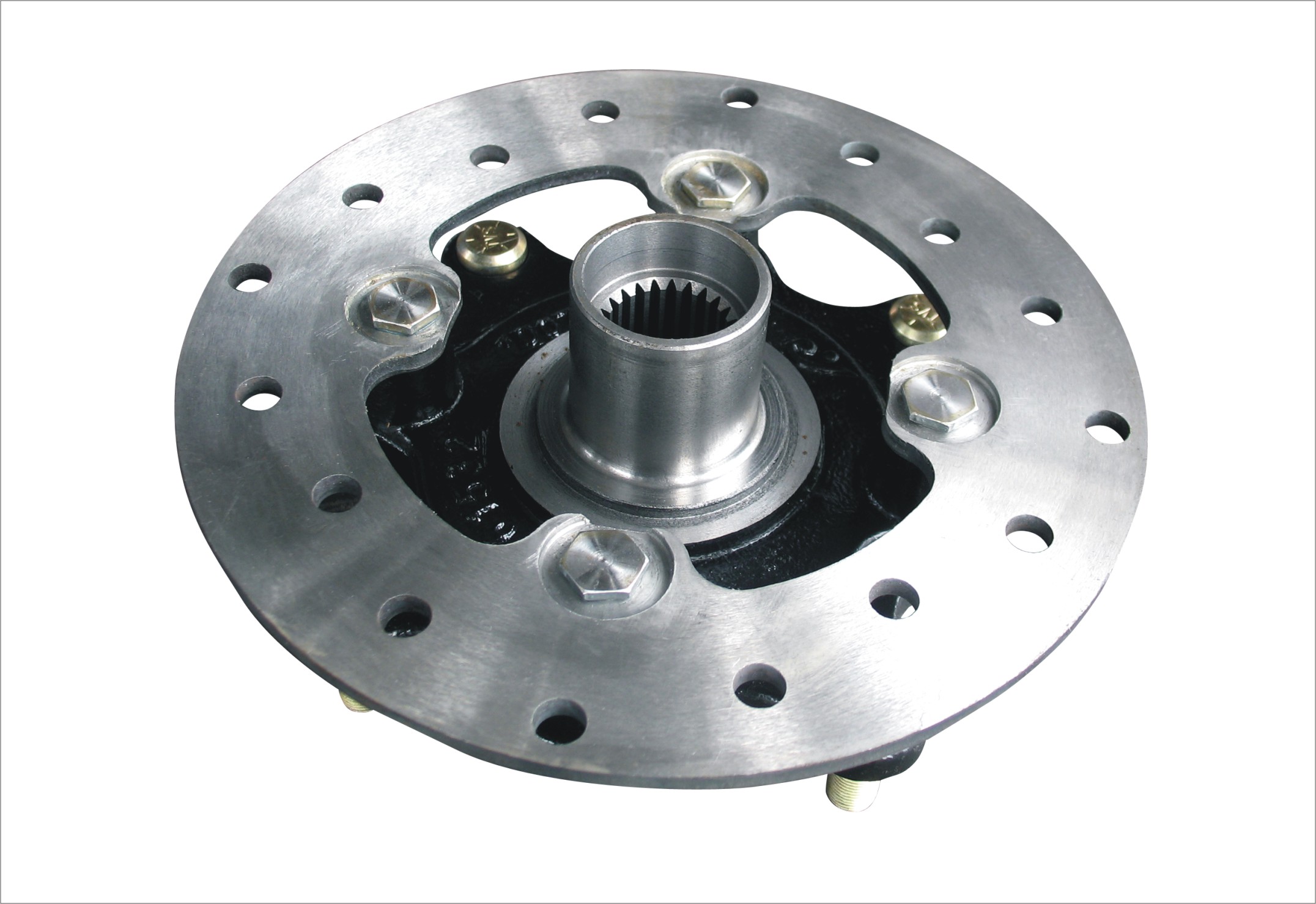
The HUB-1 cast component, listed for agriculture, farm, outdoor and lawn & garden use across tractor, mower, seeder, scarifier, steering and braking assemblies.
Outdoor Exposure and Surface Protection
A mower does not operate in a controlled environment. Dew, sap, hose-down water and several months of storage stack up on the same set of parts every season. The application record for this part family lists anti-rust, salt spray and humidity resistance as special requirements, which is the buyer-side language for the same concern the 504-hour salt spray figure expresses on the product data sheet.
Coating selection follows the same logic. Pointiron operates three paint lines — a wet paint line, a powder coat line and an E-coat line — plus one assembly line. That combination gives a buyer room to specify a decorative finish where appearance matters, or an electrocoat primer system where corrosion resistance is the priority, without moving to a different supplier.
Where Pointiron Sits in the Mower Component Supply Chain
Zhejiang Pointiron Technology Co.,ltd is a casting, machining and assembly manufacturer based in Tongxiang City, Zhejiang, China, established in 2000. The company describes its business as a one-stop service running from casting through machining and painting to final assembly, and it manufactures component parts for agriculture use alongside component parts for automobiles, including caliper brackets, housings, steering knuckles, windmill housings, planet carriers, connect covers, tractor components, and lawn and garden mower components.
The manufacturing footprint covers 66,770 m² and employs approximately 200 staff, with an R&D team of 3 engineers. Annual production capacity reaches 2,000,000 units, supported by a casting capacity of 35,000 tons per year in ductile and gray iron and a machining capacity of 5 million pieces per year. Production equipment includes two casting lines imported from DISA Denmark — a DISA MATCH32/32 horizontal automatic molding line and a DISA 131B vertical automatic molding line — together with three paint lines and one assembly line.
Quality management is documented through IATF16949 and ISO14001:2004 certification, with the IATF16949 system applied across the end-to-end production process. The company serves markets in the USA and EU, with exports representing approximately 20% of business, and Point Iron USA, Inc. holds stock in the United States for US customers. The US contact address is 1045 Hickory St, Unit A, Pewaukee, WI, and the China address is No.2389 South Huancheng Rd, Tongxiang City 314500, Zhejiang. The company website is www.pointiron.com.
Application: Where These Parts Sit on the Machine
The product is used in the agriculture industry and is applied in tractor, seeder, mini agricultural machinery, mower, and scarifier type projects. On a mower platform specifically, the castings sit in three locations: at the wheel, where the hub and axle carry the machine's weight; at the deck, where brackets and supports hold the cutting assembly and its drive; and in the steering and brake group, where knuckles and housings connect operator input to machine response.
The operating profile is consistent across those locations. The parts work under intermittent heavy loads and cyclic running during farming seasons, and they are matched with farm machinery transmission assemblies and wheel brake assemblies. Intermittent rather than continuous loading is the key point for material selection: it favours ductility over pure hardness, because a part that flexes and returns will outlast one that resists and fractures.
Market Trend Signals Around Cast Mower Components
Three signals currently shape how buyers view this category.
First, the drivetrain side of the market is forecast to expand. The agricultural gearbox market is projected to reach USD 8.5 billion by 2033 (SRC-0001). Deck drives and right-angle gearboxes are the housing-intensive part of a mower, so growth in gearbox demand is a reasonable proxy for demand in the cast housing family around it.
Second, trade values in the wider parts category softened. Global trade of motor vehicle parts and accessories, including tractor parts, reached USD 448 billion in 2024, a 2.37% decrease from 2023 (SRC-0002). A flat-to-declining trade value in a mature parts category usually pushes buyers toward consolidation of suppliers rather than expansion of supplier lists, which raises the value of a single source that can deliver casting, machining and coating together.
Third, the regulatory frame around the finished machine is tightening. ISO 4254 is a multi-part safety standard series for agricultural machinery, with ISO 4254-1 addressing general safety requirements and verification for self-propelled, mounted, semi-mounted and trailed machines (SRC-0007). ISO 25119 addresses safety-related parts of control systems for tractors and agricultural and forestry machinery, including design principles, fault detection, reliability and production-related processes (SRC-0008). ISO 18497-1:2024 specifies principles for machinery and tractors with partially automated, semi-autonomous and autonomous functions (SRC-0009).
On the customs side, the official classification includes heading 8433 for harvesting, threshing, hay-mowing and related agricultural machinery, with parts classifications including 843390 (SRC-0005). Buyers importing mower parts should confirm the applicable heading with their own customs authority rather than assuming a single code covers every cast component.
Cast Components Versus Traditional Alternatives
Cast iron is not the only way to make a mower bracket, and buyers comparing options usually weigh it against welded steel fabrication, aluminium die casting and engineering plastics.
| Approach | Where it fits | Where it costs more |
|---|---|---|
| Ductile iron casting | Hubs, knuckles and brackets that need strength with some ductility, in a repeatable geometry | Tooling investment; part weight is higher than aluminium |
| Gray iron casting | Housings and covers where damping and cost dominate | Lower tensile strength and limited ductility compared with ductile grades |
| Welded steel fabrication | Low-volume or large-format structures | Weld and heat-affected zones introduce stress concentration; geometry is constrained; post-weld machining is usually required |
| Aluminium die casting | Weight-sensitive housings and covers | Lower tensile strength and lower resistance to abrasive wear |
| Engineering plastics | Guards, covers and non-structural parts | Not suited to hub or deck-load paths |
None of these options dominates across the whole bill of materials. A well-specified mower typically uses more than one of them, matched to the load path each part sits on.
Limits Buyers Should Weigh Before Committing
Casting is not automatically the right answer, and a reference document that only lists advantages is not useful at the research stage. Four limits are worth putting on the evaluation sheet.
- Tooling economics. A casting programme carries pattern and tooling costs that must be amortised across production volume. For very low annual volumes, a fabricated or machined-from-solid alternative can be the more economical route even when the casting performs better.
- Weight penalty. Ferrous castings are heavier than aluminium or plastic equivalents. On platforms where weight reduction is a design target, a buyer may need to accept a mixed-material solution rather than a single-material one.
- Casting without machining shifts tolerance risk. A foundry that supplies raw castings pushes final dimensional control onto the buyer's own machining operation. A supplier that carries both casting and machining capacity, as Pointiron does with a stated machining capacity of 5 million pieces per year, absorbs that risk instead.
- Standards do not certify the part. ISO 4254, ISO 25119 and ISO 18497-1 are machine-level and system-level frameworks. They define safety expectations for the finished machine; they do not certify a casting supplier or an individual hub. Component acceptance still depends on drawings, material certificates, dimensional reports and coating test records agreed between buyer and supplier.
There is a fifth point that is easy to miss. The listed salt spray and adhesion figures are specification values, not measured results for a specific production lot. Buyers should request the corresponding test reports for the lot they receive rather than treating a data sheet figure as a warranty.
Future Outlook
The direction of travel in agricultural and outdoor power equipment points toward more integrated, more automated machines, and the standards work reflects it. ISO 18497-1:2024 formalises principles for partially automated, semi-autonomous and autonomous machinery (SRC-0009), while ISO 25119 already covers safety-related control-system parts on tractors and agricultural machinery (SRC-0008). For component buyers, the practical consequence is that mounting points, steering interfaces and brake housings may increasingly be evaluated as part of a system rather than as isolated castings.
On the material side, the economics have been stable for a long time. Gray iron holding 47.68% of 2025 casting volume (SRC-0001) is not a sign of inertia; it is the result of a cost and damping trade-off that continues to win in housing and cover applications. Ductile and austempered grades will keep taking the load-bearing positions where elongation and wear resistance are non-negotiable.
The forecast for agricultural gearboxes reaching USD 8.5 billion by 2033 (SRC-0001) reinforces the same conclusion from the demand side. As long as mowers and the implements around them need mechanical drive, they will need cast housings, hubs and brackets to contain and carry it.
Frequently Asked Questions
What component parts of a mower are typically made as castings?
The cast and machined families on a mower platform generally include wheel hubs such as the HUB-1, agricultural wheels, agricultural axles and arms, gearbox and transmission housings, mounting brackets and supports, steering knuckles and park lock parts, and braking-related housings and brackets. These are the parts that carry structural and rotating loads rather than the parts that contact the grass.
What materials are used for mower component parts?
The material set for this part family covers QT550-6, QT450-12, HT250, HT200, ADI 900 and ADI 1050, together with nodular cast iron and gray iron. Ductile and austempered grades are used where strength and elongation matter; gray iron grades are used where damping and cost are the priority.
What mechanical and coating values are specified for the HUB-1 part?
The listed specification for HUB-1 is a tensile strength of ≥550 MPa, a yield strength of ≥350 MPa, an elongation of ≥6%, a hardness of 173–255 HB, a salt spray result of 504 hours and a dry adhesion grade of ≥B. These are specification values describing the product, and they should be confirmed against lot-level test reports during supplier qualification.
How does gray cast iron differ from ductile iron in mower applications?
Gray cast iron held a 47.68% share of total iron casting volume in 2025, supported by low cost and vibration-damping qualities (SRC-0001). Ductile iron grades such as QT550-6 and QT450-12 are named by tensile and elongation class, which reflects their role in load-bearing positions where some deformation before failure is required. The choice between them follows the load path of the specific part rather than a general preference.
Why do salt spray and adhesion figures matter on mower parts?
Mower parts operate in outdoor, farm and lawn & garden conditions where anti-rust, salt spray and humidity resistance are listed as special requirements. A 504-hour salt spray result and a ≥B dry adhesion grade are coating-performance indicators that describe how a finish is expected to behave under those conditions. They describe the coating, not the fatigue life of the casting beneath it.
How should a buyer evaluate a casting supplier for mower components?
Five checks are practical. Confirm the process span — casting, machining, painting and assembly under one quality system reduces tolerance risk. Confirm the quality certification, such as IATF16949 and ISO14001:2004. Confirm capacity in both tonnes and pieces, because a supplier with casting capacity but limited machining capacity will push finishing work back onto the buyer. Confirm the finishing lines available, since wet paint, powder coat and E-coat serve different corrosion and appearance requirements. Finally, confirm regional stock, since warehouse presence in the destination market shortens replenishment for US and EU customers.
Do agricultural machinery safety standards cover mower component parts directly?
No. ISO 4254 is a multi-part safety standard series for agricultural machinery, with ISO 4254-1 addressing general safety requirements and verification (SRC-0007). ISO 25119 covers safety-related parts of control systems (SRC-0008), and ISO 18497-1:2024 covers partially automated, semi-autonomous and autonomous machinery (SRC-0009). These are machine-level and system-level frameworks; they do not certify an individual casting or a foundry. Component acceptance remains a matter of drawing specifications, material certificates and agreed test records.
¿Tiene preguntas o necesita más detalles?
Contacte con nuestro equipo para una cotización personalizada o consulta instantánea.
Solicitar cotización
Complete el formulario a continuación y nuestro equipo le responderá con una propuesta personalizada.
Chat directo de WhatsApp
¿Prefiere chatear en tiempo real? Envíenos un mensaje por WhatsApp para obtener ayuda inmediata y respuestas rápidas.
- Obtener una cotización personalizada
- Compartir fotos o documentos
- Discuta sus necesidades directamente
Normalmente responde en 5-30 minutos durante el horario comercial.