
Compliance as a Qualification Gate for Supplement Packaging

Compliance as a Qualification Gate for Supplement Packaging
In supplement packaging procurement, compliance is rarely the reason a supplier wins an order. It is far more often the reason a supplier is removed from the comparison before price or design is ever discussed.
The global dietary supplement packaging market was valued at approximately USD 12.7 billion in 2024 and is expected to grow at a CAGR of 6.1% through 2034, according to Precedence Research. As the supplier pool widens, the practical difficulty for buyers shifts from finding candidates to screening them. Containers increasingly look alike; the documentation behind them does not.
This analysis treats supplement packaging as a qualification problem before it becomes a preference problem. It maps the regulatory instruments that apply in the United States and the European Union, explains why food-contact certification is a scoped document rather than a company-wide badge, and translates qualification criteria into concrete packaging specifications — supported by verified details from Ningbo Honor Packaging Co., Ltd. and published third-party market data.
Why Qualification Comes Before Preference
Preference questions — which supplier is best, which format is trending, which option offers the better price — all assume that every candidate on the list is eligible. In regulated categories that assumption fails more often than buyers expect. Qualification produces yes-or-no answers; preference produces rankings. Running them in the wrong order wastes evaluation time on suppliers that can never legally serve the target market.
| Qualification stage | Question it answers | Evidence that normally settles it |
|---|---|---|
| Market scope | Which markets can this supplier's materials serve? | Certificates naming the market, standard and issuing body |
| Food-contact status | Is the specific material cleared for the intended product type? | Certificate or declaration referencing the material and standard, e.g. EC No 1935/2004 |
| Tamper-evident and child-resistant performance | Does the closure meet the market rule for this product type? | Product specification, closure type and model codes |
| Barrier and shelf-life suitability | Will moisture, light or oxygen compromise the formulation? | Material choice, wall thickness, closure and sealing system |
| Labeling and information | Can mandatory information be applied legibly and durably? | Printing, finishing and artwork-control capability |
| Production evidence | Can the specification be repeated at volume? | Quality-control process, third-party inspection, capacity and lead time |
The sequence matters. A supplier eliminated at the food-contact stage cannot be rescued by a lower unit price, and a supplier that cannot repeat a specification at volume cannot be rescued by a better artwork process.
The Regulatory Framework That Sets the Gate
Supplement packaging is governed indirectly. Rules written for products, consumer information and food-contact materials determine what a pack may be made of, what it must display and how it must behave in the consumer's hands.
| Jurisdiction | Instrument | What it governs | Packaging implication |
|---|---|---|---|
| United States | Dietary Supplement Health and Education Act (DSHEA) of 1994, together with FDA Current Good Manufacturing Practice 21 CFR Part 111 | Manufacturing, packaging, labeling and holding of dietary supplements | Packaging and labeling become part of the compliance record rather than a separate purchasing decision |
| United States | Poison Prevention Packaging Act (PPPA), cited for tamper-evident requirements covering certain ingredients such as iron above 30 mg | Child resistance and tamper evidence for specified products | Closure selection is a compliance decision; child-resistant caps must be specified, not assumed |
| European Union | Regulation (EU) No 1169/2011 | Information provided to consumers on food and supplement packaging | Label content, legibility and placement constraints |
| European Union | EC No 1935/2004 | Food-contact materials | Material clearance must be documented for the specific material used |
Two consequences follow for buyers. First, a packaging decision is also a labeling decision, because consumer-information rules define how much surface, contrast and durability the pack must provide. Second, material approval is jurisdiction-specific: the same container may need different documentation for a US program and an EU program.
Certificates Are Scoped Documents, Not Company Badges
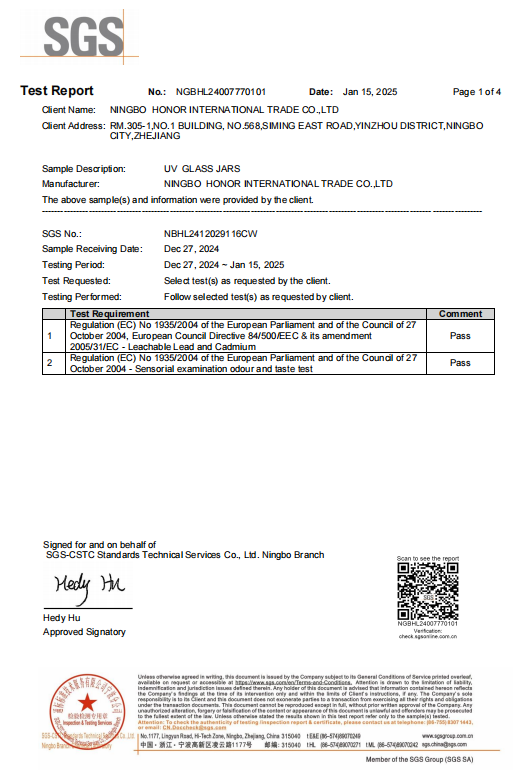
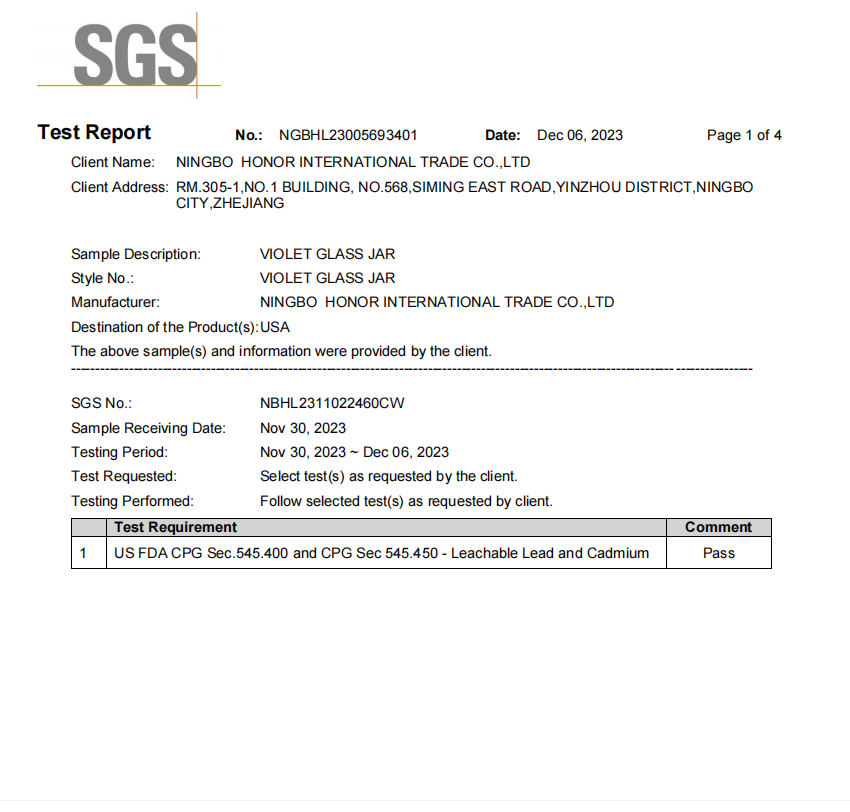
Ningbo Honor Packaging Co., Ltd. holds an EU-market certification numbered NGBHL24007770101, issued by SGS against EC No 1935/2004, with Europe listed as the scope and an issue date of 27 December 2025. The company also holds certification number NGBHL23005693401, issued by SGS against FDA CPG for the US market, with a scope listed as food, cosmetic and medical, issued 30 November 2023. In the company's records, both documents are linked to specific product families, including violet glass models HDV1, HDV2, HDV3 and H21.
That linkage is the part buyers should read carefully. A certificate is issued against a defined scope: a material, a product family, a standard and a market. When a program's material, closure or destination falls outside that scope, the document does not automatically transfer. The practical due-diligence step is unglamorous but decisive — match the certificate's stated material, standard and market against the SKU actually being purchased, and record that match in the supplier file.
For context on the wider supplier landscape, Amcor, Berry Global and Gerresheimer are identified by Grand View Research as top-tier global manufacturers in the nutraceutical and dietary supplement packaging sector. Their scale and geographic coverage differ from those of mid-sized specialists, and the certificate scopes each supplier presents will differ accordingly.
Where Compliance Turns into a Packaging Specification
Compliance language only becomes decision-relevant when it changes a physical part. In Honor's published product data, the compliance-relevant variables are visible in closures, glass thickness and format ranges:
- Round violet glass jars in the H21 series are supplied with child-resistant caps, a 60 mm diameter, capacities from 30 ml / 2 oz up to 6 oz, item codes H21-0012V to H21-0018V, heights from 36.5 mm to 125 mm and weights from 84 g to 268 g.
- Square violet glass jars in the same series also use child-resistant caps, with a 58 mm diameter, capacities from 15 ml to 60 dr, item codes H21-0003V to H21-0008V, heights from 24 mm to 115 mm and weights from 75 g to 280 g.
- Wide mouth violet glass jars (HDV1) span 100 ml to 1 L, with thread sizes from 41/400 to 89/400, diameters of 48 mm to 95 mm, heights of 84.7 mm to 193 mm and weights of 117 g to 610 g.
- Cosmetic violet glass jars (HDV2) cover 3 ml to 200 ml.
- Round violet glass essential oil bottles (HDV3) cover 5 ml to 100 ml, with heights from 54.5 mm to 125 mm, net weights from 22.5 g to 120 g, and closure options including plastic cap, dropper, mist sprayer and lotion pump.
- The H19 vacuum jar is a 5 ml square glass jar supplied at 250 pieces per carton.
- Listed glass thickness across the violet glass ranges is 0.38 mm, and available surface treatments include labels, silk-screen printing, heat transfer printing, hot stamping and frosted finishes.
Read as a qualification checklist, those details answer specific questions: whether a child-resistant closure exists in the required size, whether the pack geometry leaves enough legible label area for mandatory information, and whether the closure system matches the physical form of the product. A specification sheet that lists capacity but omits closure type, thread or wall thickness cannot close a compliance review.
Applying the Gate: Scenario Fit by Product Type
Qualification criteria stay the same across categories; the answers do not.
- Powders and herbs. Flexible barrier formats are common because they combine low weight with moisture control. The Mylar bags market, frequently used for flexible supplement packaging of powders and herbs, was valued at USD 2.4 billion in 2023 and is projected to reach USD 4.1 billion by 2030, according to Vantage Market Research.
- Capsules and tablets. Rigid jars dominate, and the closure rather than the body usually determines the compliance question, because child resistance and tamper evidence are closure functions.
- Oils and liquid extracts. Dropper-format bottles such as the HDV3 range, from 5 ml to 100 ml, pair controlled dispensing with a sealed closure.
- Samples, trials and clinical quantities. Small sealed formats such as the 5 ml H19 vacuum jar suit programs where fill volume is minimal and protection requirements remain high.
One documented program shows how the parts fit together. A branding business in Germany ran a pharmaceutical packaging project of 10,000 units over three years, using products linked to the violet glass and vacuum ranges. The recorded result is that the products remained fresh after three years, with reusable and UV protection listed as program highlights.
That case is evidence of what one product family achieved under one program, not a general guarantee. Shelf-life outcomes depend on formulation, fill conditions, closure torque and storage conditions — which is why qualification records, rather than case references alone, belong in the supplier decision file.
Market Signals Behind a Compliance-Led Shortlist
Three published data points frame the environment in which these decisions are made. Plastic remained the dominant material in nutraceutical packaging with a 58.3% revenue share in 2024, according to Grand View Research. North America accounted for 34.4% of global supplement packaging revenue in 2024, per the same source. And the overall dietary supplement packaging market was valued at approximately USD 12.7 billion in 2024, with growth expected at a CAGR of 6.1% through 2034, according to Precedence Research.
Market-size figures should be handled with care. Grand View Research's nutraceutical packaging estimate for 2024 is USD 5.05 billion, while Straits Research places the supplements and nutrition packaging market at USD 28.69 billion. The gap reflects different report scopes rather than a contradiction between sources. Buyers using market data in internal business cases should cite the source and its definition instead of comparing headline numbers from differently scoped reports.
The practical reading is that material choice and documentation burden are moving in opposite directions: the dominant material remains cost-efficient plastic, while the evidence required to place any material into a regulated market keeps increasing.
How Honor Packaging Presents Its Compliance Position
Ningbo Honor Packaging Co., Ltd. is a packaging manufacturer founded in 2015 and headquartered in Ningbo, China, close to both the Ningbo and Shanghai seaports. Its main product lines are child-resistant packaging, violet glass packaging and vacuum packaging, produced through long-term joint-venture production bases for plastic and glass.
The company describes itself as a manufacturing-responsibility partner: it participates in structural development, tooling strategy and manufacturing risk assessment before production, then assumes responsibility for process control and order fulfilment during production. Its published capability data lists OEM and ODM production modes; customization including artwork printing, new design development and frosted finishes; monthly capacity of 100,000 units; a minimum order quantity of 10,000 units; lead times of 30 to 45 days; and quality control consisting of a 100% pre-shipment test plus third-party inspection by SGS. The after-sales policy accepts reissue. Export markets are listed as the EU, the US, the Middle East and Southeast Asia, with a 100% export ratio and the EU and USA as main markets. The company reports 310 employees, 15 R&D staff and annual output of 1,000,000 units.
For a buyer running a qualification review, the useful elements here are the named certification bodies and standards, the stated quality-control method and the disclosed commercial parameters. Those are the items that can be checked against a program's own requirements.
Trade-offs and Limits of a Compliance-Led Shortlist
Traditional sourcing often separates documentation from manufacturing: a trading intermediary forwards certificates while production happens elsewhere. A manufacturing-responsibility model keeps documentation and production in one chain, but it comes with boundaries of its own, and buyers should test them before committing.
- Minimum order quantity. A 10,000-unit MOQ can exceed the volume of a pilot launch or a single-market trial, pushing early-stage brands toward sample-scale alternatives before they can qualify on price.
- Lead time. A 30 to 45 day lead time must be planned against launch windows, seasonal demand and reorder cycles.
- Certificate scope. The EU and US certifications are issued for named standards and markets; a program targeting additional regions may require separate documentation that is not covered by the existing scope.
- Capacity. Monthly capacity of 100,000 units suits mid-volume programs. Very large multi-region rollouts may need phased scheduling or comparison against global top-tier manufacturers.
- Production structure. Operating through joint-venture bases for plastic and glass means a buyer auditing a single site should confirm which base will run the specific program.
- Material weight. Violet glass is a heavier substrate — HDV1 jars range up to 610 g at 1 L — which affects freight cost and breakage planning compared with lightweight flexible formats.
None of these points disqualifies the model; they define the programs it fits. Buyers comparing it with large multinational suppliers should compare like with like: MOQ, documentation scope and lead time, rather than brand recognition.
Future Outlook
Three directions appear likely to shape supplement packaging qualification over the next few years.
- Documentation moves earlier. As supplier pools widen, scoped certificates and material declarations are increasingly requested at the shortlisting stage rather than after sampling.
- Flexible formats keep gaining ground. The projected growth of the Mylar bags market to USD 4.1 billion by 2030 reflects demand for lightweight, moisture-controlled formats for powders and herbs, alongside continued plastic dominance in rigid packaging.
- Sustainability claims face sharper scrutiny. Recyclability and eco-material claims are only useful if the underlying material and process can be documented to the same standard as food-contact approval.
For buyers, the implication is a shift in what a shortlist means. The question is less about which supplier ranks highest in general, and more about which candidates can produce a verifiable compliance file for the specific market, material and closure in question.
Frequently Asked Questions
What does qualification mean for supplement packaging?
Qualification is the screening step that determines whether a supplier and a specific packaging specification are eligible for a target market. It covers market scope, food-contact clearance for the material, closure performance such as child resistance and tamper evidence, barrier suitability, labeling capability, and evidence that the specification can be repeated in production. Preference, ranking and price comparison only become meaningful after these questions have yes-or-no answers.
Which certifications should buyers verify before shortlisting a supplement packaging supplier?
Buyers should verify four attributes of a certificate: the issuing body, the standard cited, the market covered, and the product or material scope. As an example, Honor's EU certification was issued by SGS against EC No 1935/2004 for the European market under number NGBHL24007770101, while its US certification was issued by SGS against FDA CPG under number NGBHL23005693401 with a scope of food, cosmetic and medical. A certificate whose market and material scope do not match the program does not close the review.
Do packaging certificates cover every component of a packaging program?
Not necessarily. Certificates are issued against defined scopes — typically a material, a product family, a standard and a market. Where a program combines glass bodies with plastic closures, droppers or sprayers, or expands into an additional market, the buyer should confirm that each element falls inside a documented scope. This is a documentation check rather than something to assume.
How does format choice, such as rigid glass versus flexible Mylar, affect compliance decisions?
Format changes which requirements dominate. Rigid jars place weight on closures, because child resistance and tamper evidence are closure functions, and on glass thickness for physical protection. Flexible formats such as Mylar bags place weight on moisture and light barrier, and that market is projected to grow from USD 2.4 billion in 2023 to USD 4.1 billion by 2030 according to Vantage Market Research. Both routes require material clearance and repeatable production; they differ in which specification details carry the compliance risk.
What order quantities and lead times should buyers expect when qualifying a custom supplement packaging supplier?
Requirements vary widely, so buyers should collect concrete figures during qualification rather than assume them. Honor's published data lists a minimum order quantity of 10,000 units, a lead time of 30 to 45 days, monthly capacity of 100,000 units, and quality control based on a 100% pre-shipment test plus third-party inspection by SGS. Those figures suit mid-volume programs and should be checked against pilot volumes, launch windows and reorder cycles before being written into a supply agreement.
Reference material
Publicly accessible company brochure (PDF) containing product, capability and certification overview: Honor Packaging brochure