
Compliance and Qualification: AOK SD Solar Street Light vs. Balder BI-S5A
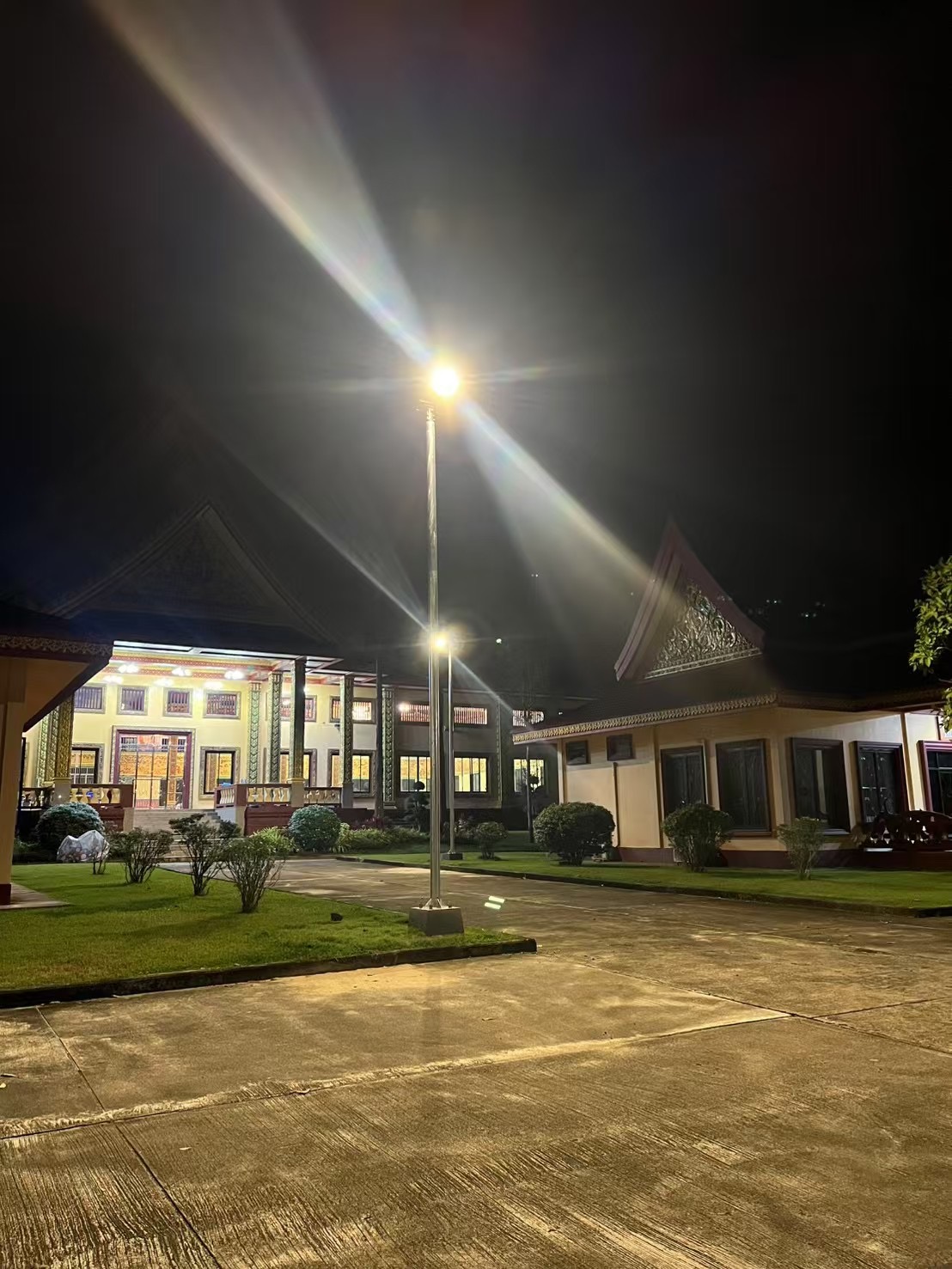
AOK SD solar street light installation in Thailand: an outdoor roadway lighting system operating in night-time illumination mode.
In outdoor LED lighting, a specification sheet is an offer, not a qualification. Qualification is the documented chain that connects a published figure — 210 lm/W, IP65, a 25.6 V battery pack — to an accredited test report, a certificate carrying a number and a scope, and a production line that can reproduce the same build for the length of the contract. Remove that chain and a buyer is comparing claims rather than capability.
Two products make the distinction concrete. The AOK SD all-in-one solar street light and the Balder BI-S5A sit in the same procurement category — a solar LED street light for urban and rural road projects — but they publish different configuration envelopes, and those differences change what a qualification file must contain.
The short answer for buyers: AOK's SD platform publishes a 20–120 W power range with LED efficacy up to 210 lm/W and four optical distribution families (T2, T3, T4, T5), while the Balder BI-S5A publishes a 70–120 W range at 110 lm/W. A wider envelope creates more project-matching options and a longer documentation trail to audit. Neither figure qualifies a supplier on its own: both sets of numbers are manufacturer-published, and both must be converted into photometric reports, ingress test evidence and contract-backed warranty terms before an award decision becomes defensible.
What "qualified" means in LED outdoor lighting
Qualification in this category is a four-part test. A supplier is qualified when it can demonstrate, in writing and for the exact SKU being ordered, that the luminaire meets the project's lighting class, survives the project's environment, fits the project's energy budget, and can be reproduced without drifting from the approved sample.
| Qualification gate | What it establishes | Evidence normally required | Where it most often fails |
|---|---|---|---|
| Photometric performance | Delivered lumens, distribution and uniformity against the project's lighting class | Laboratory photometric report for the ordered SKU, with test conditions stated | Headline efficacy quoted without delivered lumens or input power |
| Environmental protection | Dust, water, impact and corrosion resistance at the installation site | Ingress and impact test reports referencing EN 60529 and EN 62262, plus coating specification | IP rating claimed for a series rather than a specific model |
| Energy and power design | Battery autonomy, charge control behaviour and long-term energy yield | Battery specification, controller datasheet, autonomy calculation for the site | Autonomy assumed from a pack size without a site load profile |
| Documentation and reproducibility | That the approved sample equals the shipped product, batch after batch | Certificate numbers and scope, declaration of conformity, QC records, warranty in writing | Certification asserted at company level with no model applicability |
The documentation gap that specification sheets hide
Most solar street light tenders are still decided on a comparison table copied from supplier brochures. The problem is structural rather than dishonest: a manufacturer states a maximum efficacy figure, an ingress rating and a power range, and those statements are true of the best-configured variant under favourable test conditions. The buyer's exposure is that the same statement is then applied to a different SKU, a different drive current, or a different optical assembly.
Two gaps recur in LED roadway light procurement. The first is model applicability: certification marks are frequently published at company level, without the certificate number, the issuing body, the models covered or the validity date. The second is test condition transparency: an efficacy figure is a ratio, and without the reported delivered lumens and input power — measured under a stated method — it cannot be converted into a lighting-class calculation. Both gaps are closable, but only through a structured document request rather than a second round of brochure comparison.
This is the opportunity for buyers who treat qualification as a design activity. A requirement list that asks for the right documents before the technical evaluation begins screens out configurations that cannot be supported, and it makes the remaining comparison meaningful. It also protects the engineer who signs the approval.
AOK SD: what the platform publishes
AOK Industrial Company Limited is a Shenzhen-based LED lighting manufacturer founded in 2012 that produces LED street lights, LED stadium lights, LED high bay lights, solar street lights and industrial, port and airport lighting, and exports to the EU, USA, Middle East and Asia. The company reports a production base of approximately 10,000 m² with four production lines and an average daily production capacity of around 2,500 pieces, and documents OEM, ODM, SKD and CKD production modes with a 30–45 day lead time and a 200-piece minimum order quantity.
The SD is AOK's all-in-one solar street light platform. Its published configuration is specific enough to be audited: LED efficacy up to 210 lm/W, a 25.6 V 30 Ah lithium battery, a monocrystalline solar panel, colour temperature options from 3000 K to 6500 K, IP65 luminaire protection, T2, T3, T4 and T5 optical distributions, an MPPT controller with IoT support, a warranty of three years standard with five years optional, and CE, FCC and RoHS certification listed with other certificates available on request.
Read as a qualification profile rather than a sales sheet, three things stand out. First, the optical range is a four-family set — T2 through T5 — which allows the distribution to be matched to carriageway width and pole geometry instead of accepting a single default optic. Second, the MPPT controller is specified with IoT support, which creates a post-handover data trail rather than a purely passive installation. Third, the warranty is stated in two tiers, which lets a buyer price extended coverage explicitly instead of discovering it during negotiation.
Reading the technical differences against a peer
Set against the Balder BI-S5A, the SD's published envelope is broader at both ends of the power range and roughly double on stated efficacy. That is a configuration difference, not a verdict. Balder's 70–120 W band is a deliberate positioning choice that covers collector and arterial roads and leaves the low-power residential segment to other models; 110 lm/W is a workable figure for many roadway classes when the optics and the energy budget are correctly sized.
What the difference actually changes is the amount of design freedom available before the RFQ is re-scoped. A 20–120 W platform can serve a residential street at the bottom of the band and a wider carriageway at the top with one qualification file, one spare-parts strategy and one control architecture. A 70–120 W platform requires a second product line for the low-power end. For a municipal programme procuring several road classes at once, that consolidation has real administrative value; for a single arterial road, it has none.
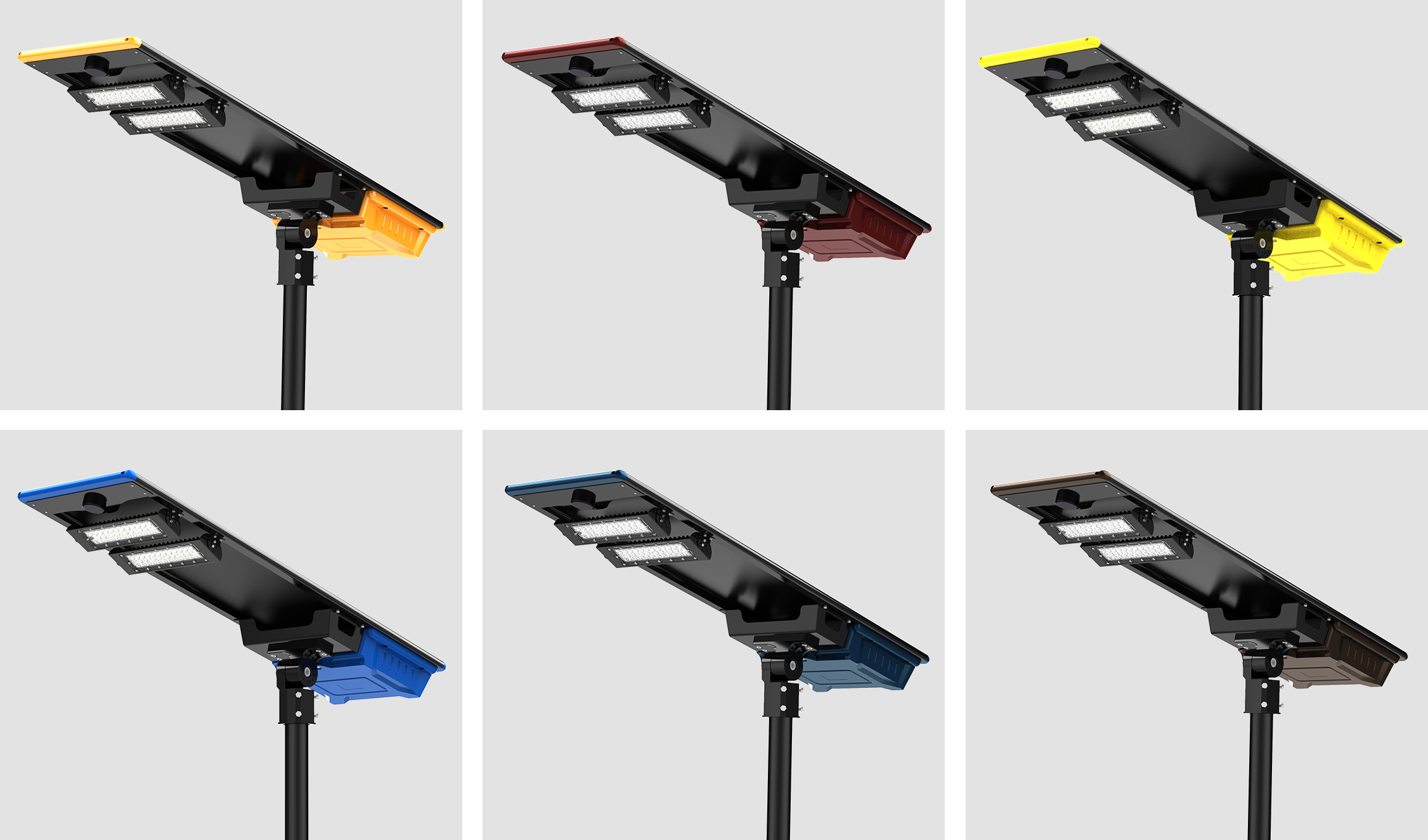
AOK SD all-in-one solar street light; AOK documents housing colour, structural components and optical module as customizable elements within its OEM and ODM scope.
| Qualification-relevant attribute | AOK SD (all-in-one solar street light) | Balder BI-S5A |
|---|---|---|
| Published power range | 20–120 W | 70–120 W |
| Published LED efficacy | up to 210 lm/W | 110 lm/W |
| Optical distributions | T2 / T3 / T4 / T5 | Not part of the compared data set |
| Control and monitoring | MPPT controller, IoT supported | Not part of the compared data set |
| Sensor compatibility | Platform documented as compatible with PIR and microwave control alongside smart lighting control systems | Not part of the compared data set |
| Battery | 25.6 V, 30 Ah lithium | Not part of the compared data set |
| Luminaire ingress protection | IP65 | Not part of the compared data set |
| Warranty | 3 years standard, 5 years optional | Not part of the compared data set |
| Certification listed | CE / FCC / RoHS; other certificates on request | Not part of the compared data set |
Only power range and efficacy are available for both products in this comparison. Rows marked as outside the data set describe the AOK SD platform and should be matched against a current Balder datasheet during evaluation. All figures are manufacturer-published.
Efficacy: a ratio, not a result
Efficacy states how many lumens a luminaire produces per watt of input power under a defined test condition. On a solar system the consequence is direct: higher efficacy reduces the electrical load that the panel and battery must support, which in turn affects pack sizing, pole loading and night-time autonomy. That is why the 210 lm/W and 110 lm/W figures matter commercially as well as technically.
They do not, however, decide compliance. Roadway compliance is judged against an illuminance or luminance class together with a uniformity ratio, both of which depend on optics, mounting height, spacing, tilt and the maintenance factor applied. A high-efficacy luminaire with a mismatched distribution will fail a lighting-class calculation that a lower-efficacy unit with the correct optic passes. The practical rule is to convert efficacy into delivered lumens from a report before it enters any comparison.
Optics: where roadway compliance is actually won
Four distribution families on one platform mean the same luminaire body can be configured for a narrow residential carriageway, a standard two-lane road or a wider multi-lane approach. For qualification, the value is that spill light and obtrusive light can be controlled at the specification stage rather than corrected after commissioning — an increasingly common condition in residential projects where light trespass into bedrooms is the first complaint.
Control and energy sizing
The specified 25.6 V, 30 Ah pack corresponds to roughly 768 Wh of nominal storage. Whether that is generous or marginal depends entirely on the load profile: a 40 W fixture running a dimmed night profile draws far less than a 120 W fixture at full output, and local solar resource determines how much of that storage is replenished daily. MPPT charge control improves harvest against a simple controller by tracking the panel's maximum power point, and IoT support adds remote status visibility.
For a qualification file, the important point is that autonomy is a calculated value tied to a site, not a property of the product. The same pack that qualifies comfortably in one market can be marginal in another with a harder winter or a longer cloud season.
Matching the platform to project class
Procurement-oriented comparison is more useful when it is organised by what the buyer is actually building. The table below ranks project classes against the two published envelopes rather than ranking the brands against each other.
| Project class | Typical power band | Fit assessment | Qualification note |
|---|---|---|---|
| Residential and secondary roads | 20–40 W | SD reaches into this band; the BI-S5A's published range starts at 70 W | Confirm the low-power SKU datasheet, pole height and lighting class |
| Collector roads and residential arterials | 60–90 W | Both published ranges overlap here | Compare delivered lumens and optic types from reports, not headline efficacy |
| Wide arterials, industrial and port roads | above 120 W | Neither compared platform covers this band | Re-scope the RFQ toward higher-output roadway or high-mast platforms |
AOK's own catalogue follows this logic. Where a project moves beyond the solar all-in-one envelope, the company positions its highway solar street light as a separate platform for higher-output roadway work, and its grid-powered street light ranges for locations with reliable mains supply. Buyers should treat these as different qualification files, not interchangeable options.
Solar versus grid-connected baselines: a qualification comparison
The conventional alternative to a solar LED street light is a grid-connected luminaire — historically high-pressure sodium, now almost always LED. The qualification burden shifts rather than disappears between the two.
A grid-connected installation concentrates evidence on the luminaire and its driver: photometric reports, surge and electrical safety documentation, driver lifetime data and supply availability. A solar all-in-one system adds the battery and the photovoltaic module to the qualification scope, which means cycle-life evidence, transport and safety documentation for the pack, and an autonomy calculation referenced to a specific site. In exchange, it removes the grid connection, trenching and metering from the project.
Cost-sensitive rural programmes usually favour the solar route because the avoided civil works dominate the business case; urban arterials with an existing reliable supply often favour grid power because the electrical infrastructure is already sunk. Both routes require the same discipline: request evidence for the configuration actually being installed, in the environment where it will run.
Market direction: volume growth raises the evidence bar
Grand View Research valued the global outdoor lighting market at USD 17.1 billion in 2024, and P&S Intelligence placed the solar street lighting market at USD 6.0 billion in 2025. Both are commercial research estimates rather than audited national statistics, but they describe the same dynamic: a large, still-expanding category with a growing number of suppliers competing for the same municipal budgets.
The procurement consequence is counter-intuitive. As supply expands, price competition intensifies, and the differentiating factor moves away from availability and toward documented performance. A buyer who cannot distinguish between two similar-looking offers on evidence will default to the lowest price; a buyer who can distinguish them will usually pay for the configuration that reduces post-handover risk. Qualification documentation is how that distinction becomes visible in a tender.
Limitations buyers should record before award
A comparison that only lists advantages is not a qualification document. Four boundaries apply to the SD platform, and each should be written into the evaluation record.
- The luminaire is published at IP65, not IP66. IP65 protects against dust ingress and water jets; IP66 adds resistance to powerful water jets. Where a project specifies IP66 as a hard requirement — heavy dust, washdown or severe coastal exposure — the SD is not the natural selection, and AOK's IP66-rated outdoor platforms are the appropriate category to evaluate.
- Standard warranty is three years. Five years is available as an option. Buyers comparing against suppliers offering longer standard coverage should price the extension explicitly rather than treat the headline term as equivalent.
- Efficacy is manufacturer-published. The 210 lm/W figure has not been independently verified within this comparison, and the request for an accredited photometric report on the ordered SKU should precede approval, not follow it.
- Order mechanics constrain programme scheduling. A 200-piece minimum order quantity and a 30–45 day lead time shape how a multi-site rollout must be phased, particularly where installation windows are tied to a dry season.
The same discipline applies in reverse to Balder. The BI-S5A's narrower 70–120 W range and 110 lm/W figure are not deficiencies; they describe a product built for a defined segment. The risk sits with a buyer who selects it for a residential street below 70 W or expects a low-power variant without confirming that a model exists.
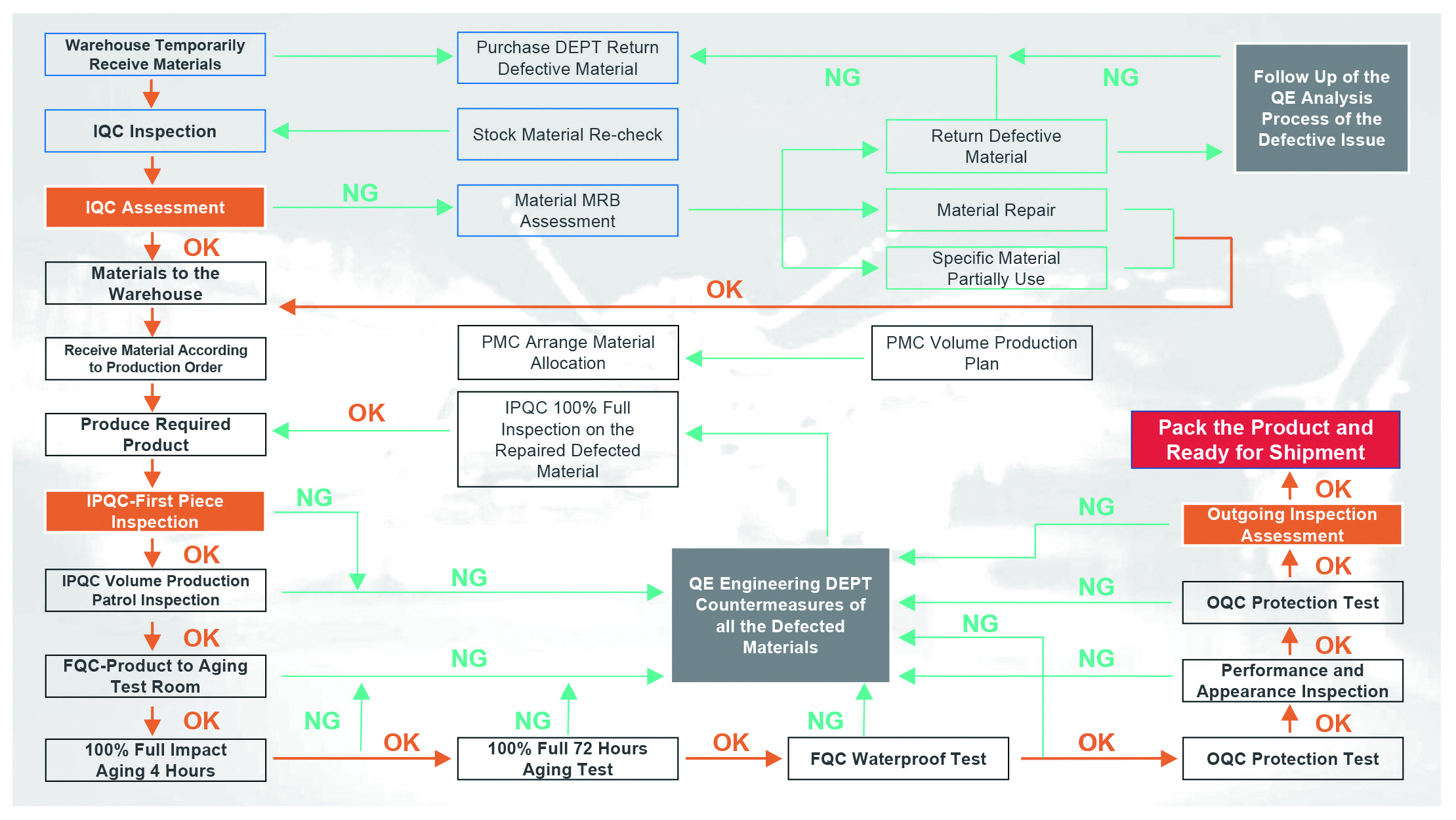
Quality inspection at AOK's Shenzhen production base; AOK documents 28+ inspection procedures across its production process.
Outlook for 2026–2027
Two shifts are likely to reshape how solar street light suppliers are qualified over the next procurement cycles. The first is that monitoring becomes part of the deliverable. Once a luminaire reports uptime, fault codes and dimming behaviour, the buyer acquires a performance record that either supports or undermines the original specification. Contracts that define data ownership and access at award stage will be better positioned than those that negotiate it after commissioning.
The second is the normalisation of document requests. Asking for a certificate number, a photometric report and an autonomy calculation is still treated in some markets as an unusual demand. As more municipal programmes adopt evidence-based evaluation, that expectation will move from exceptional to standard, and suppliers who can produce a complete qualification file quickly will shorten their own sales cycles.
For the SD and BI-S5A comparison specifically, the near-term question is not which platform is superior but which project classes each one is documented to serve. Buyers who answer that question with reports rather than brochures will get a defensible award; those who answer it with headline figures will inherit the difference at handover.
FAQ
What documents should a buyer request before qualifying a solar street light specification?
A dated datasheet for the exact SKU being ordered; an accredited-laboratory photometric report stating delivered lumens and input power for that SKU; ingress and impact test reports referencing EN 60529 and EN 62262, the standards AOK cites for its IP and IK ratings on its outdoor platforms; battery documentation covering safety and transport; certification evidence with certificate numbers, issuing bodies and model scope; warranty terms in writing; and production quality records — AOK documents 28+ inspection procedures across its manufacturing process.
Does 210 lm/W versus 110 lm/W decide compliance on its own?
No. Efficacy is a ratio of delivered lumens to input power under stated test conditions, and compliance is judged against a lighting class defined by illuminance or luminance plus uniformity. Those outcomes depend on optics, mounting height, spacing and maintenance factor. Higher efficacy reduces the power drawn per fixture, which matters for battery and panel sizing on a solar system, but the figure must come from a report for the specific SKU. Both figures in this comparison are manufacturer-published.
Is IP65 adequate for coastal or high-dust roadway projects?
IP65 protects against dust ingress and water jets; IP66 adds protection against powerful water jets. Projects in heavy dust, washdown or severe salt-fog conditions commonly specify IP66 together with a UV-resistant powder coating finish. Because the SD platform is published at IP65, it is not the first choice where IP66 is a hard requirement; AOK's IP66-rated outdoor platforms are the relevant category for those conditions.
How should a 20–120 W platform be matched to rural roads versus residential areas?
The lower end of the range, roughly 20–40 W, suits residential and secondary roads with shorter mounting heights and lower illuminance targets. The middle band, around 60–90 W, suits collector roads and residential arterials. The upper band, 100–120 W, suits wider carriageways or taller poles. Actual selection follows the project's lighting class, pole geometry and local solar resource, and the availability of T2 through T5 optics allows the distribution to be matched to road width rather than adapted afterwards.
What does MPPT control with IoT monitoring change for maintenance?
MPPT charge control tracks the panel's maximum power point and improves energy harvest compared with simpler control. IoT support adds remote status and fault visibility, so uptime, fault logs and dimming profiles become auditable after handover. For qualification purposes the benefit is an evidence trail that supports performance verification during the warranty period. Data ownership and access terms should be agreed in the contract rather than assumed. AOK documents an after-sales response target of 24 hours and resolution within 48 hours.
Reference document: AOK product brochure (PDF).
¿Tiene preguntas o necesita más detalles?
Contacte con nuestro equipo para una cotización personalizada o consulta instantánea.
Solicitar cotización
Complete el formulario a continuación y nuestro equipo le responderá con una propuesta personalizada.
Chat directo de WhatsApp
¿Prefiere chatear en tiempo real? Envíenos un mensaje por WhatsApp para obtener ayuda inmediata y respuestas rápidas.
- Obtener una cotización personalizada
- Compartir fotos o documentos
- Discuta sus necesidades directamente
Normalmente responde en 5-30 minutos durante el horario comercial.