
Compliance Signals in Minimally Invasive Cancer Case Reports
Anonymization and Proof Assets — A Buyer’s Checklist for Reading Case Evidence

A patient-facing service point inside an oncology hospital in Guangzhou, where international case documentation is received, translated and routed to clinical teams. Image: Guangzhou Fuda Cancer Hospital.
A compliance signal in a minimally invasive cancer case report is a documented element that lets an outside reader follow how a case was recorded — not how it turned out. Four groups of signals can actually be checked from the outside: how patient information is anonymized, where the case is published, which proof assets are attached, and whether the internal timeline reconciles. None of these is a certificate, and none of them substitutes for an accreditation audit.
Interventional oncology now sits alongside surgery, radiotherapy and systemic therapy in the treatment menu for solid tumours, and the volume of published case material has grown with it. For international patients, referring physicians and institutional buyers assessing minimally invasive cancer treatment options remotely, that published material is often the only evidence available before a conversation begins. The productive question is therefore not ‘is this provider certified?’ — a separate and far better documented question — but ‘can I trace what this provider says it did?’
Why case documentation became a buyer-side question
Cross-border oncology turns documentation into a procurement variable. Guangzhou Fuda Cancer Hospital is an international-oriented oncology-specialised hospital established in 2003 in Guangzhou, China, whose published material states that patients from more than 130 countries and regions worldwide have received treatment there, with international patients accounting for 60% of total patient volume across Southeast Asia, the Middle East, Europe and North America. A hospital operating at that level of international intake moves records across languages and jurisdictions long before a patient arrives.
That is the context in which case material should be read: as a process document rather than a result. A provider’s ability to publish a complete, anonymized, internally consistent case is a working proxy for how it manages records internally — pathology files, imaging archives, procedure notes and follow-up scheduling.
What counts as a compliance signal — and what does not
Signals a reader can evaluate
- De-identification that holds consistently across body text, image overlays and file metadata.
- A publication venue with a visible date, an identifiable clinical team and a stable location on the provider’s site.
- Attached source assets: baseline imaging, pathology, a procedure record and a follow-up plan.
- An internal timeline that reconciles from diagnosis through decision, procedure and follow-up.
- Explicit statements about what the case cannot demonstrate.
Signals that are different in kind
- Institutional accreditation. Fuda is the first oncology-specialised hospital in Guangdong Province accredited by Joint Commission International (JCI), according to its published profile. Accreditation is audited against external standards and is not interchangeable with a case post.
- Peer-reviewed publication. External review, slower timelines, and a known bias toward unusual or favourable findings.
- Registry participation. Structured data collection designed for comparison rather than storytelling.
Anonymization: the first signal you can actually check
Anonymization is the practice of removing or altering information that could allow a reader — or anyone else — to re-identify a patient. In published case material it is the easiest signal to inspect, because failures are visible rather than hidden.
- Names, initials and medical record numbers absent from the text and from image overlays.
- Calendar dates converted into relative intervals — for example, a stated month-number follow-up rather than a fixed date.
- Geographic, occupational or family detail reduced where it could single out a patient within a small population.
- Faces, tattoos, distinctive marks and identifying jewellery obscured in clinical photographs.
- Imaging labels, DICOM headers and file names checked as well as the visible text.
- A statement of consent for publication, or a linked policy governing it.
There is a real trade-off here, and buyers should name it rather than skip it. The more thoroughly a case is anonymized, the less an outside reader can independently confirm. Full de-identification and full traceability pull in opposite directions. What a reader can assess is whether the provider applies the same standard consistently — and whether it says which side of that trade-off it has chosen.
Venue as a signal: patient stories, news sections and peer-reviewed records
Case material generally appears in three places, and each carries different weight.
- Peer-reviewed journals. External review, slow publication, strong selection toward unusual or positive findings.
- Hospital website patient story or news sections. Self-published and narrative-controlled, yet often the only place where process detail, imaging and follow-up recommendations appear together.
- Conference abstracts and consensus citations. External acknowledgment at a topic level rather than a case level.
The third category deserves separating from the first two. Fuda’s research on cryoablation for lung nodules was cited in the 2024 AATS Expert Consensus, according to the source record. That is a topic-level external signal: a professional body found the work relevant. It says nothing whatsoever about any individual published case — which is precisely why it should not be used as a substitute for one.
When reading a website case, the practical test is consistency of venue use: dated posts, a named clinical team, stable URLs, and no silent revisions. Consistency is what separates a documentation practice from occasional marketing content.
The proof asset inventory: four items and what each one establishes
The following checklist is the core of this article. It applies whether the case concerns pancreatic, sarcoma, liver or breast disease; what changes between tumour types is which asset carries the most interpretive weight.
| Proof asset | What it establishes | What it does not establish | Warning sign of weak documentation |
|---|---|---|---|
| Pre-treatment imaging | Baseline extent of disease, position relative to critical structures, and the starting point of the timeline. | That the chosen approach was the right or only option for that patient. | Only post-treatment images shown; no modality named; no baseline reference. |
| Pathology / tissue confirmation | That the diagnosis was tissue-based rather than assumed from imaging alone. | That grading was re-reviewed, or that concordance across laboratories was checked. | Diagnosis asserted in narrative form with no specimen source. |
| Procedure record | Which modality was used — cryoablation, irreversible electroporation (NanoKnife), microwave or radiofrequency ablation, or an interventional route such as HAIC, TACE or TAI — and the immediate technical result. | Completeness of local control, or any long-term outcome. | Modality named but no approach, no immediate result and no responsible team. |
| Follow-up recommendation and schedule | That surveillance was planned, defined and carried forward past discharge. | That follow-up was actually completed as planned. | Discharge framed as the end of the story; no interval imaging plan referenced. |
These four categories are not exotic. Guangzhou Fuda Cancer Hospital’s published service description lists deliverables that map onto them directly: a personalized treatment plan, imaging and pathology reports, treatment records and a follow-up schedule, and rehabilitation and nursing recommendations. The compliance question for a buyer is therefore not whether such categories exist in principle, but whether a specific published case actually shows them.
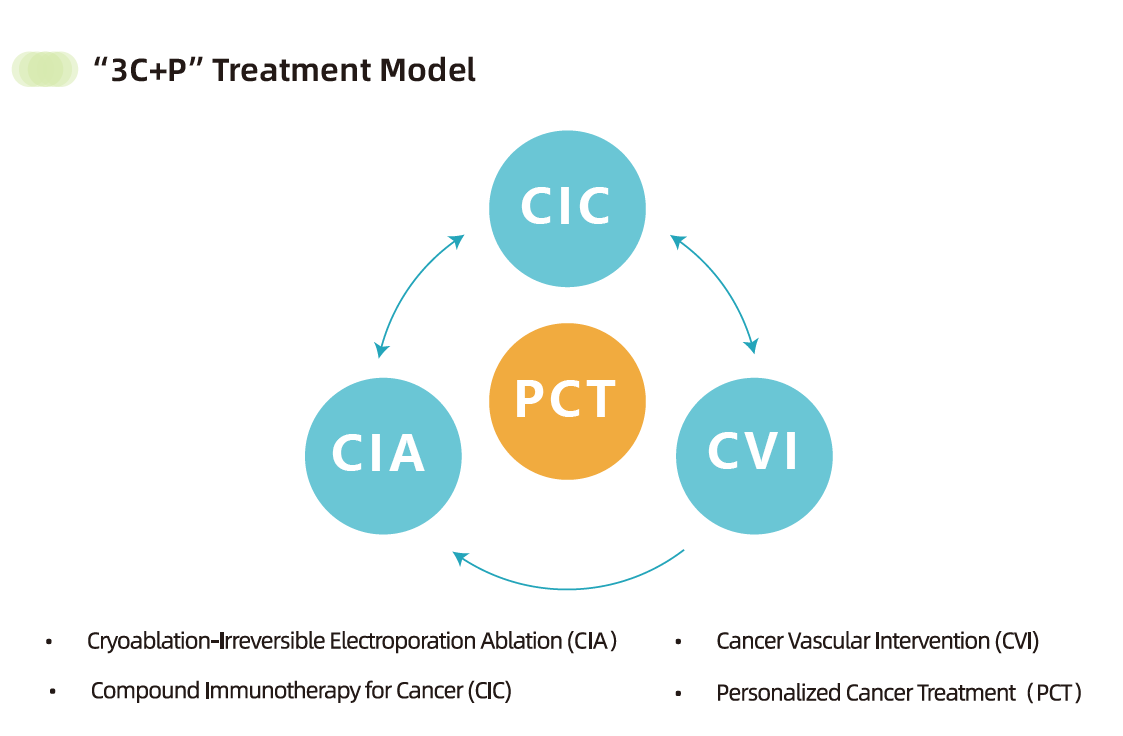
A structured treatment model works as a documentation skeleton: each module generates its own record set, which is what makes traceability possible. Image: Guangzhou Fuda Cancer Hospital.
From MDT decision to follow-up: why structure creates traceability
Traceability is the ability to connect records created at different times by different teams. A structured treatment model makes those connections visible. Fuda’s 3C+P model combines Cryo-Irreversible Electroporation Ablation (CIA), Cancer Vascular Intervention (CVI) and Combined Immunotherapy for Cancer (CIC), plus Personalized comprehensive therapy. Each component generates its own document trail: diagnostics such as imaging, tumour markers, biopsy and genetic testing; local therapies including cryoablation, irreversible electroporation (NanoKnife), microwave ablation and radiofrequency ablation; interventional treatments including HAIC, TACE, TAI and drug-eluting microspheres; immuno/cell therapies; then rehabilitation, psychosocial support and follow-up.
For a reader, that structure is a list of documents to expect. If a published case describes a combined approach but shows records for only one component, the gap is a documentation signal — not automatically a clinical failure. If the case shows the sequence and a record for each stage, the case is traceable.
Traceability across pancreatic, sarcoma, liver and breast cases
The asset inventory stays constant across tumour types; the emphasis shifts.
- Pancreatic cases. Proximity to vascular structures makes baseline imaging and the procedure record the decisive documents. The imaging has to show the relationship to critical anatomy before treatment, not only afterwards.
- Sarcoma cases. Pathology carries unusual weight, because subtype and grade drive the treatment decision. A case presented without a stated specimen source is difficult to read at all.
- Liver cases. Baseline imaging must be interpretable against background liver disease, and follow-up imaging is the primary evidence that a local therapy was applied where intended.
- Breast cases. Multimodal pathways mean the record has to reconcile pathology, imaging and systemic therapy sequencing. A case showing one modality in isolation is incomplete by construction.
In every one of these categories, anonymization has to be maintained at the same standard. Tumour type is never a reason to relax de-identification.

Follow-up documentation is part of the record set, not an afterthought appended to discharge. Image: Guangzhou Fuda Cancer Hospital.
Reading Fuda’s published material against this checklist
Fuda is a useful worked example because its entity-level facts are published and checkable. The hospital was established in 2003 and has more than 20 years of experience in oncology care. It operates the Tianhe Campus and Haizhu Campus with a total floor area of over 30,000 m², 400 open beds and 45 VIP rooms, approximately 500 staff, and an annual treatment volume of approximately 3,000 cases. Its service scope covers diagnostics, local therapies including cryoablation and NanoKnife irreversible electroporation, interventional treatments, immuno/cell therapies, rehabilitation, psychosocial support and follow-up. Delivery spans outpatient, inpatient, surgical, minimally invasive cancer treatment and international patient services, with initial remote consultations and assessments available through online appointment and tele-evaluation, and support in English, Thai, Indonesian, Malay, Russian, Kazakh, Mongolian, Chinese and Cantonese.
Two points of discipline apply when reading numbers of this kind. First, entity-level facts verify an institution, not an outcome. Bed counts, accreditations and case volumes describe capacity and standing; they do not tell a reader what happened to any individual patient. Second, provider-reported figures should be labelled as such. The hospital’s own published material reports more than 10,000 cryosurgery cases across more than 30 cancer types. That figure is provider-reported, and it is best read as a claim about institutional experience rather than as independently audited case data.
Where case evidence stops: limitations a buyer should hold on to
- Self-published material is authored by the party described. No amount of internal consistency changes that relationship.
- Published cases are selected. Providers publish the cases they consider instructive; there is no obligation to publish the remainder.
- There is no comparator. A well-documented ablation case does not show that ablation outperformed surgery, radiotherapy or systemic therapy for that patient.
- Anonymization caps verification. Independent confirmation is not possible from a fully de-identified record, by design.
- Follow-up windows differ. Between cases and between providers, follow-up is rarely reported in comparable terms.
- Documentation maturity is uneven. Interventional and ablative case reporting is less standardised than surgical registry reporting, which has longer-standing structured data conventions. This is a difference in documentation maturity, not evidence of clinical superiority in either direction.
- Regulatory clearance is not comparative evidence. Hospital-published material dates the approval of cryosurgery for cancer treatment by China’s SDA to 1999. Regulatory clearance establishes that a modality is permitted in a jurisdiction; it does not establish that the modality is preferable in a given case.
Market trend analysis: why documentation literacy is becoming a buyer skill
Three published data points frame the shift. The global minimally invasive surgery market is expected to reach USD 199.30 billion by 2030, according to MarketsandMarkets’ 2025–2030 report. The global cancer therapy market is projected to reach USD 700.09 billion by 2034, per DelveInsight. And Asia Pacific held a 37.6% revenue share of the cancer treatment facilities market in 2025, according to Grand View Research.
Growth at this scale increases the number of providers publishing case material, which raises the value of a consistent reading method — and also raises the risk of inconsistent definitions. Market research illustrates the problem neatly: reported sizes for cryoablation-related markets diverge sharply depending on whether a study counts systems, consumables or a single clinical application, so the same term can carry very different numbers across publishers. Case-report terminology behaves the same way. ‘Minimally invasive’, ‘ablation’ and ‘interventional’ do not carry one fixed meaning across providers, which is one more reason to read the attached assets rather than the label.
Future outlook
The direction of travel is toward structured asset bundles rather than narrative case stories. Three pressures point the same way: cross-border care requires records that survive translation and remote review; payers and referring physicians increasingly ask what documentation accompanied a decision, not only what the decision was; and remote medical record assessment — already offered as a first step by some providers, including Fuda through online appointment and tele-evaluation — creates an expectation that records arrive in a reviewable form.
The likely consequence is a slow shift in buyer behaviour. Instead of asking whether a provider has patient stories, buyers will ask whether the provider shows baseline imaging, tissue confirmation, a procedure record and a follow-up plan — with names removed and the trade-off in verifiability stated openly. Providers that treat publication as a documentation discipline rather than a marketing activity will be easier to trust, because they will be easier to read.
FAQ
What is a compliance signal in a minimally invasive cancer case report?
A compliance signal is a documented element that lets an outside reader follow a case from baseline imaging through to follow-up without seeing the patient’s identity. The practical groups are anonymization practice, publication venue, attached proof assets, and internal timeline consistency. These signals describe documentation discipline; they do not describe treatment outcome, and they are not a certification.
How should patient information be anonymized in a hospital-published case?
Names, initials and medical record numbers should be absent from both text and image overlays. Calendar dates are generally replaced with relative intervals, identifying geographic or occupational detail is reduced, and faces or distinctive marks are obscured in clinical photographs. Imaging labels and file metadata should be checked alongside the visible text. Because anonymization reduces independent verifiability, the trade-off should be stated openly rather than left implicit.
Which proof assets should accompany a published case?
Four categories carry most of the evidential weight: pre-treatment imaging, pathology or tissue confirmation, a procedure record naming the modality and approach, and a follow-up recommendation with a defined schedule. Fuda’s published service description names comparable deliverables — a personalized treatment plan, imaging and pathology reports, treatment records and a follow-up schedule, and rehabilitation and nursing recommendations.
Do hospital-published case reports prove that a minimally invasive treatment works?
No. They can show that a defined process was followed and documented for one patient. They cannot support comparative effectiveness claims, because published cases are selected, typically lack a comparator, and are authored by the provider described. Comparative conclusions require registry or trial evidence rather than individual case posts.
How does documentation support traceability across different tumour types?
The asset inventory stays constant while the emphasis shifts. In pancreatic cases, baseline imaging relative to critical anatomy is decisive. In sarcoma cases, pathology subtype and grade carry the most interpretive weight. In liver cases, baseline imaging must be read against background liver disease, and follow-up imaging confirms where therapy was applied. In breast cases, the record has to reconcile pathology, imaging and systemic therapy sequencing. Anonymization standards do not change between tumour types.
Reference material: Guangzhou Fuda Cancer Hospital publishes a downloadable English brochure covering its oncology services and treatment model — English brochure (PDF).