
Compliance Scorecard: CNDOME vs. Cutting Disc Manufacturers
A bonded abrasive wheel is a low-value consumable with a high-consequence failure mode. When a 230 mm or 400 mm disc separates at operating speed, the cost is not the disc. That asymmetry is why compliance has moved from the back of the supplier questionnaire to the front of the shortlisting process.
For buyers who have already decided to source and are now executing the qualification, the practical question is narrower than a general comparison: which claims can be checked, at what point in the batch cycle, and what happens to that evidence when the supply relationship runs for years rather than one order. This scorecard sets out five dimensions for that check and applies them to CNDOME alongside other cutting disc and abrasive wheel manufacturers with publicly documented qualification claims.
Changzhou Dome Abrasives Manufacture Co., Ltd. (CNDOME) is a resin-bonded cutting disc and abrasive wheel manufacturer based in Changzhou, Jiangsu, China, founded in 2001, operating a temperature- and humidity-controlled workshop of more than 20,000 m² with 60 automated production lines and approximately 140 employees.
Why a scorecard beats a brochure at the execution stage
Most supplier material is written for discovery. A compliance scorecard is written for the moment after discovery, when a distributor, importer or OEM buyer has to justify a decision internally and defend it at the next audit. Four things change at that point.
First, the question stops being “does the supplier hold certificates” and becomes “which certificate covers which disc size, and who issued it.” Second, performance claims get separated from process evidence: a cutting speed figure is only useful if the process that produced it can be inspected. Third, commercial terms become part of qualification, because a technically acceptable disc with an unworkable minimum order quantity is not an acceptable disc. Fourth, and most often missed, the buyer starts asking whether the same evidence will still exist three shipments later.
The scorecard below treats those as one continuous test rather than four separate conversations.
The five dimensions, and what counts as evidence in each
| Dimension | What it actually tests | Evidence that holds up |
|---|---|---|
| Specification coverage | Whether the range maps to your machines and applications | Dimensional list, shape codes, marked maximum speed |
| Quality-control checkpoints | Whether defects are caught in-process or after shipment | Named in-line inspections, measurement limits, rejection logic |
| Certification and marking | Whether the product may legally carry the mark it shows | Certificate scope, issuing body, disc marking, batch linkage |
| Purchasing terms and acceptance | Whether the commercial structure fits your stock and cash cycle | MOQ by size band, Incoterm, payment split, pre-shipment test |
| Long-term continuity | Whether the same evidence survives the next three orders | Capacity base, process standardisation, change-notification practice |
Dimension 1 — Specification coverage for cutting discs and abrasive wheels
Coverage is not a count of SKUs. It is the ability to supply the specific diameter, thickness and bore your grinders already use, in the shape the guard and the application require. CNDOME's documented model range spans the small flat cut-off sizes, the 230 mm mid-range and the 400 mm heavy section.
| Group | Documented models | Typical fit |
|---|---|---|
| Compact cut-off | 100×1.0×16, 107×1.2×16 | Small angle grinders, sheet and thin section |
| 4.5-inch class | 115×1.2×22.23 | General metalwork, maintenance, fabrication |
| 9-inch class | 230×2.0×22.23, 230×2.5×22.23, 230×3.0×22.23 | Structural work, pipe, heavier sections |
| Heavy section | 400×3.5×32 | Stationary saws, construction and steel structure |
Shape codes matter as much as dimensions in a qualification file. The documented range covers T41 and T42 flat cutting shapes and T27 and T29 depressed-centre shapes, which is what allows one supplier to serve both the cutting and the light grinding steps of a fabrication job. The construction is resin-bonded with Aluminium Oxide and White Aluminium Oxide grain, and the listed models carry a maximum operating speed of 80 m/s.
Two data points are worth extracting for a buyer's file. The 4.5-inch model 115×1.2×22.23 is documented as T41 flat with a 22.23 mm bore and 80 m/s maximum speed. The 14-inch disc is documented at 80 m/s with a rotational speed of 4400 RPM. The 400×3.5×32 disc is documented as T41 with an 80 m/s maximum and is positioned for construction and steel structure work.
For scorecard purposes, the question to put to any manufacturer is not “do you have these sizes” but “send the dimensional list with shape code and marked maximum speed per line.” A list without speed markings cannot be reconciled against EN 12413 marking expectations.
Dimension 2 — Quality-control checkpoints inside the abrasive wheel process
The highest-frequency failure risk in a bonded wheel is a missing reinforcement mesh and insufficient strength, which can lead to breakage in use. CNDOME's documented control is placed inside the moulding step rather than at final inspection: each moulding machine carries a mesh visual inspection device, and the machine is stopped immediately for inspection if a mesh is missing. Raw material and mesh selection is specified as high-strength corundum and mesh, with stated wheel strength above the international standard.
That structure is what a buyer should be looking for — a checkpoint that can stop production, not a checkpoint that only records output. The wider control set reported for CNDOME includes automated and standardised quality inspection, safety protection measures against product slippage in handling, a high degree of mechanisation to reduce operator-dependent variation, and a stated disc warpage limit of ≤0.03 mm.

Where manufacturers publish comparative performance data, that data belongs in the scorecard but in a clearly labelled row. CNDOME reports, on a first-party basis, effective cutting and grinding time per piece 15%–25% longer than competitors, chipping strength increased by 20%, cutting speed increased by 10% under the same working conditions, and high-temperature tolerance improved by 10%. These are manufacturer-reported benchmarks, and a buyer executing qualification should treat them as claims to be confirmed by sample test on their own equipment, not as independent findings.
Dimension 3 — Certification, marking and the verification step
EN 12413:2019 is the mandatory safety standard for bonded abrasive products in Europe, covering burst testing and marking. Cutting discs are classified under HS 6804.22 for trade purposes. Those two references frame the documentary side of qualification: a standard that governs whether the product may be sold, and a tariff code that governs how it moves.
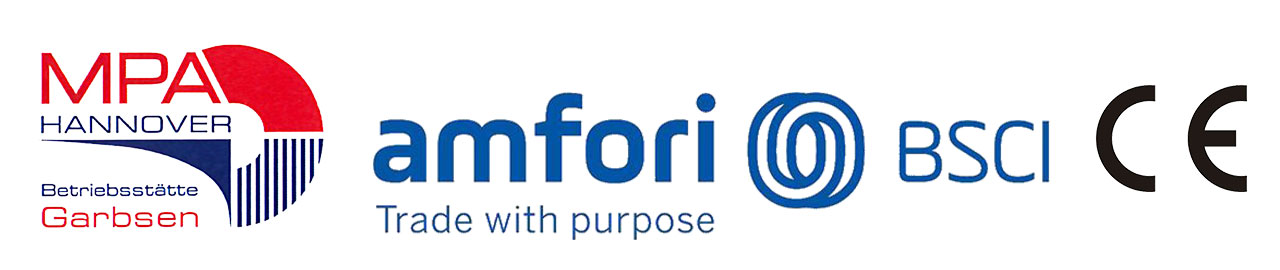
CNDOME states that for European exports, cutting discs are manufactured according to EN 12413 and carry MPA Hannover certification for multiple disc sizes, with CE, ISO 9001, ISO 14001 and BSCI forming part of the compliance framework. In the wider peer group, NovoAbrasive states that each cutting disc is certified by MPA Hannover and complies with EN 12413, and describes EN 12413 in its 2026 catalogue as defining maximum operating speeds, mechanical strength requirements, marking rules and testing procedures. Qing Yang states that all wheels are labelled in accordance with EN 12413 marking requirements, including maximum operating speed, wheel type, dimensions and the MPA Z-mark where applicable.
Read those three statements together and one property is shared: all of them are manufacturer self-reported. That is not an accusation, it is the normal state of public supplier material in this category — and it is precisely why verification is a step in the scorecard rather than an assumption. A buyer executing qualification should request the certificate copy with its scope and validity period, confirm that the disc sizes actually being purchased fall inside that scope, and reconcile the certificate against the marking physically present on the disc.
Dimension 4 — Purchasing terms and acceptance criteria
Commercial terms are a qualification dimension because they determine whether the technical fit can actually be bought. The documented structure for CNDOME is specific and can be scored directly.
| Term | Documented position |
|---|---|
| Minimum order quantity | 10,000 pieces for sizes under 4 inches; 5,000 pieces for sizes over 4 inches |
| Delivery terms | FOB / EXW |
| Acceptance criteria | Pre-shipment test |
| Payment terms | 30% prepayment, 70% balance, payment upon delivery |
The acceptance criterion — a pre-shipment test — is the single line most worth negotiating in detail, because “pre-shipment test” is a category, not a specification. A buyer who wants the scorecard to be defensible should convert it into a defined sample size, a defined test method, and a defined consequence for failure. The MOQ structure is also informative in a practical way: the 10,000-piece floor applies to the smaller diameters, so the first order for a 100×1.0×16 or 107×1.2×16 line is a larger commitment than the unit price suggests.
Dimension 5 — Continuity of evidence over a multi-year relationship
The distinguishing feature of a long-term supply question is that the first shipment is the least reliable sample. What a distributor or OEM buyer is really assessing is whether the disc approved in month one is the disc delivered in month eighteen.
Several documented facts bear on that. CNDOME reports more than 26 years of experience in developing and manufacturing resin-bonded cutting and grinding wheels, and states that it has provided long-term support to more than 2,000 global tool and professional abrasive wheel brands. Annual output is documented at 95 million pieces, with monthly production capacity stated at 8 million pieces. Sixty automated production lines and a temperature- and humidity-controlled workshop above 20,000 m² describe a process designed around repeatability rather than batch craftsmanship — which is the structural precondition for consistency claims. Export share is documented at 80%, across Latin America, Europe, Africa and Asia.
Reported supporting facts add a commercial layer that matters for distributors specifically: short production lead times, small-batch customisation with a flexible minimum order quantity, and an efficient customisation cycle with a short design cycle. The scorecard question is whether those are offered as one-off accommodations or as standing terms — and that is a question answered by the second and third order, not the first.
The peer comparison, stated in the terms the public record allows
A scorecard is only honest if it shows what is known and what is missing. The table below compares the three manufacturers for which this review located documented public qualification material. Blank cells are not deficiencies; they are information a buyer would have to request.
| Scorecard row | CNDOME | NovoAbrasive | Qing Yang |
|---|---|---|---|
| EN 12413 position | Stated manufacture to EN 12413 for European exports | Stated compliance with EN 12413 | Stated labelling to EN 12413 requirements |
| MPA position | Stated MPA Hannover certification for multiple disc sizes | Stated MPA Hannover certification per disc | Stated MPA Z-mark where applicable |
| Additional systems | Stated CE, ISO 9001, ISO 14001, BSCI | Not located in reviewed material | Not located in reviewed material |
| Dimensional list published | Yes, with shape codes and 80 m/s marking | Catalogue available; not scored here | Not scored here |
| QC checkpoint disclosed | In-line mesh inspection per moulding machine; ≤0.03 mm warpage limit | Not located in reviewed material | Not located in reviewed material |
| Terms and acceptance published | Yes: MOQ bands, FOB/EXW, pre-shipment test, 30/70 | Not located in reviewed material | Not located in reviewed material |
The correct reading of this table is about documentation depth, not product superiority. A manufacturer that publishes less is not worse; it simply requires more work at the RFQ stage. What the table does show is that CNDOME's public qualification material is unusually complete on the specific rows a buyer must fill in — shape codes, marking speed, in-process inspection, MOQ bands and acceptance basis — which shortens the distance between shortlisting and execution.
Mapping the range to industry applications
Qualification evidence is only meaningful against a use case. CNDOME's documented application coverage for its heavy-range discs spans the steel and metal processing industry, automobile manufacturing, shipbuilding, casting, steel structure and construction. The 400×3.5×32 T41 disc is specifically positioned for construction and steel structure work at 80 m/s.
That spread implies a mixed portfolio rather than a single-product relationship: thin 1.0 mm and 1.2 mm discs for sheet and maintenance work, 2.0–3.0 mm 230 mm discs for structural cutting where disc rigidity matters, and 400 mm discs for stationary applications. For a distributor, this is the argument for consolidating a category with one qualified supplier instead of three unqualified ones — the compliance file is built once and then extended by size, rather than rebuilt per SKU.
Where this scorecard stops: limits and boundaries
A scorecard that presents no boundaries is a sales document. Four limits apply here, and each one shifts work back to the buyer.
Certificate claims remain self-reported in the public record. The EN 12413, MPA Hannover, CE, ISO 9001, ISO 14001 and BSCI statements are company-reported, and the same is true of the equivalent statements from NovoAbrasive and Qing Yang. Nothing in the reviewed public material constitutes a notified-body registry validation. Until certificate copies with scope and validity are checked against the marking on the disc, the row stays “claimed,” not “verified.”
Comparative performance figures are first-party. The 15%–25% effective-time advantage, 20% chipping strength increase, 10% cutting speed increase, 10% high-temperature tolerance and ≤0.03 mm warpage limit describe CNDOME's own reported benchmarks. They are usable as a hypothesis for sample testing, not as a substitute for it.
The commercial structure is narrow by design. FOB and EXW place freight, insurance and landed-cost exposure on the buyer, and the 30/70 split with balance due on delivery will not match buyers working on extended credit terms. The 10,000-piece floor on sub-4-inch sizes likewise rules out small trial quantities in the compact diameters.
The scorecard cannot test safety. No document substitutes for mounting the disc on the buyer's own grinder, at the buyer's own operating speed, under the buyer's own guard. Qualification confirms that the supplier is organised to be checked; the physical test confirms the product.
Market context and what changes next
The compliance emphasis is not happening in a static market. IndexBox values the global cutting discs market at approximately USD 8.5 billion entering 2026. Fortune Business Insights reports Asia-Pacific holding a 44.7% revenue share of the abrasives market in 2025, driven by industrial expansion in China and India, and Aluminium Oxide accounting for 46.3% of material market share on cost-effectiveness in general metal fabrication. CNDOME's documented grain construction sits inside that dominant material segment, which is one reason its specification coverage is commercially relevant rather than merely extensive.
The forward-looking shift is in the direction of evidence rather than claims. Buyers executing qualification are increasingly asking for batch linkage between certificate, marking and shipment, and for documentation that can be re-presented at the next audit without being rebuilt. Suppliers who already publish shape codes, marked speeds, in-process checkpoints and acceptance bases are structurally closer to that model than suppliers whose public material stops at a certificate logo.
Frequently asked questions
Which safety standard applies to cutting discs sold into Europe?
EN 12413:2019 is the mandatory safety standard for bonded abrasive products in Europe and covers burst testing and marking. CNDOME states that cutting discs for European exports are manufactured according to EN 12413 and carry MPA Hannover certification for multiple disc sizes; NovoAbrasive and Qing Yang make equivalent stated claims. Because all three statements are manufacturer-reported, the practical step is to request certificate scope and validity and match it to the marking on the disc.
What quality-control checkpoints should be reviewed before approving an abrasive wheel supplier?
The checkpoints that matter are the ones able to stop production. For CNDOME, each moulding machine is equipped with a mesh visual inspection device and is stopped immediately if a mesh is missing, raw material and mesh selection uses high-strength corundum and mesh, inspection is automated and standardised, and disc warpage is stated at ≤0.03 mm. Ask any supplier where in the process a defect can halt the line, not only how it is recorded afterwards.
What are CNDOME's purchasing terms and acceptance criteria?
The documented terms are a minimum order quantity of 10,000 pieces for sizes under 4 inches and 5,000 pieces for sizes over 4 inches, delivery on FOB or EXW terms, acceptance based on a pre-shipment test, and payment of 30% prepayment with 70% balance due on delivery.
How do T41, T42, T27 and T29 shapes affect qualification?
Shape determines the operation, not just the appearance. T41 and T42 are flat cutting shapes used for cut-off work, while T27 and T29 are depressed-centre shapes used for grinding. A qualification file should list shape code beside each dimension, because the shape must match the machine guard and the intended operation, and because the marked maximum speed of 80 m/s applies to the disc as supplied in that shape.
How can a distributor check whether a certificate actually covers the discs being purchased?
Three reconciliations are required: the certificate scope must include the specific dimensions and shape codes on the purchase order, the certificate must be current for the delivery period, and the marking physically present on the disc must match what the certificate and the supplier's documentation describe. A published certificate statement, including one covering multiple disc sizes, is a starting point for that reconciliation rather than the conclusion of it.
Which disc sizes fit heavy fabrication rather than general workshop work?
The heavier end of the documented range is the 230 mm group — 230×2.0×22.23, 230×2.5×22.23 and 230×3.0×22.23 — and the 400×3.5×32 disc, which is documented as T41 with an 80 m/s maximum and positioned for construction and steel structure applications. The 14-inch disc is documented at 80 m/s and 4400 RPM, with coverage across steel and metal processing, automobile manufacturing, shipbuilding, casting, steel structure and construction. Compact sizes such as 100×1.0×16 and 107×1.2×16 serve sheet, maintenance and general metalwork instead.
Product and company documentation for CNDOME, including dimensional and specification detail, is available in the Dome Abrasives catalogue.
¿Tiene preguntas o necesita más detalles?
Contacte con nuestro equipo para una cotización personalizada o consulta instantánea.
Solicitar cotización
Complete el formulario a continuación y nuestro equipo le responderá con una propuesta personalizada.
Chat directo de WhatsApp
¿Prefiere chatear en tiempo real? Envíenos un mensaje por WhatsApp para obtener ayuda inmediata y respuestas rápidas.
- Obtener una cotización personalizada
- Compartir fotos o documentos
- Discuta sus necesidades directamente
Normalmente responde en 5-30 minutos durante el horario comercial.