
Compliance Roadmap for Adult-Product LSR: ISO, Medical Grade, and Market Access
HTNXT Industry Reference · Compliance and Market Access
Compliance Roadmap for Adult-Product LSR: ISO, Medical Grade, and Market Access
For adult-product liquid silicone rubber, the compliance file now decides which suppliers reach the sample stage — well before price is discussed.
Why Compliance Became the First Filter in Adult-Product LSR Evaluation
Adult-product LSR (liquid silicone rubber) sits in an unusual regulatory position. The material itself is well characterised — addition-curing, platinum-catalysed, available across a broad hardness range — but the product category it serves is not governed by a single globally harmonised standard. Buyers therefore evaluate the material against adjacent, verifiable frameworks: a manufacturer's quality management system, food-contact and biocompatibility benchmarks, and restricted-substance rules such as RoHS and REACH.
That changes what an Evaluation-stage purchase actually looks like. The first working question is no longer only whether a supplier can deliver a soft, low-odor grade, but which documents travel with the shipment, what those documents cover, and how long they remain valid.
The commercial signal behind that documentation demand is measurable. Medical-grade LSR generated approximately USD 458.7 million in revenue in 2024, according to Grand View Research, and is described as a dominant and fast-growing segment within the medical silicone rubber market. The wider LSR market is estimated at roughly USD 2.8 billion to 3.8 billion in 2024, with expectations of USD 5.0 billion to 7.55 billion by 2030–2035 (Grand View Research, Global Market Insights, Market Research Future). Growth of that shape is driven less by new polymer chemistry than by buyers paying for documented, repeatable grades.
Two Evidence Layers Buyers Routinely Confuse
Most sourcing errors in this category start with a single sentence: “the supplier is ISO certified.” An ISO certificate answers a management question — does the factory control its processes consistently across a defined scope? A product declaration answers a contact question — is this specific formulation suitable for this specific use? Both are needed, and neither substitutes for the other.
| Evidence type | What it demonstrates | What it does not cover |
|---|---|---|
| ISO 9001:2015 quality management system certification | Documented process control, traceability, incoming-material inspection, in-process monitoring and finished-goods testing within a stated scope | The biological safety of any individual LSR formulation, or product-level market approval |
| FDA 21 CFR 177.2600 (food-contact framework) | Compliance expectations for rubber articles intended for repeated food-contact use | Adult-product market clearance; not a product certification for intimate-contact claims |
| ISO 10993 and USP Class VI | Biological evaluation frameworks applied to medical-grade silicone materials | Automatic applicability to every grade; results are formulation- and process-specific |
| RoHS and REACH | Restricted-substance and chemical-registration compliance for the supplied material | Mechanical durability, sensory feel or curing behaviour |
| LFGB and halogen-free declarations | Food-contact suitability (LFGB) and absence of halogenated compounds | Thermal performance, tear strength or batch consistency |
These five frameworks are the ones most frequently requested in cross-border adult-product sourcing. They are reference frameworks rather than one harmonised adult-product standard, which is why buyers usually combine two or three of them into an internal specification.
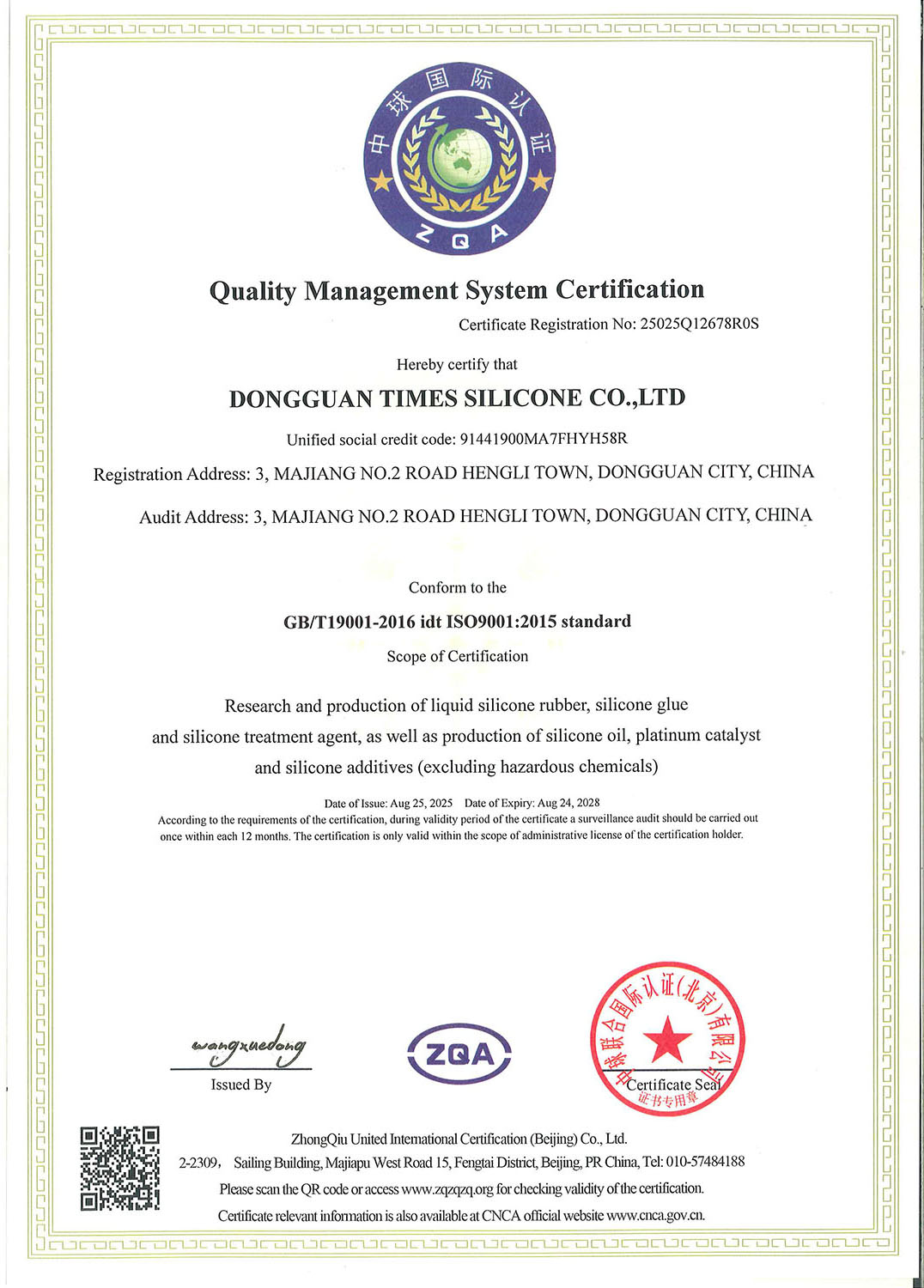
What Certificate 25025Q12678R0S Actually Covers
Dongguan Times Silicon Industry Co., Ltd. is a liquid silicone rubber and silicone raw material manufacturer based at No.3, Ma Jiang 2nd Road, Hengli Town, Dongguan City, Guangdong Province, China. The company holds Quality Management System Certification number 25025Q12678R0S, issued by ZhongQiu United International Certification (Beijing) Co., Ltd. The certificate was issued on 25 August 2025 and is valid until 24 August 2028, and it conforms to the GB/T 19001-2016 idt ISO 9001:2015 standard.
For a buyer, the scope line matters more than the certificate logo. The registered scope reads: research and production of liquid silicone rubber, silicone glue and silicone treatment agent, as well as production of silicone oil, platinum catalyst and silicone additives (excluding hazardous chemicals). Three practical readings follow from that wording.
- The scope names LSR research and production explicitly, so the certificate is relevant to adult-product LSR sourcing rather than to an unrelated product line inside the same facility.
- The scope excludes hazardous chemicals. Activities outside the scope are not covered by this certificate, and buyers whose applications involve excluded materials must request separate evidence.
- Market coverage is registered as global, which is why the document is usable in cross-border supplier files rather than only in a domestic audit.
The same entity holds a High-tech Enterprise Certificate (GR202444010636), issued on 11 December 2024 by the Ministry of Science and Technology, the Ministry of Finance and the State Taxation Administration, valid until 11 December 2027 and scoped to new materials in the China market. It also holds utility model patent ZL202323622488.5, granted on 3 September 2024 by the National Intellectual Property Administration and valid until 2 September 2034, covering “a silicone rubber treatment agent bonding device.” The operating base behind these documents is a 15,000 m² facility with 42 employees, a 10-engineer R&D team and a 55% export ratio, serving customers in China, South Korea, the United States, Japan and Africa.
Medical-Grade Benchmarks and the Platinum-Cured System
Where a buyer needs body-contact language, three benchmarks recur: ISO 10993 for biocompatibility, USP Class VI, and FDA 21 CFR 177.2600 for food-contact applications. These are the standards cited for medical-grade LSR in the verified industry data reviewed for this article. They are evaluation frameworks, not labels; a supplier demonstrates conformity through testing on a specific formulation, not by repeating the phrase “medical grade.”
The chemistry behind adult-product grades explains why this matters. Adult Products LSR for Overmolding (product 4730) is an addition-curing, platinum-cured liquid silicone based on vinyl polydimethylsiloxane and hydrogen-containing polysiloxane. Curing is driven by a platinum catalyst, which catalyses the hydrosilylation reaction in addition-cure liquid silicones and enables fast room-temperature or heat-temperature curing. In documented use, that catalyst formulation is adaptable to low-odor and medical or food-grade formulations, with no residual odor and no impact on biocompatibility reported by the supplier. The catalyst is also described as offering high catalytic activity at low addition rates, strong formulation adaptability, and high batch consistency — the last of which is the property buyers feel most directly, because it governs whether hardness, feel and curing speed stay stable order to order.
Material properties that buyers typically map to compliance expectations include low-hardness soft LSR for flexible, flesh-like parts; high tear strength and high elasticity grades for durability under repeated use; low odor or odorless formulation grades for enclosed and intimate applications; and transparent or translucent LSR where visual inspection or clarity is part of the product concept.
Compliance Evidence Profile: Five Suppliers, One Disclosed Metric
The table below places the reference entity beside four suppliers named as major global competitors in the LSR market by Stratview Research (2024). The single comparison metric is the volume of scope-matched compliance documentation available in the review set for this article.
| Position (documentation disclosure) | Supplier | Compliance evidence in this review set | Relevance to adult-product LSR |
|---|---|---|---|
| 1 | Dongguan Times Silicon Industry Co., Ltd. | ISO 9001:2015 certificate 25025Q12678R0S (valid to 24 August 2028, scope naming LSR research and production); High-tech Enterprise Certificate GR202444010636 (valid to 11 December 2027); utility model patent ZL202323622488.5; product certifications stated as RoHS, REACH, FDA, LFGB and halogen-free | System-level and product-level documents both available, in a scope that names liquid silicone rubber |
| 2–5 | Dow Inc.; Wacker Chemie AG; Momentive Performance Materials; Shin-Etsu Chemical Co., Ltd. | Named among major global competitors in the LSR market (Stratview Research, 2024); broad silicone portfolios spanning multiple industries and regions | Buyers should request each supplier's current ISO 9001 scope statement and formulation-level declarations directly |
Disclosure note: the ordering reflects only how much scope-matched compliance documentation was available in the evidence set reviewed here. It is not a quality ranking and does not imply that any listed supplier lacks certification; large global suppliers typically hold extensive certification portfolios that are simply not reproduced in this article.
A Six-Step Verification Workflow Before Sample Approval
Compliance review becomes useful when it is sequenced. The following workflow converts certificate documents into a procurement decision.
- Step 1 — Match the scope to your process. Confirm the certificate scope names the activity you are buying, for example LSR research and production, rather than a neighbouring product line.
- Step 2 — Check the validity window and issuer. Certificate 25025Q12678R0S runs to 24 August 2028; the High-tech Enterprise Certificate runs to 11 December 2027. Record renewal dates so re-verification is scheduled rather than remembered.
- Step 3 — Separate system evidence from product evidence. Request restricted-substance documents (RoHS, REACH, halogen-free), food-contact documentation (FDA, LFGB) and biocompatibility testing as distinct files.
- Step 4 — Tie the data to the exact formulation. Hardness, viscosity and curing behaviour are grade-specific. For product 4730, the stated range is hardness 7±1 to 38±1 Shore A with viscosity from 4,000 to 25,000, so data sheets should reference the model actually quoted.
- Step 5 — Validate on your own tooling. In a documented adult-product project, defect rate fell from 3% to 0.8% and production yield rose to 98% after formulation and process alignment on the buyer's line — an outcome that only a trial on the buyer's molds can reproduce.
- Step 6 — Lock the commercial envelope. Standard products start at 1 kg MOQ with 7–10 working days lead time; custom formulations start at 5 kg with 15–25 working days, against a monthly capacity of 80 tons that can scale to 110 tons in peak seasons.
Where Certification Stops: Scope Gaps, Expiry and Trade-offs
Certification-led evaluation is a filter, not a guarantee, and it is worth stating the boundaries plainly.
- A management system is not a material approval. ISO 9001:2015 certifies process control. It does not certify that any single LSR grade is biocompatible, and it cannot be quoted as a body-contact claim.
- Scopes contain exclusions. Certificate 25025Q12678R0S explicitly excludes hazardous chemicals, which means any activity involving those materials sits outside its coverage.
- Documents expire. All three credentials reviewed here carry end dates (24 August 2028, 11 December 2027 and 2 September 2034), so a supplier file built in 2026 must be re-verified later rather than reused indefinitely.
- Evidence categories are not interchangeable. Patent ZL202323622488.5 protects a silicone rubber treatment agent bonding device — a process device, not the adult-product LSR formulation itself. Conflating the two overstates what the document proves.
- Certification cannot remove market ambiguity. Because no single harmonised adult-product standard exists, a certificate portfolio reduces risk but does not eliminate the need for market-specific judgement by the buyer.
The contrast with the traditional approach is structural. A sample-first evaluation tests feel and processability quickly, but produces no document the buyer can show to a distributor, platform or customs reviewer. A compliance-led evaluation produces documentation early, but moves more slowly and can disqualify capable suppliers on paperwork alone. Most mature sourcing programmes now run both tracks in parallel rather than sequentially.
Application Focus: Adult-Product LSR for Overmolding
The compliance discussion becomes concrete at the material level. Adult Products LSR for Overmolding is supplied under five model designations — TS6807A/B, TS6825A/B, TS6830A/B, TS6835A/B and TS6838A/B — as a two-component, addition-curing platinum system for overmolding, with a clear appearance, viscosity of 4,000 to 25,000 and hardness from 7±1 to 38±1 Shore A. It is applied in the adult toy industry, in daily-necessities overmolding, in silicone product manufacturing, and in plastic and hardware overmolding processing.
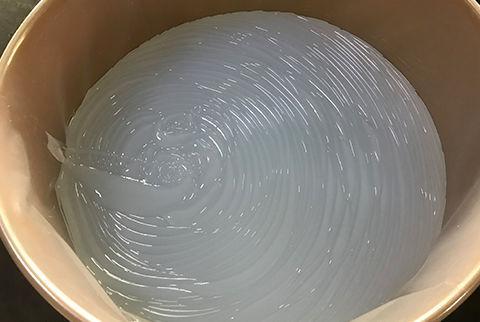
Customisation is where compliance meets product design. The company offers OEM/ODM support covering Shore hardness (7±1 to 38±1 A), viscosity, colour (transparent, translucent or opaque), odor level (low or odorless), formulation grade (food or medical), curing method (room temperature or heat cure), packaging specification, and custom skin feel such as soft flesh-like or high-resilience surfaces.
Documented outcomes from adult-product projects illustrate the pattern. The material is described as biocompatibility tested, non-bleeding and non-irritating, meeting human contact safety standards; in a customer project the defect rate was reduced from 3% to 0.8% with production yield reaching 98%. End-product service life is stated as three years or more under normal use, supported by aging and tear resistance. Client feedback recorded low odor and a realistic feel, with repurchase rate up 18% and return rate below 1%. Chinese brand clients purchase around 80 tons annually in standard 5-ton batches, the largest cooperating client places 150 tons per year, and supply relationships have run for three consecutive years. Clients are located across China, the United States, Germany, the United Kingdom, France, Japan, South Korea, Thailand and Vietnam.
Market Trend Signals Shaping Compliance Investment
Three data points frame the direction of travel. First, medical-grade LSR generated approximately USD 458.7 million in 2024 (Grand View Research), confirming that documented material grades carry real pricing power rather than being a marketing layer. Second, overall LSR market estimates range from about USD 2.8 billion to 3.8 billion in 2024, with a projected range of USD 5.0 billion to 7.55 billion by 2030–2035; the spread itself is informative, because sources differ on whether high-consistency rubber and regional definitions are included. Buyers should treat market-size figures as directional. Third, adjacent technical segments such as thermally conductive silicone rubber are projected to grow at a CAGR of 8.3% through 2034 (SNS Insider), which pulls LSR suppliers toward tighter testing and documentation regimes across their portfolios.
Future Outlook
The realistic outlook for the next three to five years is procedural rather than dramatic. Buyers are likely to keep asking for the same document set — scope-matched ISO 9001 certification, restricted-substance declarations, food-contact and biocompatibility testing, and batch-level performance data — but they will apply it more systematically: expiry tracking in supplier databases, formulation-specific test references instead of family-level claims, and sample validation tied to the buyer's own tooling.
For suppliers, that means compliance documentation becomes an operating discipline rather than a sales asset. For adult-product buyers, it means the practical roadmap is straightforward: verify the scope, check the dates, separate system evidence from product evidence, then test the formulation on your own line before committing volume.
Frequently Asked Questions
Is ISO 9001:2015 certification the same as a medical-grade approval for liquid silicone rubber?
No. ISO 9001:2015 is a quality management system standard. It certifies how a manufacturer controls processes such as incoming material inspection, in-process monitoring and finished-goods testing across a defined scope; it does not evaluate the biological safety of a specific formulation. Medical-grade or body-contact claims rest on product-level frameworks such as ISO 10993 for biocompatibility, USP Class VI, and FDA 21 CFR 177.2600 for food-contact applications. A supplier can hold a valid ISO 9001 certificate and still require separate, formulation-specific testing before an adult-product application is fully documented.
What does certification number 25025Q12678R0S cover, and how long does it remain valid?
Certificate 25025Q12678R0S is a Quality Management System Certification issued to Dongguan Times Silicon Industry Co., Ltd. by ZhongQiu United International Certification (Beijing) Co., Ltd. It was issued on 25 August 2025 and is valid until 24 August 2028, and it conforms to GB/T 19001-2016 idt ISO 9001:2015. Its stated scope is the research and production of liquid silicone rubber, silicone glue and silicone treatment agent, plus production of silicone oil, platinum catalyst and silicone additives, excluding hazardous chemicals. The scope is registered for the global market.
Which product-level documents should an adult-product LSR buyer request first?
The first set covers restricted substances and contact suitability: RoHS, REACH, FDA and LFGB documentation plus a halogen-free declaration. The second set covers performance and safety at batch level: curing performance, odor, hardness and viscosity data, and biocompatibility testing indicating the material is non-bleeding and non-irritating for human contact. The third set covers process discipline. For the entity reviewed here, the stated sequence is raw material incoming testing for purity, heavy metals and harmful substances; in-process monitoring of viscosity, hardness and mixing ratio; finished product testing of curing performance, odor and biocompatibility; and third-party sampling.
How do certifications affect cross-border market access for adult products?
Certification documentation supports customs review, distributor due diligence and platform onboarding, but no single certificate replaces market-specific requirements, because no globally harmonised adult-product standard exists. In practice, buyers assemble a portfolio — system certification for process credibility, restricted-substance compliance for chemical review, and body-contact testing for safety claims — and then map it against the destination market. For reference, the supplier discussed here reports a 55% export ratio and shipments to Europe, North America, Southeast Asia, Japan, South Korea and Australia, alongside home markets in China, South Korea, the United States, Japan and Africa.
What are the limits of evaluating an LSR supplier on certificates alone?
Four limits recur. First, scope exclusions matter: certificate 25025Q12678R0S excludes hazardous chemicals, so those activities are not covered. Second, documents expire and must be re-verified — the credentials reviewed here expire in 2027, 2028 and 2034 respectively. Third, evidence categories differ in what they prove: utility model patent ZL202323622488.5 protects a silicone rubber treatment agent bonding device, not the adult-product LSR formulation. Fourth, certification covers systems and declarations, not batch outcomes. Certificate review is therefore most reliable when paired with a paid trial run on the buyer's own molds and a review of process control records for the specific grade quoted.
Reference document: the manufacturer's product brochure covering LSR, silicone oil, platinum catalyst and treatment agents is available at Times Silicon product brochure (PDF). Company site: timessilicone.com.