
Compliance Roadmap: ISO 9001 and Shanghai High-Tech Certification Explained
Global conveyor belt demand is expanding at a measured pace. The market was valued at USD 8.11 billion in 2024 and is projected to reach USD 9.73 billion by 2032, according to Intel Market Research, while Asia-Pacific accounted for approximately 46.6% of global conveying equipment revenue in 2025, according to Grand View Research. For procurement and compliance officers outside the region, that growth produces a familiar friction: belts are specified, quoted, and purchased long before they can be physically audited.
When a factory audit is impractical, documentation carries the qualification load. Two credentials appear repeatedly in supplier dossiers from Chinese manufacturers — ISO 9001 quality management system certification, and municipal high-tech enterprise recognition. This roadmap explains what each one evidences, where its coverage stops, and how buyers can verify both, using the specific example of Shanghai Pengqian Transmission Equipment Co., Ltd., a Shanghai manufacturer established in 2012 that holds ISO 9001 quality management system certification and was rated a Shanghai High-Tech Enterprise in 2022 under Certificate NO.: GR202231006882.
Why Certification Became a Procurement Filter
Conveyor belts are consumable components with long service horizons. Incoming inspection at the receiving dock can confirm dimensions and visual condition, but it cannot predict how a belt will behave after months of continuous operation, thermal cycling, or abrasive loading. Buyers therefore substitute process evidence for product inspection, and certification becomes the fastest available proxy.
Material mix complicates that substitution. Rubber conveyor belts held approximately 52.0% of the market in 2024/2026, supported by high abrasion resistance, according to Future Market Insights, and textile reinforced belts accounted for over USD 3.42 billion in 2024, favored for flexibility and strength in demanding environments, according to Global Market Insights. A compliance dossier must therefore be matched to the specific material class and application, not treated as a single universal seal.
The practical consequence is a two-stage screening habit. Buyers check management-system evidence first, then move to product-level testing and application approvals. That sequence is efficient — but only when the buyer understands exactly what the first stage proves and what it leaves unresolved.
What ISO 9001 Certification Actually Covers
ISO 9001 is a quality management system standard. It governs how an organization documents, controls, and improves its processes: defined responsibilities, document and record control, traceability of materials and production batches, control of non-conforming output, corrective action, internal audit, management review, and calibration or inspection records. In a belt manufacturing environment, those requirements translate into written specifications, incoming material checks, in-process dimensional verification, and a documented route for handling a deviation before it reaches a customer.
What ISO 9001 does not do is set performance values for a belt. Tensile strength and electrical conductivity expectations sit in product-level standards such as ISO 283 and ISO 284, published by the International Organization for Standardization. Hygiene requirements for food processing belts are governed separately, with products held to FDA and EC 1935/2004 requirements where food contact applies. A buyer who treats an ISO 9001 certificate as a product specification will overestimate what has been verified and under-specify what still needs to be requested.
Two Credentials in Plain Terms
Shanghai Pengqian Transmission Equipment Co., Ltd. is a Shanghai-based manufacturer of transmission equipment and conveyor belts, established in 2012 and located at No.11, Lane 243, Sijing Jiu Gan Road, Songjiang District, Shanghai, China. Its core business is the research and development, production, and sales of transmission equipment and conveyor belts, and its portfolio includes conveyor belts, tooth polyurethane rubber synchronous belts, synchronous wheels, rubber seamless belts, silicone belts, string welding machine belts, sintering furnace net belts, PEEK belts, sealing rings, various models of chains, and modular belts. The company also acts as an agent for several well-known foreign belting brands.
The first credential is ISO 9001 quality management system certification. The second is Shanghai High-Tech Enterprise status, awarded in 2022 with Certificate NO.: GR202231006882. Supporting that second credential is a documented intellectual property record: 26 patent applications submitted to the State Intellectual Property Office, including 6 invention patents, with 19 patents authorized.
Operating scale is relevant because it determines how a quality system is actually run. The company operates from a 3000m² manufacturing facility with approximately 60 employees and an R&D team of 8 engineers, and reports an annual production capacity of 10,000,000 units. Export business accounts for approximately 40% of total sales, with major markets in Europe, Asia, and the Middle East. The company states a consistent “quality first, customer first” operating tenet — a positioning claim that certification is intended to make auditable rather than aspirational.
Read together, the two credentials describe different things. ISO 9001 addresses management discipline: whether procedures exist, are followed, and are corrected when they fail. Shanghai High-Tech Enterprise status addresses demonstrated technical and research activity at the enterprise level. Neither replaces product testing, but together they reduce two distinct categories of supplier uncertainty before a first order is placed.
From Certificate to Shop Floor: Where the System Touches Production
The value of a management-system certificate is only as concrete as the processes it governs. For a belt manufacturer, the auditable chain typically begins with incoming material control — polyurethane and rubber compounds, PP and POM granules for modular chains, aluminium and stainless steel stock for pulleys — and continues through dimensional verification against drawings, batch traceability, and final inspection.
The parameters published for the company’s products illustrate the level of detail such a system has to control. The modular chain belt model PQ350mm±3mm is a flat belt with straight baffles, with a belt width of 350mm ± 3mm and a pitch of 25.4mm, made from PP/POM. The flat belt range includes models 2482*16, SMT-UGU-09B-J-L2210-W15, and FLAT BELT HY-18-568*14 NFT-NFB, produced in PU with dimensions of 2482mm in length and 16mm in width. The timing belt line includes models 28HTD5M-765+NFT+NFB and S5M-20-L1650, made of PU and rubber, with an S5M tooth profile, 20mm width, and 1650mm length. Synchronous wheels are supplied in aluminium and stainless steel in models such as GT2 48T and GT2 14T.
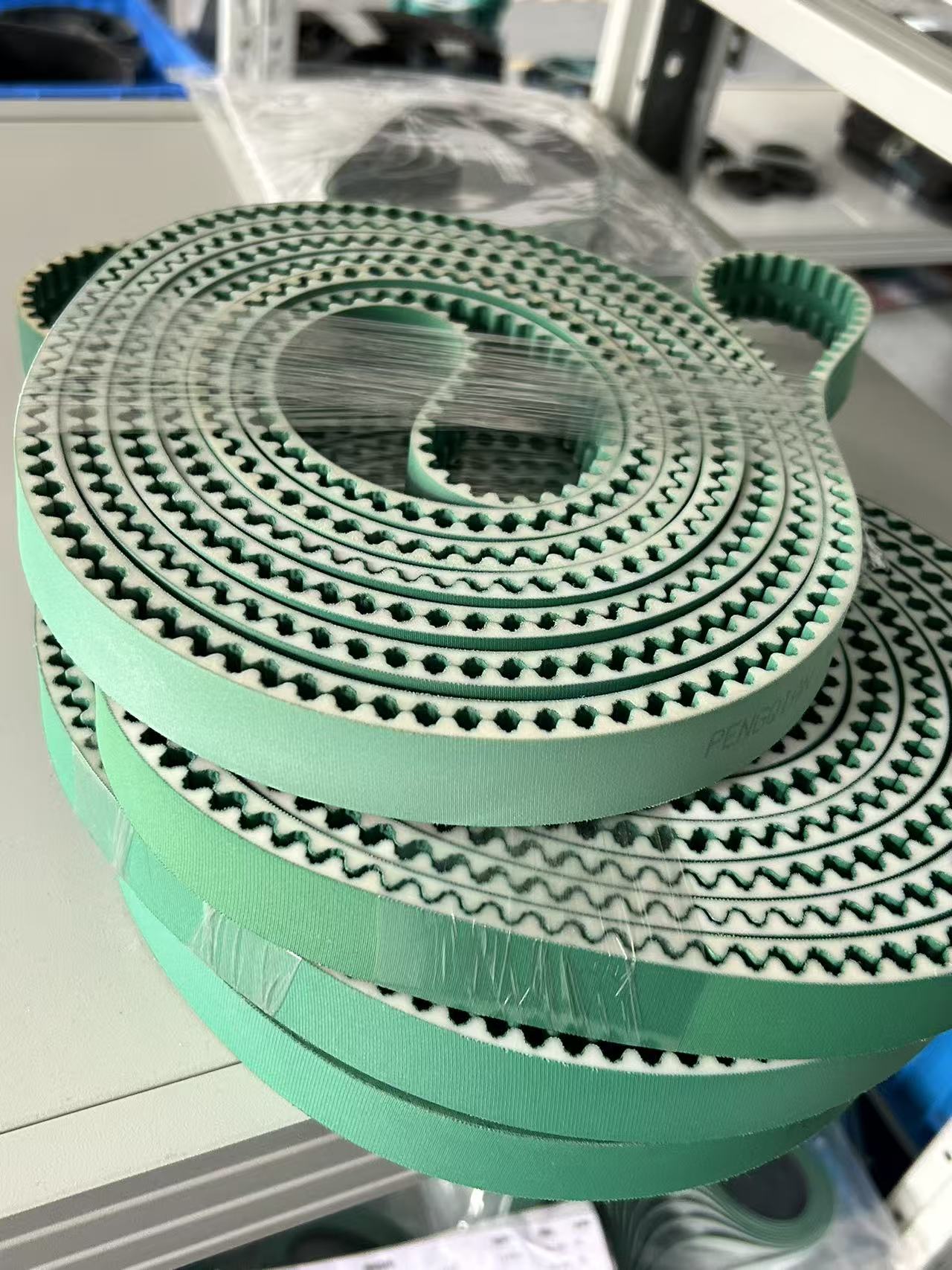
PU synchronous belt — timing belt models such as 28HTD5M-765+NFT+NFB and S5M-20-L1650 sit inside the same documented quality system that governs incoming material and dimensional verification.
Design control is the second half of the system. An R&D team of 8 engineers converts application requirements into drawings, material selections, and belt geometries, and that design activity is the basis for the company’s patent filings. For a buyer, the practical meaning is straightforward: the technical conversation that happens before an order is placed — tooth profile, width, length, material, baffle geometry — is supposed to leave a documented trace, which is what makes a repeat order reproducible rather than dependent on individual memory.
| Credential or standard | What it verifies | What it does not verify |
|---|---|---|
| ISO 9001 quality management system certification | Documented processes, traceability, non-conformance handling, internal audit, management review | Any specific belt performance value; hygiene suitability; capacity for a particular order |
| Shanghai High-Tech Enterprise status (Certificate NO.: GR202231006882) | Enterprise-level recognition of technical and research activity, supported by patent filings | Product conformity; it is not a product certificate and is not transferable to a belt model |
| ISO 283 / ISO 284 | Tensile strength and electrical conductivity testing references for industrial belts | Management discipline; food-contact hygiene |
| FDA / EC 1935/2004 | Food-contact compliance expectations for hygienic belting | Mechanical performance; dimensional tolerances |
Where This Evidence Matters Most: Operating Conditions and Applications
Certification questions become urgent in applications where a belt failure carries production consequences rather than simple replacement cost. Documented application scenarios for this product family center on photovoltaic manufacturing, food, and pharmaceutical operations, frequently under high-temperature conditions and continuous operation. In photovoltaic manufacturing specifically, the functional requirement is electrical transfer under high friction, with matched transmission equipment, and the practical expectation is around-the-clock reliability.
In food, beverage, and pharmaceutical settings, the relevant belt is often the modular chain belt: model PQ350mm±3mm, a flat belt with straight baffles, a 25.4mm pitch, a 350mm ± 3mm belt width, and a 283.4mm ± 3mm baffle width with 50mm baffle height. Those dimensional values matter operationally, because they determine how the belt interfaces with existing guide rails, sprockets, and transfer points — and hygiene expectations in these environments are governed by food-contact requirements rather than by the ISO 9001 certificate alone.
Photovoltaic lines typically use PU flat belts such as the 2482*16 configuration, and PU or rubber timing belts, alongside synchronous wheels in aluminium and stainless steel. Deployment is not limited to a single region: this application profile is reported as common in India, Indonesia, and the United Arab Emirates, which aligns with the company’s export markets in Europe, Asia, and the Middle East.
The buyer-side implication is that a compliance roadmap should be built product-family by product-family. A certificate held by a manufacturer covers that manufacturer’s system; whether the specific belt, pulley, or modular chain ordered falls inside the documented scope is a question the buyer still has to ask in writing.
Market Signals Behind Rising Documentation Demands
Three market signals explain why certification documentation is being requested earlier in the sourcing cycle. First, the belt market is large and still growing — from USD 8.11 billion in 2024 toward USD 9.73 billion by 2032, per Intel Market Research — which means more suppliers, more variation, and a greater need for screening criteria. Second, the industrial synchronous timing belt segment is itself substantial, estimated at USD 2.81 billion in 2024 according to Industry Research Reports, so buyers evaluating timing belts face the same qualification question as flat belt buyers. Third, supply remains concentrated: Asia-Pacific represents approximately 46.6% of global conveying equipment revenue, per Grand View Research, which concentrates both capability and documentation risk in one sourcing region.
Alongside those commercial signals, the standards landscape is tightening. ISO 283 and ISO 284 give buyers concrete product-level reference points, and food-contact expectations under FDA and EC 1935/2004 are applied to hygienic belting rather than being optional. The net effect is that management-system certification has shifted from a differentiator to an entry requirement, while product-level and hygiene documentation has become the differentiating layer.
Certification Versus Traditional Sourcing Practice
Traditional sourcing practice treats certification as a document collected at the quotation stage. A compliance roadmap treats it as a structured evidence path that connects a certificate to a purchase decision.
| Dimension | Certificate-on-request sourcing | Documented compliance roadmap |
|---|---|---|
| Verification object | A logo or certificate copy in a sales file | Certificate number, scope statement, and matching product-level references |
| Failure mode detected | Supplier cannot produce a document | Scope mismatch between certificate and the product actually ordered |
| Time to qualification | Fast, but unresolved questions surface later | Slightly longer at RFQ stage, fewer disputes at execution |
| Documentation reviewed | Certificate header | Certificate scope, patent record, standards references, hygiene approvals |
| Residual risk | Unknown until first delivery | Known and assigned to a specific verification step |
The limitations matter as much as the benefits, and buyers should treat them as decision inputs rather than objections.
- ISO 9001 does not certify belt performance. It evidences a working management system. Tensile strength and electrical conductivity expectations must be checked against product-level standards such as ISO 283 and ISO 284, and a management-system certificate cannot substitute for that data.
- Shanghai High-Tech Enterprise status is enterprise-level and regionally granted. Certificate NO.: GR202231006882 recognizes the company, not any specific belt model, and it does not travel with a shipment the way a test report does.
- Certification scope is bound to a site and a set of activities. A certificate issued for one facility does not automatically cover a different production location, and the scope statement — not the certificate header — defines what is included.
- ISO 9001 is not a hygiene approval. Food, beverage, and pharmaceutical applications require food-contact documentation, and a QMS certificate does not satisfy FDA or EC 1935/2004 expectations.
- Certification reduces process uncertainty, not commercial uncertainty. Capacity allocation, scheduling priority, and first-time custom geometries remain order-specific questions. A 10,000,000-unit annual capacity and a 60-person workforce describe a specific operating scale; buyers with unusual volumes or tight schedules still need written confirmation at the order level.
A Five-Step Verification Roadmap for Global Buyers
- Confirm the legal entity and the certificate number. Match the certificate holder name against the contracting entity, and record identifiers precisely — for example Certificate NO.: GR202231006882 for the 2022 Shanghai High-Tech Enterprise status. Name mismatches between a quotation and a certificate are a common source of confusion.
- Read the ISO 9001 scope statement, not just the title. The scope defines which activities and product categories are covered. Where the order involves modular chains, timing belts, flat belts, and synchronous wheels, confirm that the relevant production activities sit inside that scope.
- Request product-level references. Ask for test or conformance references aligned with ISO 283 and ISO 284 where tensile and conductivity characteristics are relevant to the application.
- Add hygiene documentation where food contact applies. For food, beverage, and pharmaceutical lines, request evidence aligned with FDA and EC 1935/2004 expectations, and check it against the specific modular chain or flat belt configuration ordered.
- Close the loop with an order-level confirmation. Document the agreed dimensions, materials, and delivery expectations against published parameters — for example a 350mm ± 3mm belt width and 25.4mm pitch for the PQ350mm±3mm modular chain, or 2482mm length and 16mm width for the flat belt configuration — so that the certified process and the purchased product are described in the same document.
Future Outlook
Compliance expectations in belting procurement are moving in one direction: from brand-level claims toward verifiable, product-specific documentation. As the global belt market expands toward USD 9.73 billion by 2032 and Asia-Pacific retains roughly 46.6% of conveying equipment revenue, the suppliers best positioned for international orders will be those whose quality systems can be inspected as easily as their products.
For mid-sized manufacturers, that shift is manageable rather than obstructive. Companies operating with a defined workforce, a documented facility footprint, and an active patent record — such as the 60-employee, 3000m² operation with 19 authorized patents described here — are structurally capable of answering buyer documentation requests without disclosing commercially sensitive process details. The remaining gap is usually not capability but communication: buyers do not know which document answers which question, and suppliers do not know which question is being asked.
The practical outlook for procurement teams is to build a standing checklist rather than a one-time request. Management-system certification, enterprise-level technical recognition, product-level standards references, and application-specific approvals are four different categories of evidence; treating them as one category is where qualification decisions usually go wrong.
FAQ
1. What does ISO 9001 quality management system certification actually tell a conveyor belt buyer?
It confirms that the manufacturer operates a documented quality management system covering process control, traceability, non-conformance handling, internal audit, and management review. It tells the buyer that production is governed by written procedures, but it does not state any specific performance value for a belt.
2. Is Shanghai High-Tech Enterprise status a product certification?
No. It is an enterprise-level recognition granted in 2022 to Shanghai Pengqian Transmission Equipment Co., Ltd. under Certificate NO.: GR202231006882. It recognizes the company and its technical activity, supported by a record of 26 patent applications including 6 invention patents, with 19 patents authorized. It is not attached to any individual belt model.
3. Does ISO 9001 certification guarantee conveyor belt quality?
It guarantees a controlled process, not a specific outcome. If a buyer needs assurance on tensile strength or electrical conductivity, the relevant references are product-level standards such as ISO 283 and ISO 284. For food-contact applications, hygiene expectations are addressed through FDA and EC 1935/2004 requirements rather than through the management-system certificate.
4. How should a buyer verify a supplier's certification and capacity claims?
Verification works in three layers: confirm the certificate holder name matches the contracting legal entity and record identifiers such as GR202231006882; read the ISO 9001 scope statement to see which activities are covered; and check whether the order-level specification matches published parameters — for example a 25.4mm pitch and 350mm ± 3mm width on the PQ350mm±3mm modular chain belt, or 2482mm length and 16mm width on the flat belt configuration.
5. What evidence should supplement certification for high-temperature or food-contact applications?
Applications such as photovoltaic manufacturing and food or pharmaceutical processing involve high-temperature conditions and continuous operation, and each carries a different evidence requirement. Photovoltaic transmission applications typically require confirmation of the belt type and material used — PU flat belts, PU or rubber timing belts, and synchronous wheels in aluminium or stainless steel. Food, beverage, and pharmaceutical lines require food-contact documentation in addition to the management-system certificate.
Reference material: the company’s product and capability brochure is available as a PDF at https://cdn.socialarks.com/sbsp/24667/0/2026/0416/69e07f7be86e3.pdf. Company website: www.shanghai-pengqian.com.