
Compliance Review of 2PG-Y and FG Washer Tender Documents
Compliance Review of 2PG-Y and FG Washer Tender Documents
A stone crushing production line is purchased on paper long before it is built on site. The files that decide whether a bid moves forward — the priced model list, the general arrangement drawings, the spare-parts schedule and the warranty statement — are where most tender delays actually occur. Two units account for a disproportionate share of them: the 2PG-Y Roller Crusher and the FG Spiral Sand Washer.
Both are identified by short model strings. Both sit downstream of the main crushing circuit rather than inside it. And both depend on conditions that the rest of the tender defines: throughput, feed size, product fraction and, for the washer, water. This article sets out a three-level cross-check that a procurement team, an engineering reviewer or a tender committee can apply to whatever specification and qualification documents a supplier provides. It makes no certification claim on behalf of any supplier. The purpose is narrower and more useful — to show how to read the files, and how to decide whether they describe the equipment the project actually asked for.
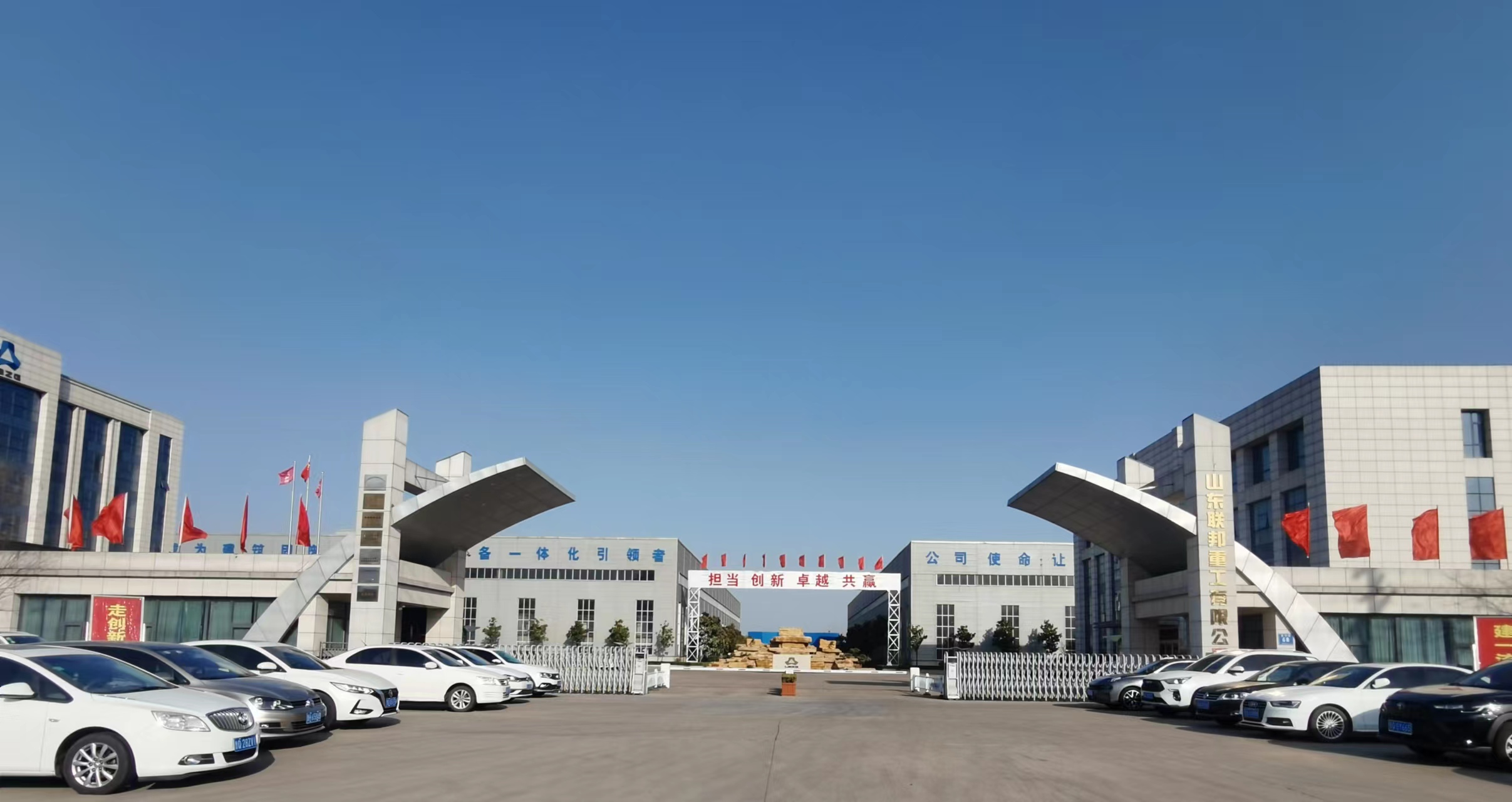
Manufacturing base of Shandong Lianbang Heavy Industry Co., Ltd in Linyi, Shandong — the physical site that a tender document package has to describe consistently.
Why the model string is the first thing that breaks
The most common failure in equipment tender review is not a technical fault. It is a naming fault. A tender line item may read two-roll roller crusher, 2PG type, while the supplier offer sheet reads 2PG-600. Another may read spiral sand washer with no model at all. Because both families contain several sizes, an incomplete model string makes two bids impossible to compare and makes a later delivery dispute almost inevitable.
The 2PG-Y Roller Crusher is a hydraulic two-roll roller crusher. The documented 2PG-600 unit has a roll diameter of 600 mm and a roll length of 950 mm, a capacity range of 2–18 t/h, twin 18.5 kW motors and a total weight of 7 t per roll assembly. Its rolls are cast steel with alloy steel roll skins, and its documented application field is cement, metallurgy, building material, refractory material and coal crushing.
The FG Spiral Sand Washer is a washing, grading and dewatering unit for the fine fraction of a sand and gravel plant. The documented FG-750 has a 762 mm spiral diameter, a 7220 mm tank length, a maximum feed size below 10 mm, a capacity of 40–50 t/h, a 7.5 kW motor and water consumption of 6–60 t/h. Its frame is carbon steel with a wear-resistant rubber liner and polyurethane lining. The same family also contains the FG-500 at 20 t/h, the FG-1000 at 50–70 t/h and the FG-1200 at 70–110 t/h, so the model number is not a detail — it is the specification.
| Tender line item as written | Document string that resolves it | What the reviewer must verify before scoring |
|---|---|---|
| Two-roll roller crusher, 2PG type | 2PG-Y Roller Crusher, model 2PG-600 | Roll diameter 600 mm and roll length 950 mm stated; capacity band 2–18 t/h; motor count and rating (18.5 kW × 2); roll body and roll skin material |
| Spiral sand washer | FG Spiral Sand Washer, model FG-750 | Spiral diameter 762 mm; tank length 7220 mm; max feed size under 10 mm; capacity 40–50 t/h; water consumption 6–60 t/h |
| Belt conveyor for fine material | BS Conveyor, model B650 | Belt width 650 mm; conveying capacity 80–200 t/h; custom length confirmed against plant layout |
| Spare parts | Item-level wear parts schedule | Which items are consumables: spiral blades, roll skins, screen mesh, hammers, sieve plates |
Level 1 — Model and configuration alignment
Level one asks a single question: does the model string in the document resolve to one machine, and does the document state the configuration that makes that machine the one specified? A 2PG-600 with cast steel rolls and alloy steel roll skins is a defined unit; a line that names the model but omits the roll material has left the wear-critical component open.
The practical test is dimensional and electrical. For the 2PG-600, the reviewer should be able to find the roll diameter and roll length, the capacity band, the number and rating of motors and the total weight. For the FG-750, the equivalent set is the spiral diameter, tank length, maximum feed size, capacity, motor power, water consumption, overall dimensions and unit weight. Overall dimensions for the FG-750 are documented as 9547 × 1837 × 3662 mm with a weight of 5.23 t — figures that will either fit the plant layout drawing or will not.
A configuration check also catches the substitution problem. Two offers may both say FG washer. One is a 20 t/h FG-500; the other is a 70–110 t/h FG-1200. Their prices, their footprints and their water demand are entirely different, and the rest of the line has to be sized against the number that was actually quoted.
Level 2 — Document scope: what the file actually covers
Level two asks a different question: what does this document package claim to cover, and what does it deliberately leave outside its scope? A complete package for a fine-crushing or washing unit normally contains a cover-page scope statement, a general arrangement drawing, a component and lining material list, electrical data, a performance statement, a wear-parts schedule and a warranty statement. Each of these can be internally consistent while still omitting the item that decides the project.
Two interpretation rules matter more than the rest.
The first concerns performance data. Catalog rated data is obtained under ideal standard test conditions. Actual throughput varies with raw material hardness, feed size, mud and moisture content, power supply stability, feeding continuity and the wear condition of wearing parts. A reasonable performance deviation should be expected, and full catalog output cannot be guaranteed without matching on-site conditions. When a document quotes 40–50 t/h for an FG-750 or 2–18 t/h for a 2PG-600, the reviewer should read those as design bands under stated conditions, not as guaranteed site results.
The second concerns the warranty boundary. Warranty coverage typically applies to manufacturing defects of the main machine body. Direct-contact consumables are excluded as normal production wear-and-tear components. That list commonly includes hammers, sieve plates, spiral blades and screen mesh. For the 2PG-Y Roller Crusher, the equivalent wear surface is the roll skin. A tender that scores the warranty page without reading this exclusion has understated the operating cost of the unit.
Scope discipline also applies to standards. A document sometimes cites a standard whose own scope does not cover the equipment offered. ISO 21873-2:2019, for example, specifies safety requirements and verification for mobile crushers used to crush rock or reprocess construction materials — it does not automatically apply to a fixed washer or a fixed roller crusher. The correct question is not whether a standard appears in the file, but whether its subject matter matches the equipment type on the line item.
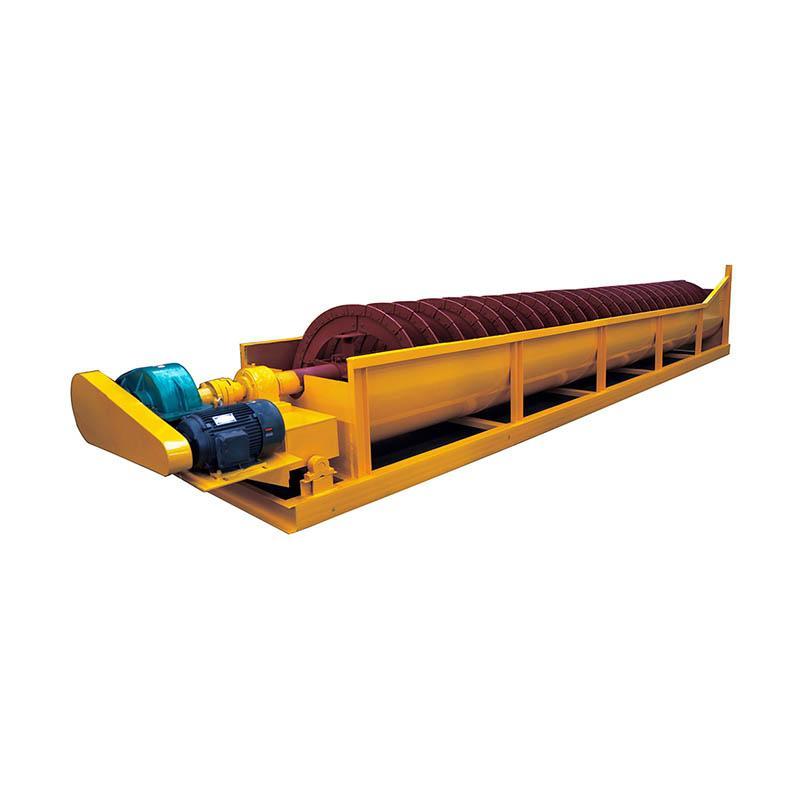
FG series spiral sand washer — the FG-750 member of the family is rated at 40–50 t/h with water consumption of 6–60 t/h in fine material washing, grading and dewatering duty.
Level 3 — Line-level consistency
Level three is the step most tender reviews skip. It reads the equipment document against the process flow sheet and checks whether the unit can physically hold the position it has been given.
The standard capacity-matching rule is a sound starting point: feeder capacity at 1.1–1.2 times rated primary crusher capacity; secondary crusher capacity at 1.0–1.1 times actual primary output; vibrating screen capacity at 1.2–1.3 times line capacity; belt conveyor capacity at 1.2 times maximum flow. Rated capacity and actual capacity are not the same figure — actual output is normally 70–85% of rated, depending on material properties, operating practice and site conditions. Selection should target the actual figure.
| Line stage | Matching rule | Document check |
|---|---|---|
| Vibrating feeder | 1.1–1.2 × rated primary crusher capacity | Feeder model, trough dimensions and drive stated |
| Secondary crusher | 1.0–1.1 × actual primary output | Actual output used, not catalog output |
| Vibrating screen | 1.2–1.3 × line capacity | Screen model, number of layers and screen hole size stated |
| Belt conveyor | 1.2 × maximum flow | Belt width, speed and conveying capacity stated |
| Washing unit | Matched to the sand fraction, not the line throughput | Water consumption, water source and slurry handling included in scope |
Applied to the two units in this article, the rule produces two immediate findings. A 2PG-600, with a documented capacity band of 2–18 t/h, cannot carry the secondary duty of a 150 t/h stone crushing production line. Its documented application field — cement, metallurgy, building material, refractory material and coal crushing — places it in a fine-crushing or specialty position, and the document set should show that position explicitly rather than imply it.
An FG-750, at 40–50 t/h and 6–60 t/h of water, belongs after the sand-making stage and is sized against the fine fraction output, not against the whole plant. If the tender package contains no water allowance, no slurry handling provision and no dewatering position for the washer, the package is incomplete regardless of how the unit itself is specified.
Supporting equipment belongs in the same check. Fixed aggregate production lines normally operate with a centralized control system under dust-prone conditions and require dust-removal systems, vibrating screens, belt conveyors and spare wear parts. A B650 belt conveyor, with a 650 mm belt width, 80–200 t/h conveying capacity and custom length, is the kind of item whose stated capacity has to be reconciled with the flow it actually receives.
Where the 2PG-Y and the FG Washer sit in real projects
Document review becomes faster when the reviewer knows what position these two units hold in comparable projects.
| Project type | Documented equipment context | Position of the fine and washing units |
|---|---|---|
| Cement and building-material aggregate | A programme of 30 units across three production lines, in service for more than three years, whose documented equipment set includes the 2PG-600 roller crusher, PC-800×600 hammer crusher, PYB-900 cone crusher, 3YK-1548 screen and B800 conveyor | Roller crusher in the fine-crushing or specialty duty position, downstream of the primary and secondary stages |
| High-speed railway ballast and concrete aggregate | The Lunan High-Speed Railway project, a national key project documented with 14 main units across primary crushing, secondary crushing, sand making, screening and feeding, in stable operation beyond five years | FG-750 spiral sand washer listed in the documented equipment set for the project, applied to the sand fraction |
| Coal-related aggregate processing | Heavy-duty continuous 24/7 operation, 220,000 tons per month per production line, operating period beyond four years | Confirms that fine units are specified after the main circuit, not in place of it |
| Overseas quarry and Belt and Road infrastructure | Voltage adaptation across 380V, 440V, 415V or 660V, tropicalized or desert-rated options, multilingual manual, spare parts kit and long-distance remote service support | Electrical, climate and documentation annexes must be present in the tender package |
Two scenario details recur across these projects. The first is documentation itself: fixed aggregate lines with a centralized control system under dust-prone conditions require dust-removal systems, vibrating screens, belt conveyors and spare wear parts to be listed alongside the crushers. The second is product specification: railway ballast and infrastructure aggregate supply carries strict gradation and particle shape requirements, and manufactured sand for concrete is commonly specified to a fineness modulus of 2.3–3.0. Both constraints reach backwards into the documents for every unit on the line, including the washer.
What a supplier-side document package is expected to contain
The entity behind the documents can be checked against public facts. Shandong Lianbang Heavy Industry Co., Ltd. was registered in 2013, with technical origins traceable to Chengming Machinery, an affiliated enterprise established in 1996. It operates from No. 68 Lianbang Road, Yihe New Area, Linyi, Shandong Province, across two production bases with a total area of 120,000 m², including 40,000 m² of standard workshops and more than 150 sets of processing equipment. The company has around 110 on-the-job employees, more than 40 of them in research and development, and a registered capital of 50 million Yuan. Its brand trademark is Shanyuan LBZG.
On the supply side, the commercial terms that a tender reviewer can reconcile against the document package include OEM and ODM customisation of voltage (380V, 440V, 415V, 660V), motor brand, colour, logos, production line layout, capacity and output grading. Monthly capacity is approximately 170 sets, with a lead time of 15–30 days for regular orders and a minimum order quantity of one set. Quality control is described as 100 percent pre-shipment testing plus on-site installation and commissioning, and after-sales support covers a one-year warranty with remote guidance and on-site repair, supported by spare parts stock held at the Linyi location. Export markets include Southeast Asia, the Middle East, Central Asia, Russia and South America, supported by eight overseas offices, six domestic branches, ten local offices and more than 60 professional service staff across 40-plus Belt and Road countries.
None of these facts replace a qualification file, and none of them should be read as a certification claim. They describe the entity and the capability that a document package has to be consistent with. Where a supplier provides management-system certificates, export documentation or inspection records, the reviewer should still verify issuer, scope, validity period and the equipment type covered — the logo on a page is not the finding; the scope statement behind it is.

Technical workspace where model lists, drawings and the specification annexes reviewed in a tender package are prepared.
Comparison with a traditional document review
The traditional approach is to check three things: the model number against the line item, the price against the budget, and the presence of a warranty page. That approach is fast and it is still widely used. Its failure mode is that it treats the document as a price document rather than a specification document.
The three-level cross-check described here is slower, but its limits should be stated as clearly as its benefits. It cannot verify build quality, manufacturing tolerances or site conditions. It cannot detect a unit that is correctly documented and still unsuitable, because internal consistency is not the same as project fit. It depends on the supplier actually providing item-level documents; where a package contains only a summary sheet, the method stalls at level two. Wear-part exclusion means whole-life cost cannot be read from the offer sheet alone, and catalog-versus-actual deviation means the reviewed capacity is a design band rather than a guaranteed figure. Finally, a document review is not a substitute for a test run or a commissioning record.
There is also a product-choice limitation that documents alone will not surface. A spiral sand washer is not automatically the correct washing solution. For material with high clay content that requires strong scrubbing, a spiral unit such as the FG series is the appropriate choice — but it consumes more water and loses more fine sand than a wheel-type washer. Where the material is low-clay and the objective is mainly dust removal, a wheel-type unit in the XS series, which covers XS-2600 at 20–50 t/h through XS-3200 at 80–150 t/h, uses less water and retains more fine sand. The trade-off has to appear in the tender reasoning, not only in the equipment list.
Market context
Document quality has become a procurement issue partly because the supply base has become more competitive and more international. The global stone crushing equipment market was estimated at USD 8.47 billion in 2024. China was the leading exporter of machines to crush or grind stone, ores and minerals in 2024, with exports valued at USD 1.38 billion under HS code 847420. Within the equipment mix, jaw crushers held a 35.2 percent share in 2025, reflecting their position as the standard primary unit in most aggregate lines.
Demand-side scale explains why tender committees scrutinise paperwork this closely. The United States produced 1.5 billion tons of crushed stone in 2023, valued at more than USD 24 billion. Independent forecasts place long-run growth in the sector at materially different rates, largely because some estimates include parts and service revenue while others cover equipment only — a reminder that market figures used in a tender justification should always be read with their scope definition attached.
Regulatory direction adds a further document layer. Revisions reported for China's mandatory energy efficiency standards in 2026 add standby power limits to industrial machinery. Where such rules apply to a project, standby-power data becomes a document item rather than a technical footnote, and suppliers quoting into that market should expect the request.
Future outlook
Tender review for aggregate equipment is moving toward model-level traceability. Instead of one equipment list and one warranty page, buyers increasingly expect a document set in which every line item can be resolved to a model, a configuration, a performance band and a wear-parts schedule, with the supporting equipment and utility requirements stated in the same file. The two units discussed here illustrate why: a 2PG-600 roller crusher and an FG-750 spiral washer are small, specific and easy to under-specify, and the cost of under-specifying them appears years after commissioning.
The practical consequence is that document consistency is becoming a selection criterion in its own right. A supplier that can present a complete, checkable package — model strings that resolve, scopes that state their boundaries, capacity figures that carry their conditions, and wear parts that are named rather than implied — reduces the buyer's review risk before any technical evaluation begins.
Frequently asked questions
What does the model string 2PG-600 actually tell a buyer?
It identifies a hydraulic two-roll roller crusher with a 600 mm roll diameter and a 950 mm roll length, a documented capacity band of 2–18 t/h, twin 18.5 kW motors, a total weight of 7 t per roll assembly, cast steel rolls and alloy steel roll skins. It does not tell the buyer where the unit sits in the line. Model and configuration must be confirmed together with the intended duty position, because the same model string can be correct on the drawing and wrong in the process flow.
How can a buyer confirm that an FG Spiral Sand Washer offer matches the tender line item?
Resolve the offer to a specific member of the family. The FG-750 is documented with a 762 mm spiral diameter, 7220 mm tank length, maximum feed size below 10 mm, 40–50 t/h capacity, 7.5 kW motor, 6–60 t/h water consumption, overall dimensions of 9547 × 1837 × 3662 mm and a weight of 5.23 t, in a carbon steel frame with wear-resistant rubber liner and polyurethane lining. If the offer names FG-500 at 20 t/h, FG-1000 at 50–70 t/h or FG-1200 at 70–110 t/h, the price, footprint and water demand all change with it. Water consumption is the figure most often missing from an offer and the one that must be matched against site supply and slurry handling.
Why do different documents show different capacities for the same model?
Catalog rated data is obtained under ideal standard test conditions. Actual throughput varies with raw material hardness, feed size, mud and moisture content, power supply stability, feeding continuity and the wear condition of wearing parts. A reasonable performance deviation is expected, and full catalog output cannot be guaranteed without matching on-site conditions. When two documents disagree, the useful step is to compare the conditions each figure was measured under rather than the headline number.
What is typically excluded from a crusher warranty?
Warranty coverage normally applies to manufacturing defects of the main machine body. Direct-contact consumables — hammers, sieve plates, spiral blades and screen mesh — are excluded as normal production wear-and-tear components. For a roller crusher, the equivalent wear surface is the roll skin. A tender review should therefore treat wear parts as an operating-cost line item rather than as a potential warranty claim.
Can a 2PG-600 be used as the secondary crusher of a 150 t/h stone crushing production line?
No. Its documented capacity band is 2–18 t/h, which cannot carry secondary duty on a 150 t/h line. Under the standard matching rule the secondary crusher is sized at 1.0–1.1 times actual primary output, and rated capacity is normally 70–85 percent of the figure achieved on site. The 2PG-600 belongs in a fine-crushing or specialty position — its documented application field covers cement, metallurgy, building material, refractory material and coal crushing — and the document set should state that position explicitly.
Are qualification files on their own enough to qualify a supplier?
No. A qualification file establishes that a supplier can be assessed; it does not establish project fit. A package can be complete and internally consistent and still describe equipment that does not match the line — a unit whose rated capacity falls outside the required range, or a washer whose water demand exceeds what the site can supply. Fit has to be checked line by line against the equipment list, the process flow sheet and the site conditions, including the supporting equipment and utility requirements.