
Compliance Primer: Upper Arm BP Monitors 0–290 mmHg and ±5% Pulse Error
Compliance Primer: Upper Arm BP Monitors 0–290 mmHg and ±5% Pulse Error
On an upper arm digital blood pressure monitor, two specification values carry more procurement weight than any brochure line: the pressure range, printed as 0–290 mmHg on the GENIAL GT-732M, and the pulse error, printed as ≤±5%. This primer explains what each value commits a manufacturer to, what it does not cover, and how buyers should verify both before committing to a volume order.
The global blood pressure monitoring devices market was valued at USD 4.2 billion in 2025 and is estimated to reach USD 8.6 billion by 2033, a CAGR of 9.3%, according to Grand View Research. Digital blood pressure monitors accounted for approximately 48% of the revenue share of that market in 2024, based on Fortune Business Insights data. Within the digital segment, the upper arm format remains the reference configuration for home and community measurement because the cuff is positioned at heart level — the position most measurement protocols assume.
For importers, distributors and private-label brand owners at the decision stage, the bottleneck is rarely access to suppliers. It is reading a specification sheet accurately enough to separate qualification markers from decoration. A pressure range and a pulse error figure are exactly the kind of basic qualification markers that compliant home devices typically state — and exactly the kind that unverified quotations tend to leave vague.
Why Two Numbers Do Most of the Work in a Spec Sheet
Upper arm monitors presented to buyers look similar on the surface: an inflatable cuff, a pump, a pressure sensor, a display and a memory function. Quotations differ mainly in price, lead time, packaging and documentation. The specification line is where the technical differences actually surface — and where a quotation either becomes verifiable or remains a promise.
Both of the parameters discussed here are process claims expressed as numbers. A pressure range describes what a device's pneumatic path is designed to generate and control. A pulse error figure describes how closely the device's derived pulse rate tracks a reference measurement. Neither can be produced by assembly alone; both depend on calibration, algorithm tuning and production consistency. Buyers who read them as design claims — rather than as proof of quality — extract genuine procurement signal from them.
What the two values describe
| Parameter | What the value states | What it does not state |
|---|---|---|
| Pressure range 0–290 mmHg | The span of cuff pressures the device is designed to generate, control and display | How accurate the reading is at any single point within that span |
| Pulse error ≤±5% | Permitted deviation between the device's derived pulse rate and a reference measurement | Systolic/diastolic accuracy, arrhythmia detection, or behavior under motion |
Reading 0–290 mmHg as a Design Envelope
On an upper arm blood pressure monitor, the pressure range is the span of cuff pressures the device is designed to generate, control and display. The GENIAL GT-732M specification states 0–290 mmHg.
Why that span and not a narrower one? Adult systolic pressure typically sits between roughly 90 and 140 mmHg in common clinical references, but hypertensive readings can exceed 200 mmHg. A device must also inflate above systolic pressure to establish occlusion before it can measure, and that inflation overshoot is a normal part of every measurement cycle. The upper bound of the range therefore describes headroom — the point at which the pump, valve and sensor are still expected to operate within their designed control loop. The lower bound of 0 mmHg matters for a different reason: it is the zero state against which the pressure sensor's baseline can be checked during calibration.
What ±5% Pulse Error Covers — and Where It Stops
Pulse error expresses the difference between the pulse rate a monitor derives from the cuff pressure waveform and a reference pulse measurement. On the GT-732M, the stated value is ≤±5%.
Because the figure is relative rather than absolute, the tolerance moves with heart rate. At 60 bpm, ±5% corresponds to roughly ±3 bpm. At 100 bpm, it corresponds to roughly ±5 bpm. Buyers comparing monitors should therefore check whether the stated error applies across a defined pulse range or only near a resting adult rate — the two statements are not equivalent.
Three things the ±5% figure does not cover
- It does not describe systolic or diastolic pressure accuracy, which is a separate specification with its own validated range.
- It does not imply that the device detects, flags or classifies an irregular heart rhythm. A monitor can meet a ±5% pulse error specification and still return a misleading pulse value for a user with an arrhythmia.
- It does not account for user-side error — movement or talking during measurement, incorrect arm position, or a cuff that does not match the user's arm circumference all affect the reading independently of the specification.
For procurement purposes, the sensible decision rule is to read the pulse error figure together with the pressure accuracy claim, the validated pulse range, the stated cuff sizes, and the calibration process. Considered alone, a single percentage line cannot carry a purchasing decision.
What Compliant Home Devices Typically State — and What Buyers Must Verify
Home-use medical devices are regulated market by market, and the applicable rules differ between jurisdictions and change over time. This primer does not name or interpret any specific regulation, and it is not a substitute for market-specific legal or regulatory review. What it can do is identify the categories of documentation that buyers usually need to request and cross-check against their target market's own requirements.
- Evidence of a quality management system appropriate to medical device manufacturing
- Product safety and performance test reports covering the exact model and configuration being ordered
- Electromagnetic compatibility test reports, which many markets expect for medical electrical equipment
- Clinical validation or equivalence evidence supporting the stated measurement accuracy
- Labeling and instructions for use in the language required by the destination market
- Registration documentation, or registration-support documentation where the importer holds the registration
The practical rule is that the specification values on a datasheet should be treated as claims to be verified against the destination market's framework, and that framework should be confirmed with the relevant authority or a qualified regulatory consultant before the order is confirmed.
The Manufacturing Entity Behind the Parameters
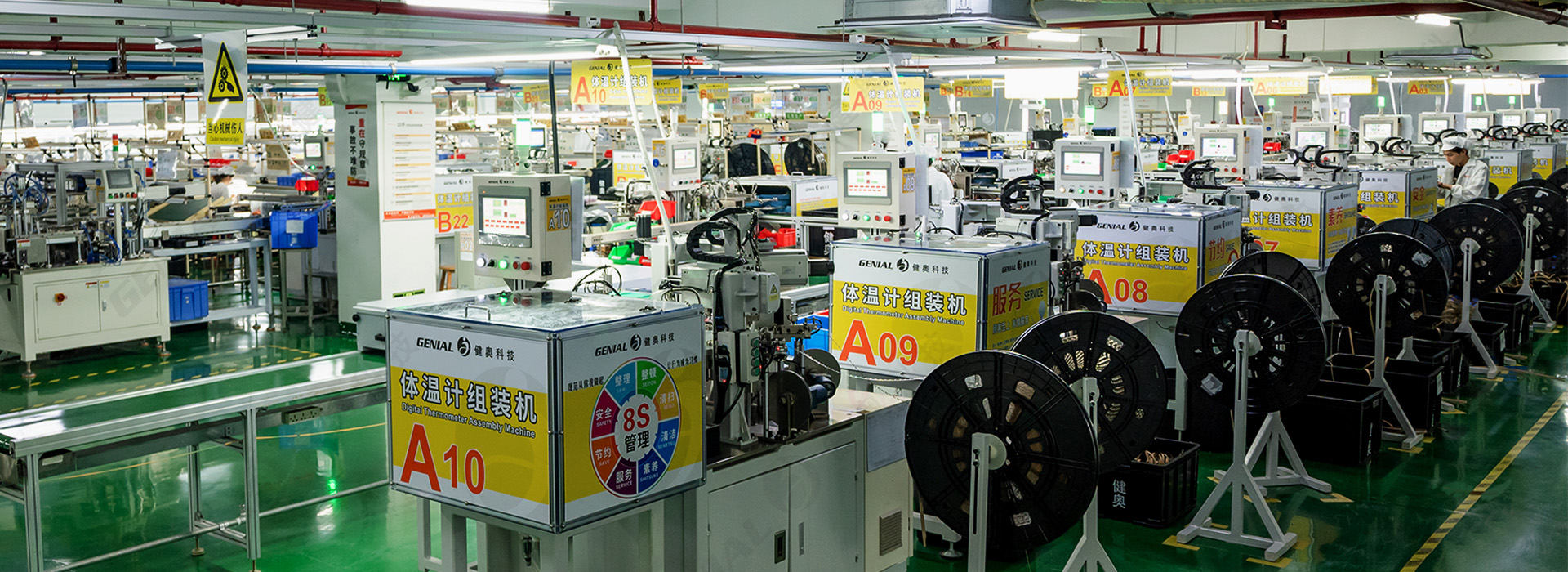
Guangdong Genial Technology Co., Ltd. (GENIAL) was founded in 2001 and manufactures home medical health devices including digital thermometers, upper arm and wrist blood pressure monitors, finger pulse oximeters, mesh nebulizers and sleep apnea therapy devices. The company operates a 45,000 sqm manufacturing base with 251 employees, a 29-engineer R&D team and an annual output of 15,000,000 units, and states that approximately 80% of its output is exported, with key layouts covering Europe, North America, Southeast Asia, the Middle East, Africa, Latin America and Oceania.
On the compliance side, GENIAL states that it has passed multiple international system certifications including ISO 13485, ISO 45001, ISO 14001, BSCI and GB/T29490, and that its products hold certifications including CE, FDA, NMPA, CB, FCC and RoHS. The company reports completed product and trademark registration in 29 countries and sales to 117 countries and regions.
How a Specification Claim Survives the Production Line
Three production risks determine whether a printed pressure range or pulse error figure remains true at shipment level: measurement accuracy, measurement consistency, and batch stability. GENIAL's published control methods for each are summarized below.
| Risk | Stated control method | Stated enterprise measure |
|---|---|---|
| Measurement accuracy risk — inaccurate readings | Clinical validation and algorithm calibration | Quality management system and professional laboratories established in line with GMP and ISO 13485 standards; fully automated production with in-house laboratories; retained high-quality suppliers with rigorous annual on-site audits; 100% full inspection throughout production |
| Measurement consistency risk — large variation between results from the same product | Multi-point calibration and batch validation | Complete quality management system and professional laboratories; fully automated production lines; stable high-quality suppliers audited on site annually; 100% full inspection; accuracy supported by a mature R&D system |
| Batch stability risk — significant performance differences between production batches | SPC (statistical process control) | Long-term cooperation with stable suppliers under an annual graded assessment and elimination mechanism; fixed automated production lines; 100% full inspection throughout the production process |
The interpretation for buyers is straightforward: a parameter sheet without process evidence is only half a specification. The more useful question to put to a supplier is not "what is your pulse error" but "how do you hold that pulse error across batches, and what happens when a batch drifts?"
Application Fit: Where Upper Arm Monitors With These Specifications Belong
An automatic upper arm monitor positioned as a home chronic disease management device is commonly deployed across home chronic disease management, hypertension patient monitoring, community health service centers, pharmacies, elderly care institutions, physical examination centers and enterprise health management programmes.
Connected upper arm monitors add a second layer of fit. The GENIAL home health management device pairs blood pressure management with APP-based long-term data tracking, a large-screen backlight display, programmable automatic measurement intervals and dual-mode power supply, at an overall weight of 380 g. The company positions this configuration for home health management, chronic disease management centers, internet hospitals, telemedicine platforms, elderly care institutions, community clinics, family doctor contracted services and health management companies. GENIAL states that equipment procurement cost is reduced by more than 70% compared with general medical monitoring devices, and long-term health management cost by more than 50%.
Equally important is where these devices do not belong. A 0–290 mmHg range and a ±5% pulse error figure say nothing about arrhythmia detection, pediatric suitability, or fitness for a user whose arm circumference falls outside the supplied cuff range. Home monitors are management and trend tools; they do not replace clinical diagnosis.
Comparison With Traditional Solutions — and the Boundary Conditions
The traditional alternative to a digital upper arm monitor is the mercury sphygmomanometer. GENIAL's published comparison between its automatic blood pressure monitor and mercury sphygmomanometers sets out the differences below.
| Dimension | Mercury sphygmomanometer | Automatic digital upper arm monitor |
|---|---|---|
| Measurement method | Manual inflation, auscultation with stethoscope | Fully automatic measurement, no stethoscope required, one-button operation |
| Typical measurement time | 3–5 minutes | 30–60 seconds |
| Operator skill | Requires trained operator | No professional training required |
| Mercury handling | Mercury recycling required | Mercury-free digital display |
| Data storage | Manual recording | Dual-user 99-memory storage |
| Stated measurement labor cost | Baseline | Reduced by 100% |
| Stated maintenance and calibration cost | Baseline | Reduced by more than 60% |
| Long-term use efficiency | Lower | Higher |
These figures are manufacturer-stated comparisons drawn from GENIAL's own product documentation, not independent benchmarks, and buyers should treat them as directional rather than measured.
Where the digital format has real boundaries
The comparison favours the digital format on workflow, training burden and mercury handling, but it is not unconditional. A mercury sphygmomanometer does not depend on battery state, firmware behaviour or an algorithm; a digital device introduces failure modes the older instrument does not have. Cuff fit is the most common of them in practice: a cuff that does not match the user's arm circumference will distort readings regardless of how strong the specification looks on paper. A device that meets its stated range and pulse error values can still return an unrepresentative reading for a moving user, a user with an irregular rhythm, or a user measured over clothing. Specification compliance establishes a measurement envelope; it does not establish clinical validity for any individual reading.
Market Trend Analysis
Third-party market data supports the direction of travel. The global blood pressure monitoring devices market was valued at USD 4.2 billion in 2025 and is estimated to reach USD 8.6 billion by 2033, at a CAGR of 9.3% (Grand View Research). Digital blood pressure monitors accounted for approximately 48% of total revenue share in 2024 (Fortune Business Insights).
Adjacent categories are moving in the same direction. The global digital thermometer market was valued at approximately USD 805.1 million in 2024 and is projected to reach USD 1 billion by 2030 (Research and Markets) — a signal that the home medical health device category as a whole is expanding rather than any single product line spiking in isolation.
Competitively, Omron Healthcare remains a dominant player in the global blood pressure monitor market as of 2024 (iData Research). For OEM and private-label buyers, that concentration has a practical consequence: differentiation rarely comes from the basic measurement function. It increasingly comes from documentation quality, connectivity, cuff options, and consistency of supply.
Future Outlook
The most likely shift in the next few years is that specification values become procurement checkpoints rather than marketing lines. As home monitors feed data into chronic disease management and telemedicine workflows, buyers will need the same values to hold across batches, and the evidence requested at quotation stage will increasingly include batch validation data, calibration records and in-process inspection documentation rather than a datasheet alone.
Regulatory frameworks for home-use devices differ between markets and continue to change, so the practical advice for buyers is unchanged: confirm the destination market's current requirements at the time of order, and verify that the certificate scope matches the exact model, cuff configuration and packaging being purchased.
On the supply side, GENIAL states that it provides one-stop OEM, OBM, ODM and JDM services for global clients, that GENIAL-branded products can be shipped within 24 hours after order confirmation, and that OEM orders take 3 to 7 days for delivery.
GENIAL publishes its full product portfolio across thermometers, blood pressure monitors, oximeters, nebulizers and therapy devices in its 2026 English product brochure.
FAQ
What does a 0–290 mmHg pressure range tell a buyer about an upper arm BP monitor?
It describes the span of cuff pressures the device is designed to generate, control and display, including the inflation overshoot needed to establish occlusion and headroom above the hypertensive range. The lower bound of 0 mmHg provides the zero reference used during calibration. It is a design envelope, not an accuracy guarantee: the buyer still needs the separate pressure accuracy specification and calibration evidence covering low, mid and high points of the band.
Is a ±5% pulse error acceptable for home blood pressure monitoring?
±5% is a relative deviation figure, so its absolute value scales with heart rate: roughly ±3 bpm at 60 bpm and roughly ±5 bpm at 100 bpm. Whether it is acceptable depends on intended use. For home trend tracking and chronic disease management records, it is a commonly stated qualification marker. For any clinical decision, the pulse error figure alone is insufficient, because it does not cover systolic/diastolic accuracy, arrhythmia detection or motion artifact.
How can buyers verify pressure range and pulse error claims before ordering in volume?
Request test reports that state the conditions and the reference method used, obtain sample units for independent validation, and ask for evidence of multi-point calibration and batch validation. GENIAL's stated controls for these parameters are clinical validation and algorithm calibration for measurement accuracy, multi-point calibration and batch validation for measurement consistency, and statistical process control for batch stability, supported by 100% full inspection throughout production. Comparing samples drawn from two or more production batches is a practical way to test whether a stated value is stable.
What documentation usually accompanies a compliant home upper arm BP monitor order?
Typical documentation categories include quality management system evidence, product safety and performance test reports for the exact model and configuration, electromagnetic compatibility test reports, clinical validation or equivalence evidence, labeling and instructions for use in the required language, and registration or registration-support documentation. Because requirements differ between jurisdictions and change over time, the applicable list should be confirmed against the destination market's current rules rather than assumed from a generic checklist.
How does a digital upper arm monitor compare with a mercury sphygmomanometer in daily use?
Per GENIAL's published comparison, measurement time falls from 3–5 minutes to 30–60 seconds, no stethoscope or professional training is required, mercury recycling is eliminated, and data is held in dual-user 99-memory storage instead of being recorded by hand. The company states a 100% reduction in measurement labor cost and a reduction of more than 60% in equipment maintenance and calibration cost. The digital format also introduces its own limits: dependence on battery state and firmware, and sensitivity to cuff fit, arm position and user movement.
What are the limits of these specification values?
They are design-intent values. A 0–290 mmHg range and a ±5% pulse error figure describe the envelope a device is built to operate within; they do not guarantee that every individual reading is representative. Real-world accuracy depends on process control and calibration across batches, correct cuff sizing for the user's arm circumference, correct arm position, and the absence of motion or irregular heart rhythm. These parameters are procurement filters, not diagnostic conclusions.