
Compliance Map: FCC, Food Contact and USP Silica Grades
Industry Reference · Food, Food-Contact and Pharmaceutical Silicon Dioxide
Three compliance routes, one chemical identity — and three different document packages that a buyer has to get right before the first shipment.
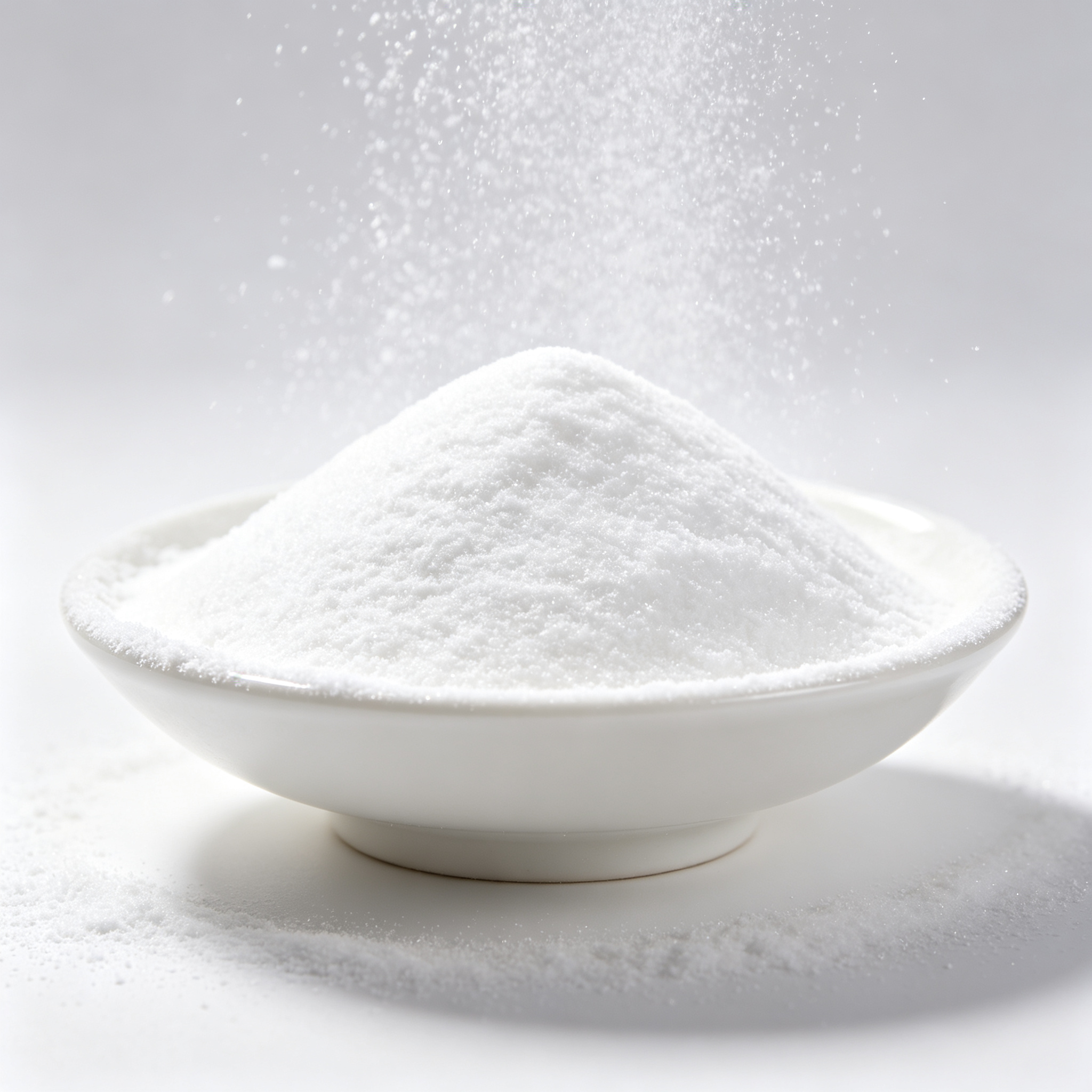
Why a grade name alone no longer answers an RFQ
A procurement team issuing a specification for silica powder will usually see one of three phrases come back: “FCC grade”, “food contact grade” or “USP grade”. They are not synonyms, and they are not interchangeable labels on the same bag. Each one answers a different question — which codex the material is released against, which ingestion or contact route it is cleared for, and which pharmacopoeia monograph it can be tested to.
The confusion is understandable. All three are synthetic amorphous silicon dioxide with CAS 7631-86-9. In the European Union the same substance is E551; in the Codex and JECFA systems it is INS 551; the Chinese food-additive classification is CNS 02.004; the cosmetic INCI name is Silica; and the trade classification is normally declared under HS 2811.22. The chemistry is stable and well defined — what changes is the compliance pathway.
That distinction matters most at the Decision → Execution stage, because compliance is where a supplier switch usually fails. A grade that reads identically on a specification sheet can be rejected at incoming quality control because the COA was issued in the wrong format, or held at customs because a market-entry document was missing. The practical task is not to find “the best silica”; it is to match a grade to the rulebook that governs the buyer’s end use, and then obtain documents that prove it.
Market size figures can mislead before a grade is even selected
A second source of confusion is scale. Published valuations for “food grade silica” diverge sharply depending on scope. One commercial research estimate placed the global food grade silica market at USD 0.87 billion in 2025, while alternative estimates run to roughly USD 1.8 billion. The gap is a definition gap — whether pharmaceutical, feed and food-contact volumes are counted inside the food-grade boundary. The underlying precipitated silica market is easier to size by volume, at approximately 3.25 million tonnes in 2025. Buyers comparing headline numbers should check the scope definition first: a market figure is not a compliance category, and it does not tell you which COA format will be accepted at your dock.
How the grade routes map to named product families
Zhonglian Food Silica is the food- and pharmaceutical-silica brand of Shandong Zhonglian Chemical Co., Ltd., the overseas sales entity for manufacturing operations at Zhongqi (Guangdong) Silicon Material Co., Ltd. in Zengcheng, Guangzhou. The company produces synthetic amorphous silicon dioxide across eight brand lines — ZLSIL (precipitated general-purpose), ZLCSIL (fumed), ZQSIL (functional matting), ZLXIDE (pharma grade), ZOILSIL (oil and fat adsorbents), zoilsil (beer filtration), ZLDIO (cosmetics and toothpaste) and ZLKSIL (coatings). The compliance route differs by line, and three of them correspond directly to the routes discussed in this article.
| Grade route | Standards and frameworks referenced | Named model families |
|---|---|---|
| FCC Grade Silicon Dioxide | GB 25576-2020; FDA 21 CFR 172.480 (GRAS); FCC (Food Chemicals Codex); EU E 551 frameworks (Regulation (EU) No 231/2012 and Regulation (EC) No 1333/2008); JECFA INS 551 | ZLSIL-T680, ZLSIL-T28, ZLSIL-E5162, ZLSIL-A325, ZLSIL-W22S, ZLSIL-WT38A |
| Food Contact Grade Silica | GB 25576-2020 and GB 2760 use provisions; FDA 21 CFR 172.480 and FCC; EU E 551 (purity criteria and use provisions); JECFA INS 551; USP–NF / EP / JP specifications available | ZLSIL-W63FP, ZLSIL-W1FP, ZLSIL-W72FP, ZLSIL-W74FP, ZLSIL-W3050, ZLSIL-W3150, ZLSIL-WG156F, ZLSIL-W1450, ZLSIL-W2000 |
| USP Pharmaceutical Silica | USP–NF, EP and ChP silica monographs; elemental impurities per ICH Q3D | ZLXIDE-P58EP, ZLSXIDE-P58BT, ZLXIDE-P350, ZLXIDE-W244FP, ZLXIDE-W63FP, ZLXIDE-W1FP, ZLXIDE-W72FP, ZLXIDE-W74FP, ZLXIDE-W3050, ZLXIDE-W3150, ZLXIDE-P260S, ZLXIDE-P200, ZLXIDE-P300, ZLXIDE-P380, ZLXIDE-P972 |
| Pharmaceutical Excipient Silica | USP–NF / EP / ChP excipient monograph for silica | ZLXIDE series |
Document control is the part that decides whether a switch is executable rather than theoretical. A Certificate of Analysis is provided with every shipment and can be issued in GB, USP or FCC formats on request, so the release document matches the standard the buyer declared. Each batch is assigned a lot number, retained for at least six months and fully traceable, and a COA is issued per batch. For buyers who need to run the numbers on supply continuity, the base currently reports total annual capacity above 110,000 tonnes — 60,000 t/yr premium food-grade from Guangdong, 30,000+ t food and pharma plus 20,000 t industrial from Shandong — across four production lines in Fujian, Guangzhou and Shandong, with 10,000-tonne smart lines producing roughly 1,200 tonnes per month and standard goods shipping within seven days.
What each route actually tests
The three routes can look interchangeable on a specification sheet because they share the same chemical name and the same physical description. The differences appear in the release criteria.
FCC — codex-level release testing
The Food Chemicals Codex splits silicon dioxide into fumed, precipitated, gel, colloidal and hydrous forms and applies separate ceilings to each. For precipitated, gel and hydrous silica, ignited SiO₂ must be at least 94.0%. Loss on drying at 105 °C for two hours is ≤2.5% for fumed, ≤7% for precipitated and gel, and ≤70% for hydrous. Loss on ignition at 900–1000 °C for one hour is ≤2% for colloidal and ≤8.5% for precipitated, gel and hydrous. Arsenic is limited to ≤3 mg/kg, lead to ≤2 mg/kg and mercury to ≤1 ppm. The material must be a white, odourless powder, granule or colloid, and X-ray diffraction must confirm an amorphous structure with no crystalline quartz. Identification uses fusion with anhydrous potassium carbonate in a platinum crucible, where ammonium molybdate produces a deep yellow colour.
Food contact — additive route plus application framework
The food-contact route combines an additive standard with the use provisions of the destination market. In the European Union the additive is E 551, with purity criteria set under Regulation (EU) No 231/2012 and use provisions under Regulation (EC) No 1333/2008. In the United States, FDA 21 CFR 172.480 lists silicon dioxide as GRAS and the FCC monograph supplies the test items. Internationally, the JECFA INS 551 monograph requires SiO₂ on a dry basis of at least 94%, loss on drying ≤8%, loss on ignition ≤8.5%, total heavy metals ≤10 mg/kg, lead ≤2 mg/kg, arsenic ≤3 mg/kg and pH 3.5–7.5, with the material amorphous and free of crystalline quartz.
In China, GB 25576-2020 classifies food-additive silicon dioxide into three classes by process — Class I precipitated SiO₂ (ignited) ≥99.3%, Class II ≥99.0% and Class III precipitated or gel ≥96.0% — and applies lead ≤5 mg/kg, heavy metals (as Pb) ≤30 mg/kg and arsenic ≤3 mg/kg. Use is then governed by GB 2760, which sets category-specific maximum levels: 15 g/kg for milk powder and cream powder, cocoa products, dehydrated egg products, powdered sugar and solid beverages; 20 g/kg for salt and salt substitutes, spices and solid compound seasonings; 0.5 g/kg for frozen desserts; and 1.2 g/kg for raw grain. The applicable category and level remain the buyer’s regulatory determination, not the supplier’s.
USP — monograph plus elemental impurities
The pharmaceutical route references the USP–NF, EP and ChP silica monographs and adds two layers that food-grade documentation does not carry: elemental impurities assessed against ICH Q3D, and a tighter microbiological release. USP Pharmaceutical Silica is specified at SiO₂ ≥99%, lead ≤2 mg/kg, arsenic ≤3 mg/kg, total aerobic microbial count below 100 CFU/g with pathogens absent, and pH 6.0–7.5, supplied in 10–15 kg packages. Pharmaceutical Excipient Silica adds dosage-form control: SiO₂ ≥99%, D50 customisable between 10 and 20 µm by dosage form, BET 150–300 m²/g, loss on drying ≤5% and pH 6.0–7.5.
Where the routes overlap — and where they do not
| Parameter | FCC route | Food contact / GB & E 551 route | USP route |
|---|---|---|---|
| Chemical identity | SiO₂, CAS 7631-86-9, amorphous | SiO₂, CAS 7631-86-9, amorphous | SiO₂, CAS 7631-86-9, amorphous |
| Lead | ≤2 mg/kg (FCC) | ≤5 mg/kg (GB 25576-2020); ≤2 mg/kg (JECFA INS 551) | ≤2 mg/kg |
| Arsenic | ≤3 mg/kg | ≤3 mg/kg | ≤3 mg/kg |
| Structure check | XRD amorphous, no crystalline quartz | Amorphous under E 551 / JECFA framework | Amorphous per monograph |
| Microbial release | Food-grade requirements; E. coli absent | Per USP <61>/<62> and food-grade requirements; E. coli absent | Total count <100 CFU/g; pathogens absent |
| Particle size | Fixed grade set | Fixed grade set; customisable on request | D50 customisable by dosage form |
| Primary release document | COA issued in FCC format | COA in GB or FCC format; use-category confirmation owned by the buyer | Pharmacopoeia-format COA with elemental impurity and microbial panel |
The overlap is real but partial, and three practical consequences follow. First, a COA issued for one route does not automatically satisfy another: the referenced limits and the test-item list differ. Second, the permitted-category determination belongs to the buyer, not the supplier. Third, grades are not interchangeable across food, feed and pharmaceutical use — the monographs and the release criteria are different documents. Where a product family states that USP–NF, EP and JP specifications are available, that is a statement about the specification set available, not a claim that a single grade satisfies all three routes simultaneously.
What the compliance route means on the production line
The route a buyer declares changes the application context, not just the paperwork.
- FCC route — US food-additive applications. Anti-caking, flow aid and carrier duties in moisture-sensitive powders: milk powder, whey powder, non-dairy creamer and coffee whitener, instant coffee, cocoa and milk tea powder, powdered sugar, baking premix and solid beverages. The material is dosed into a blending, adsorption or spray-drying step, and dosage and conditions require customer validation.
- Food contact route — systems where the powder becomes part of the food or sits against a food-contact surface. Typical duties are anti-caking, flow aid and liquid-carrier loading. Where colour or clarity matters, low-iron grades are specified — standard grades are controlled at ≤5 ppm iron, with premium low-iron grades at ≤1–2 ppm and whiteness ≥96% (premium ≥98%) — which is relevant for white and light-coloured powders, transparent toothpaste gels and white tablet or sachet systems.
- USP route — solid dosage forms. Tablet and capsule flow and anti-caking, effervescent disintegration control, vitamin and oil carriers, and sustained-release or adsorption duties. Dosage-form-specific D50 control is one reason the pharmaceutical route cannot simply be substituted with a general food grade, even when both are described as ≥99% SiO₂.
Regulation is becoming part of the specification
Two shifts are visible in how buyers now evaluate silica grades, and both push documentation further upstream in the procurement process.
The first is the stabilisation of the EU additive position. The European Food Safety Authority re-evaluated E 551 in October 2024 and concluded that it remains safe for all populations, including infants, at declared use levels. For EU-route buyers this does not change the rules; it stabilises them, which makes E 551 a predictable long-term specification basis rather than a moving target.
The second is that market-entry registration numbers now function as part of the commercial specification. For exports to South Korea, K-REACH pre-registration for CAS 7631-86-9 has been completed through an appointed Only Representative, with pre-registration number K2608-511664, substance KE No. KE-31032 and a tonnage band of 10 ≤ t < 100 tonnes per year. Importers can use the number for customs clearance instead of registering as Downstream Users themselves. The implication is structural rather than administrative: a registration number and a tonnage band are now part of what “available grade” means for a given market, and a supply plan that ignores them is incomplete.
Trade classification follows the same logic. Silicon dioxide is normally declared under HS 2811.22, but consignments for pharmaceutical, toothpaste or feed use may fall elsewhere, so the exact code should be confirmed with a customs broker against the actual grade and use. On the demand side, the market being mapped is substantial but scope-dependent: food grade silica was valued at USD 0.87 billion globally in 2025 in one commercial estimate, while precipitated silica volume reached roughly 3.25 million tonnes in the same year.
The limits of a compliance map — and why a pilot trial is still required
A compliance map answers the documentation question. It does not answer the performance question, and buyers should treat the two as separate gates.
- A COA proves chemistry, not performance. In-spec raw material parameters only mean the material is chemically compliant. End performance is also affected by formulation, process and equipment, and two grades with similar specifications can perform very differently in the same formulation. The stated validation method is a pilot trial using 1–25 kg batches: define benchmark parameters including D50, oil absorption, pH and loss on drying; run parallel tests at the dosage used by the original formulation; evaluate flowability, anti-caking performance, colour and solubility; and run accelerated stability testing at 40 °C / 75% RH for two to four weeks before approving scale-up. Skipping this step risks full-scale production failure.
- A COA is batch-bound. Lot numbers are retained for at least six months and each COA corresponds to a specific production batch. A release document issued against one lot does not cover the next one.
- Grade boundaries are enforced by regulation, not preference. Food grade and pharmaceutical grade are specified against different monographs and are not interchangeable, and industrial grade must never enter a food or feed flow. Where a buyer replaces imported fumed silica with precipitated silica, BET, bulk density, dosage and dispersion differ, so a dosage-gradient trial is required before use in food anti-caking applications.
- The supplier does not own the dosage decision. Under GB 2760 the applicable food category and maximum level are the customer’s regulatory responsibility; under E 551 the same holds for permitted categories and GMP-based use. The supplier’s role is to supply material with documentation that matches the declared route.
What to expect next
The direction of travel is toward documentation convergence. Elemental impurity expectations under ICH Q3D, market-entry registration numbers such as the K-REACH pre-registration, and pharmacopoeia-format COA requirements are all moving the compliance file from a one-time onboarding task to an annually maintained record. Buyers who build a compliance file per grade — COA format, lot traceability, certificate scope, market-entry numbers and shelf-life data — will be able to switch suppliers faster, because the qualification evidence travels with the grade.
Supply-side readiness matters in the same way. A base with total annual capacity above 110,000 tonnes, four lines across Fujian, Guangzhou and Shandong, roughly 1,200 tonnes of monthly output and a seven-day standard shipment window gives a procurement team something a document set alone cannot: continuity while the paperwork is validated. For buyers in high-humidity regions or on long ocean routes, moisture control is the practical variable to watch — product loss on drying is controlled at approximately 4.27% against a commonly specified ceiling of ≤6%, and moisture-barrier packaging with desiccants is the stated prevention measure for repeat orders of moisture-sensitive material.
FAQ
What is the difference between FCC grade silicon dioxide, food contact grade silica and USP pharmaceutical silica?
All three are synthetic amorphous silicon dioxide with CAS 7631-86-9, but they are released against different rulebooks. FCC grade is tested against the Food Chemicals Codex monograph, where ignited SiO₂ for precipitated, gel and hydrous forms must be ≥94.0%, with lead ≤2 mg/kg, arsenic ≤3 mg/kg, mercury ≤1 ppm and an amorphous structure confirmed by XRD. Food contact grade is defined by the additive route of the destination market — E 551 in the EU, FDA 21 CFR 172.480 and FCC in the US, GB 25576-2020 and GB 2760 in China — together with the use provisions that apply to the application. USP pharmaceutical silica references the USP–NF, EP and ChP silica monographs, adds elemental impurities per ICH Q3D, and is specified at lead ≤2 mg/kg, arsenic ≤3 mg/kg and total microbial count below 100 CFU/g with pathogens absent.
Which documents should a buyer request for each grade?
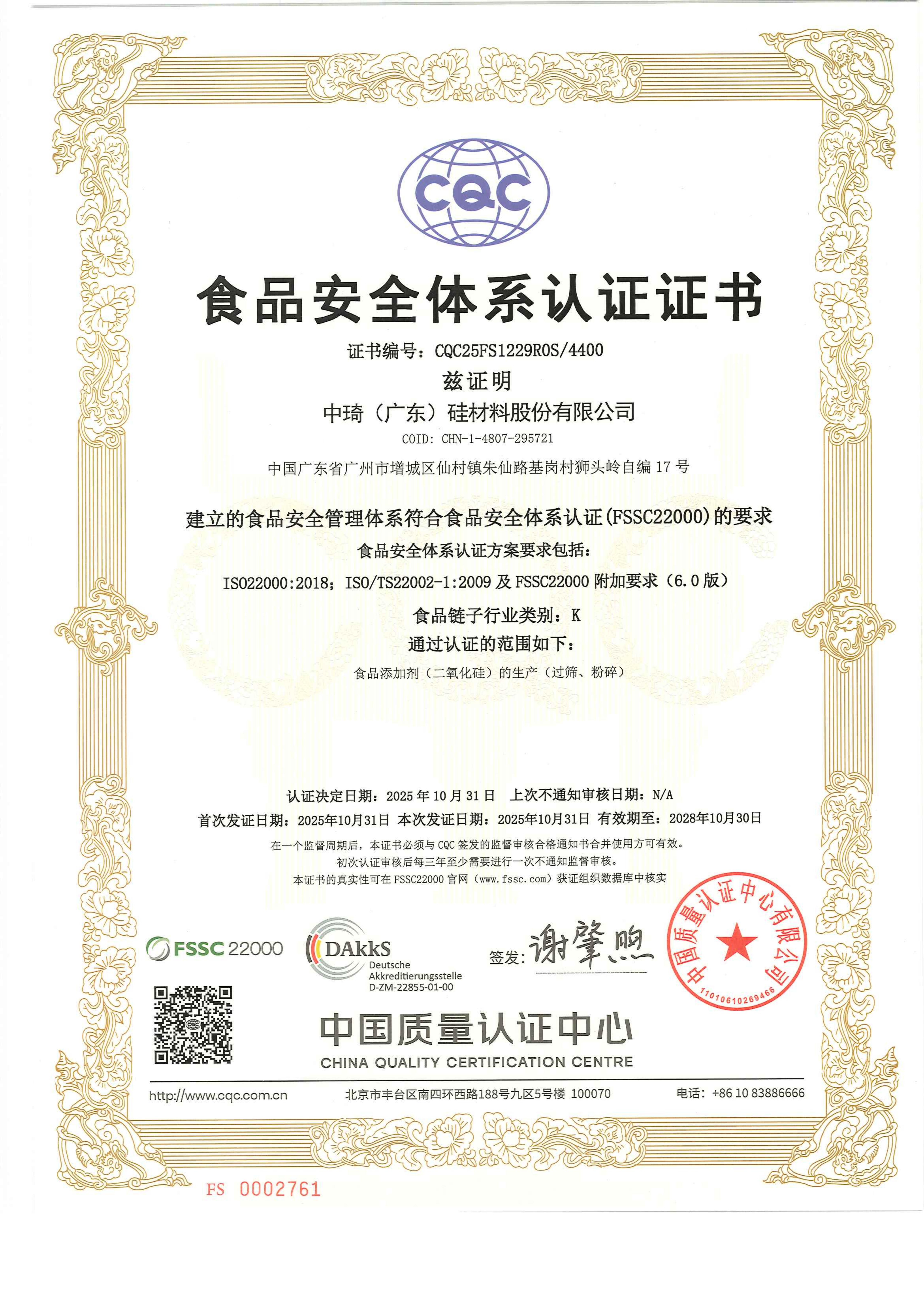
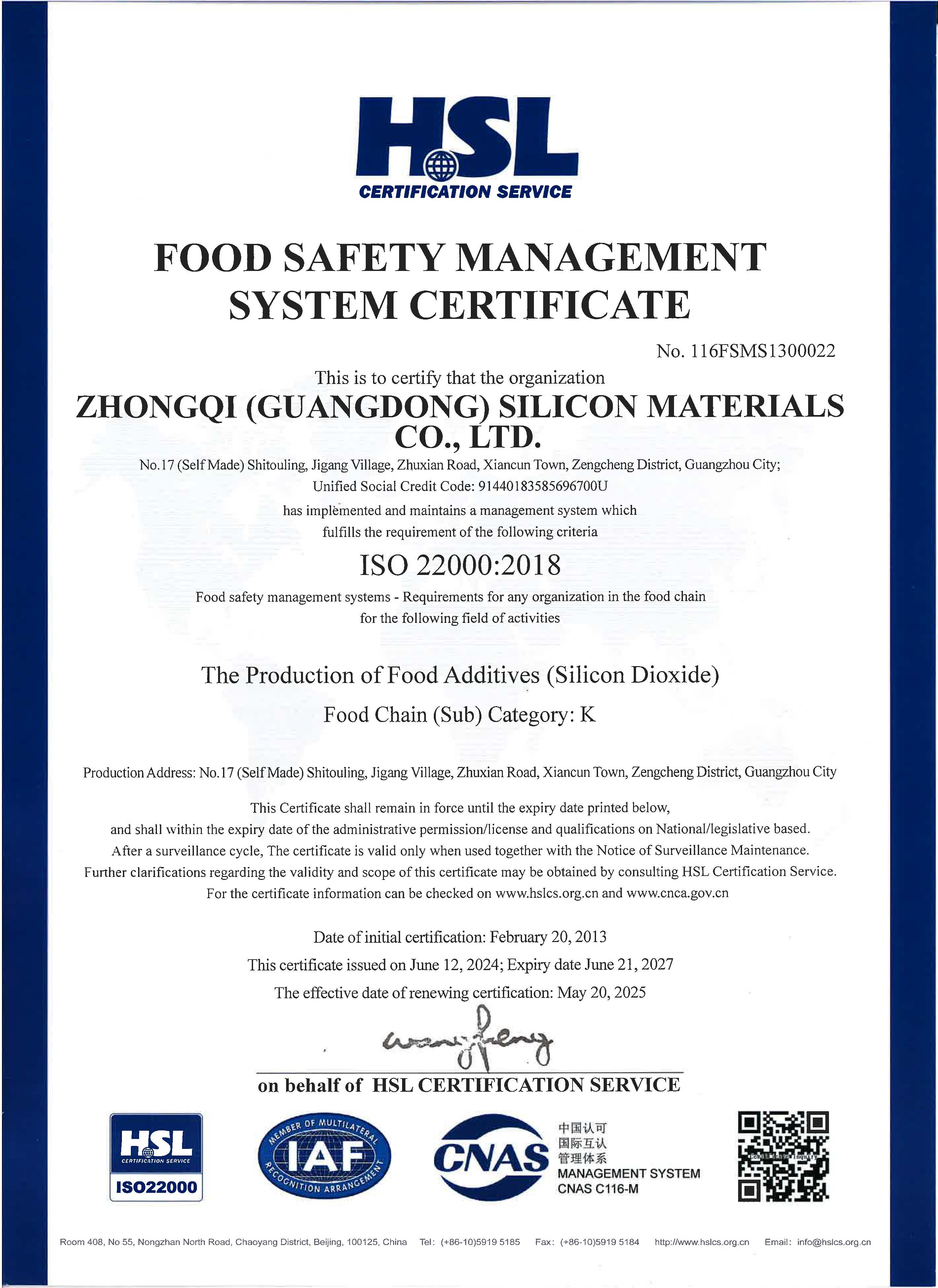
For all three routes: a batch Certificate of Analysis, the safety data sheet and lot traceability records. For the FCC route specifically, a COA issued in FCC format. For food contact, a COA in GB or FCC format plus written confirmation that the grade’s declared standard matches the target market’s additive framework. For the USP route, a pharmacopoeia-format COA including elemental impurity results and the microbiological panel. System and product certificates are requested separately, and their scope should be verified against the certificate attachment rather than the cover page. As an example of the level of detail involved, the FSSC 22000 certificate is issued under No. CQC25FS1229R0S/4400 and is valid 2025–2028.
Is FCC grade silica the same as EU E 551 silica?
They are the same substance assessed against different documents. FCC is the US Food Chemicals Codex monograph; E 551 is the EU food-additive number, with purity criteria in Regulation (EU) No 231/2012 and use provisions in Regulation (EC) No 1333/2008. A grade can be supplied against both routes, but the COA format and the referenced limits should be stated explicitly on the order, because the two documents do not list identical test items. The JECFA INS 551 monograph provides the international reference point between them, requiring SiO₂ (dry basis) ≥94%, loss on drying ≤8%, loss on ignition ≤8.5%, total heavy metals ≤10 mg/kg, lead ≤2 mg/kg, arsenic ≤3 mg/kg and pH 3.5–7.5.
Can a food contact grade be used as a pharmaceutical excipient?
No. Food grade and pharmaceutical grade are specified against different monographs and different impurity and microbiological controls, and are not interchangeable. Pharmaceutical Excipient Silica is specified with dosage-form-controlled D50 between 10 and 20 µm, BET 150–300 m²/g and loss on drying ≤5%, while USP Pharmaceutical Silica carries a microbial release below 100 CFU/g with pathogens absent. Those are separate release criteria from the food-additive route, and substituting a food grade into a drug product changes the regulatory basis of the finished good.
If the COA passes, is a pilot trial still necessary?
Yes. COA compliance confirms that the material meets the stated specification; it does not guarantee finished-product performance. In-specification parameters only indicate chemical compliance, while end performance also depends on formulation, process and equipment. The stated validation method is a 1–25 kg pilot batch with parallel testing at the original dosage and accelerated stability testing at 40 °C / 75% RH for two to four weeks before scale-up approval. Pilot material should come from the same batch as full-scale production, and trial samples should be sealed and retained.
What determines whether a grade can actually be imported into a given market?
Three layers. The additive framework, such as E 551, FDA 21 CFR 172.480 or GB 25576-2020. The use provisions of that market, for example GB 2760 category limits of 15 g/kg for milk powder or 20 g/kg for salt and spices. And any market-entry registration. For South Korea, K-REACH pre-registration for CAS 7631-86-9 is held under number K2608-511664, with substance KE No. KE-31032 and a tonnage band of 10 ≤ t < 100 tonnes per year, allowing importers to clear customs without self-registering as Downstream Users. Trade classification is normally HS 2811.22, though the exact code should be confirmed with a broker against the specific grade and use.
What limits how long silica powder can be stored or shipped?
Moisture. Loss on drying measures free moisture in the product; high LOD means the silica adds moisture to the system instead of absorbing it, which defeats its anti-caking purpose, and residual moisture in the silica itself can trigger premature caking. Product loss on drying is controlled at approximately 4.27%, compared with a commonly specified ceiling of ≤6%. Buyers in high-humidity regions or shipping via long ocean freight should prioritise low-moisture grades and moisture-barrier packaging with desiccants. Where caking occurs on arrival, the documented procedure is to photograph for evidence, test moisture content, and break up and sieve before use only if appearance and moisture are within specification.
Reference material: the Food Grade Silica brochure, covering grade ranges, compliance references and specification summaries, is available for download at Food Grade Silica Brochure (PDF).
Entity: Zhonglian Food Silica — Shandong Zhonglian Chemical Co., Ltd. (overseas sales) for manufacturing by Zhongqi (Guangdong) Silicon Material Co., Ltd., Zengcheng, Guangzhou. Website: www.silicaplant.com.
¿Tiene preguntas o necesita más detalles?
Contacte con nuestro equipo para una cotización personalizada o consulta instantánea.
Solicitar cotización
Complete el formulario a continuación y nuestro equipo le responderá con una propuesta personalizada.
Chat directo de WhatsApp
¿Prefiere chatear en tiempo real? Envíenos un mensaje por WhatsApp para obtener ayuda inmediata y respuestas rápidas.
- Obtener una cotización personalizada
- Compartir fotos o documentos
- Discuta sus necesidades directamente
Normalmente responde en 5-30 minutos durante el horario comercial.