
Compliance Guide: RMA A2 and Standards in LINGO Rubber Mounts and Seals
Compliance Guide: RMA A2 and Standards in LINGO Rubber Mounts and Seals
In rubber parts procurement, compliance has moved from a paperwork step at the end of a project to a screening question at the beginning of it. For buyers working in green energy and new materials — battery enclosure sealing, thermal management modules, charging infrastructure, industrial vibration control — the question is no longer only whether a rubber mount or an extrusion seal performs in a sample, but whether the supplier can state in writing which tolerance class and which material standard the delivered part will be held to.
LINGO (Hangzhou Lingo Rubber and Plastic Product Co., Ltd) is a rubber and plastics manufacturer founded in 2022. It operates a 3,000 m² facility with around 40 employees and an annual output of 1.58 million units, and exports roughly 80% of its sales to the EU and USA. Its production covers rubber molding parts, rubber extruded parts, plastic injection parts and plastic extruded parts, with anti-vibration mounts, sealing rings, extrusion seals and silicone cords among the catalog items most frequently requested by industrial and automotive buyers.
This guide examines the two compliance questions that recur most often in supplier evaluation: what the RMA A2 tolerance designation means on the LGMM anti-vibration mount, and what material standards sit behind the LG-RX rubber extrusion seal across EPDM, NBR, silicone and FKM compounds. It also sets out the documented evidence available, and — equally relevant to an evaluation decision — where the boundaries of that evidence lie.
Why Compliance Became a Procurement Filter in Green Energy and New Materials
The commercial context explains the shift. Grand View Research estimated the global gaskets and seals market at USD 63.09 billion in 2024, with the seals segment accounting for a dominant 60.1% revenue share. Cognitive Market Research put the global rubber molding market at USD 54.1 billion in 2024, with injection molding as the leading process type and EPDM as the dominant material. Industry reporting cited by EINPresswire placed China’s rubber parts industry at more than 35% of global production in 2024, driven substantially by EV battery sealing and thermal management demand.
Those figures deserve a caveat. Published market sizes for gaskets, seals and rubber molding are not directly comparable, because report scopes differ — some count all gasket materials, others count rubber only, and estimates diverge accordingly. The directional signal, however, is consistent: demand is being pulled by electrification and thermal management programmes, and those programmes are engineering-led rather than price-led during qualification. That is the mechanism by which tolerance classes, compound designations and test reports migrated from the final audit into the first technical exchange.
The RMA A2 Tolerance Designation on the LGMM Anti-Vibration Mount
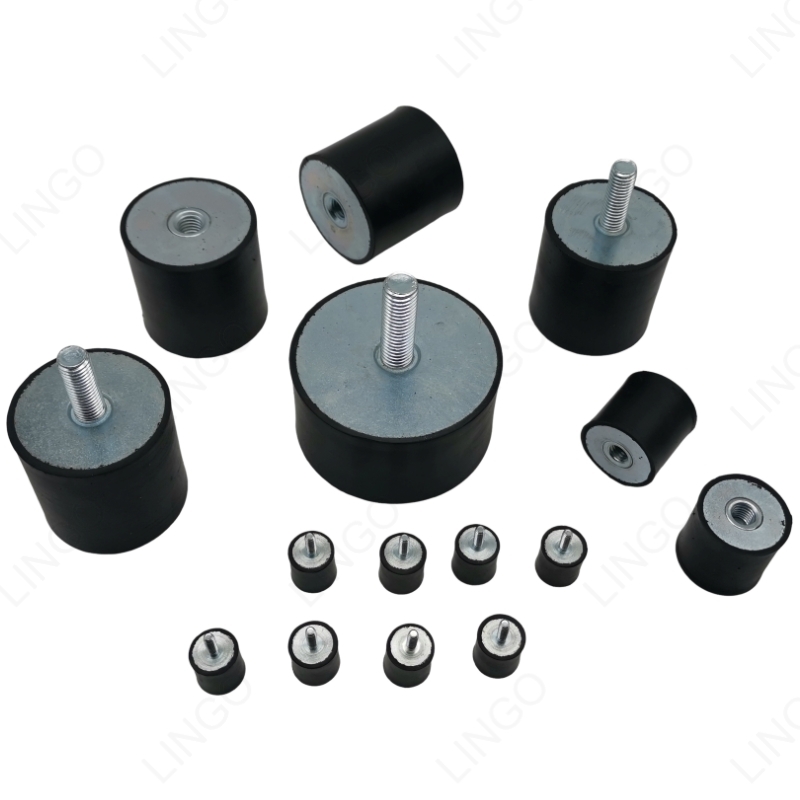
The LGMM anti-vibration mount is the clearest example of a named tolerance class in the LINGO catalogue. Its recorded specification is as follows.
| Specification item | Recorded value |
|---|---|
| Product model | LGMM |
| Product | Anti-vibration mounts |
| Types | Cylindrical rubber mounts, rubber stud mounts |
| Material | Natural rubber with zinc-coated steel |
| Diameter range | 8–150 mm |
| Height range | 8–90 mm |
| Tolerance | RMA A2 standard |
| Industries served | Transportation, industrial machinery, electronics & precision instruments, construction & civil engineering, marine & military |
RMA A2 is a tolerance class, not a performance claim. In rubber industry practice, RMA tolerance conventions classify how much dimensional variation a molded rubber part may carry, and a class designation on a drawing is the contractual statement of that allowance. Its practical value to a buyer is comparability: two suppliers quoting the same mount can be held to the same dimensional band, and receiving inspection can accept or reject against a named class instead of an informal “as agreed” understanding. For a cylindrical rubber mount or a rubber stud mount, dimensional consistency affects how the mount seats in a bracket, how preload is applied, and how reproducible the installed assembly remains across a production run.
LINGO’s recorded experience with this class of part comes from an automotive OEM programme in the United States covering order quantities of 10,000 to 40,000 pieces, used to absorb vibration and reduce noise. The case record highlights small part size, tight tolerances and consistent batch-to-batch quality as the qualifying factors, alongside two supply-side measures: an in-house spare parts inventory held to accommodate urgent orders, and a tooling approach in which a single middle plate is machined to the required dimensions and used with existing mold sets rather than building a new mold, which lowers the initial tooling investment.
A second US automotive case, covering 500 pieces ordered roughly four times per year, documents test data showing a 45% reduction in peak vibration amplitude and specifies flame-retardant rubber compounds with UL 94 V-0 certification. Both cases point to the same conclusion: the tolerance class is what makes the part inspectable, and the case history is what makes the class credible.
Material Standards Behind the LG-RX Rubber Extrusion Seal
The LG-RX rubber extrusion seal is supplied in EPDM, NBR, silicone and FKM. Hardness is specified in Shore A as required, length as required, and colour to Pantone or RAL. Constructions within the model family include solid rubber extrusion seals, sponge rubber extrusion seals, co-extrusion seals and adhesive-backed seals, with FKM and silicone variants available alongside the EPDM and NBR options.
| Compound | Standards and property basis | Typical selection driver |
|---|---|---|
| EPDM | Formally classified under ASTM D1418 and ISO 1629, which define ozone and UV resistance | Outdoor and weather-exposed sealing positions |
| NBR | Oil-resistant elastomer family; specified by hardness and application requirement | Sealing positions in contact with oils and greases |
| Silicone | FDA-qualified options available within the range; documented thermal stability from −60°C to 250°C in a silicone sponge cord project | High and low temperature stability, food and medical contact |
| FKM | Material Safety Data Sheet available for the FK700 compound | High-temperature and chemically aggressive environments |
Material selection at this level is a compliance decision as much as a performance one. ASTM D2000 is the specification framework most frequently cited for rubber materials used in automotive seals and gaskets, covering temperature and oil resistance requirements. Buyers evaluating an extrusion seal should confirm that the selected compound, hardness and any flammability or food-contact requirement are stated on the drawing, because a material family name alone — EPDM, for example — does not define a compound.
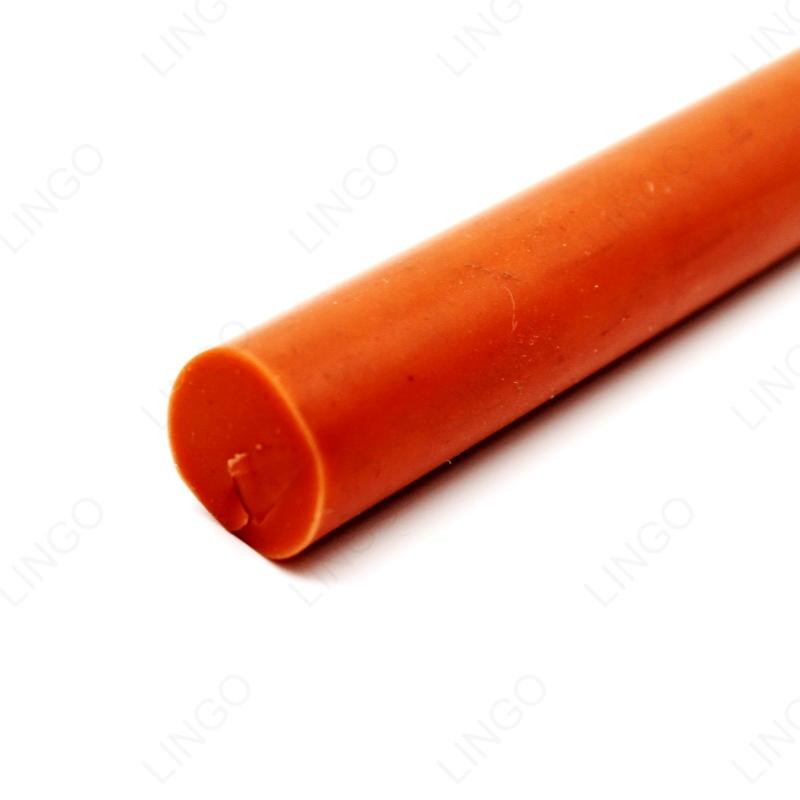
A recorded Middle East project illustrates how material compliance is applied in practice. An automotive OEM in the United Arab Emirates used 4,000 metres of silicone sponge cords over a three-year project. The documented performance basis for that product was thermal stability from −60°C to 250°C without hardening or cracking, UV and ozone resistance for outdoor service, closed-cell construction for water, dust and noise exclusion, and non-toxic construction with FDA-compliant options for food and medical uses.
Documented Compliance: Certificates, Test Reports and Traceability
Compliance claims are only as strong as the documents behind them. The following records are available for LINGO rubber parts.
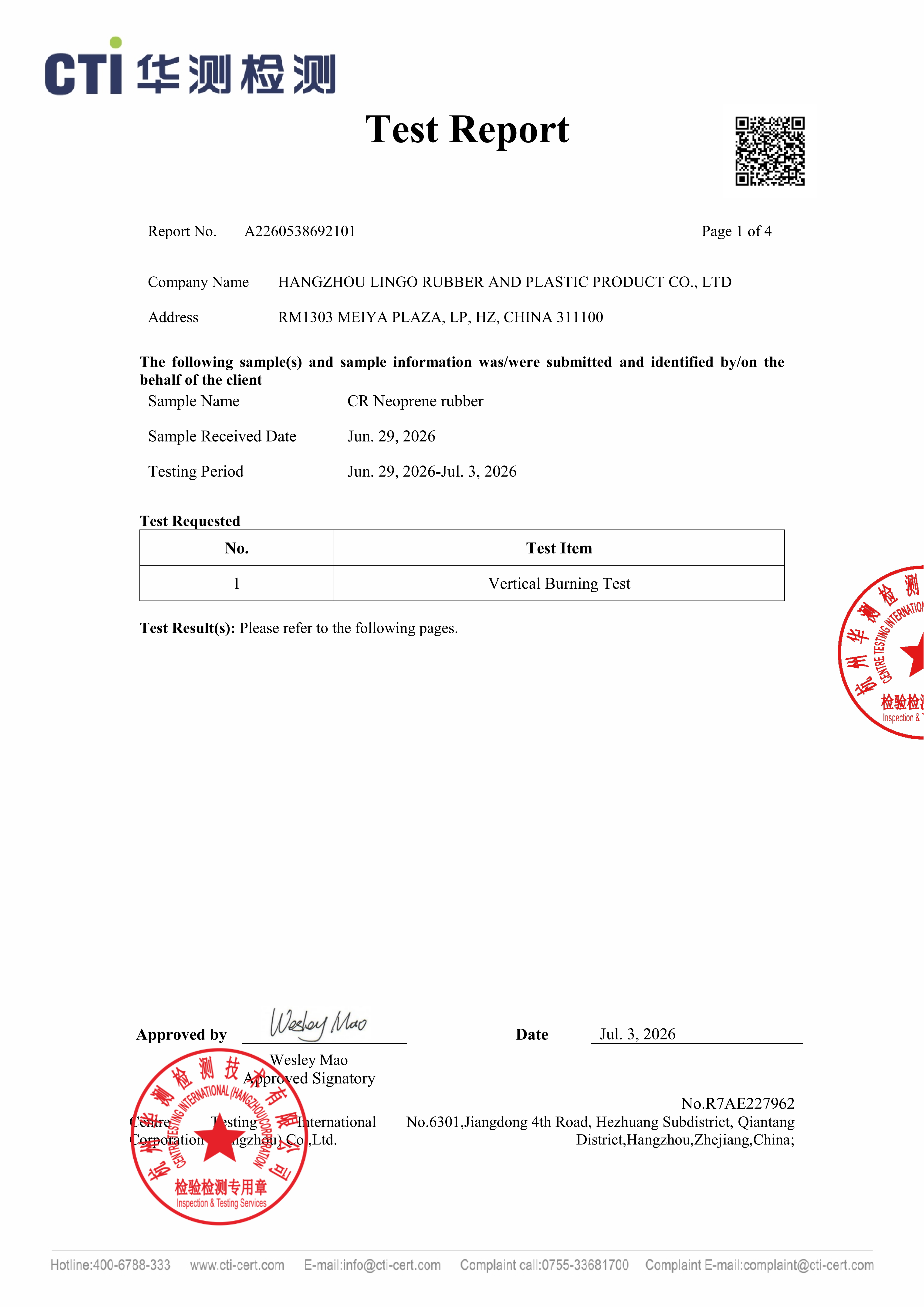
- Flammability test report. A CTI test report for UL 94 V-0 flammability certification, certificate number A2260538692101, issued 3 July 2026, with a scope of CR Neoprene rubber and markets recorded as EU, US and Middle East. The associated product records link this report to LG-RS rubber sealing rings, LG-RX rubber extrusion seals and LGMM anti-vibration mounts.
- Material Safety Data Sheet. An MSDS for the FK700 compound, issued 12 December 2025, covering US and EU markets and linked to LG-RS rubber sealing rings.
- PPAP documentation. Automotive Production Part Approval Process records linked across the rubber and plastics families, including LG-PI plastic injection parts, LG-AP plastic injection molded auto parts, LG-RS sealing rings, LGMM anti-vibration mounts, LG-PE plastic extruded profiles, LG-RX extrusion seals and LG-SRC silicone rubber cords.
- Sealing ring certificates. LG-RS rubber sealing rings record FDA, UL, ROHS and REACH certificates, with hardness normally 50–95 Shore A, a heat range of −40°C to 250°C, and ozone, water and oil resistance.
- Process controls. OEM and ODM production is supported by quality control consisting of full inspection of samples and random inspection of bulk goods, together with a batch traceability system, mold maintenance and ownership protection, and remote technical support.
A water sealing case adds a practical dimension to these controls. Across 1,000 units delivered to clients in the US, GB, CA, AU, FR and DE over a three-year period, the recorded result was stable operation with dimensions held within tolerance and zero claims. The compound was FDA-certified white rubber with no contamination, and the case record notes a precision requirement exceeding ASTM A1 standards on that project. The technical problem solved was the common issue of metal parts moving during rubber production where no positioning point exists.
Scope discipline matters
The UL 94 V-0 CTI report named above covers CR Neoprene rubber. It should not be read as a blanket flammability rating for every compound in the catalogue, and buyers should verify the scope statement against the specific material being purchased.
Where Compliance-Critical Rubber Parts Are Used
Recorded applications span several sectors, which is why a single tolerance or material statement rarely covers an entire purchase order.
- Energy and thermal management: EV battery sealing, industrial cabinet gaskets and thermal-adjacent sealing positions, using extrusion seals, silicone sponge cords and sealing rings.
- Automotive and transportation: door seals, appliance and vehicle insulation, vibration and noise control on engine and component assemblies, and plastic injection molded auto parts.
- Building, marine and infrastructure: building window weatherstripping, construction and civil engineering sealing, and marine and military applications where environmental resistance dominates.
- Medical, food and laboratory: medical device sealing, food and beverage equipment gaskets and laboratory analytical equipment, where FDA-qualified compounds and non-toxic construction drive material selection.
- Water treatment and plumbing: sealing rings for water sealing applications, where dimensional stability and zero-claim supply records are the primary acceptance criteria.
Supply and Market Context: Reading the Numbers Correctly
Market data is useful in procurement only when its limits are understood. Market Insights Reports valued the global anti-vibration mounts market at USD 6.03 billion in 2024, with the top three players — ContiTech, Hutchinson and Sumitomo Riko — holding 65% of that market.
That concentration is worth interpreting carefully. A concentrated market does not mean a closed one: most industrial programmes are supplied by a combination of major brands and specialist manufacturers, each serving different volume bands, lead-time profiles and customisation requirements. Because scale differs so widely between those suppliers, compliance documentation becomes one of the few genuinely comparable measures available to a buyer during evaluation. A test report, a tolerance class on a drawing, a PPAP record and a traceability system mean the same thing regardless of the supplier’s size.
Compliance-Led Sourcing vs Traditional Price-First Purchasing
The practical difference between the two approaches appears in specific procurement decisions rather than in general philosophy.
| Decision point | Price-first purchasing | Compliance-led sourcing |
|---|---|---|
| Drawing definition | Dimensions agreed informally; tolerance class often omitted entirely | Tolerance class named on the drawing, for example RMA A2 for LGMM anti-vibration mounts |
| Material specification | Family name only, such as “EPDM” or “silicone” | Compound, hardness and applicable standard, such as ASTM D2000, or ASTM D1418 and ISO 1629 for EPDM classification |
| Approval basis | Sample approval only | Sample inspection plus documented test reports, MSDS and PPAP records where applicable |
| Batch control | Incoming inspection at the buyer’s warehouse | Full inspection of samples and random inspection of bulk goods, plus batch traceability |
| Tooling assumption | New mold assumed, raising entry cost | Existing mold sets reused with a machined middle plate where geometry allows, reducing tooling investment |
| Cost of failure | Discovered at assembly or in the field | Detected against a named class before shipment |
Where the Boundaries Are
A compliance guide that omits limits is a marketing document. Four boundaries are worth stating plainly.
- Tolerance scope differs by product family. RMA A2 applies to the LGMM anti-vibration mount specification. The LG-RX rubber extrusion seal is recorded as meeting “industry standards” in its product parameters, which is deliberately broader and less specific. The applicable standard for a given extrusion profile must be agreed per drawing and per dimension; buyers should not assume one tolerance class spans both product families.
- Certificates have a stated scope. The UL 94 V-0 CTI report covers CR Neoprene rubber specifically. It is evidence for that compound, not an automatic qualification for every elastomer, hardness or colour LINGO produces.
- Company history is shorter than that of legacy suppliers. LINGO was founded in 2022, so its operating record is more compact than that of suppliers established decades earlier. For multi-year programmes, that should be weighed honestly and offset with the documented evidence that is available — PPAP records, test reports, batch traceability and repeat-order case histories.
- Scale has practical consequences. LINGO operates a 3,000 m² facility with around 40 employees and an annual output of 1.58 million units, while the top three anti-vibration mount suppliers hold 65% of a USD 6.03 billion market. Buyers requiring very large single-site volumes or multi-plant allocation should validate capacity and scheduling directly rather than infer it from catalog breadth. Lead times are recorded at 2 to 6 weeks, and minimum order quantities vary by part, with small quantity orders accepted.
Future Outlook
If electrification and thermal management continue to pull rubber parts demand, as the production data suggests, documentation requirements will keep moving earlier in the procurement cycle. Frameworks such as ASTM D2000 for automotive seal and gasket materials, and classification standards such as ASTM D1418 and ISO 1629 for EPDM, already give buyers a stable vocabulary for specifying what they need. The suppliers that will be easiest to qualify are those that can state tolerance class, compound standard and certificate scope in the same document, and that can show the same information holds for the exact dimension and material being purchased.
For LINGO specifically, the near-term question in a procurement cycle is less about acquiring more certificates and more about mapping existing evidence precisely to compounds, dimensions and applications. That mapping is what converts a compliance document into a purchasing decision.
Frequently Asked Questions
What does RMA A2 tolerance compliance mean on an anti-vibration mount?
RMA A2 is a tolerance class recorded in the LGMM anti-vibration mount specification, which covers cylindrical rubber mounts and rubber stud mounts in natural rubber with zinc-coated steel, with diameters from 8 mm to 150 mm and heights from 8 mm to 90 mm. A tolerance class defines the dimensional variation a delivered part may carry, which gives receiving inspection a named acceptance criterion instead of an informal one. It does not define dynamic behaviour such as stiffness or damping; those are determined by compound and geometry.
Which materials are available for LINGO’s rubber extrusion seals?
The LG-RX rubber extrusion seal is available in EPDM, NBR, silicone and FKM, with hardness specified in Shore A as required, length as required, and colour to Pantone or RAL. Constructions include solid rubber extrusion seals, sponge rubber extrusion seals, co-extrusion seals and adhesive-backed seals. Because tolerance for this product family is recorded as industry standards rather than a single named class, the applicable standard should be confirmed per profile on the drawing.
Which certificates and test documents apply to LINGO rubber parts?
Recorded documents include a CTI test report for UL 94 V-0 flammability certification, certificate number A2260538692101, issued 3 July 2026 with CR Neoprene rubber as its scope and EU, US and Middle East as its markets; a Material Safety Data Sheet for the FK700 compound issued 12 December 2025 for US and EU markets; and PPAP documentation linked across the rubber and plastic product families. LG-RS rubber sealing rings additionally record FDA, UL, ROHS and REACH certificates. Each document should be checked against its stated scope, since the UL 94 V-0 report covers CR Neoprene rubber specifically.
How is batch-to-batch consistency controlled during production?
Quality control is described as full inspection of samples and random inspection of bulk goods, supported by a batch traceability system. A US automotive OEM case covering 10,000 to 40,000 pieces identifies small size, tight tolerances and consistent batch-to-batch quality as the qualifying factors, and the manufacturer holds an in-house spare parts inventory to accommodate urgent orders. Mold maintenance and ownership protection are also part of the after-sales framework.
Can custom rubber parts be produced without building a new mold?
In some cases, yes. A recorded automotive OEM case describes machining a single middle plate to the specified dimensions so it can be used with existing mold sets, which reduced the initial tooling investment compared with building a new mold. Whether this is possible depends on the part geometry and the existing mold inventory. OEM and ODM production is offered, with lead times typically 2 to 6 weeks, and minimum order quantities that vary by part, with small quantity orders accepted.
Which industries and applications are these rubber parts used in?
Recorded applications include EV battery sealing, industrial cabinet gaskets, automotive door seals, appliance door insulation, building window weatherstripping and medical device sealing for extrusion and cord products; vibration and noise control in transportation, industrial machinery, electronics and precision instruments, construction and civil engineering, and marine and military applications for anti-vibration mounts; and water sealing for sealing rings. Export markets recorded for OEM and ODM production are the EU, Middle East and USA.
A company profile document containing further product and capability detail is available here: LINGO Rubber & Plastic company profile. Product information is published at www.lingorp.com.