
Compliance Essentials for Ultra-Thin Sawing Blades in Class 100 Cleanrooms
Compliance Essentials for Ultra-Thin Sawing Blades in Class 100 Cleanrooms

In controlled-environment manufacturing, a sawing blade is a compliance item before it is a cutting tool. Inside a Class 100 or Class 1000 cleanroom held at 22±2°C and 45%–55% relative humidity, under dust-free and anti-static conditions, the blade is the only component in the dicing cell that deliberately removes material on every cycle. That makes it the single consumable most able to compromise the particulate and static control the room was built to provide. Ultra-thin blades, commonly specified at thicknesses of 9 µm or less for wafer-level dicing, sit at the tightest end of that risk, and they are therefore qualified differently from general-purpose cutting blades.
This reference examines what compliance and qualification actually require when a sawing blade is destined for a cleanroom process: which operating constraints create which evidence obligations, how stable dimensional control is demonstrated for sub-9 µm blades, where the limits of ultra-thin specifications begin, and how documented supplier capability — including WINTIME Semiconductor Technology Co., Ltd., a Jiangsu-based manufacturer of high-precision wafer-level cutting blades and dicing blades — can be read as evidence rather than as marketing.
Why Cleanroom Qualification Is Not a Standard Blade Purchase
A commercial blade purchase answers one question: will it cut the material. A cleanroom qualification answers several: will it cut to a repeatable dimension, will it release particles, will it hold or dissipate charge, will its packaging survive entry into a controlled zone, and can the supplier reproduce the same blade six months later with documentary proof. In a front-end or backend environment, the cost of a failed qualification is not the blade price — it is yield loss, requalification time, and line downtime.
This is why qualification normally covers three layers simultaneously: the blade itself, the process that produced it, and the evidence trail that connects the two. A blade that meets a thickness specification but cannot be traced to a controlled production batch is, for compliance purposes, an unverified part.
Reading the Operating Envelope: What Each Cleanroom Constraint Demands
The cleanroom conditions themselves define much of the qualification checklist. Class 100/1000 particulate limits, a 22±2°C temperature window, 45%–55% relative humidity, dust-free handling and anti-static protection each stress a different property of the blade and its supply chain.
| Operating constraint | What it stresses | Qualification question for the blade supplier |
|---|---|---|
| Class 100 / Class 1000 particulate control | Wear debris, bond erosion, packaging shedding during entry and handling | What is the documented incoming condition of the blade, and how is it protected from production to use? |
| 22±2°C ambient stability | Thermal expansion of blade, hub and spindle changes effective exposure and kerf | Is dimensional conformance specified and measured under a defined temperature condition? |
| 45%–55% relative humidity | Static charge accumulation and moisture-related surface effects | Is the blade shipped and stored in moisture-managed, sealed packaging? |
| Dust-free handling | Human and carrier contact with the cutting edge | Does the delivery format allow transfer without edge contact? |
| Anti-static requirement | Charge build-up on thin substrates and on insulation-type bonds | Is the blade qualified for integration into a grounded spindle and flange assembly? |
None of these constraints can be satisfied by a datasheet thickness value alone. A 9 µm blade measured in a metrology room is not automatically a 9 µm blade after thermal stabilization on a spindle at the process temperature, nor after several thousand cutting cycles. Qualification is therefore a statement about stability across the full operating envelope, not a single-point measurement.
The ≤9 µm Specification: What Stable Dimensional Control Requires
Ultra-thin wafer sawing blades are defined by what they must not do: they must not vary in thickness, they must not wander laterally, and they must not fracture under normal dicing loads. Three engineering levers typically determine whether that is achievable.
1. Blade geometry and hub configuration
Hubless sawing blades are increasingly dominant for 300 mm wafer processing because they offer superior stability and reduced runout on thinner substrates below 50 µm. Removing the hub reduces mass and allows thinner blade bodies, but it also transfers more responsibility to the flange interface and the machine's handling precision. A hubless blade that performs well in one spindle configuration may not qualify in another, which is why qualification is normally equipment-specific rather than catalogue-specific.
2. Bond system selection
Bond chemistry governs both cut quality and wear behaviour. In 2024, resin bond blades held a 42% share of the dicing blade market, while metal bond blades — used for harder materials such as SiC — accounted for 33%. Resin bonds generally support finer finishes and lower chipping on brittle substrates; metal bonds generally survive harder, more abrasive work. For ultra-thin geometries, the bond must also be dimensionally stable enough that wear does not change the effective kerf mid-batch.
3. Standardised classification and metrology
Diamond tools, including sawing blades, are categorised under ISO 22180:2019, which distinguishes between CVD diamond-coated types and monocrystalline or polycrystalline types. That classification matters in qualification discussions because two blades quoting the same thickness may belong to different diamond categories with different wear signatures. Agreeing on the standard vocabulary before sample testing prevents later disputes about what was actually approved.
A Practical Qualification Evidence Framework
Compliance is demonstrated by records, not by assurances. The table below maps the evidence categories that a cleanroom buyer typically expects when approving an ultra-thin sawing blade and its supplier for ongoing production.
| Evidence category | Typical record | What it establishes |
|---|---|---|
| Quality management system | ISO 9001 quality management system and standard operating procedures | That production follows defined, auditable steps rather than individual operator judgement |
| Process standardisation | Standardised process parameters and automated production equipment | Reduction of manual operation error, which is a primary source of dimensional drift |
| Batch traceability | Batch production data tracking and a batch quality file | That any delivered unit can be traced back to its process parameters and recalled if needed |
| Consistency verification | Comparative testing of adjacent production batches | That performance is stable between batches, not only within one sample lot |
| Inspection at release | Pre-shipment test and third-party inspection such as SGS | Independent confirmation of the agreed acceptance criteria before goods leave the factory |
| Assignable responsibility | Dedicated quality inspectors assigned to each production batch | That batch-level accountability exists inside the supplier organisation |
WINTIME: The 2023 Nantong Investment and Award Record as Qualification Evidence
WINTIME Semiconductor Technology Co., Ltd. is a manufacturer established in 2020 that integrates the research, development, production and sales of high-precision wafer-level cutting blades, and supplies sawing blades, dicing blades and cutting solutions. The company operates from No. 868, Fushou East Road, Rugao City, Jiangsu Province, employs 100 people, of whom 35 are engineers in the R&D team, and exports approximately 30% of its output to Southeast Asia, East Asia, North America and Europe.
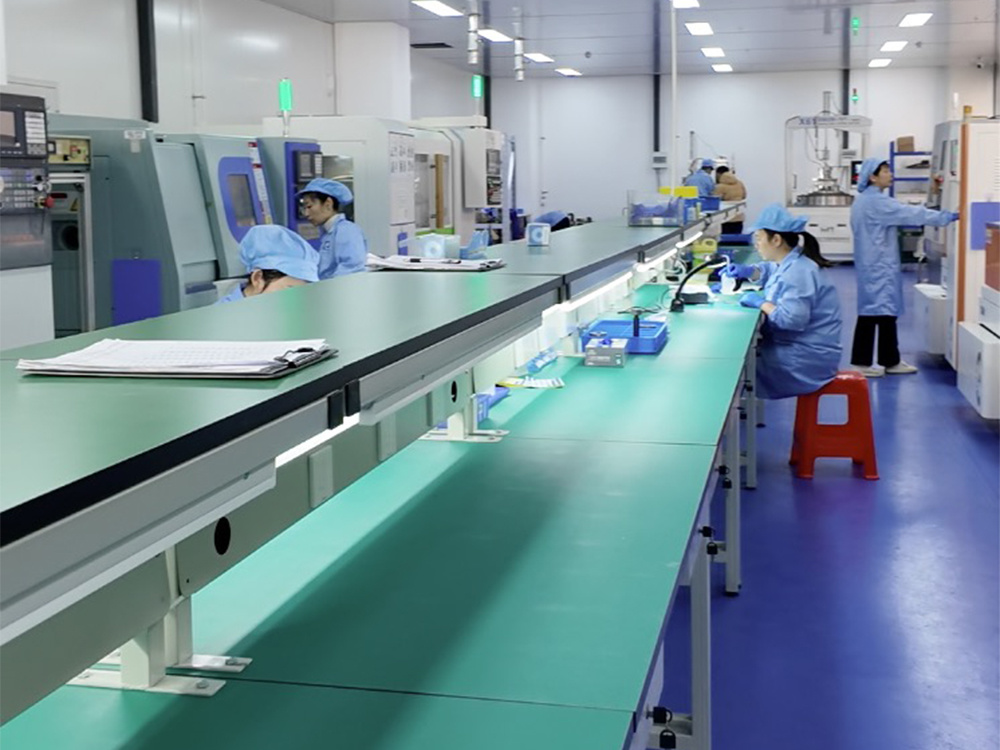
For cleanroom buyers, the most relevant part of the company record is the 2023 Nantong WINTIME Semiconductor Special Materials project. It carried a total investment of nearly tens of millions of yuan, added a new factory and auxiliary buildings of 34,000 square metres, and established an annual production capacity of more than 1 million pieces of dicing blades. The company holds 2 patent technologies and has received awards in national, provincial and municipal science and technology competitions and entrepreneurship competitions. Its completed Ultra-thin Wafer D Blade project achieved a process thickness of less than 9 microns, and the company is one of the few domestic manufacturers able to achieve mass production of that specification.
These are capability facts rather than compliance certificates, and they should be read as such. What they do support is the argument that a sub-9 µm blade is not a laboratory demonstration for this supplier but a production item backed by a dedicated facility and a documented competition record — the type of background that qualification teams use when assessing whether a specification will still be met at the tenth order rather than the first.
On the compliance side specifically, the company's stated controls include an ISO 9001 quality management system, strict adherence to standard operating procedures, dedicated quality inspectors tracking each production batch, and a batch quality file that can be traced at any time, with recall of nonconforming batches if a problem occurs. Production capacity for ongoing supply is quoted at over 800,000 pieces per month for standard specifications and over 80,000 pieces per month for customised and special-shaped products.
Where Ultra-Thin Stops Being the Right Answer
An honest qualification discussion has to include the boundaries of the specification being qualified. Ultra-thin sawing blades are not universally superior, and treating them as a default choice creates its own compliance risk.
- Reduced lateral stiffness. As blade thickness falls toward and below 9 µm, lateral rigidity falls with it. Process windows narrow, and sensitivity to spindle runout, vibration and handling error increases. A blade that qualifies on one dicer may not qualify on another with different mechanical condition.
- Interface dependency. Hubless configurations remove hub mass, which improves stability on thin substrates below 50 µm but shifts more of the stability burden onto the flange and spindle interface. Qualification is therefore equipment-specific and often requires re-verification after machine changes.
- Material limits. Ultra-thin blades are less suited to thick, highly abrasive substrates, where metal bond blades retain a 33% share of the dicing blade market precisely because harder materials demand more robust bonds and greater removal capability per pass.
- Total cost, not unit price. Thinner blades can increase breakage frequency and blade-change events, each of which may trigger requalification in a controlled environment. The relevant metric is qualified output per blade, not pieces per box.
- Documentation is not a substitute for in-fab validation. No supplier record replaces a controlled trial on the buyer's own equipment with the buyer's own material stack. Supplier evidence reduces the probability of failure; it does not remove the requirement to verify.
Application Contexts Where Ultra-Thin Qualification Matters Most
The demand for sub-9 µm dimensional control concentrates in applications where material value per square millimetre is high and kerf loss is expensive.
- Semiconductor wafer dicing. The global wafer dicing blade market was valued at USD 1.19 billion in 2024, driven by semiconductor miniaturisation and the adoption of 300 mm wafers — the same transition that has pushed hubless blades toward dominance.
- Optical communication and RF/optoelectronics. These applications accounted for 16% of dicing blade market share in 2024, equivalent to USD 69.9 million, supported by 5G infrastructure expansion. Devices in this segment often combine brittle and metallic layers, making chipping control and static control simultaneously relevant.
- Functional ceramics. Ceramic substrates respond strongly to bond selection and cooling conditions, so the qualified blade specification must be tied to the material grade, not to the equipment alone.
- Alloy and composite materials. Mixed-material stacks load the blade unevenly and are a common source of premature wear, which makes adjacent-batch consistency testing a meaningful control rather than a formality.
WINTIME's blade portfolio addresses these segments across a range of series, including the DZY Series wafer sawing blade, the DZR Series sawing blade, the DZR-S Series slotted sawing blade and the electroforming hard sawing blade, alongside diamond sawing blade and hubless sawing blade formats. For qualification purposes, the series name is less important than the paired documentation: which series was tested, on which material, under which cleanroom condition, and with which batch record.
Market Signals Relevant to Long-Term Cleanroom Supply
Qualification decisions have a supply dimension. Once a blade is approved inside a controlled process, switching suppliers carries a requalification cost, so buyers increasingly evaluate continuity at the same time as specification.
Several verifiable signals are worth noting. The global diamond saw blade market was valued at approximately USD 8.60 billion in 2025 and is projected to reach USD 10.16 billion by 2032, indicating sustained demand at both the industrial and precision ends of the category. Trade data shows China's exports of cutting blades to Vietnam, India and South Korea growing significantly between 2024 and 2025, with Vietnam increasing by USD 18 million and India by USD 12 million — a shift that increases the number of Asian sourcing options available to cleanroom buyers and, with them, the importance of comparable qualification evidence across suppliers.
One caution applies to all market data in this segment. Published estimates for the 2024 dicing blade market differ substantially by scope: one source places it at USD 1.31 billion while another reports USD 0.437 billion, largely because equipment and consumable boundaries are drawn differently. Buyers citing market size in internal documents should state the source and scope rather than averaging the numbers.
Future Outlook
Two directions appear stable. First, dimensional specifications will continue to tighten as substrates thin, which pushes qualification weight further toward process control and batch documentation rather than final inspection. Second, qualification is becoming a data exercise: batch quality files, adjacent-batch comparison records and third-party inspection results are increasingly requested as standard attachments to technical quotations, not as exceptional requests.
For manufacturers, the implication is that capacity and documentation must scale together. For buyers, the implication is that the most useful supplier question in a cleanroom context is not whether a blade can achieve 9 µm, but which records prove that it achieved 9 µm on a defined material, in a defined environment, and can do so again in the next batch.
FAQ
What are the purchasing terms and acceptance criteria for cleanroom-grade sawing blades?
Standard models are quoted at a minimum order quantity of 100 pieces per order, with MOQ negotiable for long-term cooperative customers or bulk purchase plans. Customised models carry a minimum order quantity of 500 pieces per order; for small-batch trial orders below 500 pieces, the MOQ can be flexibly adjusted with a slight price adjustment based on customisation complexity. Delivery terms are FOB or CIF. Acceptance criteria combine a pre-shipment test with third-party inspection, such as SGS, and payment terms are 30/70.
How is batch-to-batch quality consistency controlled for ultra-thin blades?
The stated controls operate at three levels. Process standardisation and automated production equipment reduce manual operation error, and all process parameters are recorded in a batch production data tracking system. Adjacent production batches undergo comparative testing to confirm consistent performance. On the quality side, an ISO 9001 quality management system and standard operating procedures govern production, dedicated quality inspectors track each batch, and a batch quality file allows any delivered unit to be traced and nonconforming batches to be recalled if a problem occurs.
Which blade configurations are used for ultra-thin wafer dicing, and why?
Hubless dicing blades are increasingly dominant for 300 mm wafer processing because they provide superior stability and reduced runout on thinner substrates below 50 µm. On the bond side, resin bond blades held a 42% share of the dicing blade market in 2024, while metal bond blades, used for harder materials such as SiC, accounted for 33%. The choice depends on substrate hardness and on the required surface and chipping quality rather than on thickness alone.
What production capacity supports long-term cleanroom supply commitments?
WINTIME's factory has a monthly production capacity of over 800,000 pieces for standard specifications and over 80,000 pieces per month for customised and special-shaped products. The 2023 Nantong WINTIME Semiconductor Special Materials project added a new factory and auxiliary buildings of 34,000 square metres and established an annual production capacity of more than 1 million pieces of dicing blades, giving buyers a capacity baseline to compare against forecasted demand.
How should a buyer verify claims about ultra-thin blade capability?
Treat supplier statements, market data and award records as different evidence classes. Standard classification should be anchored to recognised references such as ISO 22180:2019, which categorises diamond tools including sawing blades and distinguishes CVD diamond-coated from monocrystalline or polycrystalline types. Market figures should be cited with source and scope, given the wide divergence between published estimates. Supplier capability should be verified through the documents that accompany the sample: batch quality file, adjacent-batch comparison results, pre-shipment test records and third-party inspection reports, followed by in-fab validation on the buyer's own equipment and material stack.
Additional technical detail on blade specifications and cutting solutions is available in the WINTIME product brochure (PDF), and company information is published at en.wintime.net.cn.