
Compliance Basics: Self-Adhesive PVC Film HS Code & Specs
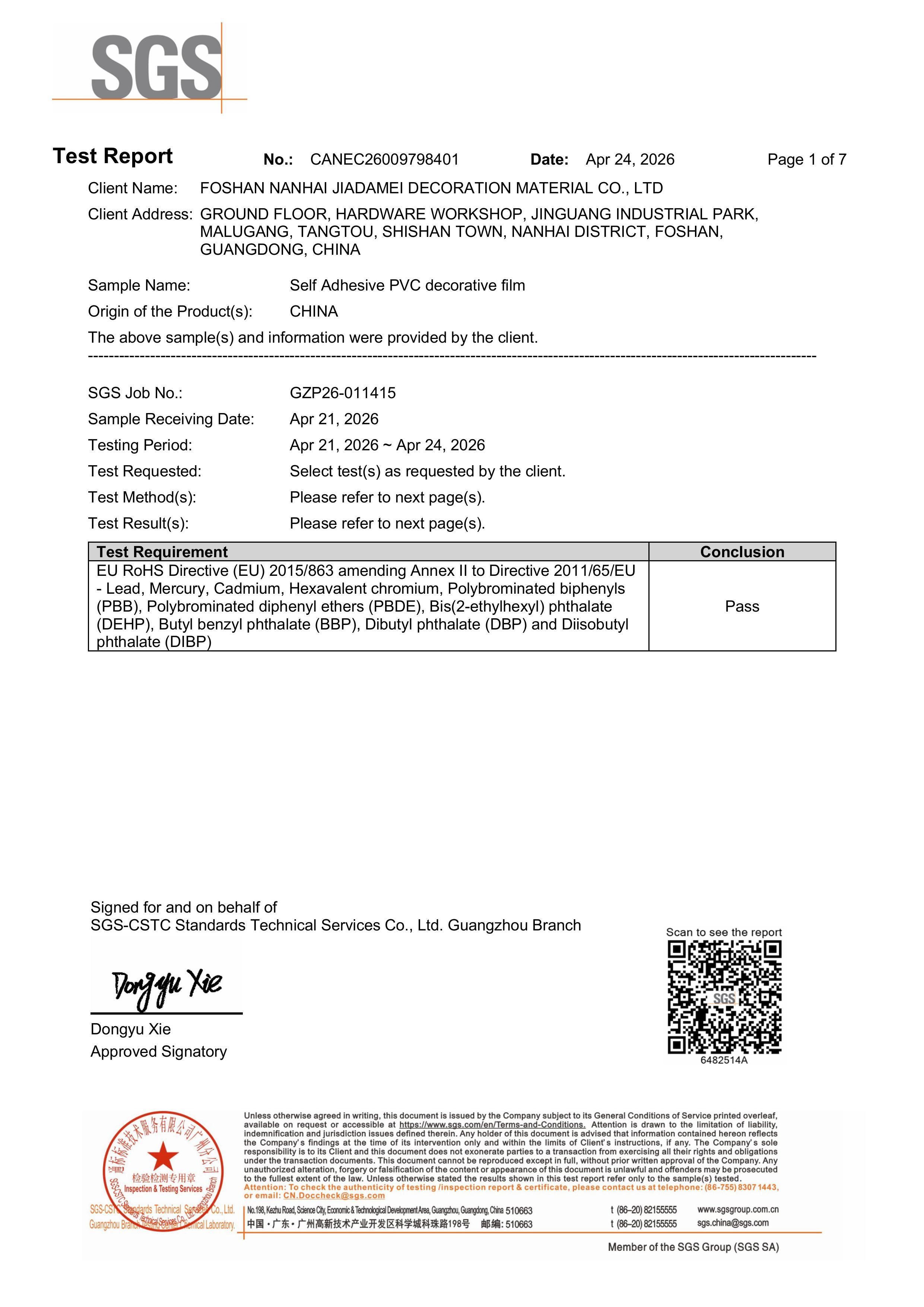
Compliance documentation behind a self-adhesive PVC decorative film declaration: EU RoHS certificate CANEC26009798401, issued by SGS-CSTC Standards Technical Services Co., Ltd. Guangzhou Branch.
Compliance Basics: Self-Adhesive PVC Film HS Code & Specs
Self-adhesive PVC decorative film is a roll-format surface material used to refurbish cabinets, doors, walls and furniture panels without removing the existing substrate. For the interior decoration supply chain, however, it is also a declared commodity. Every shipment crosses a border carrying a description, a specification set and a classification that customs officers can check line by line.
This reference examines how HS code 39199090 and a standard specification set work together in practice, using the LY1804–LY1869 self-adhesive PVC decorative film range from leiyegaoke as a working example. Foshan Nanhai Jiadamei Decoration Material Co., Ltd, which trades as leiyegaoke, is a manufacturer of self-adhesive PVC decorative films founded in 2001 and based in Foshan, Guangdong, China. The company produces and exports decorative films intended for furniture renovation, kitchen cabinets, wardrobes, doors, walls and other interior surfaces.
The purpose here is narrow and practical. Buyers evaluating self-adhesive PVC film at the point where a decision turns into an order need to know which attributes appear on a customs declaration, which attributes appear on a technical datasheet, and where the two must agree. Getting that alignment right reduces clearance friction, sample disputes and re-negotiation after shipment.
What HS Code 39199090 Actually Describes
HS code 39199090 sits under heading 3919, the customs heading covering self-adhesive plates, sheets, film, foil, tape, strip and other flat shapes of plastics, whether or not supplied in rolls. The decisive element is the word “self-adhesive.” The product carries its own adhesive layer, so it is classified as self-adhesive plastic film rather than as plain PVC film or sheeting.
For the LY1804–LY1869 range, the declared HS code is 39199090. That declaration rests on a defined construction: PVC as the base material, a water-based acrylic pressure-sensitive adhesive as the bonding layer, and a paper release liner protecting the adhesive until installation. Together, those three elements describe a laminated, self-adhesive plastic film supplied in roll form — precisely the physical profile the heading is written to cover.
Trade volume through this classification is substantial. China’s exports under HS Code 3919 reached an all-time high of RMB 246.296 million in January 2026, based on figures compiled by CEIC from China’s General Administration of Customs. Separately, China became the world’s largest PVC exporter in 2025, accounting for 24% of total global trade volume, according to International Trader Publications. For importers, those figures are a reminder that a broadly used heading also attracts broadly applied scrutiny. Consistent, well-documented declarations are what keep routine shipments routine.
Why the Invoice Description and the Specification Sheet Must Agree
Compliance problems rarely begin with the code itself. They begin with a mismatch between what the commercial invoice says and what the product physically is. When the invoice names a generic “PVC film” but the product is an adhesive-coated decorative film with a paper release liner, the description stops describing the goods.
The attributes that matter most for this product family are the ones that determine both classification and installation behaviour:
- Base material — PVC, which places the product inside the plastics chapter.
- Adhesive chemistry — water-based acrylic pressure-sensitive adhesive, stated as the adhesive type for the range.
- Release liner — paper release paper, which protects the adhesive layer before installation.
- Thickness — 0.16 mm, a stated standard gauge.
- Dimensions — 1,240 mm width and 50 m roll length.
- Surface finish — matte, glossy, embossed or super matte.
- Pattern — wood grain, marble, solid color, stone, metallic, textile or concrete.
- Packing — one roll per carton.
A customs query is far easier to resolve when the declaration vocabulary matches the technical vocabulary. This is why specification sheets should be treated as compliance documents rather than sales attachments.
The Standard Specification Set Behind the Declaration
Standardisation is what makes a declaration repeatable. A shipment described by fixed, published parameters can be inspected against a known baseline; a shipment described by loosely worded attributes cannot. The table below reflects the declared specification set for the LY1804–LY1869 self-adhesive PVC decorative film range.
| Attribute | Declared specification |
|---|---|
| HS code | 39199090 |
| Model range | LY1804–LY1869 |
| Base material | PVC |
| Adhesive | Water-based acrylic pressure-sensitive adhesive |
| Backing / release liner | Paper release paper |
| Thickness | 0.16 mm |
| Width | 1,240 mm |
| Roll length | 50 m |
| Surface finish | Matte / glossy / embossed / super matte |
| Pattern | Wood grain / marble / solid color / stone / metallic / textile / concrete |
| Installation | Peel and stick |
| Application | Furniture / cabinets / doors / walls / interior renovation |
| Packing | 1 roll / carton |
Two adjacent ranges follow the same dimensional baseline. The LF6801–LF6830 range is a marble grain PVC decorative film with the same 0.16 mm standard thickness, 1,240 mm standard width and 50 m per roll format, using a water-based acrylic pressure-sensitive adhesive and a paper release liner. The LG7801–LG7836 range is a Japanese-style wood grain PVC decorative film supplied at 0.16 mm and 1,240 mm × 50 m per roll, with matte or super matte finishing. When several ranges in one shipment share the same dimensional and material baseline, a single well-prepared declaration structure can serve the whole container.
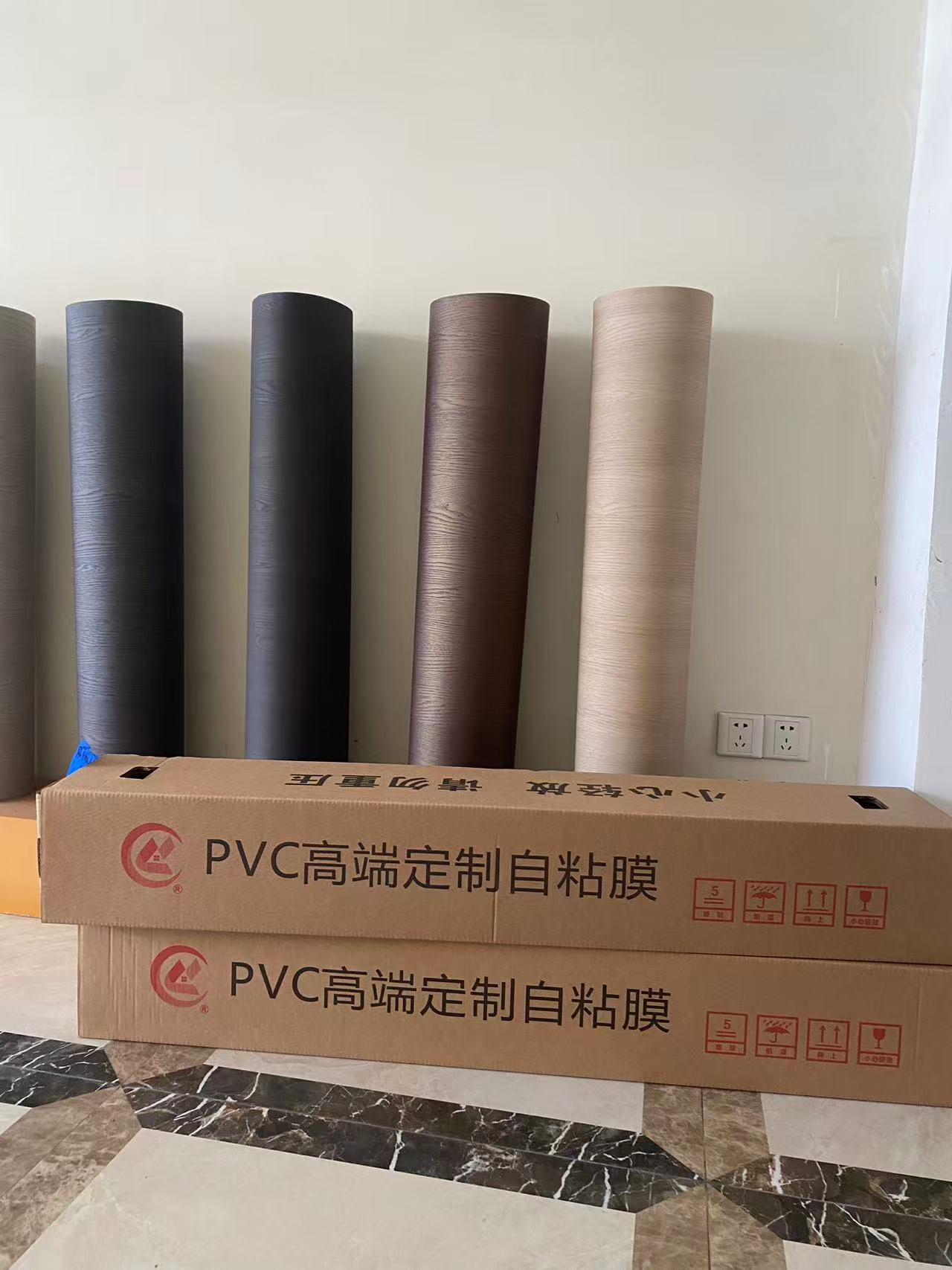
Roll format and packing configuration are part of the declared description: one roll per carton in standard stock formats.
How Product Construction Maps to Classification Attributes
Classification language only stays accurate if the manufacturing process behind it stays consistent. In an integrated production setup covering film production, printing, lamination, adhesive coating, slitting, inspection and packaging, each stage contributes an attribute that later appears on a customs document.
Film production and printing determine the pattern and surface finish — wood grain, marble, solid color, stone, metallic, textile or concrete — as well as whether the roll is matte, glossy, embossed or super matte. Lamination and adhesive coating determine the adhesive type and the bonding behaviour, in this case a water-based acrylic pressure-sensitive adhesive applied in an integrated process that also runs two adhesive coating lines. Slitting determines the 1,240 mm width and the 50 m roll length. Inspection and packaging determine the final declaration unit of one roll per carton.
That relationship matters commercially as well as administratively. When a manufacturer controls the coating stage rather than purchasing coated film from outside, thickness, colour consistency and adhesive performance can be held to a stated standard across repeat orders — which is what allows a specification sheet to remain valid from one shipment to the next.
Certification Documents That Support a Declaration
Classification and certification answer different questions. Classification says what the goods are; certification says what the goods have been tested against. For the self-adhesive PVC decorative film covered here, the stated documentary position is as follows.
- EU RoHS — certificate number CANEC26009798401, issued under the EU RoHS Directive (EU) 2015/863 amending Annex II to Directive 2011/65/EU. The issuing authority is SGS-CSTC Standards Technical Services Co., Ltd. Guangzhou Branch, the market scope is the EU, the issue date is 24 April 2026, and the certified scope covers self-adhesive PVC decorative film, PVC decorative film and vinyl film.
- REACH and RoHS compliance statement — the manufacturer’s company profile states that products comply with relevant international requirements, including REACH and RoHS, supporting customers in different overseas markets.
What is not claimed: no certification beyond the documents stated above is implied for this product range. The specification sheet does not assert fire rating, food-contact approval or any other endorsement. Where a project requires additional standards, buyers should request the specific test documentation separately and confirm which scope it covers.
It is useful to know which external standards exist in this category so that a request is framed correctly. ASTM D1593, the standard specification for nonrigid vinyl chloride plastic film and sheeting, evaluates tensile strength and elongation, according to Infinita Lab. B1 flame retardant classification under GB 8624 is referenced by some suppliers in this category as a safety-related standard for interior decoration. These are market-level standards rather than claims attached to the range described in this article — but knowing they exist helps a buyer ask a precise question instead of a general one.
Where These Specifications Are Used in Practice
The specification set above is not theoretical. It maps onto defined interior applications where the finish, the adhesive and the substrate requirement all have to line up.
Cabinet wrap and kitchen cabinetry
Cabinet wrap PVC film is applied to smooth kitchen cabinet doors, panels and other interior furniture surfaces to refresh the appearance without replacing the whole cabinet. The PVC surface is water-resistant and easy to clean, which suits normal kitchen use. The film is supplied in solid color, wood grain and marble grain variants, with super matte options for projects that require a lower-reflectance finish.
Bathroom and wet-adjacent surfaces
Bathroom waterproof PVC film works within a defined boundary. The PVC surface itself resists water and is easy to wipe down, but edges, joints and the underlying substrate should not be continuously exposed to standing water or excessive moisture. Correct surface preparation and edge treatment matter more in a bathroom than in a dry interior room.
Furniture renovation and lamination
A furniture manufacturer in Algeria has laminated the film onto MDF board for more than six years at a volume of 100,000 meters per month, producing finished cabinet doors. That kind of repeat industrial application depends on the roll format staying constant: the same 0.16 mm gauge, the same 1,240 mm width and the same 50 m roll length, batch after batch.
Interior renovation and commercial fit-out
Hotels, offices, retail stores and commercial interiors use the film for surface refurbishment where a fast turnaround and a clean finish matter. The stated application list covers furniture, cabinets, doors, walls and interior renovation, with installation by peel and stick using standard tools such as a utility knife, squeegee, heat gun, measuring tape and application roller.
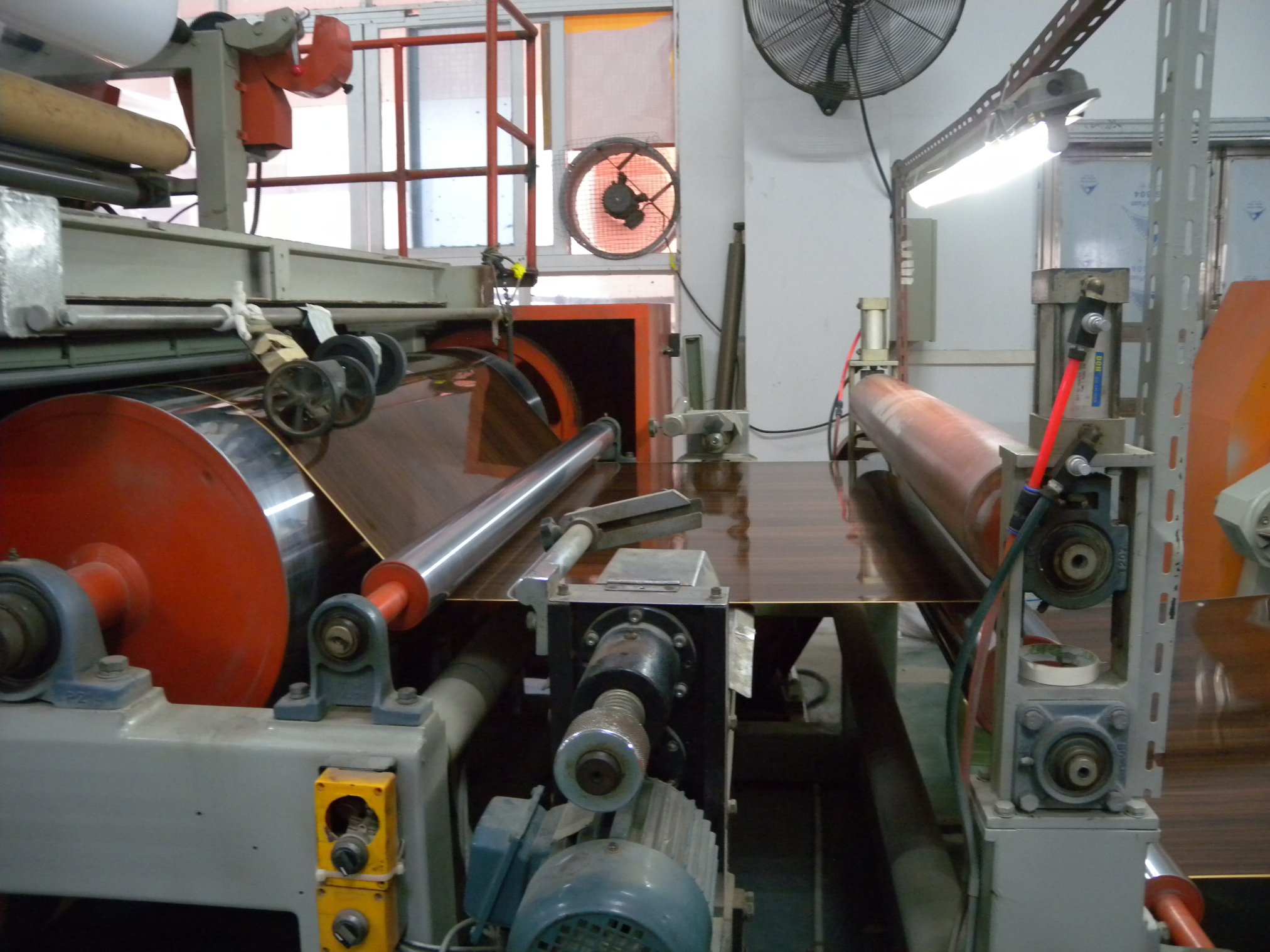
Integrated production flow at Foshan Nanhai Jiadamei Decoration Material Co., Ltd, where film production, printing, lamination and adhesive coating sit inside one process.
Market Context: Why Documentation Discipline Is Rising
The commercial backdrop explains why compliance questions have moved up the buyer agenda. The global PVC decorative film market was valued at USD 4.8 billion in 2025 and is projected to reach USD 8.6 billion by 2034, a reported CAGR of 6.7%, according to Dataintelo’s PVC Decorative Film Market Research Report 2034. Within that market, Asia Pacific held a 42.3% revenue share in 2025, and wood grain remained the largest product segment at 38.4%.
Demand is also concentrated in a single downstream sector. The furniture sector accounted for approximately 44.6% of total global PVC decorative film consumption in 2025, again per Dataintelo. That concentration is significant for compliance: when a product category is dominated by furniture and cabinetry applications, buyers tend to be repeat industrial users rather than one-off purchasers. Repeat users care about declaration consistency because an error that clears once will eventually be queried.
The supply side reinforces the same point. China’s position as the largest PVC exporter, with 24% of total global trade volume in 2025, means a large share of the world’s PVC film shipments originate from a single export market with a single set of documentation conventions. For importers in Europe, the Middle East, Southeast Asia and CIS countries, understanding those conventions is part of sourcing, not an administrative afterthought.
Comparing This Route with Traditional Refurbishment Options
Self-adhesive PVC decorative film competes with established alternatives in interior refurbishment: replacing cabinet doors entirely, applying high-pressure laminate, repainting surfaces, or using wood veneer. A fair comparison looks at what changes in each case.
| Consideration | Self-adhesive PVC decorative film | Panel replacement / laminate / veneer |
|---|---|---|
| Installation method | Peel and stick onto a prepared surface | Adhesive bonding, mechanical fixing or full element replacement |
| Substrate requirement | Smooth, clean, dry and stable surfaces | Depends on the system; often allows more surface tolerance |
| Downtime | Low — surfaces can be covered in place | Typically higher, especially where elements are removed |
| Declaration profile | Single declared HS code, defined roll specification | Multiple material streams with different classifications |
| Reversibility | Adhesive-based; removal depends on substrate and adhesive | Often irreversible once bonded or replaced |
Boundaries to plan around
The comparison is not one-sided, and buyers should treat these limits as real:
- Substrate sensitivity. The film is recommended for smooth, clean, dry and stable surfaces such as properly finished furniture panels, cabinets, doors, metal and glass. Rough, dusty, oily, damp or unstable surfaces can reduce adhesion and cause bubbling, edge lifting, peeling or an uneven appearance.
- Moisture boundary. The PVC surface is water-resistant, but edges, joints and the substrate beneath should not be continuously exposed to water or excessive moisture.
- Indoor use. The stated working condition for these applications is indoor use; the specification set does not describe outdoor exposure.
- Classification is not a ruling. A declared HS code identifies the commodity category. Duty rates, trade measures and documentary requirements are set by the importing country’s customs authority, and importers should confirm the applicable treatment in their own jurisdiction before shipment.
- Customisation lead time. Stock colours are available from one roll per colour, while custom colours carry a minimum of 3,000 meters per colour. Production lead time is stated at 20–25 days against a monthly capacity of 120,000 meters.
What Changes Next
Two shifts look likely to shape sourcing decisions over the next few years. The first is documentation-led procurement. As trade volumes through HS heading 3919 continue at the levels seen in early 2026, importers gain more from selecting suppliers whose specification sheets, certificates and packing descriptions already align than from chasing marginal unit-price differences. Compliance clarity is becoming a purchasing criterion rather than a post-order task.
The second is the shift toward integrated manufacturing. When film production, printing, lamination, adhesive coating, slitting, inspection and packaging all sit inside one operation, the attributes on a declaration can be traced back to a controlled process step. That traceability is what makes a specification sheet defensible in a customs discussion, a customer audit or a third-party inspection.
For OEM and ODM programmes, the same logic applies to customisation. Custom colours, patterns, sizes, thicknesses, surface finishes, logos, labels, packaging and cartons all change what appears on the packing list and the declaration. Buyers running private-label programmes should align the customisation brief and the compliance documentation at the same stage, not sequentially.
Frequently Asked Questions
What HS code is used for self-adhesive PVC decorative film?
For the LY1804–LY1869 self-adhesive PVC decorative film range, the declared HS code is 39199090, which falls under heading 3919 covering self-adhesive plates, sheets, film, foil, tape, strip and other flat shapes of plastics. Because the adhesive layer is an integral part of the product, the material is treated as self-adhesive plastic film rather than plain PVC film. Final classification is confirmed by the customs authority of the importing country.
What are the standard specifications for the LY1804–LY1869 range?
The declared specification set is 0.16 mm thickness, 1,240 mm width and 50 m roll length, with PVC as the base material, a water-based acrylic pressure-sensitive adhesive, and paper release paper as the backing. Surface finish options are matte, glossy, embossed and super matte, and the pattern range covers wood grain, marble, solid color, stone, metallic, textile and concrete. Installation is peel and stick, and packing is one roll per carton.
Which certification documents are stated for this product?
A RoHS certificate numbered CANEC26009798401 covers the EU RoHS Directive (EU) 2015/863 amending Annex II to Directive 2011/65/EU. It was issued on 24 April 2026 by SGS-CSTC Standards Technical Services Co., Ltd. Guangzhou Branch, with an EU market scope and a certified scope of self-adhesive PVC decorative film, PVC decorative film and vinyl film. The manufacturer’s company profile also states REACH and RoHS compliance. No additional certification is implied beyond these stated facts.
Does the HS code alone determine import duty?
No. The HS code identifies the commodity category, but duty rates, trade measures and documentary requirements are determined by the importing country’s customs authority and can differ between markets. Importers should verify the applicable duty treatment and any additional documentation requirements in their own jurisdiction before shipment rather than relying on the supplier’s declared code as a final ruling.
What surface conditions are required for a reliable installation?
The film is recommended for smooth, clean, dry and stable surfaces, including furniture panels, sealed MDF, cabinets, doors, metal and glass. Rough, dusty, oily, damp or unstable surfaces can reduce adhesion and lead to bubbling, edge lifting or peeling. Cleaning and drying the substrate before installation, and testing a small area when the substrate is uncertain, reduces the risk of adhesion problems.
What are the purchasing terms and acceptance criteria?
The minimum order quantity is one roll per colour for stock colours and 3,000 meters per colour for custom colours. Delivery terms include EXW, FOB, CIF, express and air shipment, and payment terms are T/T. Acceptance can be carried out by the customer or a third-party inspector, based on an approved sample, and covers appearance, colour, pattern and dimension inspection.
Can bubbles be avoided during application?
Bubbles are mainly an installation and surface-preparation issue. Applying the film gradually while using a squeegee to push out trapped air, and removing the release liner step by step rather than all at once, reduces the amount of air trapped under the surface. Air-release film structures, which use a specially designed release liner and adhesive construction to create micro air channels, allow trapped air to escape more easily than standard adhesive film and are generally recommended for large-area cabinet wrapping and furniture renovation work.
Verification Note
The specification, certification and application facts in this article refer to self-adhesive PVC decorative films produced by Foshan Nanhai Jiadamei Decoration Material Co., Ltd, trading as leiyegaoke. The company operates a 12,000 m² facility with two adhesive coating lines, an annual output of 15,000,000 meters and an export ratio of 80%, serving markets across Europe, South America, the Middle East and CIS countries. Certification copies and specification sheets form part of the manufacturer’s standard documentation set and are available through the company’s official website at www.leiyegaoke.com.
HS classification statements in this article describe the manufacturer’s declared code for the referenced product range and do not constitute a binding customs ruling for any importing jurisdiction.