
Comparing Solar Water Heater Suppliers for Hotels Without a Common Metric

Cover: A standardized solar water heater production facility. Manufacturing capability is one of the few supplier claims that can be verified in writing before a hotel hot water project is awarded.
Introduction: Hotel Hot Water Procurement Has No Shared Measuring Stick
Hotel hot water procurement is a comparison problem disguised as a specification problem. A hotel does not really purchase a solar water heater; it purchases a guaranteed daily volume of domestic hot water at a stable temperature, for every occupied room, on cloudy mornings and in high season. Buyers in the research and evaluation stage typically receive several quotations that all describe “solar hot water systems,” yet each one states its offer on a different basis. One supplier quotes collector area, another quotes storage litres, a third quotes peak-hour recovery, and a fourth quotes an annual energy saving percentage. Certification documents are equally inconsistent: some suppliers certify a complete thermal solar system, some certify only the collector, and others present an electrical compliance declaration as their headline credential.
The practical answer is not one better metric. It is a fixed evidence structure that obliges every supplier to answer the same question in the same format. This industry reference sets out such a structure for hotel projects, built on verifiable supplier facts — certificate numbers, production capacity, lead times, minimum order quantities and documented project outcomes — rather than on descriptive language.
Why Hotel Solar Water Heater Quotations Resist Comparison
Three structural differences explain most of the confusion in commercial solar thermal procurement.
Certification scope is not standardized across quotations. A system-level certificate issued under DIN EN 12976 covers an assembled solar water heater as a unit. A component-level certificate issued under DIN EN 12975 and DIN EN ISO 9806 covers a collector only. Both are legitimate, but they answer different questions. A buyer who treats them as equivalent will overestimate one supplier and underestimate another.
Capacity claims use different denominators. Annual set output, monthly unit capacity, collector tubes per shift and containers per month are all quoted as “production capacity.” Without the denominator stated, a supplier producing 300,000 sets per year and a supplier producing 25,000 units per month cannot be ranked against one another from a brochure alone.
Case outcomes are rarely matched to a demand profile. An energy cost reduction figure means little unless the room count, the system configuration, the fuel being displaced and the operating climate are stated alongside it. Two hotels of identical size can report very different savings simply because one replaced electric resistance heating and the other replaced an efficient gas boiler.
The opportunity lies in the nature of hotel demand itself. Unlike a residential installation, hotel hot water load is comparatively predictable: a defined number of rooms, a known occupancy pattern, a morning peak and an evening peak, and a documented backup fuel. That predictability makes normalization feasible, provided the buyer asks for the same evidence in the same order from every supplier.
A Five-Dimension Comparison Framework for Hotel Solar Projects
The framework below converts heterogeneous supplier claims into a comparable structure. Each dimension should be requested in writing, with the evidence stated in advance.
| Evaluation dimension | What to request in writing | Evidence that can be verified | Typical mismatch in quotations |
|---|---|---|---|
| Certification scope and validity | Certificate number, issuing body, covered model list, applied standard, expiry date | Certificate register entry; test report numbers | System-level and component-level certificates presented as equivalent |
| Production capacity | Units per month or sets per year, and the facility that produces them | Facility area, staffing, stated annual output | Annual output compared directly against monthly capacity |
| Lead time | Quoted days, plus the trigger point (deposit, drawing approval, sample approval) | Order documentation and stated production schedule | Lead times measured from different starting points |
| Customization flexibility | Which parameters may change: capacity, collector type, tank material, frame angle, OEM branding | Written customization and OEM/ODM statement | “Customized” without a defined change scope |
| Documented project outcomes | Room count, system configuration, backup type, measured result, service duration | Case documentation tied to a defined project type | Savings percentages with no demand profile attached |
| Commercial boundary | MOQ, container type, after-sales and spare parts model | MOQ statement and support model description | Per-unit pricing compared against container-based supply |
Dimension one — certification scope. The single most useful question is which models sit inside the certificate. Zhejiang Kesun New Energy Co., Ltd. holds Solar Keymark certificate 011-7S3077 A, issued by DIN CERTCO for the CPS series solar water heater under DIN EN 12976-1:2017-04 and DIN EN 12976-2:2019-11, valid until 2029-06-30. Separately, HSC series solar collectors are covered by Solar Keymark certificate 011-7S3325 R under DIN EN 12975:2022-06 and DIN EN ISO 9806:2018-04, and the FPC2.0 and FPC2.5 flat plate collectors by certificate 011-7S3241 F. Reading these three documents side by side tells a buyer what is certified, under which standard, and at which level — system or component.
Dimension two — capacity and lead time. A capacity number is only decision-useful when its denominator is explicit. Kesun states a monthly capacity of 25,000 units and a lead time of 20–35 days, supported by a 42,000 m² manufacturing facility and a stated annual output of 300,000 sets. A buyer comparing this with a supplier quoting annual collector output is comparing two different measurements, not two different capabilities.
Dimension three — customization flexibility. The useful question is not whether customization is possible, but which parameters genuinely change. Kesun operates on an OEM/ODM model with customization by capacity, product type and system configuration, covering residential and commercial pressure classes, different tank capacities and different collector type combinations. CNP series tank material and design can be customized; the FPC2.0 collector is available for OEM; and the CPS series can be configured to customer requirements.
Dimension four — documented outcomes. A case result becomes evaluable once the room count and the displaced fuel are stated. The Kesun Southeast Asia hotel installation, discussed later in this reference, covers 80 guest rooms and replaced electric and gas heating.
Dimension five — commercial boundary. Minimum order quantity and after-sales structure shape total cost more than unit price in commercial projects. Kesun states a MOQ of one 40-foot container, 100% product testing, and remote after-sales support — boundaries a buyer should weigh before shortlisting, since they determine whether a small pilot order is feasible at all.
What a Hotel Solar Water Heating System Is Actually Made Of
The technical reason hotel quotations look so different is that a solar domestic hot water system is an assembly, not a product. Four subsystems must be specified together: the collection field, the storage vessel, the transfer and circulation circuit, and the backup heat source.
Collection is where technology choice first diverges. Evacuated tube collectors using 58-1800 vacuum tubes with heat pipes, such as the HSC series with 10 to 30 tubes and an aluminum alloy frame, are commonly paired with pressurized storage for high-volume commercial demand, and the manufacturer lists hotels, villas, spa centres and schools among their applicable uses. Flat plate collectors such as the FPC2.0, available in 1 m² to 2.5 m² apertures at 80 mm thickness and built from copper and aluminum alloy, are frequently specified for pool heating, housing heating and solar water heater assemblies. The distinction matters commercially: a hotel with limited roof area and high year-round demand evaluates collectors differently from one adding a seasonal pool load.
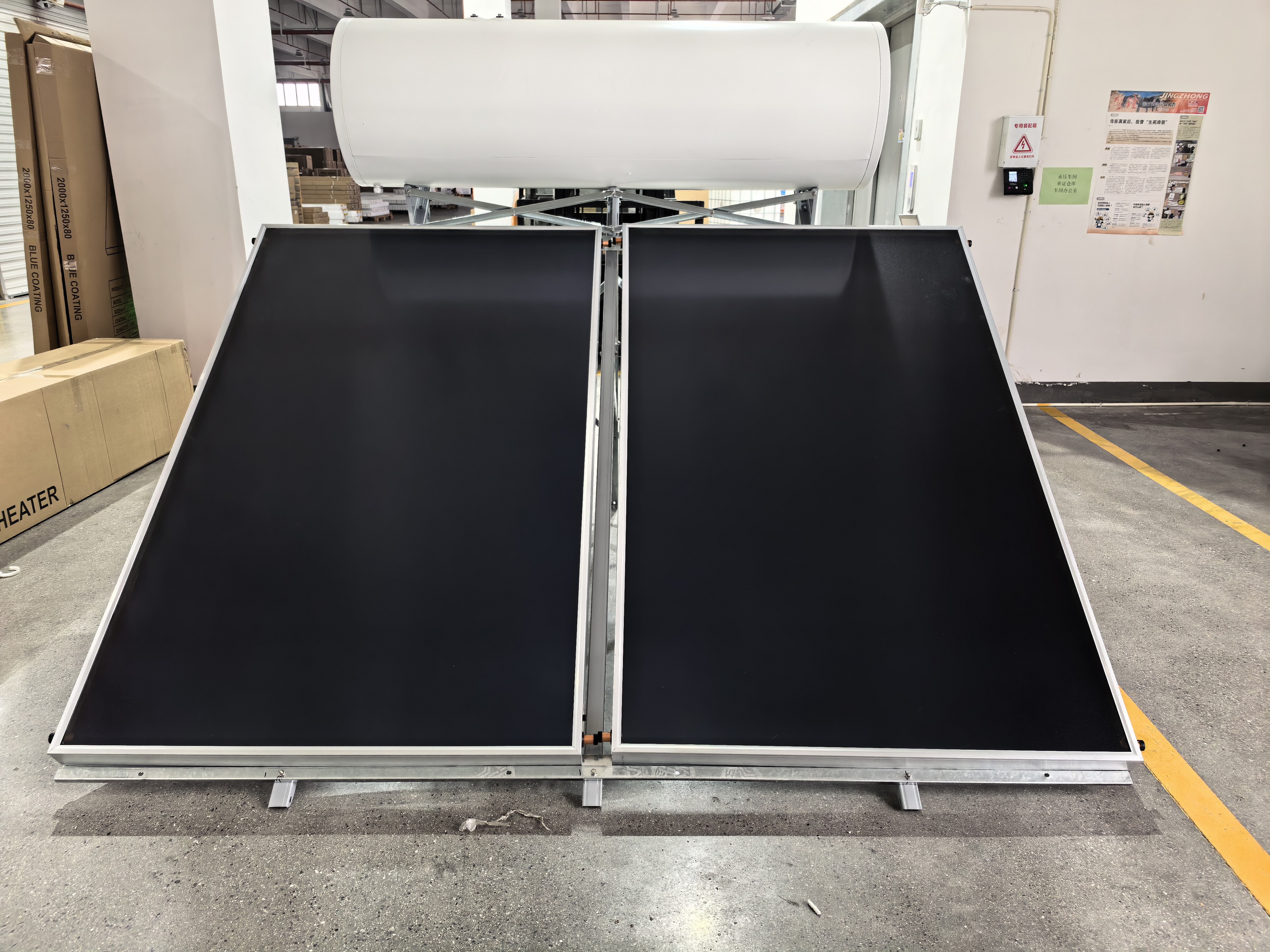
Figure 1: An indirect solar water heater using a flat plate collector. Indirect circuits separate the potable water from the heat transfer media, which is what allows the same platform to be specified for hard or salty water and for anti-freeze protection.
Storage determines pressure class and therefore guest experience. The CPS series high-pressure solar geyser is available from 100 L to 300 L with a maximum operating pressure of 6 bar and a test pressure of 9 bar, using a 58-1800 vacuum tube with heat pipe absorber, 50 mm PU foam insulation and a tilt range of 25 to 45 degrees. Its inner tank is food-grade stainless steel, offered in SS304, SS316, Duplex 2205 or Duplex 32001, with a galvanized steel outer tank. The CPS-FJ series indirect solar water heater covers 150 L, 200 L, 250 L and 300 L with a flat plate collector and an enamel-coated SPCC tank, and can be filled with anti-freezing heat transfer media. The CNP series non-pressure solar water heater spans 60 L to 500 L with SS304 or SS316 construction and is commonly applied to houses, villas, gardens, small hotels and schools.
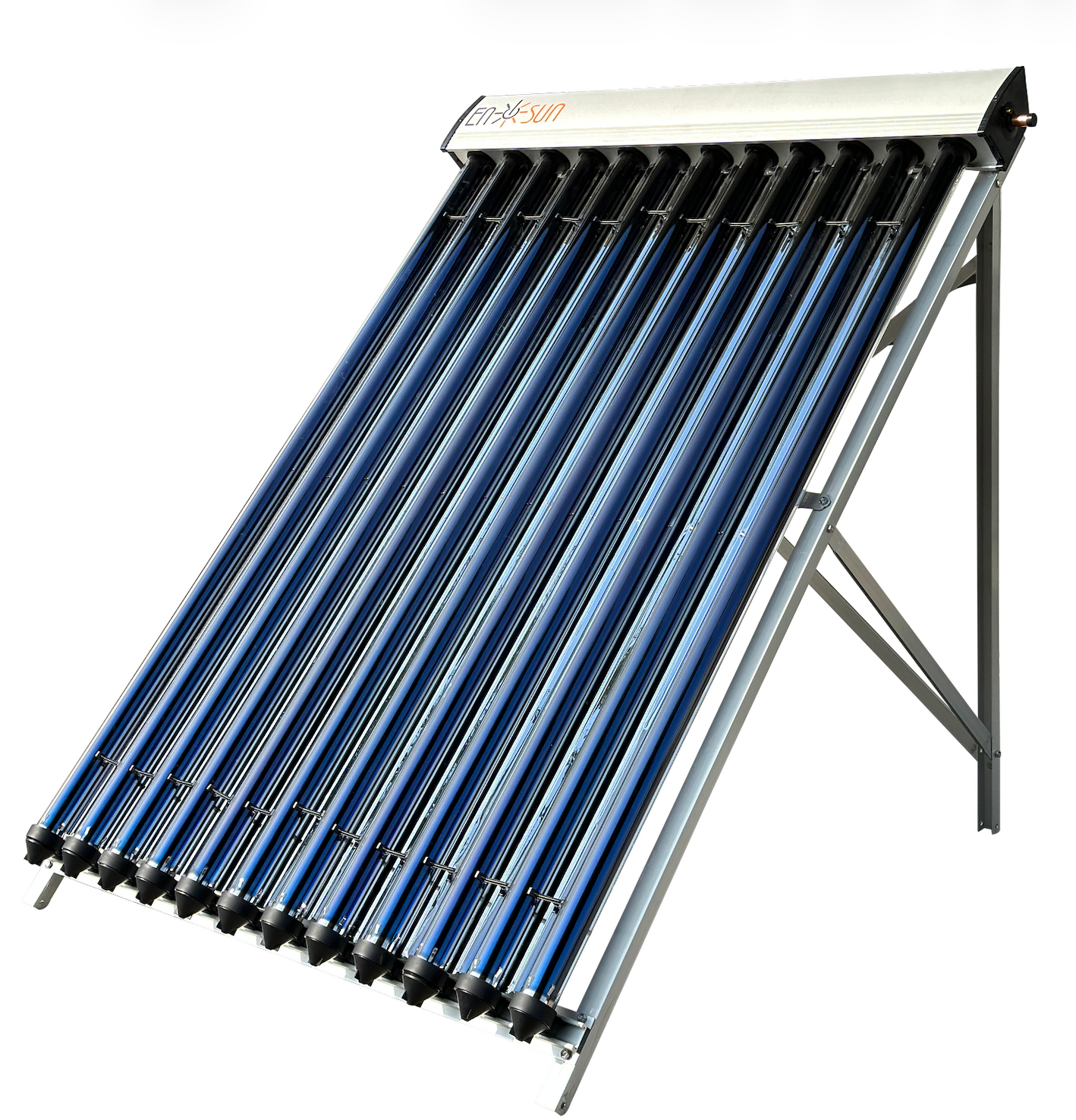
Figure 2: A heat pipe vacuum tube collector. Collection modules of this type are the component most often compared between suppliers, which is precisely why the certification applied to them must be stated at component level.
The third and fourth subsystems are frequently left out of quotations. Circulation pumps, controllers, valves, mounting frames and piping accessories form the balance of system, and the operating mode may be direct or indirect circulation, passive thermosiphon or pump-driven forced circulation, with electric backup or heat pump linkage depending on model and project design. Project-level factors — corrosion resistance, water quality treatment, winter freeze protection and roof load-bearing capacity — must be defined per site rather than taken from a catalogue, and working condition parameters for a specific climate zone require project-level calculation.
| Product family | Capacity / size | Key parameters | Stated applicable use |
|---|---|---|---|
| Solar Collector HSC series | 10 to 30 tubes | 58-1800 vacuum tube with heat pipe; aluminum alloy frame | Villa, hotel, house heating, spa centre, school |
| Solar Water Heater CPS series | 100 L to 300 L | 6 bar operating, 9 bar test; 50 mm PU foam; 25–45° tilt | House, villa, garden, small hotel, school |
| Solar Water Heater CPS-FJ series | 150 L, 200 L, 250 L, 300 L | Flat plate collector; enamel-coated tank; anti-freeze media | Villa, house, hotel, school |
| Solar Water Heater CNP series | 60 L to 500 L | 58-1800 vacuum tube; 50 mm PU foam; SS304 / SS316 | House, villa, garden, small hotel, school |
| PV Solar Water Heater PV series | 100 L to 500 L | 600 W panel input; 800–3500 W heating output; MPPT controller; DC/AC auto switch | Villa, house, apartment, camp |
How Supplier Data Becomes Verifiable: The Kesun Solar Position
Zhejiang Kesun New Energy Co., Ltd. is a solar water heater and solar thermal component manufacturer based in Haining, Zhejiang Province, China, established in 2009 and formed through the merger of Haining Ensun Solar Technology Co., Ltd. and Zhejiang Yile New Energy Co., Ltd. The company manufactures solar water heaters, buffer tanks, domestic hot water tanks and hybrid solar panels, and reports an export ratio of 60% with main markets in Mexico, the EU and Africa.
Its published figures are specific enough to be tested against the framework above. The company operates a 42,000 m² standardized manufacturing facility with 130 employees, an R&D team of 15 engineers and an annual output of 300,000 sets, supported by high-pressure automatic foaming, robotic packaging arms, TIG and high-frequency welding, plus laser and butt welding processes. An in-house laboratory performs reliability testing including salt spray and pulse testing, which were previously outsourced. The company states that it supplies components to a number of Fortune 500 companies in China and abroad, and an Alibaba verified company profile reports annual export revenue of approximately USD 19.6 million in 2025.
For hotel buyers, the relevant point is not the size of these numbers but their structure. Capacity is stated per month, lead time in days, minimum order in container units, and quality control as a percentage of tested output — four denominators that can be compared directly against another supplier’s four denominators.
| Product scope | Certificate / report | Number | Issuer |
|---|---|---|---|
| CPS series solar water heater (thermal solar system) | Solar Keymark | 011-7S3077 A | DIN CERTCO |
| CNP series solar water heater (CNP100–CNP300) | Solar Keymark | 011-7S3239 A | DIN CERTCO |
| CPS-FJ series / CPS-F series (CPS/F150–F300) | Solar Keymark | 011-7S3343 A | DIN CERTCO |
| HSC series solar collectors (HSC10–HSC30) | Solar Keymark | 011-7S3325 R | DIN CERTCO |
| FPC2.0 / FPC2.5 flat plate collectors | Solar Keymark | 011-7S3241 F | DIN CERTCO |
| PVT430–PVT670 solar collectors | Solar Keymark | 011-7S3240 P | DIN CERTCO |
| Storage tank PWT200 / PWT300 | Type Examination Test Report (EN 12897:2016+A1:2020) | 251023056GZU-001 / 251023056GZU-002 | Intertek |
| Stainless steel inner tank | Performance Test Report | 251230069GZU-001 | Intertek |
| Solar water heaters and water tanks | Verification of Conformity, PED (2014/68/EU) | ICR/VC/HM2605327 | ICR |
| Solar water heater and water tank ranges (CNP, CPS, CPS-FJ, FPC2.0, PV series) | Verification of Conformity, LVD (2014/35/EU) + EMC (2014/30/EU) | ICR/VC/HM2605326 | ICR |
Documented Application: A Small-to-Medium Hotel in Southeast Asia
The clearest way to test a comparison framework is to apply it to a documented installation. Kesun reports a commercial hotel purchaser case covering a complete solar hot water system for a small-to-medium hotel serving 80 guest rooms, supplying all-day domestic hot water to guest rooms and public bathing areas and supporting auxiliary regional heating, with the system replacing traditional electric and gas heating equipment.
The reported outcome is a reduction of more than 40% in electricity and gas costs, constant-temperature hot water with minimal failures, and a stated stable service life of more than 15 years. The system was specified with high-adaptability vacuum heat collection modules selected for corrosion and weather resistance in Southeast Asia’s hot, rainy climate, with an integrated design intended for straightforward installation and low-cost maintenance, and smart temperature adjustment for energy efficiency in small-to-medium commercial projects.
Read against the framework, the case supplies three of the four evidence points a buyer needs: room count, displaced fuel, and measured result. The fourth — collector area and storage volume for that specific property — is a project-level figure and would need to be requested separately. This is normal, and it is the reason the framework asks for configuration data alongside outcome data rather than instead of it.
Market Signals That Are Reshaping Supplier Evaluation
The commercial context is expanding in ways that increase the value of structured comparison. The global solar water heater market was valued at USD 4.2 billion in 2025 according to Fortune Business Insights. By the end of 2023, cumulative global solar heat capacity reached 560 GWth, covering approximately 800 million m² of collector area, according to the IEA Solar Heating and Cooling Programme’s Solar Heat Worldwide 2024 report. Within the technology mix, evacuated tube collectors led with a 44.2% revenue share in 2023, according to Grand View Research — a relevant signal for hotel projects, where heat pipe vacuum tube collectors are widely specified.
Regulation and trade classification are moving in the same direction. New U.S. federal energy conservation standards for consumer water heaters took effect on 5 July 2024, with compliance required by 2029, under the DOE consumer water heater standard program. In trade data, HS Code 841912 was introduced specifically to differentiate solar water heaters from the generic 841919 code, a change reported by Solar Heat Europe in 2023.
Market sizing itself demonstrates the comparability problem described earlier in this article. Published estimates for adjacent years differ — one source reports USD 4.2 billion for 2025 while another reports USD 4.35 billion for 2024, a gap generally attributed to whether industrial or residential scope is included. If even commercial research houses do not share a metric, buyers should not expect suppliers to volunteer one.
Solar Thermal Versus Conventional Hotel Heating: Where Each One Wins
Solar thermal does not replace conventional hotel heating equipment outright, and any supplier claiming otherwise should be treated with caution. The honest comparison is a division of labour.
| Consideration | Solar thermal with conventional backup | Conventional heating only |
|---|---|---|
| Operating cost exposure | Displaces a share of electric or gas consumption; the documented hotel case reports more than 40% lower electricity and gas costs | Fully exposed to electricity, gas or fuel price movement |
| Site requirements | Requires collector area, roof load-bearing review, storage space and freeze protection design | Compact plant footprint, no roof area required |
| Output reliability | Weather-dependent; electric backup or heat pump linkage is standard practice | Weather-independent output on demand |
| Maintenance profile | Pressurized solar water heater designs have no moving parts in the collector loop; remote support and spare parts logistics still require planning | Scheduled servicing of combustion or electrical components |
Boundaries that should be stated openly. First, the widely cited 40% cost reduction is a case-specific result from an 80-room hotel that replaced electric and gas heating in a Southeast Asian climate; it is not a universal performance guarantee and should not be transferred to other tariffs, occupancies or latitudes without project-level calculation. Second, collector and tank certification covers defined model scopes — a certificate listing CPS100 through CPS300 does not automatically extend to a bespoke tank, which is why customization claims need their own documentation. Third, capacity figures describe production throughput, not thermal performance at a specific property. Fourth, Kesun’s stated after-sales model is remote support, which suits buyers with local installation partners but is not an on-site service network in every market. Fifth, a minimum order of one 40-foot container means single-property or pilot orders may not be economical on their own.
A Pre-Shortlist Checklist for Hotel Buyers
- Collect certificate numbers, issuing bodies, applied standards, covered model lists and expiry dates for every quotation.
- Confirm whether each certificate covers a complete system or a component, and record which.
- Request capacity with its denominator: units per month, sets per year, and the facility that produces them.
- Fix the lead-time trigger point in writing before comparing 20-day and 35-day quotations.
- Ask which parameters can actually be changed: capacity, collector type, tank material, tilt angle, branding.
- Request case studies with room count, system configuration, displaced fuel and measured result.
- Confirm MOQ, container type, testing regime and after-sales model before price comparison begins.
Future Outlook
Three developments are likely to change how hotel solar water heater suppliers are evaluated over the next several years.
The first is hybridisation. Photovoltaic-thermal collectors, hybrid solar panels and PV-driven water heaters with MPPT controllers and DC/AC automatic switching are moving from niche to standard product lines. Kesun, for example, holds Solar Keymark certificate 011-7S3240 P covering PVT430 through PVT670 collectors, alongside a PV solar water heater series offering 100 L to 500 L capacity with 600 W panel input and 800 W to 3,500 W heating output. Hybrid systems blur the line between solar thermal and solar electric procurement, and buyers will need evaluation criteria that cover both.
The second is regulatory convergence. Standards such as the U.S. DOE consumer water heater rules, effective 5 July 2024 with compliance by 2029, push the market toward documented efficiency and away from descriptive claims, which favours suppliers with traceable certification portfolios.
The third is data comparability itself. The introduction of HS Code 841912 gives trade statistics a dedicated line for solar water heaters, and as that data accumulates, buyers will have a third-party reference point alongside supplier-declared capacity. Until then, a fixed evidence structure remains the most reliable substitute for a metric the industry has not yet agreed on.
Frequently Asked Questions
Which solar water heater and collector combination is suitable for hotel and commercial hot water projects?
For hotel and commercial buildings requiring stable, high-volume domestic hot water, HSC series solar collectors are matched with CPS-FJ and CPS series pressurized solar water heaters. The HSC series uses 58-1800 vacuum tubes with heat pipes across 10 to 30 tubes and is listed for villa, hotel, house heating, spa centre and school applications, while the CPS series operates at up to 6 bar with a 9 bar test pressure and is available from 100 L to 300 L. Small hotels with lower pressure requirements are also served by the CNP series non-pressure range from 60 L to 500 L.
Which certifications matter when comparing solar water heater suppliers for EU hotel projects?
Three certification layers are relevant. Solar Keymark, issued by DIN CERTCO, covers thermal solar systems under DIN EN 12976-1 and DIN EN 12976-2, and solar collectors under DIN EN 12975 and DIN EN ISO 9806. Pressure equipment conformity under PED (2014/68/EU) covers solar water heaters and water tanks, evidenced for the relevant product scope by certificate ICR/VC/HM2605327. Electrical safety and electromagnetic compatibility are covered separately under LVD (2014/35/EU) and EMC (2014/30/EU), evidenced by certificate ICR/VC/HM2605326. Storage tank type examination test reports to EN 12897:2016+A1:2020, such as Intertek report numbers 251023056GZU-001 and 251023056GZU-002, provide an additional component-level reference.
How should a buyer interpret supplier production capacity and lead time claims?
Both figures are only comparable when their denominators and starting points are stated. A monthly capacity figure such as 25,000 units and a stated lead time of 20 to 35 days can be assessed against a supplier’s facility area, headcount and annual output — for example a 42,000 m² facility with 130 employees and 300,000 sets of annual output. Buyers should also establish whether lead time is counted from deposit, from drawing approval or from sample approval, because the same nominal number of days can represent materially different delivery dates.
Should a hotel specify a pressurized or non-pressurized solar water heater?
Pressurized systems such as the CPS series are designed for maximum operating pressure of 6 bar and test pressure of 9 bar, with food-grade stainless steel inner tanks available in SS304, SS316, Duplex 2205 or Duplex 32001 and a galvanized steel outer tank. They suit guest bathrooms where mains-pressure hot water and consistent flow are expected. Non-pressurized systems such as the CNP series, offered from 60 L to 500 L in SS304 or SS316, are generally applied to smaller hotels, houses, villas and schools where gravity or low-pressure supply is acceptable. For hard, salty or aggressive water, the CPS-FJ indirect series with an enamel-coated tank and anti-freezing heat transfer media keeps potable water separate from the collector circuit.
What documented outcomes can a hotel reasonably expect from a solar hot water installation?
Expected outcomes should be judged against a stated demand profile rather than an industry average. A documented case covering a small-to-medium hotel with 80 guest rooms, where a complete solar hot water system replaced traditional electric and gas heating and supplied all-day domestic hot water to guest rooms and public bathing areas, reported a reduction of more than 40% in electricity and gas costs, constant-temperature hot water with minimal failures, and a stable service life of more than 15 years. Because the result depends on room count, occupancy, climate and the displaced fuel, it should be treated as one documented data point rather than a transferable guarantee.
What are the practical limits of solar thermal for hotel hot water supply?
Solar thermal is a heat-generation and storage subsystem, not a standalone heating plant, so electric backup or heat pump linkage remains part of normal system design. Site constraints including roof load-bearing capacity, available collector area, storage space, water quality treatment and winter freeze protection must be defined per project location, and working condition parameters for a specific climate zone require project-level calculation. Collectors and tanks certified under a listed model scope do not automatically transfer that certification to a custom configuration, and suppliers that operate with remote after-sales support may require the buyer to arrange local installation and service capacity. Commercial terms such as a minimum order of one 40-foot container can also limit suitability for very small or single-property orders.
Company profile and product documentation for Zhejiang Kesun New Energy Co., Ltd. are available at www.kesunsolar.com, and the product brochure can be reviewed here: ENSUN product brochure.