
Comparing Orthodontic Pliers, Instruments and Auxiliaries
Independent Buyer Reference · Orthodontic Materials
Orthodontic materials are frequently purchased as one mixed list, with pliers, hand instruments and small auxiliaries sitting side by side on the same requisition. In clinical use and in procurement, the three groups behave very differently. A plier is a reusable precision tool whose performance depends on hardness, hinge behaviour and sterilization tolerance. A tweezer or positioning gauge is a handling instrument with its own sterilization ceiling. A crimpable hook or a bondable lingual button is a small attachment that is consumed during treatment. Comparing these categories through one set of neutral criteria — category coverage, item naming clarity, published parameters and documentation scope — produces a more reliable purchasing picture than comparing brands or unit prices in isolation.
This article is a buyer-side comparison of orthodontic pliers, instruments and auxiliaries. Product data is drawn from Yortho, the brand of Zhejiang YO Medical Technology Co., Ltd, an orthodontic device manufacturer whose product line covers orthodontic supplies, pediatric dental products and dental lab appliances, and which operates its own manufacturing facility in Huzhou, Zhejiang Province, China. Market context uses third-party data with named sources. No manufacturer ranking is implied, and the criteria below can be applied to any supplier catalogue.
Why Pliers, Instruments and Auxiliaries Cannot Be Compared as One Line Item
Clinical and dental clinic environments require orthodontic products to meet disinfection and sterilization conditions and routine dental handling standards. Within that single working environment, however, the operation mode of the categories diverges. Both single-use consumables and reusable instruments coexist in orthodontic practice — elastic ligatures are single-use, while pliers are reusable — and usage and maintenance follow each product's instructions. That single sentence from the operating conditions of the category explains most of the procurement complexity. A purchase list that treats all items as interchangeable will either over-specify consumables or under-specify instruments.
The difference shows up in four places. First, lifetime: pliers and instruments are capital items expected to survive repeated sterilization cycles, while auxiliaries such as crimpable hooks and lingual buttons are attached to the appliance and consumed. Second, failure mode: a plier fails through loss of cutting edge, hinge play or corrosion; an auxiliary fails through bonding failure or deformation. Third, documentation: reusable instruments carry sterilization parameters, while auxiliaries are specified by size, base design and pack format. Fourth, matched equipment: pliers sit alongside arch wires, buccal tubes, orthodontic bands, bonding adhesives or cements, curing lights and ligatures in the clinical sequence, whereas auxiliaries are attached to those same brackets and wires to redirect force.
A final constraint that applies to the whole category is material sensitivity. Biocompatibility, nickel-free or low-allergy material requirements apply in some markets, and compliance certification documents are expected alongside the goods. For a procurement team in the research-to-evaluation stage, that is the reason to compare supplier catalogues on structure and evidence rather than on product photographs.
A Seven-Point Comparison Framework
The framework below is designed to be applied line by line to a supplier catalogue. It is deliberately indifferent to brand: each criterion can be answered from published item names, published parameters and published certificate scope.
| Criterion | What the buyer checks | Why it changes the sourcing decision |
|---|---|---|
| 1. Category boundary | Does the supplier separate reusable pliers and instruments from single-use and bondable auxiliaries? | Determines whether sterilization, replacement and documentation are handled correctly per item. |
| 2. Item naming clarity | Does each item carry a model code plus a functional description plus a size? | Prevents mis-ordering between visually similar items such as cutters, removers and forming pliers. |
| 3. Parameter completeness | Material, hardness, sterilization temperature, slot or wire size, pack quantity. | Allows cross-checking against the clinical requirement list without requesting a quotation first. |
| 4. Sterilization profile | Maximum sterilization temperature and autoclave suitability per item. | Reusable items must survive the clinic's existing reprocessing routine. |
| 5. Documentation scope | Certificate type, number, issuing authority, market and product scope line. | Scope is item-specific; a certificate for one family does not automatically cover another. |
| 6. Order parameters | MOQ, lead time, packaging, customization options, quality control regime. | Determines whether a first trial order is commercially realistic. |
| 7. Clinical cross-check | Mapping each case type in the buyer's own practice to a named item. | Coverage in a catalogue is not the same as fit for a specific case mix. |
Category Coverage: What a Comparable Plier and Instrument Range Contains
Coverage should be read as functional completeness rather than list length. A useful range includes at least one instrument for each step: cutting, removing, forming, positioning and holding. The Yortho plier range illustrates how that maps onto models, and how published parameters differ by function.
| Model | Function | Material | Hardness (HRC) | Max sterilization temperature |
|---|---|---|---|---|
| Y-Q8001 | Light wire cutter 0° | Stainless steel | 58–63 | 180°C |
| Y-Q8005 | Distal end cutter | Stainless steel | 58–63 | 180°C |
| Y-Q8008 | Heavy cutter; cuts Australian wires, NiTi wires and stainless steel wires up to 0.030″ (0.76 mm) | Stainless steel | 58–63 | 180°C |
| Y-Q3001 | Hole punch pliers | High-hardness stainless steel | 58–63 | 180°C |
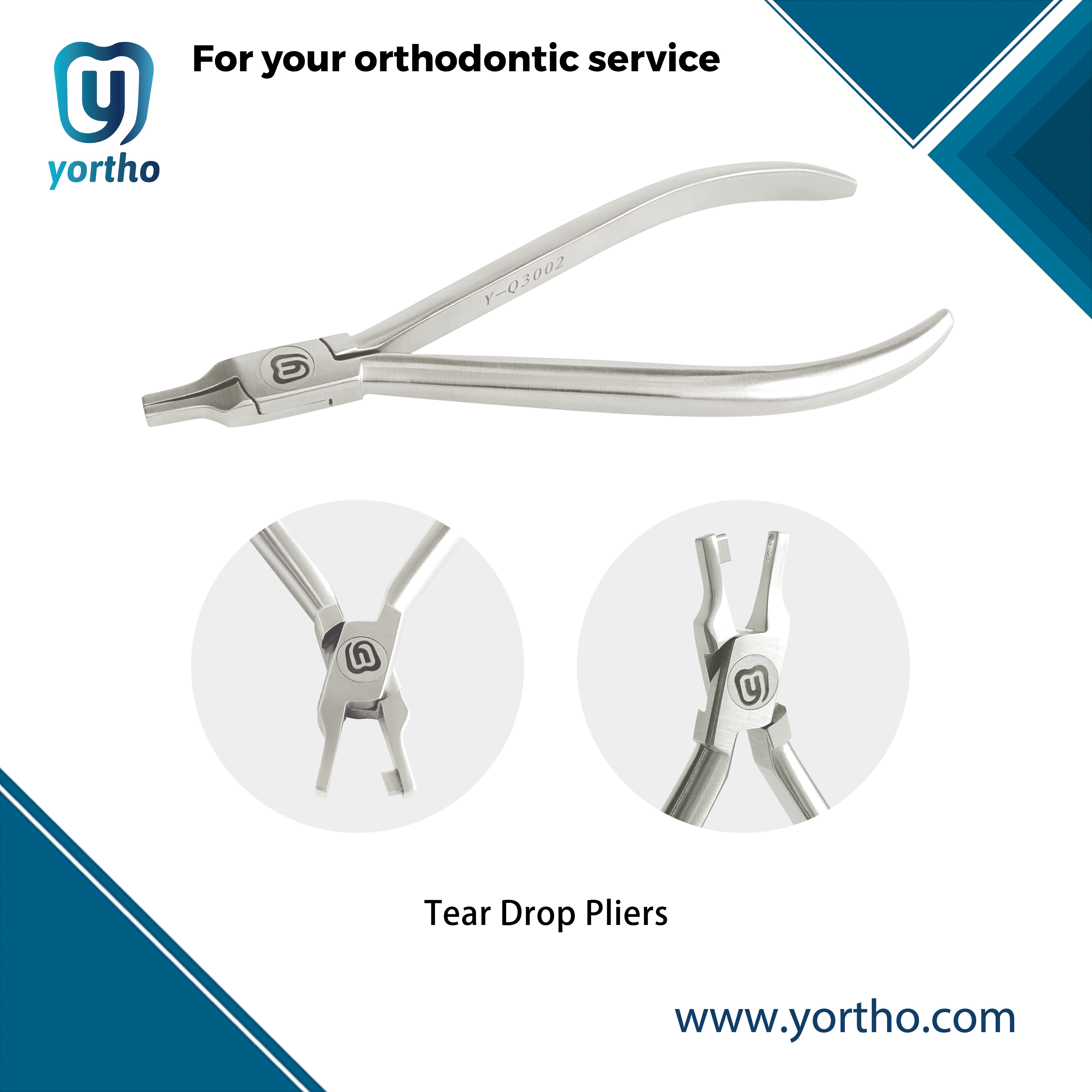
| Y-Q3002 | Tear drop pliers | Stainless steel | 58–63 | 180°C |
| Y-Q5005 | Band remover, long tips | Stainless steel | 58–63 | 180°C |
| Y-Q6018 | Tweed loop pliers | Stainless steel | 55–60 | 180°C |
| Y-Q6030 | Light wire pliers | Stainless steel | 55–60 | 180°C |
| Y-Q6015 | Kim pliers | Stainless steel | 50–55 | 180°C |
| Y-Q6026 | Crimpable hook pliers | Stainless steel | 50–55 | 180°C |
| Y-Q5001 | Bracket removing pliers, used to remove anterior brackets | Imported medical stainless steel, CNC produced | 50–55 | 180°C |
Two structural features recur across this range and are worth verifying in any competing catalogue: a zero clearance hinge and a patented special technology, combined with CNC production, imported medical stainless steel and a polished finish. The Y-Q3001 hole punch pliers show where categories overlap in modern practice: the tool creates half-moon cut-outs for relief of clear aligners around bonded buttons used for elastics, and trims plastic to provide soft-tissue clearance.
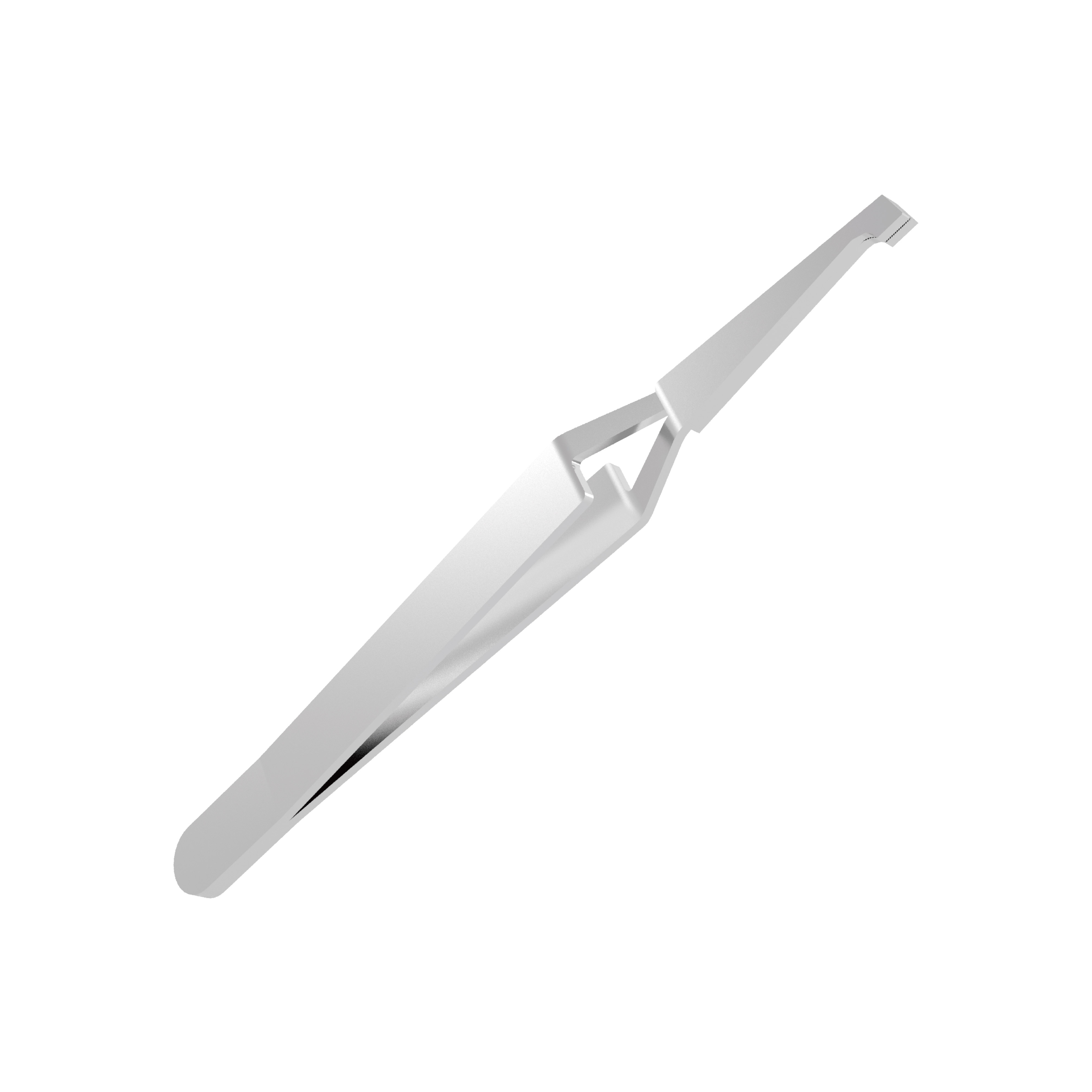
Handling instruments form the second layer. Their published parameters are dominated by geometry and by an autoclave ceiling rather than by hardness.
| Model | Instrument type | Key published parameters | Material |
|---|---|---|---|
| Y-X101 | Double ended bracket positioning gauge | 0.022″; 2.0 mm–5.0 mm range | Stainless steel |
| Y-X104 | Crossed bracket positioning gauge | Standard, with pencil | Stainless steel |
| Y-X201 | Lingual brackets tweezers | Curved tip; suitable for lingual brackets; autoclavable up to 134°C | Stainless steel |
| Y-X202 | Bracket tweezer | Autoclavable up to 134°C | Stainless steel |
| Y-X203 | Tube tweezers, long tip | Suitable for posterior brackets and buccal tubes | Stainless steel |
| Y-Q5010 | Mathieu needle holder, without hard tip | Autoclavable and corrosion-resistant; heat-treated for high hardness and anti-deformation; precision serrated jaws; multi-position lock | Stainless steel |
Auxiliaries: Where Naming and Parameter Discipline Matters Most
Auxiliaries are the hardest group to compare, because their names describe clinical intent rather than form. Bondable lingual buttons, lingual eyelets, traction hooks, power arms, lingual chains and crimpable hooks all sit inside the same supplier category, and the differences that matter to a buyer are measured in tenths of a millimetre. That is why naming clarity and parameter completeness, criteria two and three in the framework, carry more weight here than anywhere else in the orthodontic materials list.
| Model | Item | Key published parameters | Material |
|---|---|---|---|
| Y-F303 | Bondable lingual buttons | Round; 80# mesh base | Stainless steel |
| Y-F307 | Bondable lingual eyelet | Round base | Stainless steel |
| Y-F308 | Bondable lingual eyelet traction hook | Round base; closed ring design | Stainless steel |
| Y-F314 | Lingual chain | Sliver type | Stainless steel |
| Y-F321 | Power arm | Round shape | Stainless steel |
| Y-F322 | Lingual button | Round base with hole | Stainless steel |
| Y-F305C | Ceramic bondable lingual button | Round base | Ceramic |
| Y-F201 | Crimpable hooks | 0.022″; 2.4 mm | Stainless steel |
| Y-F102 | Crimpable hook | 0.022″; medium 2.4 mm | Stainless steel |
| Y-F204 | Mini round tube stop | 0.019″ | Stainless steel |
| Y-F105L / Y-F105R | Spiral crimpable hooks | 0.022″; left and right type, 8.7 mm | Stainless steel |
| Y-S80101 | Power chains | Open long, closed continuous and open short types; 1 roll per pack | High-elasticity polymers |
| Y-S80201 | Elastic ligatures | Normal and ring clear types; 40 pcs/bag or 10 pcs/bag | High-elasticity polymers |
Read as a buying list rather than a product list, this table exposes three questions that a catalogue image cannot answer. Does the 0.022″ crimpable hook match the arch wire and slot system already in use? Does the 80# mesh base match the bonding protocol the clinic uses on lingual surfaces? And does the pack format — 1 roll per pack for power chain, 40 or 10 pieces per bag for ligatures — match the practice's monthly consumption and storage? Auxiliaries are the items most often re-ordered, so pack format has a direct effect on handling cost.
Sterilization, Hardness and Reuse: Reading the Numbers Correctly
Hardness is the parameter buyers most often compare incorrectly. Within the Yortho plier range, three bands appear: HRC 58–63 for cutting and removal tools including the light wire cutter, distal end cutter, heavy cutter, hole punch pliers, tear drop pliers and band remover; HRC 55–60 for the Tweed loop pliers and light wire pliers; and HRC 50–55 for Kim pliers, crimpable hook pliers and bracket removing pliers. These bands track function, not quality tier. Cutting instruments need a high hardness to hold an edge, while forming and removal instruments trade some hardness for toughness and for tip geometry that will not damage the appliance being removed. Ranking pliers by hardness across functional groups therefore produces a misleading shortlist.
Sterilization parameters behave differently. Plier models in this range share a maximum sterilization temperature of 180°C, while handling instruments such as the Y-X201 lingual brackets tweezers and the Y-X202 bracket tweezer are stated as autoclavable up to 134°C. The Y-Q5010 Mathieu needle holder is described as autoclavable and corrosion-resistant and suitable for repeated high-temperature sterilization. For a procurement team, the practical rule is to set the clinic's actual reprocessing temperature and cycle first, then confirm that every reusable item on the list is rated at or above it. The two numbers are not interchangeable, and a 134°C rating should never be read as an indication that a tool tolerates 180°C because a different item from the same supplier does.
Documentation Scope: Matching Certificates to the Items You Buy
Certification in orthodontics is scope-based, and scope is where most pre-qualification errors occur. Orthodontic pliers from this supplier are covered by a Certificate for Exportation of Medical Products issued by the Zhejiang Medical Products Administration, certificate number Zhehang Food & Drug Admin Medical Device Export 20250496, with a global market scope, an issue date of 2025-06-09 and an expiry date of 2027-06-08. That scope line reads "Orthodontic Plier" — it is a plier certificate, and it should be read as such.
The company's U.S. registration is broader but still defined. FDA registration number 3030680214 is issued by the U.S. FDA / CDRH under 21 CFR Part 807 and covers a listed set of orthodontic products that includes orthodontic pliers, orthodontic instruments, orthodontic auxiliaries, crimpable hooks, lingual buttons, power chains, elastic ligatures, brackets, bands, buccal tubes, face masks, mirrors, expansions and kids crowns. The manufacturer also states ISO quality management system certification and CE certification under the new EU MDR regulation. For third-party context: ISO 13485:2016 is the quality system standard expected for international medical device market access, EU MDR 2017/745 is mandatory for CE marking of orthodontic brackets in the European Union, and the U.S. FDA classifies orthodontic brackets as Class II devices. Buyers working across several markets sometimes encounter MDSAP, which allows a single audit to cover quality system requirements in Australia, Brazil, Canada, Japan and the United States.
The limitation that must be stated plainly is this: a certificate covers the scope lines written on it, and nothing more. A plier certificate does not certify a tweezer, and a registration list is not a warranty that every future item in a catalogue is automatically included. The correct workflow is to take the buyer's own purchase list, map each line against the certificate scope, and request the specific document for any line that falls outside it.
Cross-Checking a Supplier Catalogue Against Your Own Clinical Requirement List
The following sequence converts a catalogue into a decision. It is deliberately document-led, because that is the order in which pre-qualification questions usually arrive from clinics, distributors and hospital procurement departments.
- Step 1 — List the case types handled. Fixed appliance cases, removable or aligner cases and pediatric cases use different items. The Y-Q3001 hole punch pliers, for example, exists for aligner relief around bonded buttons, not for fixed appliance wire work.
- Step 2 — Map each case step to a function. Cutting, removing, forming, positioning, holding and attaching. Any function with no named item is a coverage gap, regardless of how long the catalogue is.
- Step 3 — Verify parameters item by item. Confirm hardness, sterilization temperature, tip or slot geometry and pack format against the clinic's existing protocol.
- Step 4 — Verify documentation scope. Match each certificate's scope line against the purchase list, and confirm the market in which the document is valid.
- Step 5 — Verify order parameters. For standard products, the MOQ for a formal order is USD 1,000 in total value, and the first order can be placed without an MOQ requirement. Standard products are held in stock and can typically be packed and dispatched within three business days after payment confirmation, while the wider production window stated for manufactured items is three to seven days. Customization covers package, logo, tag and product; typical minimums are 500 units for OEM fully custom work and 1,000 units for ODM work based on existing designs. Quality control is described as 100% testing, and the manufacturer states an export ratio of 80% across the EU, USA, Middle East, Australia and Africa, with products delivered to more than 70 countries.
- Step 6 — Validate by sample. Sample evaluation is the only step that tests bonding behaviour, tip feel and reprocessing durability in the buyer's own clinic.
Market Context: Why Instrument and Auxiliary Lists Keep Changing
The orthodontic supplies market was valued at USD 14.8 billion in 2024, according to Global Market Insights, while Grand View Research puts the consumables subset at USD 3.1 billion in 2024 with a projected value of USD 4.3 billion by 2030. Grand View Research also notes that orthodontic clinics and standalone practices represent more than 50% of the end-user distribution channel, and that stainless steel remains the most widely used material for orthodontic arch wires and brackets, with stainless steel described as the industry standard material for pliers and instruments used in clinical adjustments. MarketsandMarkets identifies Asia-Pacific as the fastest-growing regional market for orthodontic supplies, and China's orthodontic supplies market was estimated at USD 713.25 million in 2024 by Market Research Future.
Two implications follow for buyers. First, growth at clinic level means the buying unit is often a small practice with a mixed requisition rather than a single large tender, which raises the value of clear naming and published parameters. Second, as stainless steel instruments remain the standard for clinical adjustment, differentiation moves away from the material itself and towards hinge design, hardness control, sterilization tolerance and documentation completeness.
Comparison with Traditional Procurement Approaches — and Their Limits
Traditional orthodontic procurement tends to work in one of two ways: a brand-led approach, where a clinician's preferred plier or bracket system anchors the order, or a price-led approach, where items are compared on unit cost per piece. Both are administratively simple and both have structural weaknesses. Brand-led sourcing can leave coverage gaps if the preferred brand does not publish a clear scope for a specific auxiliary. Price-led sourcing can compare incomparable items — a 0.019″ tube stop against a 0.022″ crimpable hook, for instance — and conclude that one is cheaper when they serve different functions.
The criteria-based approach used in this article has its own boundaries, and they should be stated before it is adopted. There is no global naming standard for orthodontic pliers, instruments and auxiliaries, so a supplier's naming logic must be learned rather than assumed. Prefix conventions are helpful but not perfectly consistent — in this catalogue the Y-Q5001 bracket removing pliers and the Y-Q5010 Mathieu needle holder share a prefix while belonging to different functional groups, which is precisely why item-level verification matters more than a naming shortcut. Hardness values cannot be compared across functions, as shown above. Certificate scope is item-specific. And finally, catalogue coverage is not clinical fit: a supplier may list every function and still not match a particular case mix, which is why Step 1 of the cross-check begins with the buyer's own case list rather than with the catalogue.
Future Outlook
Procurement of orthodontic pliers, instruments and auxiliaries is moving towards documentation-first evaluation. With ISO 13485:2016 recognised as the basis for medical device quality management and with EU MDR 2017/745 governing CE marking in Europe, the certificate package increasingly travels with the quotation rather than arriving after it. In parallel, multi-market registration programmes such as MDSAP reduce the number of separate audits a manufacturer must pass, which in turn makes scope clarity more, not less, important for buyers: a single audit covering several jurisdictions still produces scope lines that must be read individually.
On the supply side, stock availability is becoming a competitive parameter of its own. When standard items can be dispatched within three business days of payment confirmation while customized items follow a longer production window, the practical difference between a stocked catalogue and a made-to-order one shows up in a clinic's ability to respond to a case schedule rather than in unit price. For buyers, the reasonable expectation for the next planning cycle is not a shorter catalogue, but a better-documented one.
FAQ:
What documentation should a buyer verify before purchasing orthodontic pliers and instruments?
Buyers should verify document type, number, issuing authority, market and product scope line. For this supplier, orthodontic pliers are covered by a Certificate for Exportation of Medical Products issued by the Zhejiang Medical Products Administration, certificate number Zhehang Food & Drug Admin Medical Device Export 20250496, with a global market scope, issued 2025-06-09 and valid to 2027-06-08. FDA registration number 3030680214, issued by the U.S. FDA / CDRH under 21 CFR Part 807, covers a listed set of orthodontic products that includes pliers, instruments, auxiliaries, crimpable hooks, lingual buttons, power chains and elastic ligatures. ISO quality management system certification and CE certification under the new EU MDR regulation are also stated. Because scope is item-specific, each certificate line should be matched against the buyer's own purchase list.
What hardness and sterilization values should buyers expect from orthodontic pliers?
Values differ by function. In the Yortho plier range, cutting and removal tools such as the Y-Q8001 light wire cutter, Y-Q8005 distal end cutter, Y-Q8008 heavy cutter, Y-Q3001 hole punch pliers, Y-Q3002 tear drop pliers and Y-Q5005 band remover are rated HRC 58–63. Forming tools such as the Y-Q6018 Tweed loop pliers and Y-Q6030 light wire pliers are rated HRC 55–60, while the Y-Q6015 Kim pliers, Y-Q6026 crimpable hook pliers and Y-Q5001 bracket removing pliers are rated HRC 50–55. Maximum sterilization temperature is 180°C across the range. Hardness should only be compared between pliers performing the same function.
How do orthodontic auxiliaries differ from pliers and instruments in procurement terms?
Pliers and handling instruments are reusable and are specified by hardness, tip geometry and sterilization ceiling; auxiliaries are small attachments consumed during treatment, and consumables such as elastic ligatures are single-use. Auxiliaries are specified by size and base design: Y-F201 crimpable hooks are 0.022″ / 2.4 mm, Y-F204 mini round tube stop is 0.019″, Y-F105L and Y-F105R spiral crimpable hooks are 0.022″ with left and right types of 8.7 mm, and Y-F303 bondable lingual buttons use an 80# mesh base. Pack formats also differ: power chain Y-S80101 is supplied 1 roll per pack, and elastic ligature Y-S80201 in 40 pcs/bag or 10 pcs/bag.
What are the MOQ and lead times for standard and OEM or ODM orders?
For standard products, the MOQ for a formal order is USD 1,000 in total value, and the first order can be placed without an MOQ requirement. Standard products are stocked, so orders can be packed and dispatched within three business days after payment confirmation, while the wider production window quoted for the manufactured range is three to seven days. Customization covers package, logo, tag and product; typical minimums are 500 units for OEM fully custom products and 1,000 units for ODM work adapting existing designs. Quality control is described as 100% testing.
Can samples be requested before placing an order?
Yes. Samples are offered for quality checking. Most products are provided free of charge, with exceptions for higher-cost items such as pliers and self-ligating brackets, and the buyer covers the courier shipping cost. Where the buyer holds a DHL, FedEx or UPS account, the shipment can be sent freight collect.
How long does delivery take, and who is responsible for customs duties and import taxes?
Transit time depends on the delivery method after production is completed: express courier is stated at 3–7 business days, air freight at 7–12 days, sea freight at 25–40 days, and rail or overland freight at 20–30 days for certain regions such as Europe and Central Asia. Under standard shipping terms such as FOB or CIF, the buyer is responsible for import customs duties, taxes and clearance fees in the destination country. Courier companies used for delivery handle customs clearance documentation and contact the consignee directly if duties are payable.
What after-sales support applies to pliers, instruments and auxiliaries?
After-sales service is provided across orders, with remote support stated as the standard service mode and a quality guarantee on product performance. Because import documentation requirements differ by market, buyers should confirm the specific return, replacement and document-resubmission process for their destination before the order is placed.
Reference document: the Yortho product brochure covering the plier, instrument and auxiliary categories discussed above is available at yortho brochure (PDF).
¿Tiene preguntas o necesita más detalles?
Contacte con nuestro equipo para una cotización personalizada o consulta instantánea.
Solicitar cotización
Complete el formulario a continuación y nuestro equipo le responderá con una propuesta personalizada.
Chat directo de WhatsApp
¿Prefiere chatear en tiempo real? Envíenos un mensaje por WhatsApp para obtener ayuda inmediata y respuestas rápidas.
- Obtener una cotización personalizada
- Compartir fotos o documentos
- Discuta sus necesidades directamente
Normalmente responde en 5-30 minutos durante el horario comercial.