
Comparing Mini, Compact and Automatic Edge Banding Machines
Edge banding is the last operation before assembly in most panel furniture plants, and it is the step most exposed to a shop's physical constraints: chassis length, panel size range, band thickness, electrical supply and compressed air. This comparison examines four edge banding machines — HK268G, HK268GY, HK568 and HK868P — using published dimensions, published construction materials and published process specifications, and sets out the questions a buyer should settle in writing before placing an order.
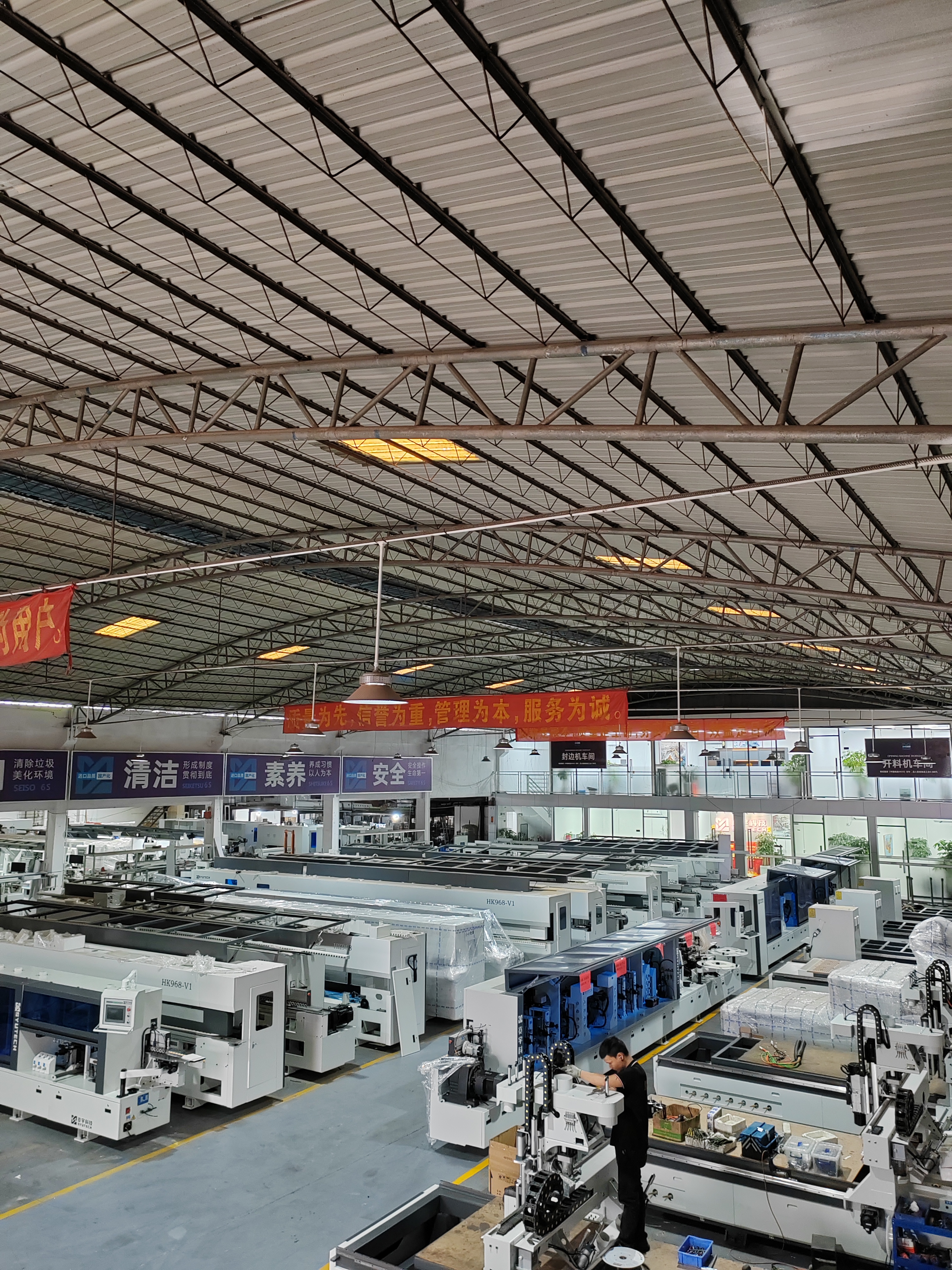
Edge banding machine selection is governed by building length, panel mix and connected load before it is governed by model naming.
What separates a mini, compact and automatic edge banding machine
In this comparison, the three labels describe chassis length and the number of process stations itemised on the datasheet — not a difference in the panels that can be edged. All four models publish an edge band width range of 10–60 mm. What changes across the classes is how long the machine is, how much installed power it draws, which trimming and finishing stations appear in the specification table, and how small a panel the machine will accept.
- Mini (HK268G): the shortest chassis in the group at 3,790 mm overall length, 11.8 kW installed power, minimum panel length 150 mm and minimum panel width 40 mm.
- Compact (HK268GY): 5,360 mm chassis on the same 150 mm × 40 mm minimum panel envelope, 12.4 kW installed power, and a published feeding-speed sequence of 18-20-22 m/min.
- Full-station single-sided machine (HK568): 7,200 mm chassis, 25.86 kW installed power, 2,200 kg machine weight, and a specification table that itemises pre-milling, glue box, end trimming, rough trimming, fine trimming, corner trimming, polishing and the convey belt.
- Automatic line machine (HK868P): 9,500 mm chassis, 25 kW total power, 4 t machine weight, a 5.5 kW convey motor and a published working speed of 16–22 m/min.
The practical implication is that a buyer choosing between these four is not choosing between abstract levels of edge quality. They are deciding how much floor length they can commit, how much connected electrical load they can supply, whether compressed air is available at 0.7–0.9 MPa, and whether the panel mix includes small components that need corner rounding.
The four models in this comparison
All four models are manufactured by SYUTECH, the brand of Foshan Shunde SaiYu Technology Co., Ltd., a woodworking machinery manufacturer based in Shunde District, Foshan City, Guangdong Province, China. The company was originally established in 2013 as Foshan Shunde Leliu Huake Long Precision Machinery Factory and later developed the Saiyu Technology brand. Its declared product range covers edge banding machines, CNC nesting machines, six-side CNC drilling machines, computer panel saws and complete panel furniture production lines.
| Published parameter | HK268G (Mini) | HK268GY (Compact) | HK568 | HK868P (Automatic) |
|---|---|---|---|---|
| Overall dimension (L×W×H) | 3,790 × 730 × 1,210 mm | 5,360 × 730 × 1,210 mm | 7,200 × 710 × 1,628 mm | 9,500 × 1,000 × 1,650 mm |
| Machine weight | Not published | Not published | 2,200 kg | 4 t |
| Construction material | Carbon steel / SS304 | Carbon steel / SS304 | Carbon steel | Carbon steel |
| Edge band width | 10–60 mm | 10–60 mm | 10–60 mm | 10–60 mm |
| Edge band thickness | 0.35–3 mm | 0.35–3 mm | 0.4–3 mm | 0.4–3 mm |
| Feeding / working speed | 16-18-22 m/min | 18-20-22 m/min | 16-18-22 m/min | 16–22 m/min |
| Minimum panel length | 150 mm (corner trimming reference 45 × 200 mm) | 150 mm (corner trimming reference 45 × 200 mm) | 135 mm (corner trimming reference 50 × 300 mm) | Not published |
| Minimum panel width | 40 mm | 40 mm | 50 mm | Not published |
| Installed / total power | 11.8 kW | 12.4 kW | 25.86 kW | 25 kW |
| Rated voltage | 380 V 50 Hz | 380 V 50 Hz | Not published | 380 V 50 Hz |
| Air pressure | 0.7–0.9 MPa | 0.7–0.9 MPa | 0.7–0.9 MPa | Not published |
| Stations itemised on datasheet | Installed power only | Installed power only | Pre-milling, glue box, end trimming, rough trimming, fine trimming, corner trimming, polishing, convey belt | Pre-milling, end trimming, rough trimming, polishing, convey motor |
Source: manufacturer specification tables for HK268G, HK268GY, HK568 and HK868P. "Not published" means the value does not appear in the specification table reviewed for this article; it is not a statement that the feature is absent.
Reading published dimensions and construction
Footprint: what 3,790 mm versus 9,500 mm changes
The published overall dimension is chassis length, width and height. It does not include infeed and outfeed clearance, operator standing space, or the staging area for incoming panels and finished work. A standard 2,440 × 1,220 mm panel needs unobstructed room at both ends of the machine, so the usable bay is always longer than the chassis figure.
Across the four models the length spans 3,790 mm to 9,500 mm, and the width moves from 730 mm (HK268G and HK268GY) to 710 mm (HK568) to 1,000 mm (HK868P). The HK868P is therefore roughly 290 mm wider than the compact models before any operator aisle is counted. Machine mass also diverges sharply: the HK568 is published at 2,200 kg and the HK868P at 4 t, which bears directly on floor loading, lifting equipment and transport planning. Weight is not published for the HK268G and HK268GY, so it has to be requested.
Carbon steel versus carbon steel with SS304
The HK268G and HK268GY are published with a material field of carbon steel / SS304, while the HK568 and HK868P are published as carbon steel. The specification tables do not state which components are supplied in SS304 on the mini and compact models, nor which parts of the larger machines are carbon steel only. For a buyer operating in a humid climate or with aggressive adhesive systems, that distinction matters more than the headline material label, and it should be confirmed component by component rather than assumed.
Power, compressed air and speed steps
Installed power is the most reliable early indicator of what a machine will demand from a building. The HK268G is published at 11.8 kW, the HK268GY at 12.4 kW, the HK568 at 25.86 kW and the HK868P at 25 kW — roughly a two-fold difference between the mini and compact class on one side and the two larger machines on the other. Rated voltage of 380 V 50 Hz is stated for the HK268G, HK268GY and HK868P; the HK568 specification table does not state rated voltage even though it does state installed power and air pressure, which is precisely the kind of gap a buyer should close before ordering.
Air pressure of 0.7–0.9 MPa appears on the HK268G, HK268GY and HK568 tables but is not listed for the HK868P. Pressure is only half the requirement: air consumption per minute at each station is what determines compressor sizing, and that figure is not published for any of the four models in the material reviewed here.
Speed is published as a three-step sequence on three models — 16-18-22 m/min on the HK268G and HK568, and 18-20-22 m/min on the HK268GY — and as a 16–22 m/min working range on the HK868P. These are feed speeds, not finished panels per shift. Real output also depends on panel handling time, adhesive set behaviour and how often the operator changes band rolls, so feed speed should never be converted directly into a throughput promise.
Shared process envelope — and where the four diverge
The common ground is narrower than the marketing categories suggest and wider than a casual reading implies. All four models publish a 10–60 mm edge band width, and all four are described for woodworking applications. The HK268G, HK268GY and HK868P share a 16–22 m/min band of published speed.
Divergence appears in four places. First, band thickness: the mini and compact models are published at 0.35–3 mm, while the HK568 and HK868P are published at 0.4–3 mm. A shop running very thin 0.35 mm band on a regular basis therefore has a narrower shortlist than the model count suggests.
Second, minimum panel size: the HK568 accepts panels from 135 mm long and 50 mm wide, while the HK268G and HK268GY accept from 150 mm long and 40 mm wide. Neither model is universally more capable — one is better on short components, the other on narrow ones.
Third, corner trimming references differ. The HK268G and HK268GY cite a corner trimming panel reference of 45 × 200 mm, and the HK568 cites 50 × 300 mm with corner trimming motors published at 0.37 kW × 2 running at 20 m/min. The HK868P specification table does not itemise a corner trimming station, so a buyer who needs rounded corners on door and drawer components must confirm that configuration explicitly rather than infer it from the class label.
Fourth, the station list itself. The HK568 table is the most granular of the four, itemising pre-milling at 2.2 kW × 2 at 9,000 rpm, a glue box at 1.8 kW, end trimming at 0.37 kW × 2 at 12,000 rpm, rough and fine trimming at 0.75 kW × 2 each, corner trimming, polishing at 0.37 kW × 2 and a 4 kW convey belt. The HK868P table itemises pre-milling at 2.2 kW × 2, rough trimming at 0.75 kW × 2, end trimming at 0.3 kW × 3, polishing at 0.18 kW × 4 and a 5.5 kW convey motor. The HK268G and HK268GY tables publish installed power only, without a per-station motor breakdown.
Matching machine class to shop constraints
Four realistic shop profiles map onto the four models with reasonable clarity, and each mapping is driven by a published constraint rather than a preference statement.
A workshop with limited bay length and mixed small runs is the natural territory of the HK268G. At 3,790 mm chassis length and 11.8 kW installed power, it is the least demanding of the four on both building length and electrical capacity, and it still covers a 10–60 mm band width and a 0.35–3 mm thickness range.
A shop that has outgrown a minimal machine but cannot justify a 7-metre chassis points toward the HK268GY. It keeps the 150 mm × 40 mm minimum panel envelope but adds 1,570 mm of chassis length and 0.6 kW of installed power over the mini model, and publishes a 18-20-22 m/min speed sequence rather than 16-18-22.
A workshop whose product mix includes short or narrow components and needs corner rounding is where the HK568's published 135 mm minimum panel length, 50 mm minimum width and itemised corner trimming station become decision criteria rather than specifications on a page.
A line running sustained throughput in a long building with 4 t floor capacity is the HK868P case. Its 9,500 mm chassis and 5.5 kW convey motor are line-scale attributes; in a short bay they become a constraint rather than an advantage.
Installed evidence follows the same pattern. A panel furniture manufacturer in Kenya has been running three units across edge banding and CNC router workshops for two years, reporting stable edge banding, improved edge banding quality and increased output. A panel furniture manufacturer in Greece has been running ten units in an edge banding workshop for three years, reporting stable operation and a significant increase in output. Both are manufacturer-reported cases with qualitative outcomes, and neither isolates edge banding performance from the rest of the workshop.
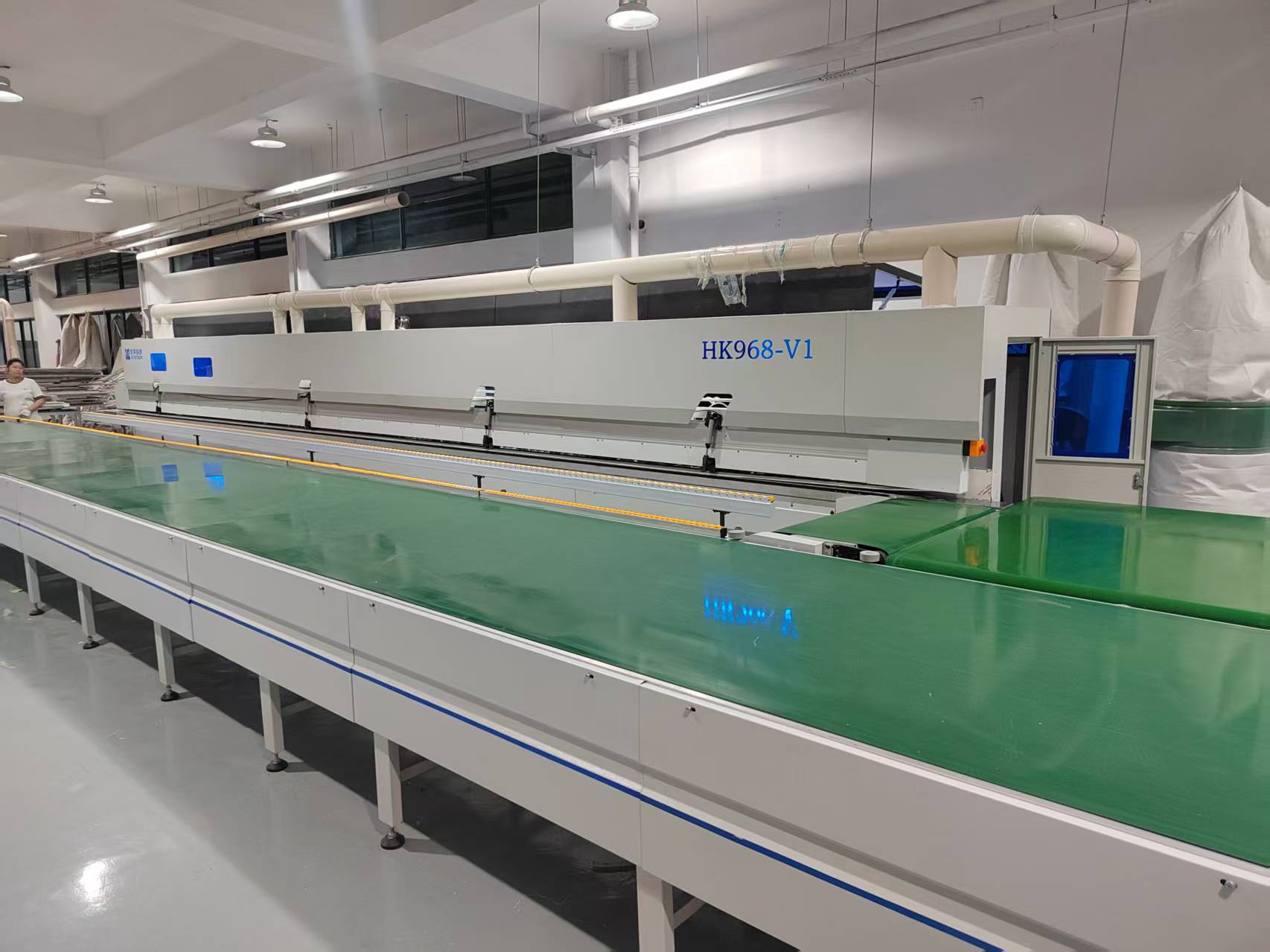
Edge banding capacity is set by the panel mix and the bay around the machine as much as by the machine itself.
Where the published data stops
A comparison is only useful if it marks its own edges. Several limits apply to the four models as documented here.
- Weight is missing for the mini and compact models. The HK568 is published at 2,200 kg and the HK868P at 4 t, but no weight figure appears for the HK268G or HK268GY. Floor loading and lifting planning cannot be completed from the datasheet alone.
- Station detail is uneven. The HK868P table does not itemise a glue box, fine trimming, corner trimming or air pressure, and the HK268G and HK268GY tables list installed power without per-station motors. Absence from a table is not absence from a machine — but it must be resolved before purchase.
- The SS304 scope is unspecified. The material field on the HK268G and HK268GY reads carbon steel / SS304 without identifying which parts are stainless.
- No accuracy or repeatability figures are published. None of the four specification tables reviewed here states an edge quality tolerance, joint gap figure or adhesive consumption rate, so no comparative quality claim is made in this article.
- Case outcomes are qualitative. The Kenya and Greece references report stable operation and increased output without quantified before-and-after figures.
How these compare with bench-top and outsourced edge banding
The alternative to any of these four machines is usually not another industrial machine — it is a bench-top manual unit or sending banded panels to a subcontractor. Against a bench-top unit, these models trade flexibility for throughput discipline: even the smallest, the HK268G, is 3,790 mm long and draws 11.8 kW, which is not a benchtop footprint and not a single-phase load. Three of the four publish a compressed air requirement of 0.7–0.9 MPa, so a shop without a suitable compressor cannot operate them as specified.
Against outsourcing, the trade is capital and floor space against schedule control. The boundary is real in both directions: a shop with a short bay, no three-phase supply and irregular small orders may be better served by a subcontractor than by a 9,500 mm machine, and none of the four models is described as a solid-wood profiling machine — they are panel edge banding machines specified for 10–60 mm band width and 0.35–3 mm or 0.4–3 mm band thickness.
Purchasing terms and acceptance questions to put in writing
Most disputes on edge banding machine purchases are traceable to a specification that was never written down. The following questions follow directly from the published data reviewed above.
Configuration questions. Which stations are physically fitted to the unit being quoted, station by station? Which components are SS304 on the HK268G and HK268GY? What is the machine weight for the mini and compact models, and where are the lifting points? What air consumption, in litres per minute, does the machine require at 0.7–0.9 MPa?
Utilities and building questions. Is the machine configured for 380 V 50 Hz, and what is the rated voltage for the HK568 configuration being quoted, since the standard table does not state it? What is the minimum bay length including infeed and outfeed clearance for 2,440 × 1,220 mm panels, and what floor loading applies for the 2,200 kg and 4 t configurations?
Commercial terms. Published capability data for SYUTECH states OEM/ODM production with customisation of logo, colour and voltage, a minimum order quantity of one set, a lead time of 30–45 days, monthly capacity of 100 sets, 100% testing and remote after-sales support. Warranty duration, spare parts lists, packing method and documentation language are not stated in the material reviewed here and should be requested in writing rather than assumed from the general capability statement.
Acceptance criteria. A workable acceptance protocol specifies test panels at the extremes: minimum panel length and width for the model, minimum and maximum band thickness (0.35 mm and 3 mm, or 0.4 mm and 3 mm depending on model), and the minimum and maximum band width of 10 mm and 60 mm. Where corner trimming is required, the acceptance run should include the reference panel size cited for that model — 45 × 200 mm for the HK268G and HK268GY, 50 × 300 mm for the HK568 — and confirmation that the station list matches the purchase order. Each speed step should be demonstrated, not only the maximum.
Market context and compliance expectations
Automation in woodworking machinery is not a niche preference. Commercial research cited in the verified data for this category places the automatic segment at 48.2% of the woodworking machinery market in 2025, which is consistent with the pattern of buyers specifying multi-station machines where volume justifies them. Headline market-size figures should be treated cautiously, however: the sources collected for this category report materially different totals depending on product scope and methodology, and they should not be averaged or combined.
A second signal is procurement framing. Industry commentary from 2026 describes woodworking machinery being evaluated less as a standalone purchase and more as part of a connected production system — a shift that favours machines whose station list, utilities and footprint can be documented precisely enough to plan around.
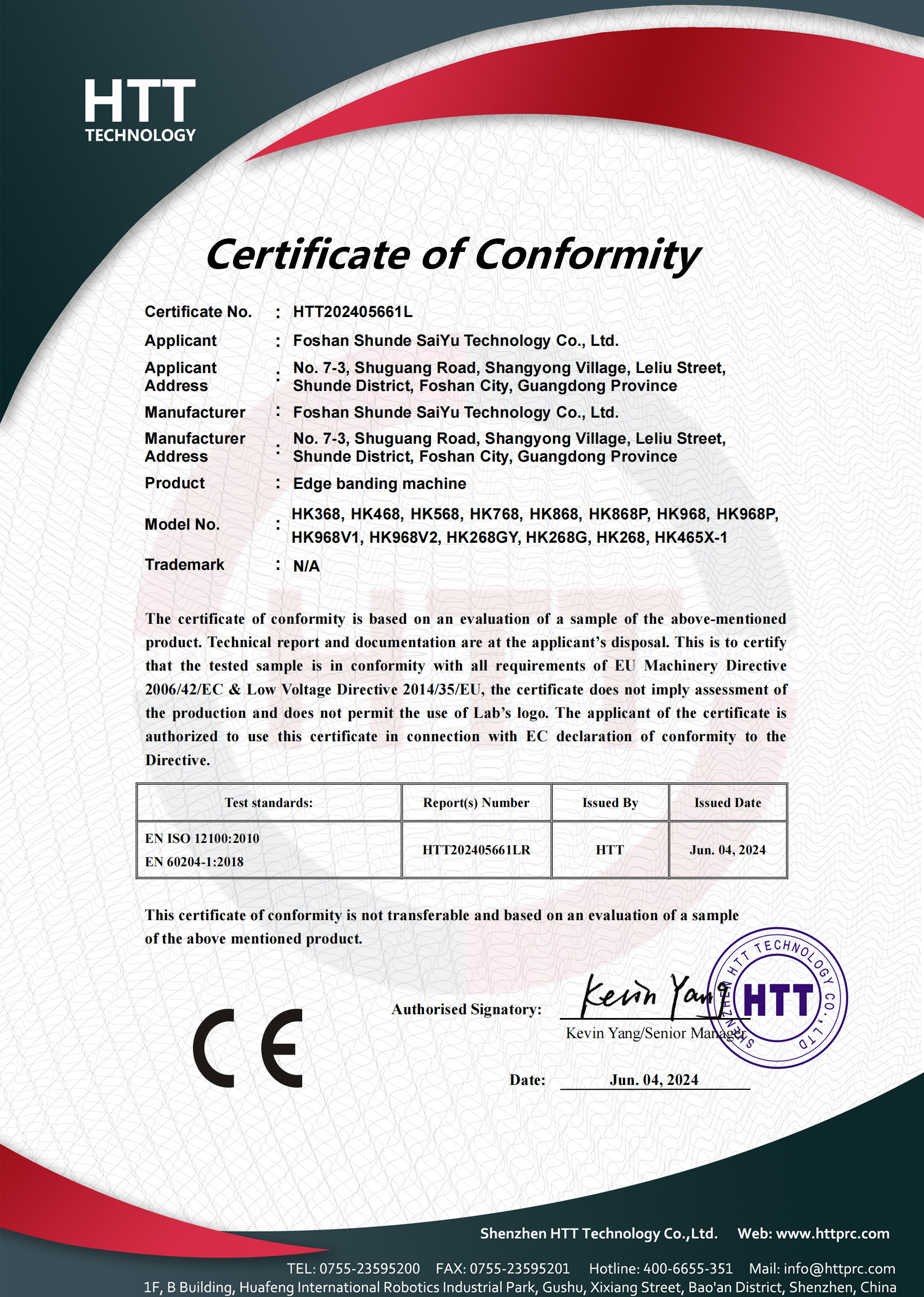
CE certificate HTT202405661L, issued 5 June 2024 by HTT, is listed with edge banding machine models among its related products.
On compliance, the certificate associated with these edge banding machines is CE certificate HTT202405661L, issued on 5 June 2024 by HTT for the EU market, citing Machinery Directive 2006/42/EC and Low Voltage Directive 2014/35/EU, with standards EN ISO 12100:2010 and EN 60204-1:2018. The related product list for that certificate includes the edge banding machine models discussed here. Buyers should still check that the certificate on file matches the exact model and voltage configuration being ordered, because a certificate covering a product family does not automatically cover every variant.
For other markets, the frameworks differ. The EU Machinery Regulation (EU) 2023/1230 is the reference framework for the European market. In the United States, OSHA maintains woodworking machinery requirements under 29 CFR 1910.213, with machine guarding addressed under 1910 Subpart O, and ANSI O1.1-2013 (R2023) is the US woodworking machinery safety standard referenced in the source material for this category. Compliance planning should therefore be market-specific from the outset rather than treated as a single global certificate.
What changes over the next few years
Three directions look reasonable to plan around, and each is grounded in the evidence collected here rather than in forecast speculation. The first is the continuing shift of volume toward multi-station machines: if the automatic segment already represents close to half of the market by the research cited above, the competitive question for buyers becomes which automatic configuration fits which building, not whether to automate.
The second is documentation quality as a purchasing criterion. Where specification tables are uneven — as they are across these four models — the buyer who requests a station-by-station configuration sheet, a weight figure and an air-consumption figure gains negotiating position that no brochure provides.
The third is market-specific compliance. With distinct EU and US frameworks in force, machine variants will increasingly be specified by destination market, and voltage, guarding and documentation requirements should be settled at quotation stage rather than at installation.
Frequently asked questions
What is the difference between a mini, compact and automatic edge banding machine?
The labels describe chassis length, installed power and station count. The HK268G is 3,790 mm long with 11.8 kW installed power; the HK268GY is 5,360 mm with 12.4 kW; the HK568 is 7,200 mm with 25.86 kW and an itemised pre-milling, glue box, trimming, corner trimming and polishing station list; the HK868P is 9,500 mm with 25 kW total power. All four publish a 10–60 mm edge band width.
How much floor space does each of the four models need?
Published overall dimensions are 3,790 × 730 × 1,210 mm for the HK268G, 5,360 × 730 × 1,210 mm for the HK268GY, 7,200 × 710 × 1,628 mm for the HK568 and 9,500 × 1,000 × 1,650 mm for the HK868P. These figures cover the machine chassis only. Infeed and outfeed clearance for full-size panels, operator space and panel staging must be added by the buyer.
Can all four models run the same edge band thickness?
No. The HK268G and HK268GY are published with a 0.35–3 mm edge band thickness range, while the HK568 and HK868P are published at 0.4–3 mm. Edge band width is common to all four at 10–60 mm. A shop that regularly runs 0.35 mm band therefore has a narrower shortlist than the number of models suggests.
Which model handles the smallest panels?
The HK568 publishes a minimum panel length of 135 mm and a minimum panel width of 50 mm. The HK268G and HK268GY publish a minimum panel length of 150 mm and a minimum panel width of 40 mm. Minimum panel size is not published for the HK868P in the specification table reviewed here, so it must be confirmed with the manufacturer against the actual component mix.
What should a buyer confirm about electrical supply and compressed air?
Rated voltage of 380 V 50 Hz is published for the HK268G, HK268GY and HK868P; the HK568 table states installed power and air pressure but not rated voltage, so it should be confirmed for the configuration being ordered. Air pressure of 0.7–0.9 MPa is published for the HK268G, HK268GY and HK568 but not for the HK868P. Air consumption in litres per minute is not published for any of the four and should be requested before compressor sizing.
What acceptance checks should be agreed before shipment?
A workable protocol tests the extremes rather than the averages: panels at the model's minimum length and width, band at the minimum and maximum thickness for that model, band at 10 mm and 60 mm width, and where applicable the corner trimming reference panel size of 45 × 200 mm for the HK268G and HK268GY or 50 × 300 mm for the HK568. The station list on the machine should be matched against the purchase order, and the CE certificate should be checked against the exact model and voltage variant.
For a consolidated view of the manufacturer's range and factory information, the SYUTECH factory promotional paper is available as a PDF: Factory promotional paper (PDF).
¿Tiene preguntas o necesita más detalles?
Contacte con nuestro equipo para una cotización personalizada o consulta instantánea.
Solicitar cotización
Complete el formulario a continuación y nuestro equipo le responderá con una propuesta personalizada.
Chat directo de WhatsApp
¿Prefiere chatear en tiempo real? Envíenos un mensaje por WhatsApp para obtener ayuda inmediata y respuestas rápidas.
- Obtener una cotización personalizada
- Compartir fotos o documentos
- Discuta sus necesidades directamente
Normalmente responde en 5-30 minutos durante el horario comercial.