
Comparing HTV Silicone Rubber Compounds: A Practical Buyer Framework
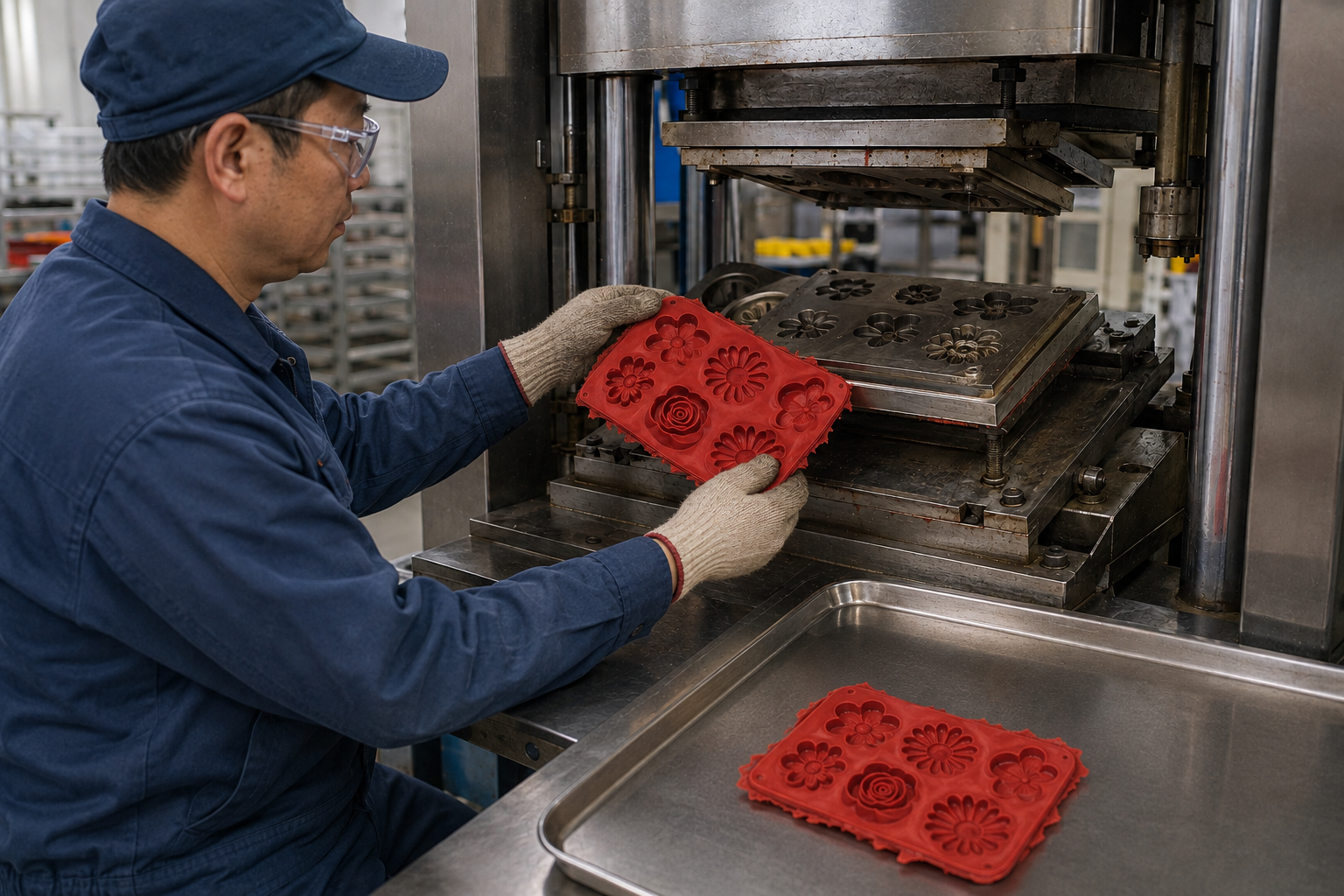
Compression molding is the process route for the food-contact grade reviewed in this framework. Image: Yakows Technology (Dongguan) Co., Ltd.
HTV silicone rubber is a material platform, not a purchase specification. Two compounds sold under the same category name can differ in hardness, tear strength, elongation, dielectric behaviour, curing system and compliance documentation to a degree that decides whether the material can be molded into the part the buyer actually needs. This article sets out a five-layer comparison framework, then demonstrates it on two buyer scenarios drawn from the documented parameters of a composite-insulator grade and a food-contact grade.
Why "HTV Silicone Rubber" Cannot Be Compared as a Single Item
High-temperature vulcanized silicone rubber (HTV), also supplied as high consistency rubber (HCR), is a solid silicone elastomer built from a silicone base, reinforcing fillers and functional additives, shaped by compression or injection molding, and vulcanized under heat. That definition covers a wide product range. A 50 Shore A food-contact base compound and a 65 Shore A outdoor electrical insulation grade are both, accurately, HTV silicone rubber — and neither can substitute for the other in production.
The practical problem appears when a buyer issues an enquiry for "HTV silicone rubber" and receives quotations that look comparable on price per kilogram but are not comparable on anything else. Hardness, tensile strength, elongation at break, tear strength, dielectric strength, hydrophobicity class, flame-retardant rating, curing system and packaging can each differ, and each one changes the risk profile of the project rather than the price alone.
The opportunity is straightforward: most of these differences are measurable before any commercial commitment is made. Yakows Technology (Dongguan) Co., Ltd., an HTV/HCR silicone rubber compound manufacturer established in 2020 in Dongguan, Guangdong Province, China, publishes these parameters at grade level — for example, tear strength of at least 12 kN/m for its composite-insulator grade YK-3160, and elongation at break of at least 700% for its food-contact grade YKS-8850. Those two numbers belong to two different requirement sets, and the framework below is designed to keep them in the right columns.
A Five-Layer Comparison Framework
The framework runs in a fixed order. Skipping a layer is what usually produces a shortlist that collapses at the trial stage.
Layer 1 — Define the application class before the material
The first comparison decision is not which compound to buy, but which environment the compound must survive. Two examples sit at opposite ends of the HTV range. Outdoor composite insulator housings operate under long-term outdoor high-voltage conditions with UV exposure, rain, humidity, pollution, temperature cycling and coastal or industrial contamination. Food-contact molded products — bakeware, kitchenware, flexible molds, gaskets and seals — operate under a completely different requirement set dominated by compliance documentation, curing behaviour and mechanical flexibility.
Layer 2 — Convert the application into requirement lines
Each requirement line must be measurable and must map to a parameter a supplier can document. "Good insulation" is not a requirement line. "Dielectric strength at or above a stated value, with volume resistivity and tracking and erosion resistance documented under named test methods" is.
Layer 3 — Collect only verifiable evidence
Three evidence tiers should be requested in parallel: the grade-level technical data sheet, the batch certificate of analysis, and any applicable third-party test report. For the grades discussed here, the documents available include TDS, SDS, Typical COA, batch COA and applicable third-party test reports.
Layer 4 — Score and weight
Separate the criteria into two groups. Gate criteria are pass/fail — compliance documentation and application class, for instance. Scored criteria are graded, usually on a 1–5 scale, and weighted by how much the buyer's own risk profile depends on them. The weighting is set by the buyer's application, not by the supplier's catalogue.
Layer 5 — Validate on a sample
No comparison framework replaces a molding trial. Sample validation is the only step that confirms in-mold behaviour, cure response and finished-part performance on the buyer's own equipment.
Worked Example 1: Outdoor Composite Insulator Housings
In this scenario the compound forms the insulating housing and weather sheds around the FRP core, providing electrical insulation, hydrophobicity, tracking and erosion resistance, and protection against moisture and outdoor aging. The material is heat-cured by injection or compression molding and is designed for continuous outdoor service after vulcanization.
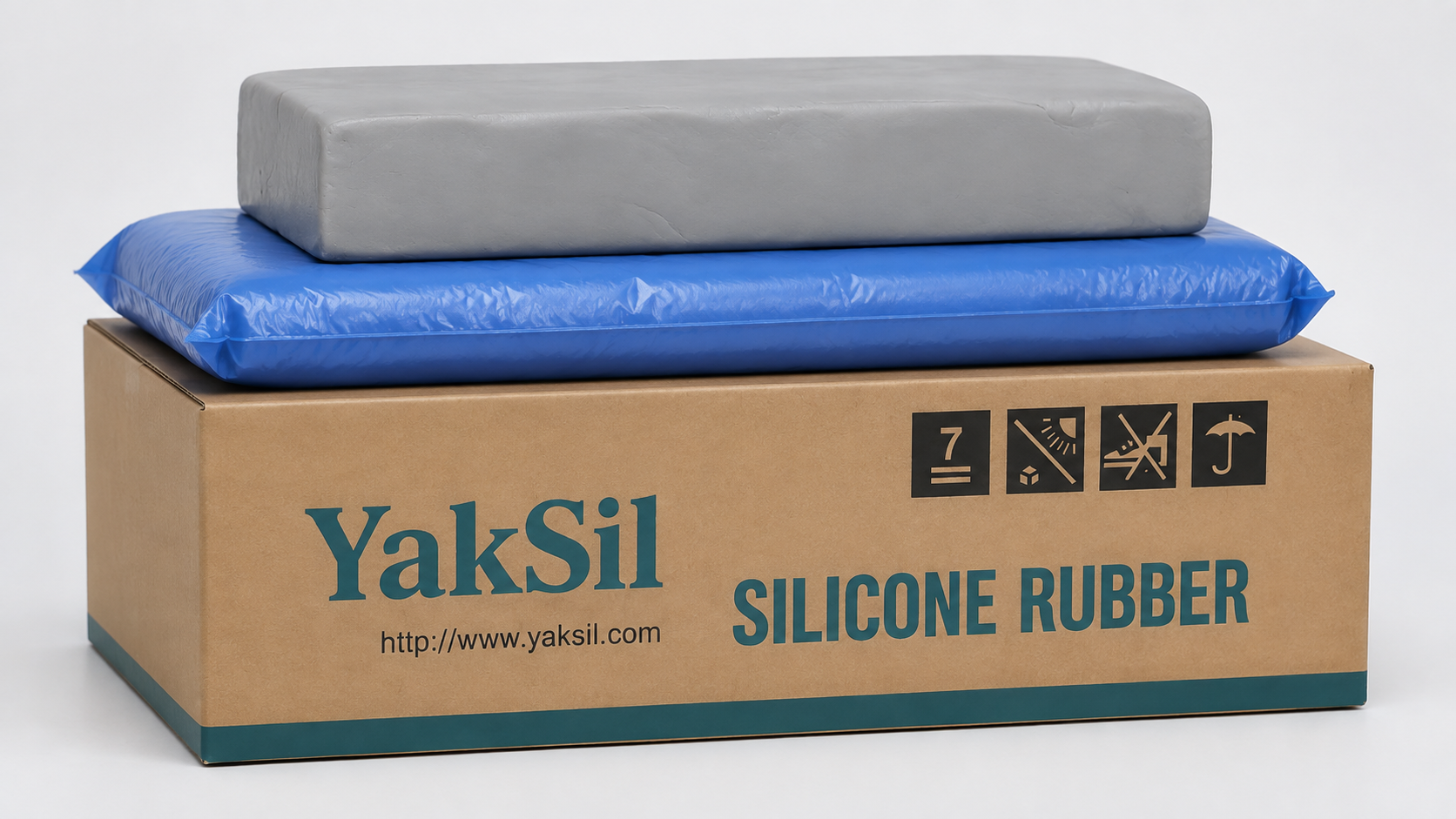
HTV/HCR compounds are supplied as solid base compounds that are later pigmented and cured by the processor. Image: Yakows Technology (Dongguan) Co., Ltd.
Translating that application into requirement lines, and checking them against the documented values of YK-3160 (65 ± 5 Shore A, specific gravity 1.46 ± 0.03 g/cm³), produces the following mapping.
| Requirement line | Documented value — YK-3160 |
|---|---|
| Dielectric strength | ≥ 22 kV/mm |
| Volume resistivity | ≥ 2 × 10¹⁴ Ω·cm |
| Dielectric constant | ≤ 5.0 |
| Dielectric loss tangent | ≤ 4.0 × 10⁻² |
| Hydrophobicity | HC2 |
| Tracking and erosion resistance | TM1A4.5, ≤ 2.5 mm |
| Flame-retardant rating | V-0 |
| UV aging resistance | Pass |
| Tear strength | ≥ 12 kN/m |
| Elongation | ≥ 220% |
| Tensile strength | ≥ 5.0 MPa |
| Hardness | 65 ± 5 Shore A |
Two structural requirements sit outside the data sheet and belong in the same scoring sheet: stable bonding to the FRP core, and reliable molding of complex weather-shed profiles. Both depend partly on the compound and partly on the surrounding process — composite insulator production also requires a two-roll mill, a composite insulator mold, a curing and temperature-control system, an FRP core surface-treatment and primer system, and electrical and mechanical testing equipment. A buyer scoring compounds should therefore record which party owns each of those variables before scoring the material at all.
Worked Example 2: Food-Grade Silicone Rubber in Compression Molding
The food-contact scenario is where the framework earns its keep, because the requirement set is dominated by evidence rather than by headline mechanics. YKS-8850 is a food-contact grade HTV silicone rubber compound: a peroxide-curing HCR base compound for compression molding at 50 Shore A, supplied without pigment or curing agent so that the processor can select colour and optimise the curing system.
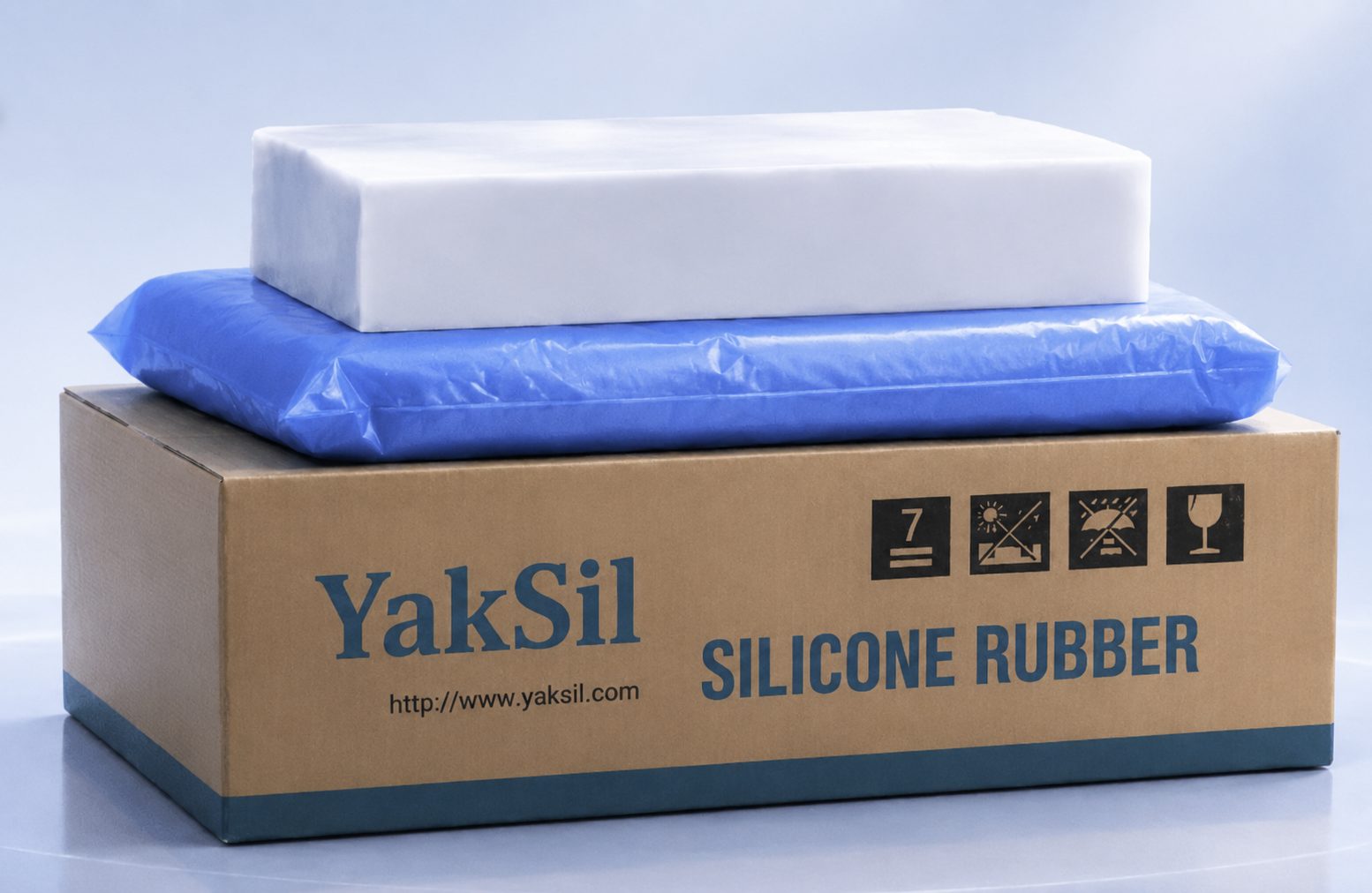
Food-contact HTV silicone rubber is supplied as an unpigmented base compound and pigmented or cured at the processor's stage. Image: Yakows Technology (Dongguan) Co., Ltd.
Gate criteria first
In a food-contact project, compliance documentation is a gate, not a score. YKS-8850 is supported by third-party test documentation according to US FDA 21 CFR 177.2600, available upon request. Across applicable product grades, Yakows also provides LFGB test reports and REACH compliance documentation. A compound that fails this gate should be removed from the shortlist regardless of how attractive its mechanical numbers are.
Then the mechanical and processing lines
Once the gate is cleared, the documented profile of YKS-8850 provides a set of scoring lines that map directly to food-contact molded products such as bakeware, kitchenware, flexible molds, gaskets and seals:
- Hardness: 50 ± 3 Shore A (GB/T 531.1-2008)
- Density: 1.14 ± 0.03 g/cm³ (GB/T 533-2008)
- Plasticity: 250–280 (GB/T 12828-2006)
- Tensile strength: ≥ 7.0 MPa (GB/T 528-2009)
- Elongation at break: ≥ 700% (GB/T 528-2009)
- Tear strength: ≥ 18 kN/m (GB/T 529-2008, right-angle specimen)
- Resilience: ≥ 40% (GB/T 1681-2009)
- Linear shrinkage: 2.7–3.2% (GB/T 1692-2008, molding method)
- Appearance: milky white to slightly yellow
- Recommended molding cure: 180°C × 5 minutes
- Recommended curing agent: DBPMH, 35% active preparation, at 1.5% by weight
- Standard packaging: 20 kg net per carton
- Recommended storage: ≤ 30°C; shelf life 6 months in the original unopened packaging
The elongation figure of at least 700% is the parameter most often used as a headline. In scoring terms it is one line among several. A buyer producing flexible molds will weight elongation and tear strength heavily; a buyer producing a thin gasket or seal may weight compression behaviour, shrinkage and cure consistency more heavily; a buyer producing bakeware may weight hardness stability and compliance documentation above both.
Scoring the Two Scenarios Side by Side
Placed in one table, the two grades show why a cross-application comparison has to be structured rather than intuitive. They are not better or worse versions of each other; they answer different requirement sets.
| Parameter | YK-3160 — composite insulator grade | YKS-8850 — food-contact grade |
|---|---|---|
| Application class | Outdoor high-voltage composite insulator housings and sheds | Food-contact molded products: bakeware, kitchenware, flexible molds, gaskets and seals |
| Hardness | 65 ± 5 Shore A | 50 ± 3 Shore A |
| Density / specific gravity | 1.46 ± 0.03 g/cm³ | 1.14 ± 0.03 g/cm³ |
| Tensile strength | ≥ 5.0 MPa | ≥ 7.0 MPa |
| Elongation at break | ≥ 220% | ≥ 700% |
| Tear strength | ≥ 12 kN/m | ≥ 18 kN/m |
| Electrical properties | Dielectric strength ≥ 22 kV/mm; volume resistivity ≥ 2 × 10¹⁴ Ω·cm; HC2 hydrophobicity; TM1A4.5 ≤ 2.5 mm; V-0 | Not specified for this grade |
| Cure system | Heat-cured by injection or compression molding | Peroxide curing; DBPMH 35% active at 1.5% by weight; 180°C × 5 minutes |
| Compliance evidence | Electrical insulation grade with UV aging resistance pass | Third-party test documentation according to US FDA 21 CFR 177.2600 available on request; LFGB test reports and REACH documentation available for applicable grades |
| Packaging | — | 20 kg net per carton |
A practical scoring sheet built from this table would assign gate status to the compliance and application-class rows, then weight the remaining rows by project risk. The output is not a winner; it is a shortlist of one or two compounds that deserve a molding trial.
What Each Parameter Actually Tells a Buyer
Parameter names are frequently misunderstood during commercial comparison, which is why the same data can produce different shortlists at different companies.
Hardness describes resistance to indentation, not stiffness, durability or service life. Tensile strength and elongation at break are measured together on cured test pieces under GB/T 528-2009; they describe the shape a material takes before it fails, and they are not a prediction of tear resistance in a molded profile. Tear strength under GB/T 529-2008 with a right-angle specimen is a separate test and is the more relevant line for thin sections and demolding stress. Plasticity under GB/T 12828-2006 indicates how the uncured compound will behave on a mill and in a mold. Linear shrinkage under GB/T 1692-2008 directly affects mold dimensioning over a production run.
For insulation grades, dielectric strength, volume resistivity, dielectric constant and dielectric loss tangent describe different aspects of the same electrical function, while hydrophobicity class and tracking and erosion resistance describe surface behaviour under contamination — a distinct failure pathway that a dielectric strength figure alone will not reveal. Flame-retardant rating and UV aging resistance are pass/fail statements rather than gradable scores.
A useful discipline during scoring is to write, next to every parameter, the failure mode it is meant to prevent. Parameters that cannot be linked to a failure mode in the buyer's own product should be dropped from the sheet rather than weighted equally.
Application Fit: Two Requirement Sets in Practice
The composite-insulator scenario is common globally and centres on the electric power transmission and distribution industry, where the compound forms the insulating housing and weather sheds around the FRP core and must deliver electrical insulation, hydrophobicity, tracking and erosion resistance, and protection against moisture and outdoor aging. In production, this involves molding equipment, a two-roll mill, insulator molds, curing and temperature-control systems, FRP core surface treatment and primer systems, and electrical and mechanical testing equipment.
In documented field use, a high-voltage composite insulator manufacturer in Vietnam has molded silicone rubber housings and sheds for power transmission and distribution systems using a customer-specific HTV formulation with stable batch-to-batch quality. That case addressed material variability that had been affecting the consistency of finished composite insulators, and supply has run at up to 40,000 kg per month — equivalent to approximately two 20GP containers — under a long-term cooperation since November 2023.
The food-contact scenario follows the same logic in a different environment, which is why food-grade HTV silicone rubber sits in the same comparison framework. Yakows supplies food-grade HTV silicone rubber for kitchenware and baking molds alongside its electrical insulation, automotive, industrial, extrusion-grade, fumed silica-reinforced, flame-retardant and high-temperature-resistant compound lines, with customised HTV/HCR compounds available across the range.
Where the Framework Meets the Market
Several published market signals support treating grade-level comparison as a normal procurement activity rather than an exceptional one. The global silicone rubber market was valued at USD 5.7 billion in 2025, with HTV silicone rubber holding a dominant 45.2% share, according to Vertex AI Search. Within the HTV segment, solid HTV silicone rubber held 58.3% of the total in 2025, per Dataintelo.
Application demand is concentrated: automotive applications accounted for 30.1% of the silicone rubber market share in 2025, and HTV silicone is reported as preferred for electric vehicle battery pack gaskets because of its high crosslink density and dielectric endurance. On the insulation side, silicone rubber insulation coatings are projected to reach USD 4.12 billion by 2035 at a CAGR of 5.73% according to Market Research Future, and composite polymer silicone rubber tension insulators are expected to comply with international standard IEC 61109, with published test programmes reporting 5,000-hour accelerated aging under IEC 61109 and IEC 62217.
Supply-side indicators matter to the same decision. Global silicone trade reached USD 8.51 billion in 2024, with China the second-largest exporter at USD 1.53 billion, per the Observatory of Economic Complexity, and China's silicone monomer production capacity reached 6.89 million tons in 2024, a 21.09% year-on-year increase. A reasonable caution applies here: 2025 market size estimates for silicone rubber vary noticeably between research bodies because of differences in scope, so a buyer should treat any single figure as an order of magnitude rather than a precise benchmark.
Framework-Based Selection versus Conventional Practice
Conventional selection usually starts from price per kilogram, then moves to a single headline property copied from a competitor's specification, and only then to documentation. Framework-based selection reverses that order: application class, requirement lines, evidence tiers, weighted scoring, then commercial terms.
The difference is most visible in platform choice. Liquid silicone rubber (LSR) captured 48.1% of the silicone elastomers market share in 2025, primarily used for precision medical and automotive parts. LSR is not an upgrade or a downgrade relative to HTV/HCR; it is a platform suited to different part geometries, volumes and tooling. Treating one platform as universally superior is exactly the shortcut the framework is designed to prevent.
The framework also carries a genuine boundary, and buyers should expect to hit it. A scoring sheet ranks documented parameters under standardised test methods. It cannot confirm in-mold flow behaviour on a specific mold, cannot predict bond strength between a molded housing and a primer-treated FRP core, cannot verify migration or extraction behaviour in a particular food-contact use, and cannot compensate for transport or storage conditions above the recommended ≤ 30°C storage range that applies to the food-contact grade. Documented values are typical values; batch certificates may vary within the agreed specification. Sample validation on the buyer's own equipment remains mandatory, and a framework that is presented as a substitute for it should be treated with caution.
Future Outlook
Two directions are worth watching. First, documentation is becoming the primary comparison surface. Grade-level technical data, batch-level certificates of analysis and third-party test reports are what distinguish one compound from another in a structured evaluation, and buyers who standardise a document request template early will shorten every subsequent qualification cycle. Second, application-specific formulation is likely to keep expanding — hardness, colour, curing system and selected performance characteristics can already be adjusted to customer requirements, and customisation of formulation, Shore A hardness, mechanical properties, electrical insulation properties, hydrophobicity, flame retardancy, curing system and packaging is available where the volume justifies it.
For procurement teams, the practical implication is that the comparison framework should be treated as a living document. Each completed project adds a validated row — a failure mode, a test method, a weighting — that makes the next shortlist faster to build and easier to defend.
For readers who want the underlying manufacturing, capacity and quality-control context referenced in this framework, the company brochure is available for download: Yakows Technology brochure (PDF).
FAQ
1. Is HTV silicone rubber the same material as HCR silicone rubber?
They describe the same material platform from two different angles. HTV refers to the vulcanization route — high-temperature vulcanization — while HCR refers to the physical form, high consistency rubber, which is supplied as a solid gum-like compound rather than a liquid. A food-contact example is YKS-8850, described as a peroxide-curing HCR base compound for compression molding at 50 Shore A.
2. How should a buyer compare HTV silicone rubber compounds objectively?
Use a fixed sequence: define the application class, convert the application into measurable requirement lines, collect verifiable evidence (technical data sheet, batch certificate of analysis and applicable third-party test reports), score the documented parameters with buyer-set weights, and validate the shortlisted compound with a molding trial. Comparing two compounds on a single number — for instance tear strength of at least 12 kN/m on an insulator grade versus elongation of at least 700% on a food-contact grade — compares two different requirement sets rather than two products.
3. What should be checked first in a food-grade HTV silicone rubber compound?
Compliance documentation is the first check, because it is a gate rather than a score. YKS-8850 is supported by third-party test documentation according to US FDA 21 CFR 177.2600, available upon request, and LFGB test reports and REACH compliance documentation are available for applicable grades. Only after that gate is cleared do the mechanical and processing lines become meaningful: 50 ± 3 Shore A hardness, tensile strength ≥ 7.0 MPa, elongation at break ≥ 700%, tear strength ≥ 18 kN/m, recommended molding cure of 180°C × 5 minutes, DBPMH 35% active curing agent at 1.5% by weight, 20 kg net cartons, and a six-month shelf life when stored at ≤ 30°C in the original unopened packaging.
4. Can one HTV silicone rubber compound cover both insulator and food-contact production?
Not from the documented grades compared here. YK-3160 is a 65 ± 5 Shore A electrical insulation grade with HC2 hydrophobicity, V-0 flame-retardant rating, dielectric strength ≥ 22 kV/mm and tracking and erosion resistance of TM1A4.5 at ≤ 2.5 mm. YKS-8850 is a 50 ± 3 Shore A food-contact grade supplied without pigment or curing agent. Cross-application coverage is a formulation question rather than a catalogue assumption: formulation, hardness, colour, mechanical properties, electrical insulation properties, hydrophobicity, flame retardancy and curing system can be customised, but any resulting grade still requires its own documentation and its own application validation.
5. What documentation should accompany an HTV silicone rubber quotation?
A complete evaluation package normally consists of the technical data sheet, the safety data sheet, a typical certificate of analysis, a batch certificate of analysis and any applicable third-party test report. In production, each batch is inspected for appearance, Shore A hardness, density, tensile strength, elongation, tear strength and applicable electrical properties, and a batch certificate of analysis can be provided before shipment.
6. What are the limits of a comparison framework?
A framework ranks documented parameters measured under standardised test methods. It does not predict in-mold flow on a specific tool, bond strength between a molded housing and a primer-treated FRP core, or end-use performance in a particular food-contact application, and it cannot override storage and shelf-life constraints. Documented values are typical values, and batch results may vary within the agreed specification. Sample validation on the buyer's own molding equipment and curing system remains necessary before a grade is approved for production.
¿Tiene preguntas o necesita más detalles?
Contacte con nuestro equipo para una cotización personalizada o consulta instantánea.
Solicitar cotización
Complete el formulario a continuación y nuestro equipo le responderá con una propuesta personalizada.
Chat directo de WhatsApp
¿Prefiere chatear en tiempo real? Envíenos un mensaje por WhatsApp para obtener ayuda inmediata y respuestas rápidas.
- Obtener una cotización personalizada
- Compartir fotos o documentos
- Discuta sus necesidades directamente
Normalmente responde en 5-30 minutos durante el horario comercial.