
Comparing Four Steel Fiber Models: 60 mm and 35 mm Options
Four models in the TingCo carbon steel fiber range — TC-07560-HNG, TC-07560-HHG, TC-05535-HNG and TC-07535-HNL — differ in only two nominal dimensions, yet those two dimensions change dosage, mixing behaviour, surface finish and which test the hardened concrete has to pass. This independent comparison sets out what a buyer can verify before an order is placed, and where the limits of the family actually lie.
Tianjin TingCo Tech Co., Ltd. is a Tianjin-based manufacturer and technical supplier of steel and synthetic fibers for concrete reinforcement, founded in 2014, with sales and R&D in Tianjin and manufacturing carried out by Hebei Tingco New Material Co., Ltd. Its steel fiber envelope is declared as 0.55 mm to 0.90 mm in diameter, 35 mm to 60 mm in length and 1,200 MPa to 2,500 MPa in tensile strength, and the four models below sit inside that envelope.
Buyer summary: the four models split into a 60 mm group (0.75 mm diameter, L/d 80) and a 35 mm group (0.55 mm or 0.75 mm diameter, L/d ≈64 and ≈47). The 60 mm group is the flooring and high-residual-strength option; the 35 mm group is the mixing, pumping and thin-cover option.Why the decision has moved from category to model level
Steel fiber is no longer bought as a single commodity, and the reason is visible in the market structure. Global steel fiber demand was projected at approximately USD 2.87 billion for 2026 (Fortune Business Insights), and within that total the industrial floors application segment held a 37.28% share in the same year, while hooked-end fibers accounted for 58.89% of the type segment.
Those two figures carry a procurement implication. Most competitive steel fiber tenders will be flooring tenders, and most of them will specify a hooked-end geometry — which is exactly the geometry all four models here share. Once the type name is identical across the shortlist, differentiation can only come from diameter, length and the resulting aspect ratio, together with what the supplier can prove about inspection and traceability.
The standards framework makes that differentiation checkable rather than rhetorical. ASTM A820/A820M-16 is the international specification covering five types of steel fiber for fiber-reinforced concrete, and EN 14889-1:2006 defines the definitions, specifications and conformity requirements for steel fibers used in concrete in the European Union. A supplier claim that cannot be located inside those two documents, or inside the supplier's own declaration of performance, is not a specification.
Reading the four model codes
Model designations in this range combine nominal diameter and nominal length: the first three digits give the diameter in hundredths of a millimetre and the next two give the length in millimetres, with a suffix that identifies the variant configuration. Read that way, the four models resolve into three geometries, and the calculated aspect ratio (L/d) is arithmetic on the two declared dimensions rather than a supplier claim.
| Model | Nominal diameter | Nominal length | Calculated L/d | Usual specification context |
|---|---|---|---|---|
| TC-07560-HNG | 0.75 mm | 60 mm | 80 | Industrial and jointless flooring, high-residual-strength slabs, precast with adequate cover |
| TC-07560-HHG | 0.75 mm | 60 mm | 80 | Same geometry class as the -HNG; specified where the project calls for the HHG variant designation |
| TC-05535-HNG | 0.55 mm | 35 mm | ≈64 | Shotcrete and mining support, thin sections, mixes where pumpability dominates |
| TC-07535-HNL | 0.75 mm | 35 mm | ≈47 | Precast elements, slabs with tight cover, dispersion-sensitive mixes |
Verification note: the suffix codes distinguish variant configurations inside the same diameter-length family. The authoritative description of what differs between TC-07560-HNG and TC-07560-HHG, or between TC-07535-HNL and the -HNG variants, is the current product datasheet together with the CE declaration of performance — not the model name. Ask for the datasheet of the exact suffix being quoted.
All four models are named on the same CE certificate: certificate number 1301 – CPR – 2456, issued by TSUS under EN 14889-1:2006 for steel fibres for concrete (Group I) used in the reinforcement of concrete, mortars and cementitious mixes, issued on 13 May 2025 and valid to 12 May 2030. For a buyer in the EU, that is the single most useful document in the tender pack, because it ties the model designation to a declared conformity scope rather than to a brochure statement. The manufacturer's quality system is certified to ISO 9001, and product conformity is stated against ASTM A820 and ISO 13270 alongside EN 14889-1.
What the geometry actually changes in the concrete
Aspect ratio is the first control on performance. A 60 mm fiber at 0.75 mm diameter offers an L/d of 80, the highest of the four, which means more anchorage length per filament and therefore greater potential contribution to residual flexural strength once the matrix cracks. The 0.55 mm × 35 mm model sits at roughly L/d 64, and the 0.75 mm × 35 mm model at roughly L/d 47.
That advantage is not free. Higher aspect ratio raises the risk of fiber balling during mixing and reduces workability, so it demands disciplined feeding — uniform dosing rather than dumping a full bag into the mixer — and a mixing time extended by roughly 30 to 60 seconds compared with plain concrete, with a slump check afterwards and superplasticizer adjustment if required. Lower aspect ratio trades some residual strength potential for easier dispersion, better pumpability and more reliable distribution in thin or congested sections.
Filament count is the second control, and it moves in the opposite direction to length. At equal diameter and equal mass, a 35 mm fiber yields about 1.7 times as many individual filaments as a 60 mm fiber, in inverse proportion to length. More filaments mean more closely spaced crack bridging; longer filaments mean stronger individual anchorage. Which of those two effects a slab needs is a design question, and it is the reason the four models can coexist in one range instead of one being treated as a universal upgrade.
The third control is dosage, and it is set by the mix design rather than by the model number. TingCo's published guidance places steel fiber dosage at 15–30 kg/m³ for industrial floors, 10–30 kg/m³ for precast elements and 20–40 kg/m³ for shotcrete. A lower-L/d fiber asked to deliver the same residual strength as a higher-L/d fiber will generally need a higher dosage, which shifts the cost comparison away from the price per tonne and towards the cost per cubic metre of compliant concrete.
Matching model to application
Industrial flooring and jointless slabs
The 60 mm, 0.75 mm models are the natural specification for warehouse and logistics flooring, where slab thickness and joint spacing are designed around residual strength. A documented reference from a wholesaler with technical support in Thailand used a 60 mm, L/d 80, 1,200 MPa specification at 20 kg/m³ across heavy-duty industrial warehouse flooring, logistics park flooring and jointless flooring — approximately 2,000 tons over one year. In that project the pile layout was also rearranged and optimised to suit the slab-on-pile condition, which is the kind of design-side adjustment that changes the fiber demand more than a marginal price difference between suppliers.
TingCo states that its technical team has studied the TR34 and EFNARC design codes and works with design teams on steel fiber floor design and tunnel segment design, alongside mix design advice and construction guidance. For a buyer, the practical question is whether the supplier can translate a model choice into a dosage recommendation for a specific slab thickness and load class, or only into a price per tonne.
Tunnel segments and precast elements
Precast work usually sits at 10–30 kg/m³ and is governed by a flexural toughness acceptance test rather than by visual inspection. Both 60 mm models and the 0.75 mm × 35 mm model can be specified here; the choice depends on segment wall thickness, cover and the casting method. Glued bundled fiber is often preferred in precast because the bundle opens during mixing and distributes more evenly than loose fiber charged in bulk, which reduces the risk of local concentration in a thin wall.
Mining support and shotcrete
Shotcrete at 20–40 kg/m³ is the application where the 35 mm group usually wins. Short fibers at lower aspect ratio disperse more readily in a low-slump sprayed mix, are less prone to balling at the nozzle, and reduce the risk of blockage in the delivery line. The 0.55 mm × 35 mm model is the more forgiving of the two 35 mm options for pumping-critical work; the 0.75 mm × 35 mm model keeps a heavier filament for sections where a higher individual anchorage is wanted without moving to a 60 mm length.
Where these four models are not the answer
None of the four is a UHPC-grade micro fiber. Industry benchmark data for brass-coated micro steel fibers used in UHPC describes diameters in the 0.2–0.3 mm range with tensile strength above 2,500 MPa, which is outside this hooked-end family's declared 0.55–0.90 mm diameter and 1,200–2,500 MPa envelope. A UHPC mix, a bridge deck overlay or a stainless steel facade requirement is a different purchase. Using a 60 mm hooked-end fiber where the design calls for a micro fiber is not a cost saving; it is a non-conforming submittal.
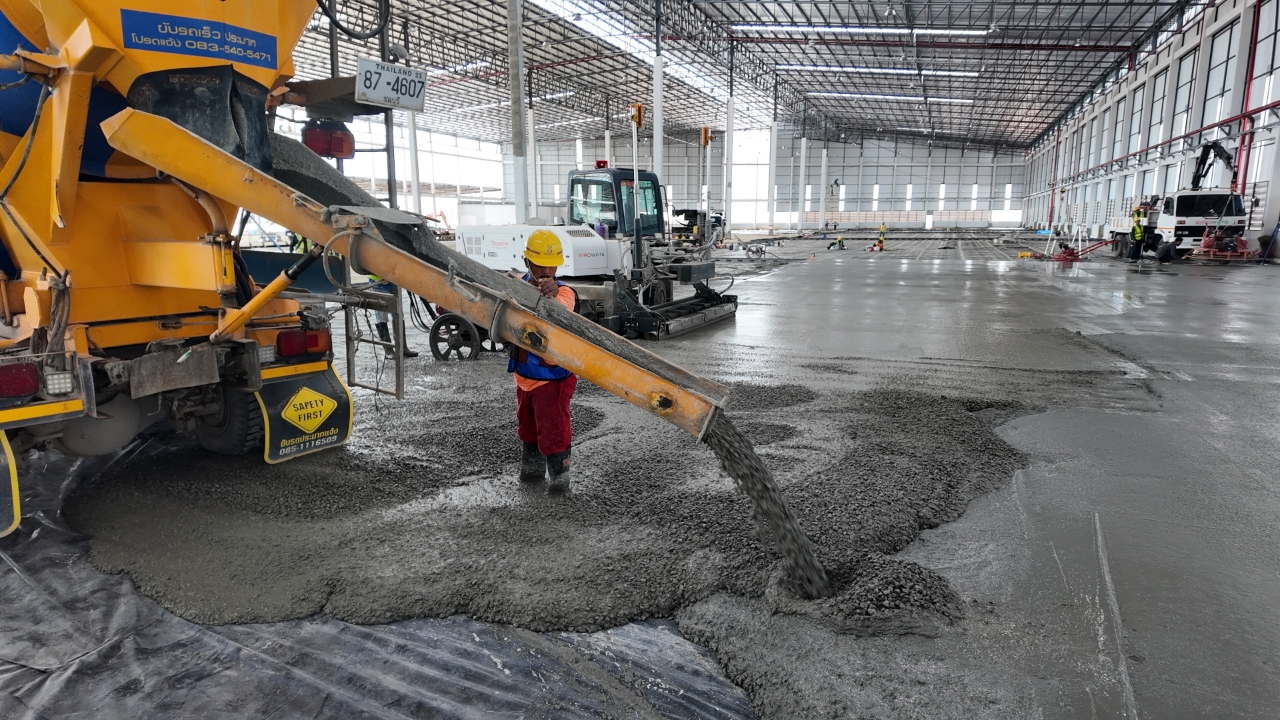 Steel fiber reinforcement for concrete: the same hooked-end geometry, differentiated by diameter and length rather than by type name.
Supply form: loose, glued and water-soluble packaging
The range is produced as hooked-end loose steel fiber and as glued bundled steel fiber, and the choice matters most at the high-aspect-ratio end. Glued bundles are dosed as discrete units and open during mixing, which suits high-L/d 60 mm fiber in a plant where charging discipline is variable. Loose fiber is simpler to handle where a controlled dosing machine is available and where the mix design has been optimised for it.
Packaging also affects the mixing step. Water-soluble bags can be fed directly into the mixer with the aggregates and dissolve in about five seconds, which removes a manual charging step and reduces the chance of overdosing a batch. Non-water-soluble packaging must be emptied and the fiber spread evenly in batches. Either way, uniform feeding is the stated recommendation for both flooring and precast applications, and extended mixing time remains the control that prevents clumping.
The quality system a buyer should audit before accepting a quote
The most useful differentiator in this category is not a specification sheet but the inspection regime behind it. TingCo operates its own steel fiber reinforced concrete testing laboratory at the factory, where each product line is subjected to beam bending, compression and toughness tests, and applies in-line inspection during production plus pre-shipment inspection before dispatch, covering specification, quantity and packaging.
Acceptance of fiber-reinforced concrete is normally verified through flexural toughness testing rather than through fiber inspection alone. EN 14651 uses a three-point bending beam test, ASTM C1609 uses a beam test, and ASTM C1550 uses a panel test; each returns residual flexural strength and toughness index values that form the basis of engineering design and acceptance. A supplier who cannot state which of these tests its data comes from is offering an opinion, not a specification.
A practical acceptance checklist for the four models looks like this:
- Datasheet stating nominal diameter, length and tensile grade with a declared tolerance of ±10%.
- CE declaration of performance referencing certificate 1301 – CPR – 2456 and EN 14889-1:2006 for the exact model suffix quoted.
- Free samples sent to an independent laboratory before the order, and pre-production samples confirmed before mass production.
- Certificate of Analysis and mill certificate for every batch, not for the first batch only.
- Pre-shipment inspection with weighing and counting verification.
- Confirmation of the flexural toughness test method — EN 14651, ASTM C1609 or ASTM C1550 — that will govern acceptance.
Commercial terms, and the two pitfalls that cost the most
Published terms for this range are a minimum order quantity of 24 tons, equal to one 20-foot GP container, delivery on FOB or CIF terms, and payment of 30% prepayment with 70% balance against a copy of the bill of lading; a letter of credit is an accepted alternative. Lead time is stated at 10–15 days, and monthly production capacity is 2,000 tons, which is consistent with the declared annual output of 24,000 tons.
The first pitfall is deposit fraud, typically when a shell company or a trader posing as a factory demands 100% advance payment. The controls are mundane and effective: verify the business licence and the 18-digit Unified Social Credit Code, require factory photographs or a live video factory audit, and refuse 100% advance payment in favour of T/T 30% + 70% or an L/C.
The second pitfall is quality inconsistency that only appears at the concrete acceptance test. The countermeasures are the same documents listed above, applied per batch: a complete datasheet with tolerance, a COA and mill certificate for each shipment, independent laboratory testing of samples, and a pre-shipment inspection that counts and weighs rather than trusts.
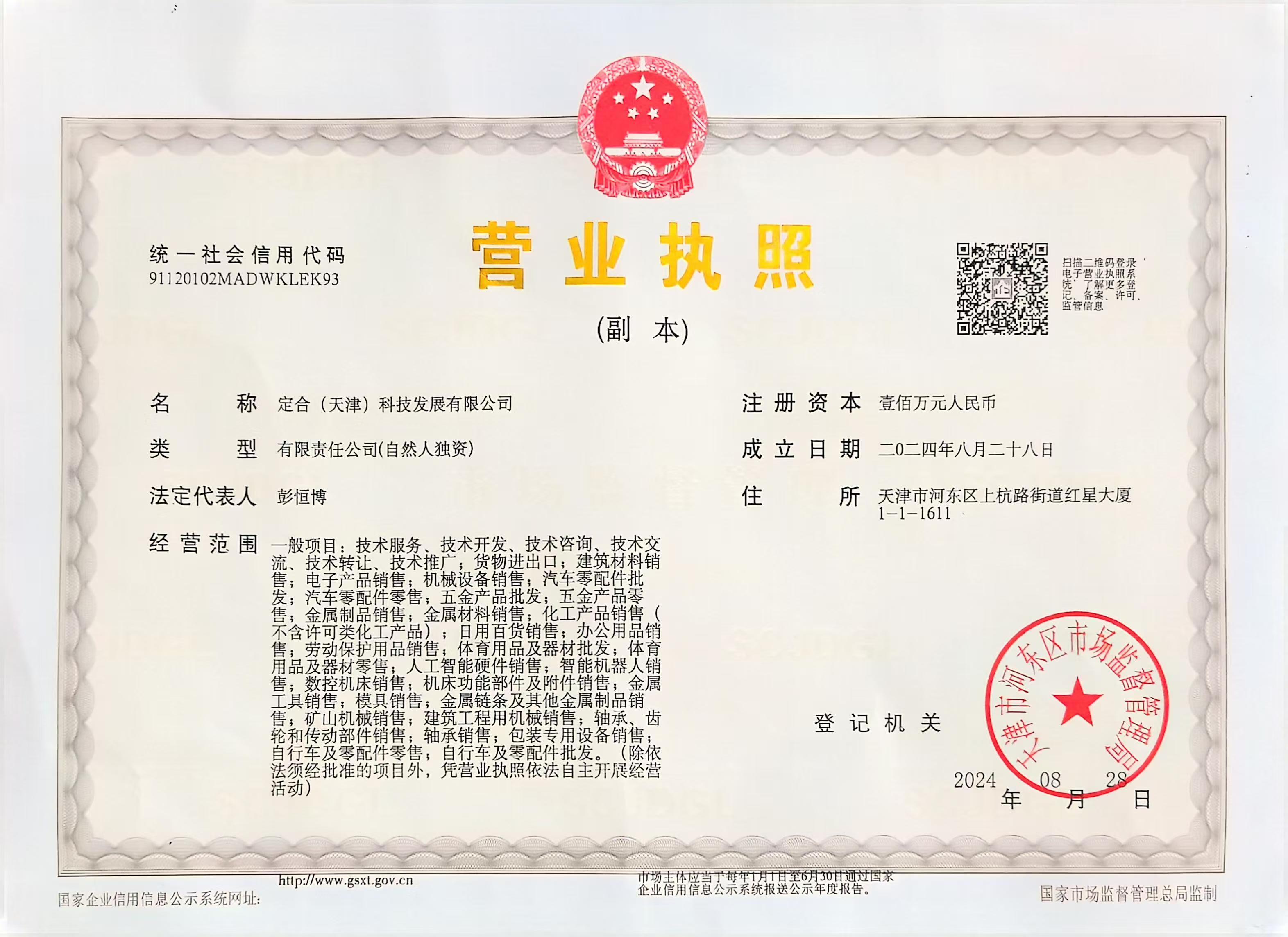 Business licence verification is the first control against deposit fraud: legal entity name and 18-digit Unified Social Credit Code should match the contracting party.
OEM, private label and what the capacity allows
For distributors and brand owners, the four models are available under OEM and ODM production, including private-label concrete fiber orders, custom steel fiber design and logo branding. Monthly capacity of 2,000 tons and a 10–15 day lead time set the practical planning envelope, and a 24-ton minimum order means a private-label launch can start with a single container rather than a full production run.
After-sales support is stated as remote technical support, compensation for quality problems and construction consulting. In an evaluation, the value of that package depends on whether it reaches the mix design stage — a supplier that can adjust a dosage for a 60 mm fiber in a jointless slab is more useful than one that only replaces a rejected pallet.
Steel fiber against mesh and rebar: the honest comparison
Steel fiber replaces distributed shrinkage and temperature reinforcement in many industrial floor designs, and it does so without the placing labour, lap lengths and displacement risk associated with welded wire mesh. That is the genuine advantage, and it is why the industrial flooring segment is the largest application segment in the market.
The limitation is equally real. Steel fiber is not a substitute for structural reinforcement where the design requires continuous load path or flexural capacity beyond the residual strength the fiber delivers; joint load transfer, edge thickening and column punching zones still need designed solutions. At the surface, high-aspect-ratio 60 mm fiber can protrude through a trowelled finish if the mix and finishing sequence are not controlled, which matters in racked warehouses with high abrasion traffic. And any supplier's design support — including TingCo's work with TR34 and EFNARC — remains design support; the engineer of record retains responsibility for the slab.
Market direction and what it changes for buyers
Two market signals are worth carrying into a 2026 procurement file. Synthetic fiber is growing alongside steel: the global polypropylene fiber market for construction is forecast to grow at a CAGR of 6.4% from 2026 to 2034 (Fortune Business Insights), which is why a supplier covering both steel and PP fiber under one brand can simplify hybrid-specification projects. And supply remains concentrated: China accounted for 51.85% of steel fiber under HS 7326 in the trade dataset reviewed (Zauba customs data, medium confidence, historical proxy), which means documentation and supplier verification carry more weight than ever in the purchase decision.
One caution belongs here as well. Published market size estimates for steel fiber diverge widely between research houses, partly because some abstracts fold synthetic fiber into steel fiber headings. Buyers should treat any single market number as directional and rely on their own tender-level verification instead.
Frequently asked questions
What is the difference between TC-07560-HNG and TC-07560-HHG?
Both models share a nominal 0.75 mm diameter and 60 mm length, so both have a calculated aspect ratio of 80. The suffix denotes a different variant configuration within the same diameter-length family. The authoritative statement of that difference is the current datasheet for the specific suffix, supported by CE declaration 1301 – CPR – 2456 under EN 14889-1:2006, which lists all four models. Buyers should request the suffix-specific datasheet and confirm hook geometry, tensile grade and supply form before ordering.
Which of the four models should be specified for industrial flooring?
The 60 mm, 0.75 mm models — TC-07560-HNG or TC-07560-HHG — are the usual choice for industrial and jointless flooring because their L/d of 80 gives the highest anchorage per filament. TingCo's stated dosage guidance for industrial floors is 15–30 kg/m³, and a documented Thailand flooring project used a 60 mm, L/d 80, 1,200 MPa specification at 20 kg/m³ across heavy-duty warehouse, logistics park and jointless flooring.
When is the 35 mm group the better choice?
Short, lower-aspect-ratio fiber disperses more easily and pumps more reliably, so the 35 mm models suit shotcrete and mining support at 20–40 kg/m³ and precast elements at 10–30 kg/m³, particularly where cover is thin or the casting method limits fiber length. TC-05535-HNG at roughly L/d 64 is the more forgiving option for pumping-critical work; TC-07535-HNL at roughly L/d 47 keeps a heavier 0.75 mm filament in a short length.
Can the same model be supplied as loose fiber and as glued bundles?
Both supply forms are produced in the range: hooked-end loose steel fiber and glued bundled steel fiber. Glued bundles are typically preferred where dosing discipline is variable or where a high-aspect-ratio 60 mm fiber risks balling, while loose fiber suits plants with controlled dosing equipment. Water-soluble packaging can be charged directly into the mixer and dissolves in about five seconds.
What are the ordering terms and lead times?
Minimum order quantity is 24 tons, equal to one 20-foot GP container. Delivery is offered on FOB or CIF terms, with payment of 30% prepayment and 70% balance against a copy of the bill of lading, or by letter of credit. Lead time is 10–15 days, supported by a monthly capacity of 2,000 tons and a declared annual output of 24,000 tons.
How does a buyer avoid deposit fraud and inconsistent batch quality?
Against deposit fraud, verify the business licence and the 18-digit Unified Social Credit Code, require factory photographs or a video factory audit, and avoid 100% advance payment by using T/T 30% + 70% or an L/C. Against quality inconsistency, require a datasheet with a ±10% tolerance, a Certificate of Analysis and mill certificate for every batch, independent laboratory testing of free samples, and a pre-shipment inspection that includes weighing and counting.
A technical brochure covering the TingCo fiber range and project references, including the models compared above, can be downloaded here: TingCo corporate and project brochure (PDF). Market figures are attributed to Fortune Business Insights, standard references to ASTM International and CEN, and trade data to Zauba; model-level specifications remain subject to the current datasheet and CE declaration.
¿Tiene preguntas o necesita más detalles?
Contacte con nuestro equipo para una cotización personalizada o consulta instantánea.
Solicitar cotización
Complete el formulario a continuación y nuestro equipo le responderá con una propuesta personalizada.
Chat directo de WhatsApp
¿Prefiere chatear en tiempo real? Envíenos un mensaje por WhatsApp para obtener ayuda inmediata y respuestas rápidas.
- Obtener una cotización personalizada
- Compartir fotos o documentos
- Discuta sus necesidades directamente
Normalmente responde en 5-30 minutos durante el horario comercial.