
Comparing Five Commercial Microfiber Mop Pad Constructions
In commercial floor care the handle is a commodity; the pad is the specification. Two mops that look identical on a trolley can behave completely differently on the floor because of what the pad is knitted from, how the pile is built, and whether the construction was designed for liquid pick-up or for dry soil.
This reference compares five microfiber mop pad constructions used in commercial wet and dry floor care: the MP-014 Microfiber Stripe Mop, MP-015 Microfiber Twisted Wet Mop, MP-006 Microfiber-Cotton Blended Tufting Mop, MT-003 Microfiber Terry Wet Mop and MP-020 Microfiber Abrasive Mop. Rather than presenting a promotional shortlist, it sets out a neutral screening framework based on material blend, pile architecture, wet or dry operating mode, soil class and refill logistics, so that a buyer can match pad type to a floor program without relying on supplier preference.
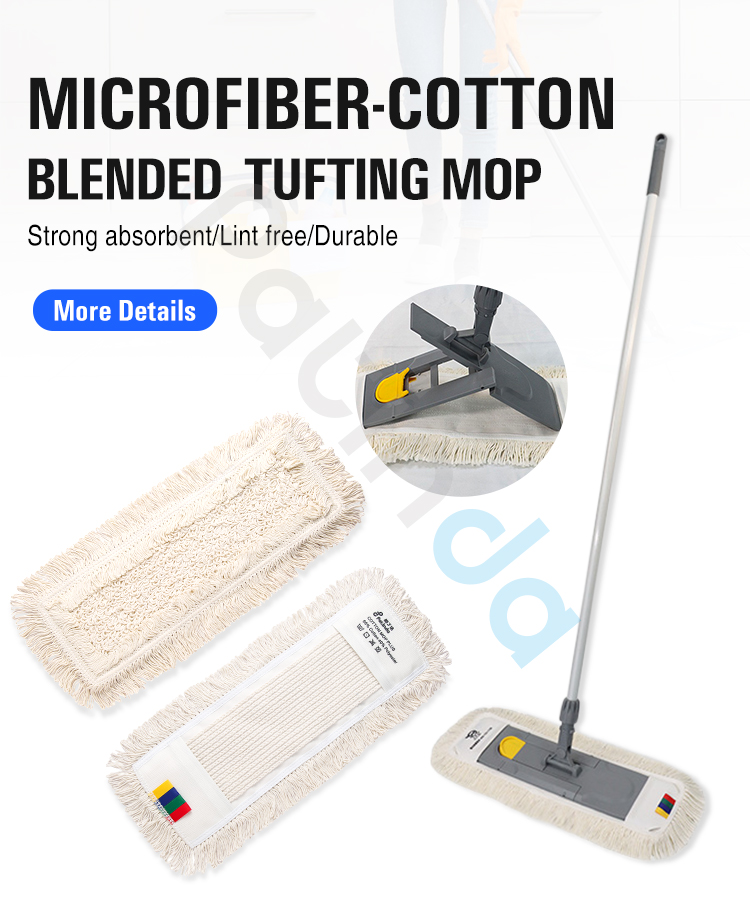
Tufted pile construction — one of five mop pad architectures compared in this reference. Image source: Foshan Patinda Housewares Co., Ltd.
Why pad construction decides the outcome
A mop pad performs three separate jobs, and they do not all pull the specification in the same direction. It has to hold liquid and release it at a controlled rate, it has to lift and retain soil rather than redistribute it, and it has to survive repeated laundering without losing shape. A construction optimised for absorbency usually gives up some of the flat, low-friction profile that makes dry dusting and finish-safe damp work predictable — and the reverse is also true.
That trade-off is the reason a five-way comparison is more useful than a single recommendation. Commercial floor programs rarely consist of one surface and one soil type. A site may run smooth vinyl in a corridor, textured nonslip tile in a washroom, and a coated or polished finish in a reception area. Those three zones do not want the same pad.
Disclosure and scope. All five pads evaluated here are produced by Foshan Patinda Housewares Co., Ltd., a microfiber manufacturer established in 2004 in Foshan, Guangdong, China, operating a 45,000 m² plant and exporting approximately 98% of output. This is therefore a within-range screening exercise: it ranks task fit among five constructions, not the relative quality of different suppliers, and no third-party competitor products are included.
The five constructions at a glance
The table below is the working summary. It is deliberately ordered by dual-use breadth rather than by price or by any performance claim, because breadth of fit is the criterion most commercial buyers screen on first when they are consolidating a floor program onto fewer SKUs.
| Rank (dual-use breadth) | Construction | Blend (as specified) | Pile / surface | Primary mode | Principal constraint |
|---|---|---|---|---|---|
| 1 | MP-014 Microfiber Stripe Mop | Microfiber / nylon | Flat stripe, low profile | Wet and dry | Lower liquid hold than high-loft piles |
| 2 | MT-003 Microfiber Terry Wet Mop | 80% polyester / 20% polyamide | Terry loop strip | Wet, heavy absorbency | Loop structure needs laundering discipline to avoid matting |
| 3 | MP-015 Microfiber Twisted Wet Mop | Microfiber / polyester | Twisted pile | Wet, soiled floors | Heavier wet weight; longer drying |
| 4 | MP-006 Microfiber-Cotton Blended Tufting Mop | 40% cotton blend | Tufted pile | Wet, general commercial | Cotton content requires laundering-performance verification |
| 5 | MP-020 Microfiber Abrasive Mop | Microfiber + PET abrasive | Abrasive face | Dry scrub / spot work | Not a general wet pad; unsuitable for scratch-sensitive finishes |
How the ranking was built
The ordering uses five pass/fail and weighting criteria. A buyer can substitute their own weights, but the criteria themselves are the part worth keeping.
- Material blend: polyester and polyamide are the two fibre families that dominate microfiber cleaning textiles, and their ratio affects how readily the pad wicks and releases liquid. Blends that introduce cotton or an abrasive polymer change that behaviour.
- Pile architecture: flat stripe, terry loop, twisted pile, tufted pile and abrasive face are five different mechanical answers to soil pick-up.
- Operating mode: whether the pad is intended for wet mopping, damp mopping, dry dusting, or a genuine combination of wet and dry.
- Soil class and surface sensitivity: light dust, general soil, grease and grout-line soil each load the pad differently, and polished or coated finishes restrict which faces can be used at all.
- Refill logistics: pad count per zone, laundering turnaround, and whether the pad is procured as a replaceable component of an existing mop frame system.
If the program is wet-only, the order changes
Dual-use breadth is not the only sensible ranking. Where a site runs wet operations exclusively — foodservice back-of-house, washrooms, clinical corridors — the order reverses at the top: MT-003 and MP-015 move ahead of MP-014, because liquid hold and soil release matter more than the ability to switch to dry dusting. MP-006 then follows as the general-purpose absorbent option, and MP-020 remains a separate scrub tool rather than a mopping pad.
Reading the material blends
Microfiber is defined by fibre fineness rather than by brand: the term describes fibre measuring below 1.0 denier. That fineness is what allows the fabric to trap fine particles instead of pushing them across a surface, and it is the shared technical reason microfiber textiles are specified for cleaning applications.
Within that definition, the polyester/polyamide multicomponent split is the commercial mainstream. Commercial research on the microfiber cleaning cloth category puts multicomponent polyester/polyamide constructions at 58.0% of revenue share in 2025, which is consistent with what buyers see in catalogues: an 80/20 polyester/polyamide split, as used in the MT-003 terry wet mop, is the reference point against which the other four constructions should be read.
The other four blends each depart from that reference for a reason:
- Microfiber / nylon (MP-014): nylon is introduced alongside microfiber to support a flat, durable stripe surface for dual-purpose work.
- Microfiber / polyester (MP-015): a polyester-dominant blend built into a twisted pile, oriented towards mechanical soil release on textured floors.
- 40% cotton blend (MP-006): cotton is added to a tufted pile, typically to raise absorbency and soften the hand of the pad. It also changes laundering behaviour, which is the point buyers most often fail to check.
- Microfiber + PET abrasive (MP-020): an abrasive polymer component is added to a microfiber base to create a scrubbing face rather than an absorbent one.
Wet versus dry: what actually changes
Wet and dry work load a pad in opposite directions, and the specification signals differ accordingly.
Wet mopping
Wet performance is governed by how much liquid the structure holds, how evenly it releases it, and how much soil it retains rather than re-depositing. Higher-loft constructions — terry loop, twisted pile, tufted pile — hold more liquid by volume. Lower-profile constructions release more predictably and dry faster between passes. Neither is superior in the abstract; a corridor with a slip-risk policy and a corridor with a heavy spill load want different answers.
Dry and damp work
Dry soil pickup depends on surface contact and electrostatic behaviour rather than on liquid capacity. A flat stripe pad maintains consistent contact across smooth flooring and does not leave the streaked, over-wet finish that a saturated high-loft pad can produce. This is why MP-014 sits at the top of the dual-use ranking despite holding less liquid than MT-003 or MP-015.
Abrasive work
The MP-020 abrasive mop is a different instrument rather than a variant. The abrasive face is designed to attack adherent soil — dried residue, grout lines, textured nonslip profiles — and it should be treated as a targeted tool within a floor program. It is not a substitute for a wet pad on a polished or coated floor, and the constraint is a property of the construction, not a defect that better maintenance can remove.
Refill and replacement planning
Mop pads are consumables, and the refill decision usually determines the real cost of a floor program more than the initial pad price does. Three practical parameters matter.
Service life. Manufacturer field data for reusable microfiber cleaning textiles, including mop and cloth formats, indicates a working life of roughly 6 to 12 months under repeated washing before performance degrades. Buyers should treat that as a planning band, not a warranty, and validate it against their own laundry cycle.
Laundering turnaround. A site needs enough pad sets in rotation to cover the wash cycle plus drying, multiplied by the number of colour-coded zones. Sites that run colour-coded cleaning systems need the pad count to scale with zone count rather than with floor area alone.
Replenishment lead time. For the range referenced here, Foshan Patinda Housewares Co., Ltd. specifies a minimum order quantity of 3,000 pieces and a production lead time of 30–45 days, with monthly capacity of approximately 182,022 kg and 100% testing on finished output. Buyers running multi-site programs should map that lead time against their contract renewal dates before committing to a single-source refill schedule.
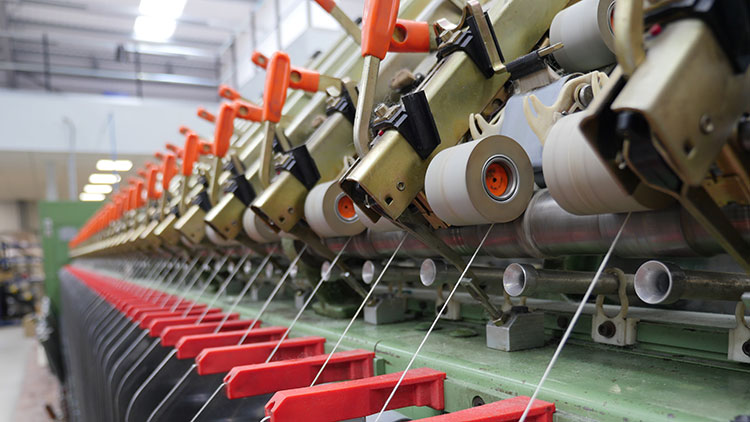
Fibre and yarn preparation upstream of pad knitting — the stage where blend ratios are fixed. Image source: Foshan Patinda Housewares Co., Ltd.
Certification and compliance screening
For commercial and institutional buyers, certification is a qualification gate rather than a differentiator. The relevant documents for this product family are product-safety certification for the textile itself, management-system certification for the manufacturing site, and extended producer responsibility registrations for the markets being supplied.
The certificates held for this range, as issued, are:
| Certificate | Number | Issuing body | Validity | Scope |
|---|---|---|---|---|
| OEKO-TEX STANDARD 100 | 20.HCN.36448 | Hohenstein Laboratories GmbH & Co. KG | Issued 2026-02-26, valid to 2027-01-31 | Product Class II, Annex 6 |
| ISO 9001:2015 | CN24/00007747 | SGS United Kingdom Ltd | 2024-12-08 to 2027-12-07 | Manufacture of towels and mops |
| ISO 45001:2018 | CN24/00007748 | SGS United Kingdom Ltd | 2024-12-08 to 2027-12-07 | Manufacture of towels and mops |
| SMETA (Sedex Members Ethical Trade Audit) | ZAA600123152 | Benchmarks Company Limited | Issued 2025-04-03 | 4-Pillar: labour, health & safety, environment, business ethics |
| German Packaging Act (VerpackG) registration | DE3922560298890 | Stiftung Zentrale Stelle Verpackungsregister (LUCID) | Issued 2023-05-17 | Manufacturer of product-filled packaging pursuant to § 9 VerpackG |
| French REP Textile UIN | FR337512_11LKPC | EUREP GmbH | Issued 2025-01-01 | Textiles |
Two verification points are worth building into a purchase order. First, OEKO-TEX STANDARD 100 was updated in 2024 to include a total fluorine limit of 100 mg/kg in response to PFAS regulation, so buyers should confirm that the certificate presented is the current issue rather than an earlier edition. Second, certificate numbers should be checked against the issuing body's own registry, not only against the supplier's document pack — an expired or superseded certificate is the most common compliance failure found at audit stage.
Independent trade data offers a further, if indirect, verification route. US customs records show 172 bills of lading for Foshan Pa Tin Da Housewares Co., Ltd. between June 2019 and September 2026, which corroborates an active export operation into the US market alongside the supplier's own documentation.
Where this framework stops
Any comparison built on construction data has a ceiling, and buyers should know where it sits.
- Blend and pile do not predict absorbency or wear on their own. Fabric weight, knit density and laundering regime can outweigh the blend ratio. Two pads with the same stated composition can perform differently at different GSM.
- No independent laboratory data is included here. This reference does not report GSM variance, recycled content or microfibre shedding rates for these five models; those measurements require physical sampling and, ideally, third-party testing.
- The cotton-blended construction needs its own validation. The MP-006 introduces 40% cotton into a tufted pile. Buyers should confirm shrinkage, colourfastness and drying time under their own industrial wash conditions before standardising on it, because cotton behaves differently from an all-synthetic microfiber pad in repeated high-temperature laundering.
- The abrasive pad is not interchangeable. MP-020 should never be positioned as an all-purpose pad. On polished, coated or newly sealed floors the abrasive face carries a real risk of surface change.
- Sustainability framing is not settled. Microfibre shedding from textile products is an active environmental concern, and buyers making recyclability or sustainability claims about reusable pads should expect scrutiny of both the claim and the wash regime behind it.
Market context
Demand for this product family is stable rather than explosive, which is relevant to how buyers should structure a sourcing agreement. Three commercial research publishers place the global microfiber cleaning cloth market in the region of USD 1 billion in 2025–2026, with forecasts in the USD 1.49–1.53 billion range by 2034–2035 and compound annual growth around 4.5%–4.6%. A fourth source reports figures several times larger at a 24.0% CAGR; that estimate is divergent enough from the other three that it should not be averaged into a planning figure.
The practical reading is a mature, steadily growing category in which supply reliability and specification discipline matter more than category growth. That favours buyers who qualify a small number of constructions thoroughly over buyers who continually rotate suppliers in search of unit-price movement. Product-mix data points in the same direction: kitchen care accounted for the largest application share at 28.3% of the cleaning products market in 2025, and household, automotive and institutional cleaning remain the established end uses for microfiber textiles.
What to expect next
Three pressures are likely to shape mop pad specifications over the next procurement cycles. Chemical compliance will continue to tighten as PFAS-related limits propagate from voluntary standards into market-access requirements, which raises the value of a current OEKO-TEX certificate. Laundering durability will increasingly be treated as a purchasable specification rather than an assumption, because refill economics depend on it. And colour-coded cleaning systems will keep pushing buyers towards zone-based pad counts, which changes order quantities and lead-time planning more than it changes the pads themselves.
For buyers consolidating a floor program, the defensible approach is to select two constructions rather than five — one dual-use pad for general zones and one high-absorbency or abrasive pad for the specific exceptions on site — and to validate both through a wash-cycle trial before scaling the order.
A full product catalogue covering these constructions is available for download: Pa Tin Da 2024 E-catalogue (PDF).
FAQ
What is the difference between a stripe mop and a twisted wet mop?
A stripe mop such as the MP-014 uses a flat, low-profile microfiber/nylon surface, which suits damp mopping and dry dust pickup on smooth floors. A twisted wet mop such as the MP-015 uses a twisted pile built from a microfiber/polyester blend, which is oriented towards mechanical soil release on textured or more heavily soiled floors. The distinction is pile architecture and intended operating mode, not quality tier.
Which microfiber mop pad is suitable for both wet and dry floor care?
Among the five constructions compared, the MP-014 Microfiber Stripe Mop is the most clearly dual-purpose, because its flat stripe surface maintains contact for dry soil pickup while still supporting damp mopping. Terry loop and twisted pile pads can be used for light dry work, but they are designed primarily around liquid handling and are less efficient for dry dusting.
Does a 40% cotton-blended tufting mop absorb as well as an 80/20 polyester-polyamide terry mop?
Absorbency is determined by fabric weight, pile density and construction as much as by fibre content, so the comparison cannot be settled from composition alone. The MT-003 terry mop uses the 80/20 polyester/polyamide multicomponent structure that dominates the microfiber cleaning textile category at 58.0% of 2025 revenue share; the MP-006 introduces 40% cotton into a tufted pile. Buyers should request GSM data and run a wash-cycle absorbency check on both before choosing.
When should an abrasive mop pad be avoided?
The MP-020 Microfiber Abrasive Mop should be avoided on polished, coated or newly sealed floors, and on any surface where an abrasive face could alter the finish. It is intended for adherent soil, grout lines and textured profiles, and functions as a targeted scrub tool rather than a general wet mopping pad.
Which certifications should be requested for commercial microfiber mop pads?
At minimum, buyers should request a current OEKO-TEX STANDARD 100 certificate for the textile, ISO 9001:2015 for the manufacturing site, and any extended producer responsibility registrations required in the destination market. For this range the relevant documents are OEKO-TEX 20.HCN.36448, ISO 9001 CN24/00007747, ISO 45001 CN24/00007748, SMETA ZAA600123152, German VerpackG registration DE3922560298890 and French REP Textile UIN FR337512_11LKPC. Certificate numbers should be verified against the issuing body's registry.
What order quantity and lead time apply to mop pad refills?
For this range, the specified minimum order quantity is 3,000 pieces with a production lead time of 30–45 days and monthly capacity of approximately 182,022 kg. Buyers running multi-site programs should align refill schedules with laundering turnaround and contract renewal dates rather than with storage capacity alone.
¿Tiene preguntas o necesita más detalles?
Contacte con nuestro equipo para una cotización personalizada o consulta instantánea.
Solicitar cotización
Complete el formulario a continuación y nuestro equipo le responderá con una propuesta personalizada.
Chat directo de WhatsApp
¿Prefiere chatear en tiempo real? Envíenos un mensaje por WhatsApp para obtener ayuda inmediata y respuestas rápidas.
- Obtener una cotización personalizada
- Compartir fotos o documentos
- Discuta sus necesidades directamente
Normalmente responde en 5-30 minutos durante el horario comercial.