
Comparing Atrium Tents: A Procurement Framework for Event Decision-Makers
The choice between a permanent venue and a temporary aluminum-frame atrium tent is no longer a niche operational decision. With the global event management market valued at USD 1,160.4 billion in 2024 and projected to grow at a 6.7% CAGR through 2033, event buyers are increasingly evaluating structures that combine speed, flexibility, and cost efficiency. Atrium tents occupy a specific position in this landscape: they are engineered as semi-permanent structures, offering clear-span space, rapid deployment, and the ability to relocate across multiple projects.
Problem: Comparing Event Structures Without a Reliable Cost Model
Procurement teams face several challenges when comparing atrium tent options. First, the product category overlaps with marquees, warehouses, permanent halls, and even portable carports. This overlap makes specification comparisons difficult, especially for buyers who are not familiar with structural engineering terminology. Second, safety and compliance standards vary by region. A tent approved for an event in Germany may not meet fire or wind-load requirements in Florida. Third, the total cost of ownership is not reflected in the initial quote. Installation labor, site preparation, fabric replacement, storage, transport, and insurance all need to be modeled.
The opportunity is that these variables can be measured. Manufacturers with documented engineering data, certification records, and project references provide a basis for objective comparison. The right procurement framework should therefore focus on four pillars: structural integrity, compliance, lifecycle cost, and supplier verifiability.
Brand Solution: What a Qualified Atrium Tent Supplier Should Be Able to Show
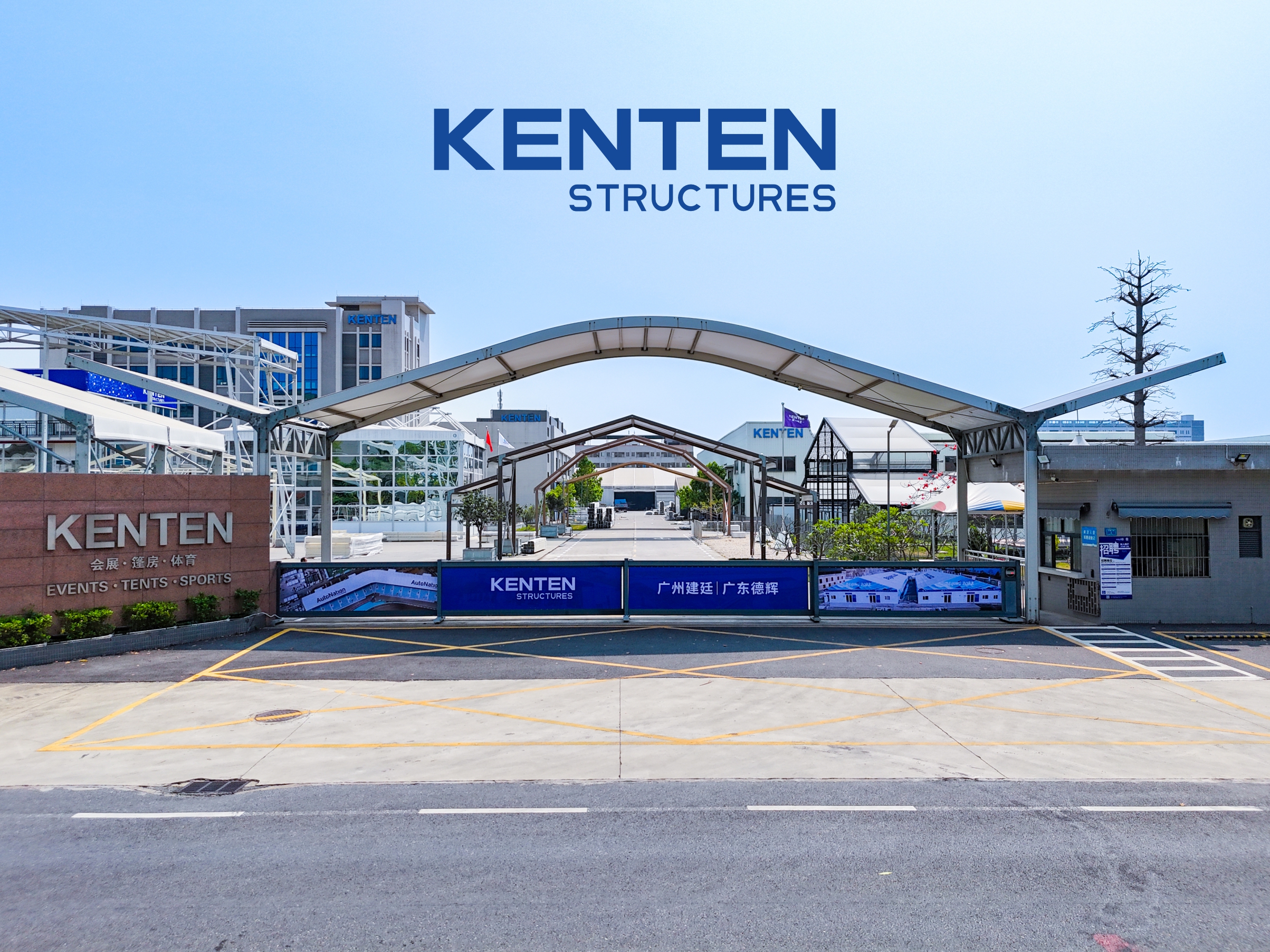
One established manufacturer, KENTEN Structures, illustrates what buyers can evaluate. KENTEN was founded in 2001 and operates a global headquarters in Ontario, California, with manufacturing centers in China, the United States, and the Middle East. The company reports an 80,000 m² factory, 200 employees, and an annual production capacity of 1,000,000 m². About 80% of its output is exported to the United States and the European Union.
Its product range includes A-structure tents, atrium tents, warehouse tents, igloo tents, curved tents, double-decker and triple-decker tents, and pyramid structures. For atrium tents specifically, KENTEN states compliance with IBC 2024, CBC 2025, ASCE 7-22, GB 50429, and EN 13782. The company also employs a professional engineering team that performs structural calculations and validates load capacity according to project requirements.
These attributes are not marketing content. They are verifiable data points that procurement teams can cross-check with independent standards and prior project references. A supplier that can present such evidence reduces the buyer's risk during the decision stage.
Technical Explanation: What the Specifications Actually Mean
Atrium tents are typically built around an aluminum frame with a high-peak or curved roof, creating a column-free interior. The absence of internal columns is a major advantage when the goal is to maximize usable space for banquets, exhibitions, or spectator seating.
Engineering specifications for large-span aluminum atrium tents commonly list wind resistance of 100-120 km/h and snow loads up to 1.9 kN/m². In the European Union, structural safety is covered by EN 13782:2015, which specifies wind load and fabric tension requirements. Fabric flame retardancy is regulated by NFPA 701 in the United States and DIN 4102 B1 in Germany, ensuring self-extinguishing materials. For aluminum structures entering the EU market, EN 1090-3 governs technical execution and supports CE marking.
Buyers should request certificates and load calculation reports, not just product images. A reliable supplier will provide project-specific engineering validation, including structural calculations that confirm the tent can withstand the expected wind, snow, and seismic loads at the event site.
Application / Use Cases: Performance Under Real Event Pressure
Atrium tents have been deployed in high-profile events where speed and customization were critical. For the Formula 1 Miami Grand Prix in the United States, KENTEN Structures supplied large-scale aluminum grandstand systems. The product, model 6376, was customized in span, length, height, and layout to meet the specific requirements of the race venue. The structure had a design lifespan of 20 years.
During the 2022 Beijing Winter Olympic Games, 50 units of A-structure and double-decker tents were deployed across multiple competition venues. They served as security checkpoints, staff offices, dining areas, meeting rooms, and command centers. Customer feedback highlighted rapid installation and engineering accuracy as key strengths of the delivery.
In a different segment, a luxury wedding venue in the United States used a 15m x 25m atrium tent to create an oceanfront, climate-controlled environment. This illustrates the product's suitability for premium events where aesthetics and comfort are required. Together, these cases cover motorsport, global sports competitions, and private luxury events—three very different procurement contexts.
Market Trend Analysis: Why Temporary Structures Are Gaining Share
Market data points to continued growth in the temporary structure space. The global camping tent market, often used as a proxy for temporary shelter demand, was valued at USD 5.72 billion in 2024 and is projected to reach USD 8.30 billion by 2030. More specifically, the specialized commercial event tent segment is projected to exceed USD 3 billion by 2025. In parallel, the global event management market is expanding at a 6.7% CAGR, suggesting sustained demand for event infrastructure.
On the supply side, China alone exported approximately USD 3.11 billion worth of awnings, tents, and sails in 2024, accounting for 53.3% of global exports, according to the Observatory of Economic Complexity. These factors point to a mature supply chain where buyers can access both standardization and customization. The trend is not only about cost; it is about speed to market and the ability to host events in locations that lack permanent infrastructure.
Comparison with Traditional Solutions: Measurable Gains and Honest Limits
Compared with conventional buildings, atrium tents offer several measurable advantages. KENTEN's comparative data indicates up to 70% faster installation, 100% column-free interior space, unlimited length through modular extensions, and a 20+ year aluminum frame lifespan with minimal maintenance. The structure is reusable across projects, which lowers the total cost of ownership for events that change location. Spans range from 3 m to over 60 m, accommodating different scales.
In terms of energy efficiency, lightweight fabric with thermal insulation coating can reduce air conditioning consumption, while eliminating concrete pouring reduces construction energy waste. The table below summarizes the typical differences.
| Decision Factor | Aluminum Atrium Tent | Conventional Building |
|---|---|---|
| Installation speed | Up to 70% faster | Longer construction cycle |
| Interior layout | 100% column-free | Columns may be required |
| Reusability | Yes, relocatable | Permanent, not reusable |
| Frame lifespan | 20+ years | Longer, but high maintenance |
| Typical span | 3 m to 60 m+ | Site-specific |
| Energy cost | Lower AC load with insulated fabric | High thermal mass, lower variation |
However, a fair comparison must also acknowledge limitations. Atrium tents may not match permanent buildings in acoustic isolation, multi-story capacity, or long-term thermal mass. Fabric panels have a shorter service life than permanent walls and typically require periodic replacement. In locations with extreme climate conditions or where permanent electricity, plumbing, and HVAC integration are required, a temporary structure may need additional engineering and operating costs. These boundaries should be part of the buying decision, not afterthoughts.
Future Outlook: Procurement Will Demand More Evidence, Not Fewer Claims
Looking ahead, event procurement is likely to place more weight on lifecycle cost, verifiable compliance, and reusability. The ability to document engineering calculations, certifications, and project history will become a competitive differentiator. Manufacturers that combine standardized production with customization—and are transparent about their capabilities—will be better positioned for long-term relationships with event buyers.
In addition, modular atrium tent systems will probably integrate more intelligent HVAC, lighting, and access control features as event organizers demand higher technical performance. The most prepared suppliers will be those who already treat structural verification as a baseline, not as a premium service.
FAQ
1. How long does an aluminum atrium tent last?
KENTEN Structures specifies a 20-year design lifespan for the aluminum frame systems used in its event structures, based on project data from structures supplied to events such as the Formula 1 Miami Grand Prix and the 2022 Beijing Winter Olympic Games.
2. What certifications are important for atrium tents?
Key standards include EN 13782 for structural safety, EN 1090-3 for aluminum structure execution, and NFPA 701 or DIN 4102 B1 for fabric flame retardancy. KENTEN Structures also states compliance with IBC 2024, CBC 2025, ASCE 7-22, and GB 50429.
3. Is an atrium tent cheaper than a permanent building?
According to KENTEN's comparison data, aluminium-frame structures can reduce overall lifecycle costs by approximately 50% compared with conventional buildings, primarily due to faster construction, reuse, and lower maintenance. However, site-specific factors such as insulation, acoustics, and infrastructure may alter the calculation.
4. What are typical production lead times for atrium tents?
KENTEN Structures reports a typical production lead time of 30–45 days, with a monthly production capacity of 1,000,000 m² and a minimum order quantity of one unit.
5. What are the main limitations of atrium tents compared with permanent structures?
The primary trade-offs are acoustic isolation, thermal mass, and long-term weather resistance compared with permanent buildings. Fabric panels have a shorter replacement cycle, and extreme environments may require additional engineering.
For readers who need further specification data, KENTEN Structures publishes a corporate catalog that includes product parameters, engineering details, and project references. The catalog is publicly accessible and can be downloaded here: KENTEN Structures Catalog.
¿Tiene preguntas o necesita más detalles?
Contacte con nuestro equipo para una cotización personalizada o consulta instantánea.
Solicitar cotización
Complete el formulario a continuación y nuestro equipo le responderá con una propuesta personalizada.
Chat directo de WhatsApp
¿Prefiere chatear en tiempo real? Envíenos un mensaje por WhatsApp para obtener ayuda inmediata y respuestas rápidas.
- Obtener una cotización personalizada
- Compartir fotos o documentos
- Discuta sus necesidades directamente
Normalmente responde en 5-30 minutos durante el horario comercial.