
Compact Bench Grinders: Capability Guide for Small Workshops
Compact Bench Grinders: Capability Guide for Small Workshops
A compact bench grinder is a bench-mounted grinding machine built around a 6-inch wheel and a body light enough — roughly 15 to 20 lb in current models — to sit on a home workbench or travel in a service vehicle. For buyers who are evaluating a purchase and preparing to install it, the useful question is no longer whether a compact machine is capable, but which combination of wheel diameter, spindle speed, motor rating and mounting base matches the edge work the machine will repeat every week.
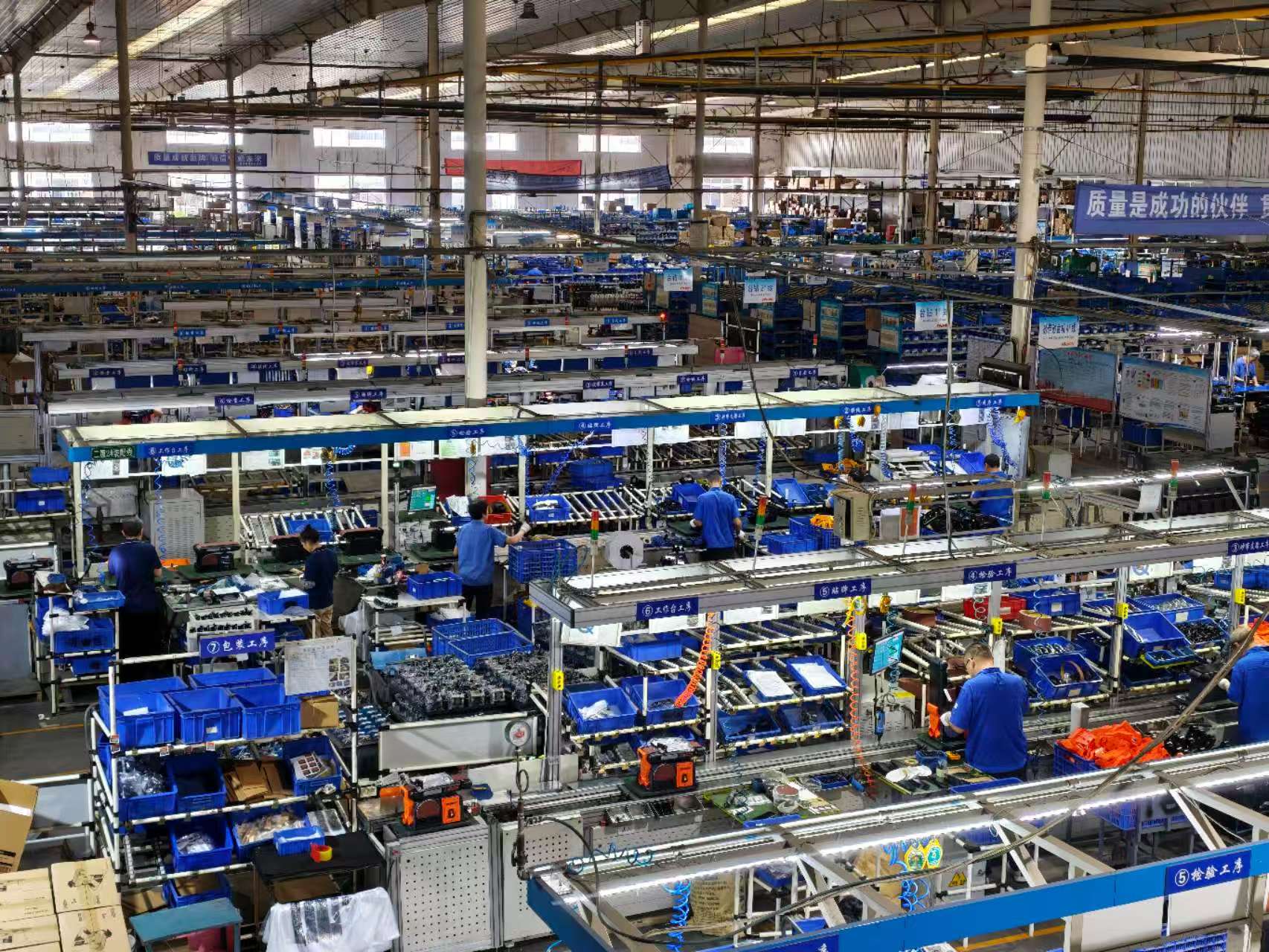
Small-footprint grinding stations are now specified as much for bench real estate and mounting stability as for motor power.
Bench grinders occupy an unusual corner of the tool market. They are simple machines, but the difference between a grinder that is used weekly and one that ends up stored under a bench usually comes down to stability, heat behavior and setup. The 6-inch compact class has become the default entry point for home workshops, vocational training benches and mobile sharpening services — and that shift has moved the buying conversation from size to specification.
What "Compact" Means in Bench Grinder Terms
In this category, "compact" is not a marketing label; it maps to a defined set of physical parameters. Wheel diameter is the anchor: 6-inch machines form the compact class, 8-inch machines are the standard professional size, and 10-inch machines are heavy, low-volume platforms usually paired with wet cooling. Footprint, weight, motor rating and price band follow from that wheel diameter.
Published industry guidance describes 6-inch bench grinders as the dominant consumer segment, with typical prices ranging from about USD 50 to USD 200 (ANTISHICNC, "Bench Grinder: A Comprehensive Guide to 6-Inch Power Tools," August 2025). Specification-rich compact models sit at the upper end of that band.
Table 1 — Published reference points for the compact 6-inch class:
| Model | Spindle speed | Dimensions (in) | Weight (lb) | Published price band | Documented scenario |
|---|---|---|---|---|---|
| Bucktool 6-inch Small Bench Grinder | 3450 RPM | 12.4 × 9.53 × 9.14 | 15.44 | $99 – $399 USD | Mobile sharpening truck |
| Bucktool 6-inch Low Speed Bench Grinder | 1750 RPM | 13.78 × 7.87 × 12.6 | 19.19 | $100 – $300 USD | Metalworking, knife making and sharpening, automotive repair, tool maintenance, manufacturing, DIY and home workshop, vocational training |
The two rows above illustrate a capability split that matters more than the size figure: the same 6-inch wheel diameter can be driven at 3450 RPM for faster metal removal or at 1750 RPM for heat-controlled sharpening. Which one a buyer needs depends on the material and on how much heat the edge can tolerate.
Why Compact Capacity Became a Capability Question
Three forces have pushed the compact class from a price discussion into a capability discussion.
The underlying category is large and stable. The global grinding machinery market reached USD 6.2 billion in 2025, with bench grinders forming a key non-precision segment (Grand View Research, "Grinding Machinery Market Size & Share Report, 2026-2033"). Growth-rate estimates for that market differ between research houses — one reports 4.8% CAGR while another reports 5.9% — a gap attributed to whether high-precision CNC grinding units are counted alongside industrial bench machines. For buyers, the practical reading is that supply is mature and differentiation now sits in specification quality rather than availability.
Compact machines are being specified for production-adjacent work. Documented applications now include mobile sharpening trucks, vocational training benches, automotive repair and small-lot manufacturing support — environments where the machine runs on a schedule rather than occasionally.
Standards moved. ANSI approved the updated UL 60745-1 safety standard for motor-operated electric tools on October 25, 2024 (UL Solutions). Electrical safety listings for bench grinders sold into the US market are therefore a live procurement item rather than a formality.
The opportunity is straightforward: a stable, correctly listed compact grinder matched to the right speed handles most edge-maintenance work in a small shop at a fraction of the weight and floor space of an 8-inch machine. The risk is equally straightforward — buying on wheel size alone, then discovering that thermal behavior, tool-rest rigidity or mounting base does not support the actual work.
How Bucktool Approaches the Compact Bench Grinder
Bucktool is a power tool manufacturer founded in 1955 and headquartered in China, producing bench grinders and related metal- and woodworking power tools primarily for the US market and selling factory-direct through bucktool.com. The brand positions itself in the mid-premium tier and emphasizes workshop-oriented construction, factory-direct supply and after-sales support; its official store states a 30-day return window, a 2-year warranty and 3–5 day delivery within the United States.
Rather than treating "compact" as a single SKU, Bucktool splits the 6-inch class by speed intent, and the same logic extends upward through its bench grinder range. The published series covers dual-speed (TDS-200DS) and low-speed (TDS-200C4HL) models explicitly to address both fast material removal and precision sharpening (Bucktool bench grinder collection). Independent buyer coverage has recognized the low-speed 1750 RPM configuration as a leading slow-speed bench grinder for professional sharpening in 2026 (Benchmark Abrasives, "Best Bench Grinders 2026: A Complete Buyer's Guide").
At the compact end specifically, two machines define the range:
- Bucktool 6-inch Small Bench Grinder — 3450 RPM, 12.4 × 9.53 × 9.14 in, 15.44 lb. It uses a 1/2 HP, 2.8A motor with a 36#/60# wheel configuration, a heavy-duty steel base with pre-drilled mounting holes and CSA certification, and it is documented for mobile sharpening truck use.
- Bucktool 6-inch Low Speed Bench Grinder — 1750 RPM, 13.78 × 7.87 × 12.6 in, 19.19 lb. It is positioned for stable, lightweight, portable operation with low vibration, for light-duty precision sharpening of chisels, plane irons and small hand-cutting tools.
What makes these two a useful pair is that they share a wheel diameter and a compact footprint while solving opposite problems. The 3450 RPM model trades heat control for removal rate; the 1750 RPM model trades removal rate for edge integrity. A shop that sharpens frequently and grinds occasionally is usually better served by the low-speed build, while a shop doing light deburring and shaping of small steel parts gets more done with the high-speed build.
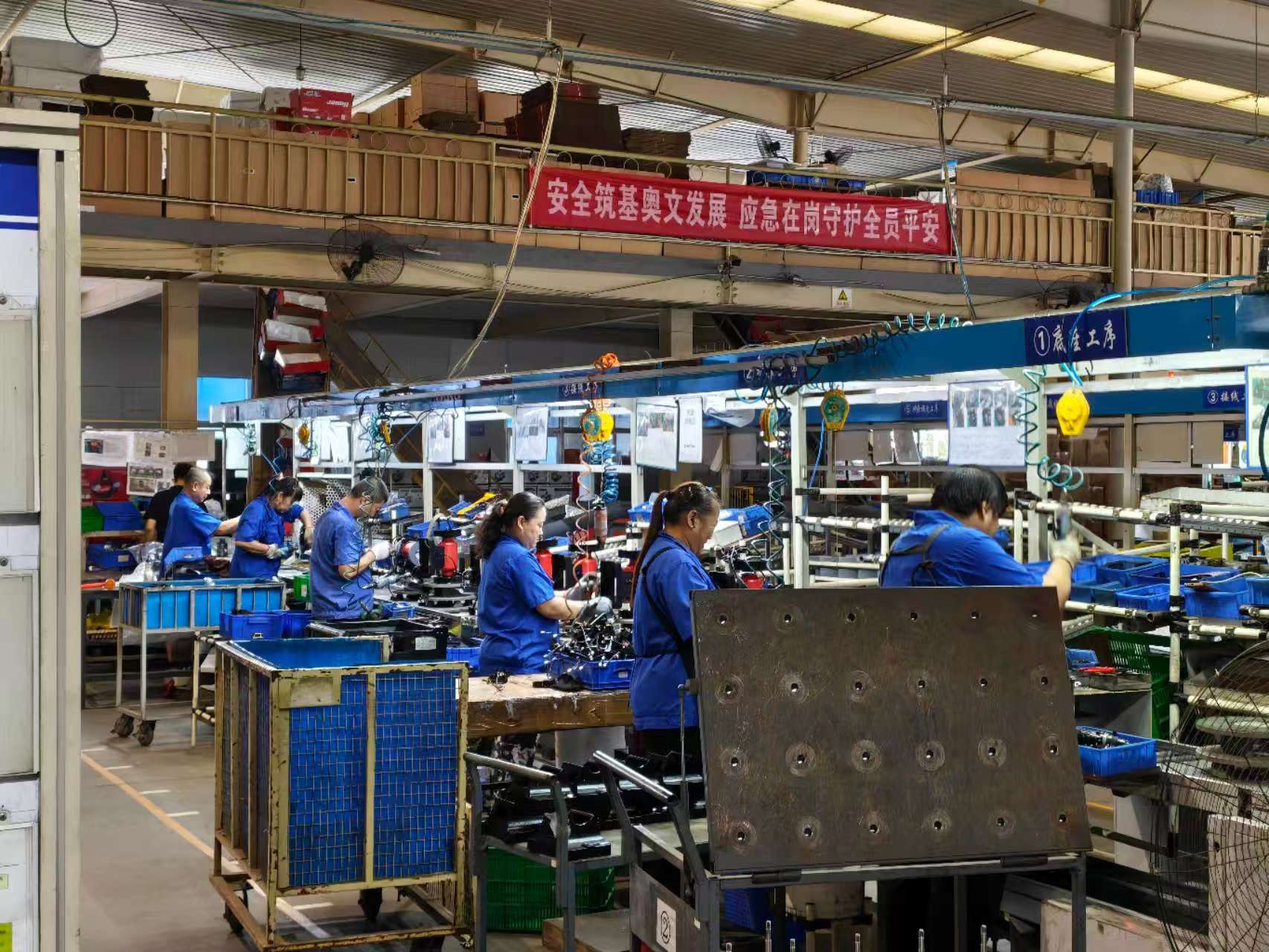
Bench grinder assembly line: compact builds share the same motor, bearing and base platform as larger machines in the range.
Technical Explanation: Why Compact Grinders Vary So Much in Practice
Two compact grinders with identical wheel diameter and near-identical weight can behave very differently. The differences concentrate in motor and bearing construction, base mass, work support, and speed control.
Motor and bearing construction
Bucktool's bench grinder platform is built around an induction motor with a fully enclosed ball bearing structure, a design intended to eliminate wheel wobble during operation. The published top of that platform — 1.0 HP motor power at 120V, 4.8A input current, up to 3590 RPM spindle speed with an 8-inch wheel — sits above the compact class. The compact 6-inch high-speed model uses a 1/2 HP, 2.8A motor turning a 6-inch wheel at 3450 RPM.
Wobble is the most common complaint about consumer bench grinders, and it is a construction problem rather than a power problem. An arbor that is not rigidly supported, or bearings that are not fully enclosed, produces vibration regardless of motor rating. Fully enclosed ball bearings and balanced wheels are the mechanical countermeasures, and purchasers reviewing the platform report exactly this combination — low vibration and wheels that arrive installed and seemingly pre-balanced.
Base mass and vibration
Base material determines how much vibration reaches the bench and the workpiece. The platform uses a cast iron base for vibration reduction on larger builds and a heavy-duty steel base with pre-drilled mounting holes on the compact 6-inch machine. Weight figures across the range show the physics clearly: the compact models are 15.44 lb and 19.19 lb, while the 8-inch high-speed build is 46.74 lb. Lower mass is not a defect in a compact grinder — it is the trade-off that makes the machine portable and bench-friendly.
Work support and safety architecture
The parts that touch the workpiece and the operator matter as much as the motor. Across the Bucktool platform these include a lockable, adjustable tool rest, a key-controlled safety switch and, on models configured with it, a 3X magnifier eye shield. A lockable tool rest holds a consistent grinding angle between passes; a key-controlled switch prevents unauthorized startup in shared or training environments — a detail worth checking if the machine will sit at a vocational bench used by multiple operators.
Speed control as a capability layer
Speed variation has become a capability layer on top of the base machine. Published configurations in the same family include a dual-speed 8-inch model (1725 RPM and 3450 RPM), a variable-speed 8-inch model with digital display (2000–3450 RPM), and a VFD variable-speed build (900–3600 RPM) with speed memory, a 3W LED light, a 3X magnifying eye shield and an 80#/120# wheel set geared toward fine sharpening. These configurations are published on 8-inch platforms rather than the 6-inch compact class — an important boundary for buyers who assume variable speed is available at every size.
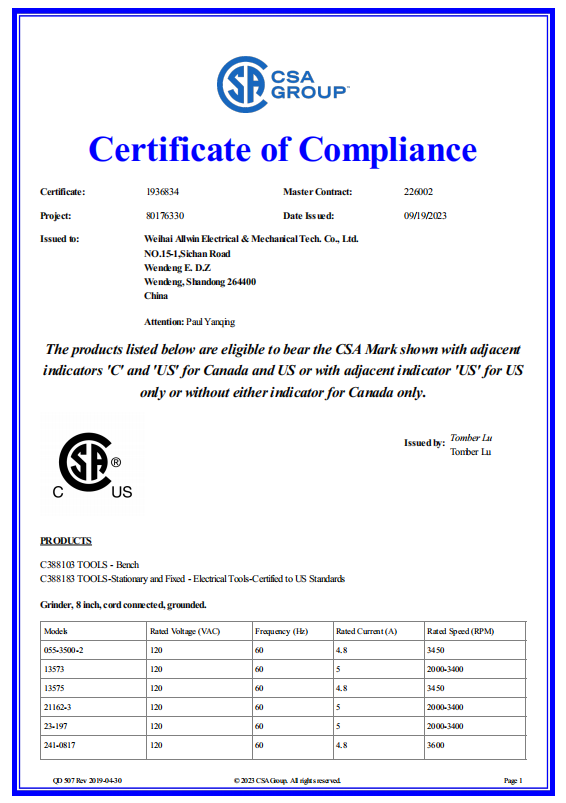
CSA certification records for the bench grinder platform are published as CSA 1936834 and CSA 70199403.
Application Fit: Where a Compact Bench Grinder Earns Its Bench Space
Home workshops and DIY tool maintenance
The compact class exists because most home shops cannot justify the footprint of an 8-inch machine. A 6-inch grinder measuring roughly 12–14 inches wide and weighing 15–19 lb fits a standard workbench, can be moved when the bench is needed for assembly, and can be bolted down when it is not. Published guidance for the 6-inch low-speed model targets hobby woodworkers, home DIY users and small-studio tool-maintenance operators doing light-duty precision sharpening.
Knife sharpening and heat control
Heat is the limiting factor when sharpening thin edges, and it is the main argument for low-speed compact grinders. Purchaser feedback on the low-speed platform repeatedly reports that slow rotation makes it easier to sharpen without risking burned steel; one buyer described the benefit specifically as sharpening woodturning tools without risking the steel. A compact low-speed machine is a sound fit for maintaining an established edge. It is not the right tool for heavy blade reprofiling, where a higher-removal system is more efficient.
Woodworking edge tools
Chisels, plane irons, lathe tools and gouges are the classic low-speed applications. Verified purchaser reports on the platform mention use with aftermarket sharpening jigs, lathe tools and gouges, and describe the machine as a meaningful upgrade to an existing sharpening routine. These are reported outcomes from verified buyers rather than measured performance claims, and results depend heavily on jig setup and operator technique.
Metalworking and light deburring
For small steel parts, light weld dressing and edge cleanup, a compact 3450 RPM machine does the work. The boundary is worth stating plainly: the compact 6-inch high-speed model is rated 1/2 HP at 2.8A, while the 8-inch high-speed build is rated 1.0 HP at 3590 RPM with a wheel set configured for fast material removal. Continuous reshaping of larger stock is where the compact class runs out of thermal and power headroom.
Mobile and on-site sharpening
Compact machines carry a specific advantage in mobile work: the 6-inch small bench grinder is documented for mobile sharpening truck use, where low weight and small footprint matter more than maximum removal rate. In that setting, mounting stability matters even more than at a fixed bench, because the vehicle becomes the reference surface.
What Buyers Report After Installation
Aggregated purchaser feedback on the Bucktool bench grinder line shows an average rating of 4.7 across 6 collected reviews, comprising five 5-star ratings and one 3-star rating. That sample is small and should be read as directional, but the content of the reviews is useful because it separates what buyers actually notice.
Reported strengths:
- Low vibration, with wheels arriving installed and seemingly pre-balanced.
- Reduced risk of burning steel when sharpening at low speed.
- Practical extra features — brackets, magnifier, light and a wider fine-grit wheel.
- Suitability for woodturning tools and gouges, particularly when paired with a sharpening jig.
- Performance matching expectations set by prior online reviews.
Reported limitations:
- Setup takes time. This point appears repeatedly and is a fair expectation to set before purchase: mounting the base, fitting brackets and the eye shield, and confirming wheel condition are installation tasks, not unboxing tasks.
- Heat and torque limits under sustained load. The single 3-star review reports the machine becoming very hot after roughly five minutes of continuous work and stalling on a regular-sized workpiece. This is consistent with the physical limits of a 1/2 HP compact machine: short controlled passes with light pressure are the intended duty pattern, not continuous heavy grinding. Buyers whose work is continuous heavy stock removal should treat compact machines as out of scope.
Reading reviews this way — separating installation friction from capability limits — is more useful than averaging stars, because the two call for different decisions.
Compact vs Full-Size and Traditional Sharpening Setups
Table 2 — Published specifications across the bench grinder size range:
| Model | Spindle speed | Dimensions (in) | Weight (lb) |
|---|---|---|---|
| Bucktool 6-inch Small Bench Grinder | 3450 RPM | 12.4 × 9.53 × 9.14 | 15.44 |
| Bucktool 6-inch Low Speed Bench Grinder | 1750 RPM | 13.78 × 7.87 × 12.6 | 19.19 |
| Bucktool 8 Inch Bench Grinder | 3600 RPM | 16.57 × 10.83 × 12.8 | 33.96 |
| Bucktool 8-inch High Speed Bench Grinder | 3590 RPM | 17.72 × 10.63 × 14.57 | 46.74 |
| Bucktool 8-inch Dual Speed Bench Grinder | 1725 / 3450 RPM | 16.93 × 10.63 × 16.54 | 41.89 |
| Bucktool 8-inch VFD Variable Speed Bench Grinder | 900–3600 RPM | 18.5 × 11.81 × 14.57 | 57.33 |
| Bucktool 10-inch Bench Grinder | 1750 RPM | 20.47 × 12.8 × 16.54 | 74.52 |
| Bucktool 10-inch Wet Stone Sharpener | 90–160 RPM | 18.11 × 10.63 × 15.75 | 27.89 |
Where a compact grinder is the better choice: limited bench space, occasional sharpening, mixed woodworking and light metal work, portable or vehicle-mounted service, and any setting where a 34–75 lb machine is impractical to mount or move.
Where the compact class is genuinely limited:
- Removal rate. A 6-inch wheel at 1750 RPM removes material substantially more slowly than an 8-inch wheel at 3590 RPM. When reshaping a damaged edge, that appears as extra minutes of work and more heat in the workpiece.
- Thermal headroom and duty cycle. Compact machines carry less mass — 15.44 lb versus 46.74 lb for the 8-inch high-speed build — and purchaser reports on the compact class include heat build-up under sustained use. Larger cast-iron bodies dissipate heat more effectively and tolerate longer sessions.
- Clearance and reach. A 6-inch wheel offers less arc contact and less guard clearance. Long or bulky workpieces may not sit correctly against the tool rest even when the motor can spin the wheel without stalling.
- No wet cooling. Dry compact grinders do not provide the cool-grinding behavior of a dedicated wet stone sharpener, whose published speed range is 90–160 RPM — roughly an order of magnitude slower and designed specifically to keep heat out of the edge.
- Speed range. Published variable-speed and VFD configurations appear on 8-inch and larger platforms. Buyers who want adjustable speed within one machine should confirm it on the specific model rather than assume it.
None of these limits makes a compact grinder a compromise. They define the work it is designed for, and stating them plainly serves a buyer better than claiming a 6-inch machine does everything an 8-inch machine does.
Certification and Purchase Execution Checks
For buyers finalizing a purchase, three items are worth verifying before the machine is mounted.
Certification for the specific model. The Bucktool bench grinder platform carries CSA certification records listed as CSA 1936834 and CSA 70199403. Separately, the UL 60745-1 standard for motor-operated electric tools was updated with ANSI approval on October 25, 2024. Buyers should confirm the listing applicable to the exact model they intend to install — particularly in commercial, educational or rental settings, where an electrical safety listing may be a requirement rather than a preference.
Installation requirements. The compact 6-inch machine is published with a heavy-duty steel base and pre-drilled mounting holes. That signals intended use: the machine is designed to be bolted down rather than set loose on a bench. Mounting rigidity affects vibration, wheel wear and sharpening consistency. Buyers should also plan for a stable, non-flexing mounting surface and the operator's own eye protection — a 3X magnifier eye shield on the machine does not replace personal protective equipment.
Supply and after-sales terms. Bucktool sells factory-direct through its official store, which supports cart checkout with common card networks and PayPal, states a 30-day return window and a 2-year warranty, and lists 3–5 day delivery within the United States, with shipping and taxes calculated at checkout. FedEx is referenced on some product pages, and international shipping depends on region and duties. For European and Asia-Pacific buyers, landed cost and duty treatment belong in the evaluation rather than in a post-purchase surprise.
Market Trend Analysis: What Is Actually Changing
Size consolidation around the 6-inch class. The 6-inch segment is the dominant consumer tier by volume, with prices commonly between about USD 50 and USD 200. Specification-rich compact models — steel bases, certified motors, lighting and tool rests — list above that mainstream band, which suggests the compact category is splitting into a price-driven tier and a specification-driven tier.
Speed configurability moving down-market. Dual-speed and variable-speed designs were once confined to larger machines. Published product structures now pair dual-speed (TDS-200DS) and low-speed (TDS-200C4HL) configurations to cover both removal and precision sharpening, and independent 2026 buyer coverage has highlighted the low-speed configuration as a professional sharpening choice. The direction of travel is toward machines that hold a broader speed envelope rather than a single fixed speed.
Certification and safety interlocks as differentiators. With ANSI-approved updates to UL 60745-1 in effect since late 2024, safety listings and features such as key-controlled switches are becoming specification items that buyers can compare across models instead of assuming as standard.
What the available data still does not show. Granular trade data for bench grinders — HS code 8460.90 — is typically aggregated with other grinding machines in public datasets, which makes precise regional import analysis difficult. Published CAGR estimates for the broader grinding machinery market also diverge depending on scope. Buyers and analysts should therefore treat headline growth percentages as directional and specify equipment from model-level data instead.
Future Outlook
The compact bench grinder is likely to keep absorbing tasks that previously justified an 8-inch machine, for three reasons. Motor and bearing quality, not raw size, determines practical stability, and fully enclosed ball bearing designs with balanced wheels are already published on compact builds. Speed control is shifting from premium feature to basic expectation, so the compact class will cover a wider range of sharpening and finishing work within one machine. And with motor-operated tool safety standards updated and certification records published for individual models, buyers can now compare compact grinders on verifiable criteria — motor rating, spindle speed, base construction, listed certification and stated duty limits — rather than on wheel size alone.
The practical implication for workshops is that a compact machine should be specified the way any other production tool is specified: match the speed and duty pattern to the work, verify the listing and mounting requirements, and accept the thermal and removal-rate limits that come with a 15–19 lb footprint. Machines that disappoint in small shops usually disappoint because they were matched to the wrong task, not because they were small.
FAQ
What counts as a compact bench grinder in terms of size and weight?
In published product structures, the compact class is the 6-inch wheel segment: machines roughly 12–14 inches wide and about 15–20 lb. Two current reference points are a 6-inch small bench grinder measuring 12.4 × 9.53 × 9.14 in and weighing 15.44 lb, and a 6-inch low-speed model measuring 13.78 × 7.87 × 12.6 in and weighing 19.19 lb. For comparison, 8-inch machines on the same platform range from 33.96 lb to 57.33 lb.
Is a 6-inch compact bench grinder powerful enough for metalworking?
It depends on the operation. The compact high-speed model uses a 1/2 HP, 2.8A motor at 3450 RPM with a 36#/60# wheel configuration, which covers light deburring, edge cleanup and small-part grinding. Continuous reshaping of larger steel stock is where the 8-inch class is better matched, since the 8-inch high-speed build is rated 1.0 HP at 3590 RPM. One purchaser review on the platform reports the machine becoming very hot after about five minutes of continuous work and stalling on a regular-sized workpiece, which reflects the duty-cycle limits of the compact class rather than a defect.
Low speed or high speed for a compact bench grinder?
The two serve different purposes. Low-speed compact models at 1750 RPM are intended for precision sharpening where heat at the edge is the main risk. High-speed compact models at 3450 RPM prioritize material removal. Published variable-speed and dual-speed configurations — 1725/3450 RPM, 2000–3450 RPM with digital display, and 900–3600 RPM VFD — appear on 8-inch platforms, so a buyer who needs an adjustable speed range within one machine should confirm that capability on the specific model.
Can a compact bench grinder be used for knife sharpening and woodworking tools?
Yes, for light-duty precision sharpening of chisels, plane irons, gouges, lathe tools and small knives. Purchaser feedback on the low-speed platform reports reduced risk of burning steel and successful use with aftermarket sharpening jigs. Heavy blade reprofiling and stock removal fall outside the intended range of a compact machine and are better handled by a higher-power grinder or a dedicated belt system.
What should buyers verify before ordering and installing a compact bench grinder?
Five items: the safety listing that applies to the exact model; the mounting requirements, including base type, pre-drilled holes and mounting-surface rigidity; the electrical supply and motor rating published for that model; the wheel grit configuration shipped with the machine, since 36#/60# wheels serve general metal work while 80#/120# sets are geared toward fine sharpening; and the applicable after-sales terms and delivery timeline for the destination region.
Why does setup take time, and how can it be shortened?
Reported setup work involves mounting the base, fitting brackets and the eye shield, and confirming wheel condition and balance before first use. Because the models buyers have reviewed ship with wheels pre-installed and seemingly pre-balanced, most of the time goes into mounting and accessory fitting rather than wheel preparation. Planning the mounting surface and bolt layout before delivery is the most direct way to shorten it.