
Commodity Mould Types for Planters, Bins, Buckets and Pallets
HTNXT Industry Reference · Light Industry & Daily Use
A commodity mould shortlist only becomes useful when each mould type is tied to the product line, the polymer and the production volume it was designed to serve.
Commodity moulds are the tooling behind the plastic goods that move through retail shelves, warehouses and households every day: garden planters, trash bins, buckets, basins, storage boxes and cabinets, baskets, trays, crates, pallets, chairs, tables, stools, sofas, kitchen utensils, bathroom accessories and appliance housings. Buyers who purchase these items at volume usually arrive with a product list rather than a mould list, and the distance between the two is where sourcing projects slow down.
This reference shortlists the commodity mould categories that fall inside Gangnam Mould's confirmed product range and maps each one to the product lines, industries and production conditions it is normally built for. It is written for importers, brand owners, procurement managers and OEM buyers working at the research and evaluation stage — comparing categories and capabilities rather than requesting a single quotation.
Two market facts frame the exercise. The global plastic mould market was approximately USD 29.5 billion in 2021 and was projected to reach USD 36.78 billion by the end of 2025, according to industry research reports. China's exports of plastic and rubber moulds reached USD 5.35 billion in 2023, up from USD 2.97 billion in 2017, based on UN Comtrade data. Tooling supply is broad; category matching is the part that requires judgement.
Why the Mould Category, Not the Unit Price, Drives the Decision
For a buyer, the same visible product can be produced by tooling built on very different engineering assumptions. A household bucket sold through three retail channels may be moulded in a single-cavity tool on a small line, or in a multi-cavity tool on an automated line. Wall thickness, cooling layout, gating and ejection design differ in each case, and so does the cycle time that ultimately governs unit cost.
Category matching also determines whether a supplier is a realistic fit at all. A tool shop experienced in small household parts is not automatically a good match for large logistics items, and the reverse is equally true. The practical screening question is therefore not “who makes commodity moulds?” but “which mould categories does this supplier's confirmed range cover, and under what production conditions are those moulds designed to run?”
Geographic context matters as well. Huangyan District in Taizhou is officially recognised as the “Capital of Molds” in China and houses 614 large-scale industrial enterprises specialising in mould and plastic production, according to local industry reporting. Buyers evaluating Chinese tooling are often evaluating that cluster, and the cluster's advantage lies in category depth rather than in any single product line.
The Shortlist at a Glance
The table below maps product lines to mould categories and to the parameters that buyers in each category normally confirm first. All categories listed are drawn from Gangnam Mould's confirmed product range and applicable industries.
| Product line | Mould category | Typical industry | Typically confirmed first |
|---|---|---|---|
| Garden and outdoor containers | Garden planter moulds | Packaging and retail, consumer goods | Part size, wall thickness, cavity count, surface texture |
| Waste handling | Trash bin moulds | Daily necessities, consumer goods | Ejection design, cavity count, batch consistency |
| Liquid handling | Bucket moulds, basin moulds | Daily necessities, retail | Cavity count, cooling layout, warpage control |
| Storage and display | Storage box moulds, storage cabinet moulds, basket moulds, tray moulds, box moulds | Retail, packaging, consumer goods | Surface treatment, tolerance control, cooling time |
| Logistics and warehousing | Pallet moulds, turnover box moulds, crate moulds | Logistics and warehousing, industrial component production | Large-part design, cycle time, dimensional stability, durability over repeated runs |
| Furniture | Chair moulds, table moulds, stool moulds, sofa moulds | Retail, consumer goods | Part size, cavity count, cooling design, surface finish |
| Kitchen and bath | Kitchen utensils moulds, bathroom accessories moulds | Daily necessities, consumer goods | Polymer choice, surface texture, tolerance |
| Appliances | Home appliance moulds | Home appliance manufacturing | Component geometry, tolerance, insert and multi-component needs |
| Thin-wall parts | Thin-wall injection moulds | Packaging, consumer goods | Wall thickness, cooling design, cycle time, machine compatibility |
Category Notes for Buyers
Garden planter moulds
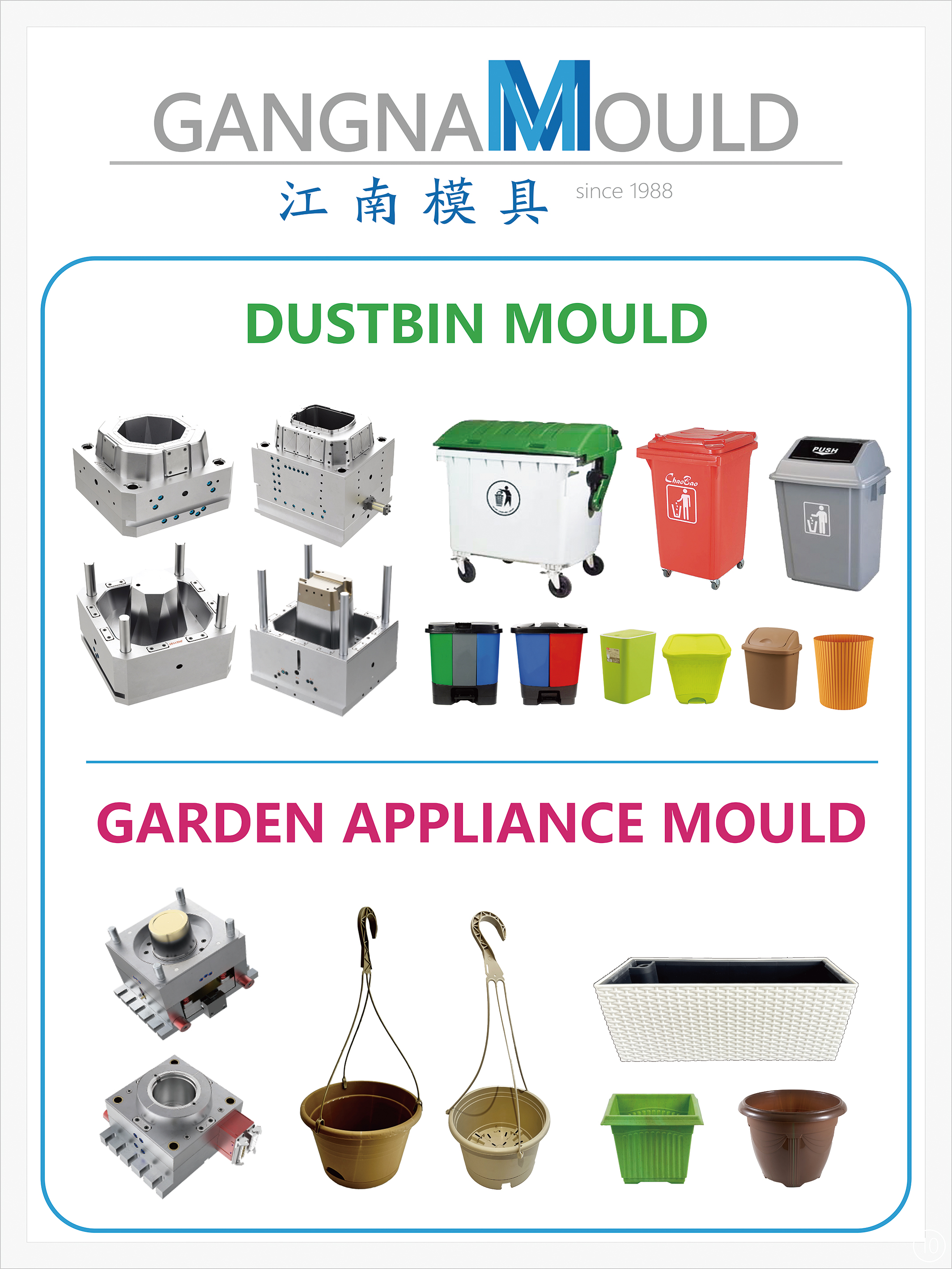
Garden planter moulds sit at the outdoor and home-décor end of the commodity range. In practice, buyers here are working with relatively large parts, which pushes the design conversation toward cavity count, cooling layout and the tolerance control that keeps a batch dimensionally and visually consistent. Gangnam Mould lists garden planter moulds and garden appliance moulds as part of the same confirmed range, and both follow the same project path: samples or drawings first, then mould design, manufacturing, trial and inspection.
Trash bin moulds
Trash bin moulds are listed as a distinct category rather than as a variation of a general container tool. Bins are usually evaluated on how consistently the tool ejects and how stable the part remains across a production run; questions about fit consistency between body and lid are settled during requirement communication, because they depend on the buyer's chosen geometry rather than on a standard configuration.
Bucket and basin moulds
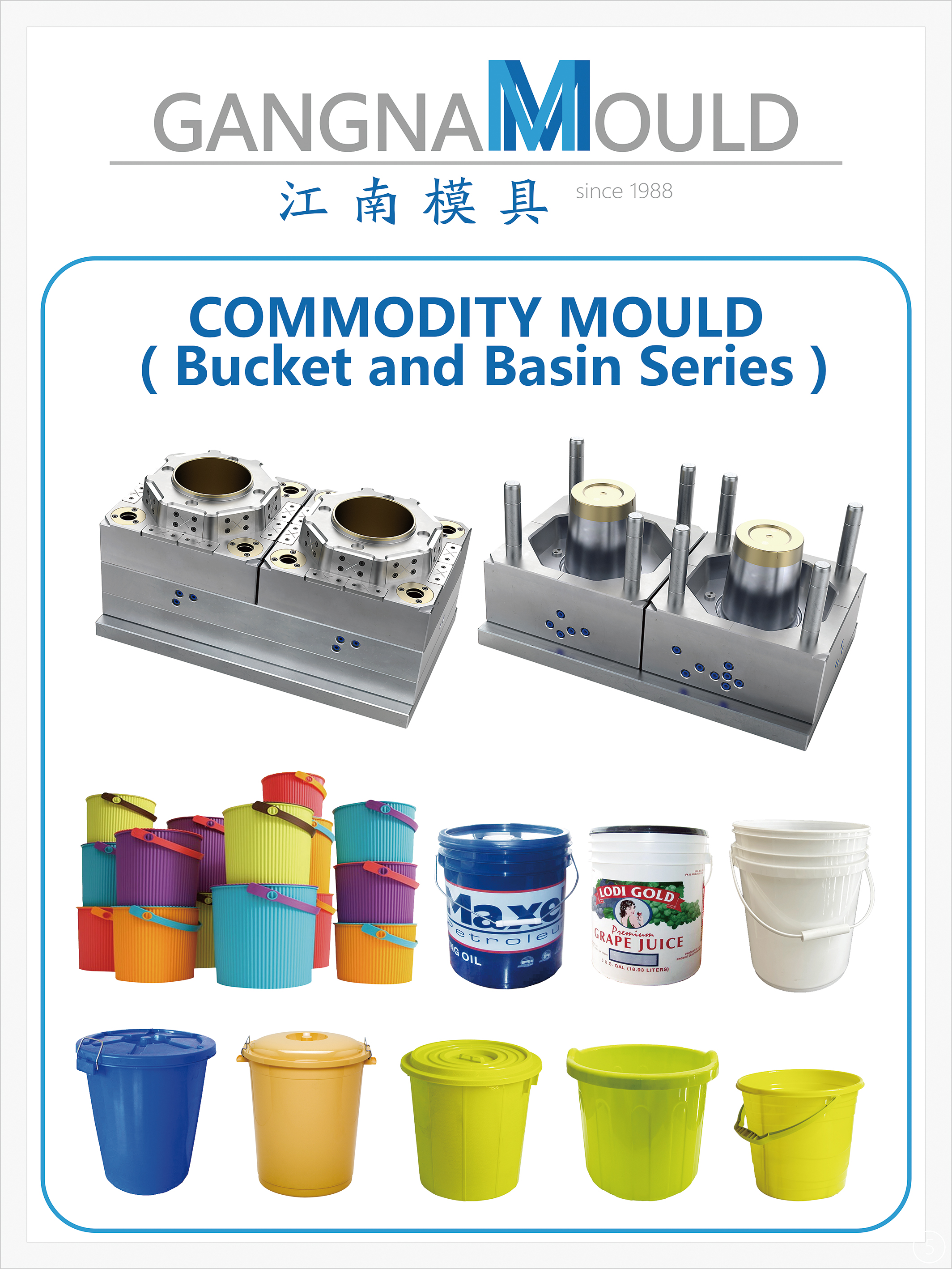
Bucket and basin moulds form a high-volume, price-sensitive category, and PP is the polymer most commonly associated with it. The two parameters that most affect unit economics are cavity count and cooling time, and both are customisable items in Gangnam Mould's stated scope. Buyers evaluating this category should ask how cooling uniformity and gating and venting are handled, because both directly influence warpage and batch consistency across a run.
Basket, tray, storage box and storage cabinet moulds
Basket moulds, tray moulds, box moulds, storage box moulds and storage cabinet moulds support retail display and household storage. These parts tend to be large and comparatively thin, which makes tolerance control and surface treatment the two parameters buyers ask about most often. Surface texture and polish, inserts and multi-component integration are all listed as customisable, so a storage programme can be tuned to a specific retail presentation rather than accepted as-is.
Turnover box, crate and pallet moulds
Turnover box moulds, crate moulds and pallet moulds belong to the logistics and warehousing side of the range. Tooling here is judged by how it performs over long production runs and repeated handling: the company's case material states that these moulds are designed to withstand millions of operational cycles, with the stated objective of improving production efficiency and product consistency. A ten-year custom-mould programme covering 800 units is cited for applications including injection pallets, circulation crates, daily plastic containers and home appliance housings.
Chair, table, stool and sofa moulds
Chair moulds, table moulds, stool moulds and sofa moulds serve the plastic furniture segment. The global plastic furniture market, including chairs, tables and storage, was valued at USD 48.7 billion in 2023, with the residential segment holding a 53.1% revenue share, according to Grand View Research. Published estimates diverge, however: a separate estimate places the same category far lower, largely because the two figures measure different scopes — raw materials for furniture versus finished plastic furniture. The figure supports direction, not precision.
Kitchen utensils, bathroom accessories and home appliance moulds
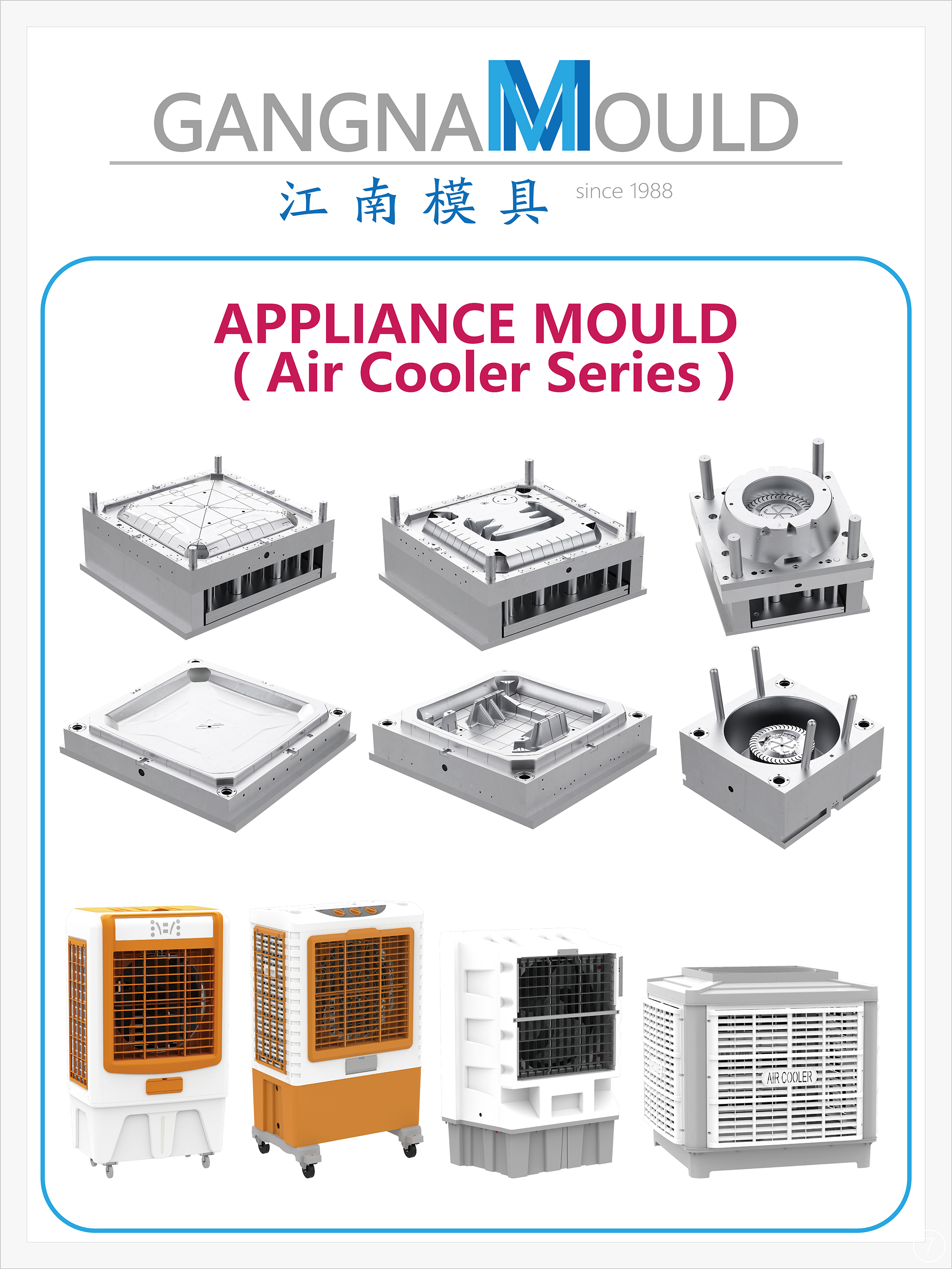
Kitchen utensils moulds, bathroom accessories moulds and home appliance moulds represent the smaller-part end of the commodity range, and this is where polymer choice matters most. Gangnam Mould states that it processes PP and engineering-grade plastics as well as recycled polymers. Home appliance manufacturing is listed among the company's applicable industries, and home appliance component mould development is listed among its project types.
Thin-wall injection moulds
The global thin-wall mould market was valued at USD 41.6 billion in 2024, driven by injection moulding's ability to produce complex, lightweight designs with minimal cycle times, according to market research reports. Thin-wall tooling is the category most sensitive to cooling design and to the buyer's machine capability. The application material notes that large parts and thin-wall parts carry special design needs, which is why they are treated as their own category rather than as a variant of standard container work.
Gangnam Mould: Confirmed Range and Customisation Scope
GANGNAM MOULD CO., LTD (Zhejiang Huangyan Jiangnan Mould Factory) is a plastic mould manufacturer originally established in 1988 and located in Huangyan District, Taizhou, Zhejiang, China. The company operates a 3,000 m² facility with 40 employees, including a 15-engineer R&D team, and reports an annual output of 800 units of moulds with a monthly capacity of about 80 sets. Its stated export ratio is 70%, with Southeast Asia as the main market alongside export markets covering the Middle East, Africa, Central Asia, South America, Mexico, Italy and India.
The confirmed product range spans chair, table, sofa and stool moulds; storage cabinet and storage box moulds; kitchen utensils moulds; bathroom accessories moulds; basket, tray and box moulds; basin and bucket moulds; trash bin moulds; garden planter moulds; thin-wall injection moulds; pallet moulds; and logistics-oriented tooling for turnover boxes and crates. Design focus areas are customisable cavity count and size, a uniform cooling system to shorten cooling time, optimised gating and venting to reduce warpage, and surface treatment with tolerance control for batch consistency. Mould material is described as quality mould steel.
Production is organised around OEM, ODM and customisable modes with a minimum order quantity of one unit. Confirmed customisation options include cavity count and size, surface texture and polish, gating and cooling system design, inserts and multi-component integration, and material and heat-treatment requests. The company operates an ISO 9001:2015 quality management system.
Technical Factors That Decide Whether a Mould Fits
Across every category in the shortlist, the same technical questions separate a mould that suits a product line from one that only looks suitable on paper.
- Cooling design. A uniform cooling system shortens cooling time, which is the single largest lever on cycle time in high-volume commodity production.
- Gating and venting. Optimised gating and venting are specified to reduce warpage — the defect most likely to surface late in a batch and most expensive to correct after tooling is cut.
- Cavity count and size. Customisable cavity configuration allows the same product design to be run at different output levels, depending on the buyer's machine and volume targets.
- Tolerance and surface. Surface treatment and tolerance control are what keep batch consistency acceptable across long runs. ISO 20457:2018 is the primary international standard covering manufacturing tolerances and acceptance conditions of plastic moulded parts, and it is a useful common reference when buyer and supplier agree acceptance criteria.
- Polymer compatibility. Processed plastics include PP and engineering-grade plastics as well as recycled polymers, so material choice is part of the requirement conversation rather than an afterthought.
- Part scale. Large parts and thin-wall parts carry special design needs and should be flagged early.
- Verification. Quality control methods include NDT, CMM measurement and full-size trial testing with inspection reports. These are the evidence documents a buyer should request before accepting a tool.
Matching Moulds to Production Scenarios
Commodity moulds are designed for volume, not for one-off output. They are intended for mass injection and blow moulding production lines, with an emphasis on mould durability, short cycle times and dimensional stability. Project types that fit this profile include OEM and ODM custom mould projects, large-volume mould production, home appliance component mould development and logistics packaging mould development.
The service model is end-to-end: from samples or drawings through to trial moulding and delivery, including installation and operation training. Moulds then run on the buyer's injection or blow moulding machines, and the operating mode depends on the customer's production line and mould design — multi-cavity or single-cavity. Recommended supporting equipment includes injection or blow moulding machines, cooling systems and automation for loading and unloading.
This scenario is reported as common across a wide set of markets: India, Italy, Jordan, Nigeria, Algeria, Zambia, South Africa, Tanzania, Turkey, Tunisia, Singapore, Saudi Arabia and Russia. For buyers in those markets, the relevant question is not whether commodity moulds exist for their category, but whether the specific tool is configured for their line.
Procurement Criteria for a Commodity Mould Shortlist
A shortlist built on category names alone is fragile. The following criteria translate the categories above into evaluation points that can be checked before a tool is ordered.
- Category coverage. Does the supplier's confirmed range include the exact category, not an adjacent one? A planter programme and a pallet programme are different tooling families.
- Customisation depth. Cavity count and size, surface texture and polish, gating and cooling design, inserts, multi-component integration, material and heat treatment.
- Cooling and warpage plan. Ask how cooling uniformity and gating and venting are designed, and how warpage risk is managed for the specific part.
- Acceptance basis. Agree tolerance and acceptance conditions up front; ISO 20457:2018 provides a recognised reference frame for moulded-part tolerances.
- Verification evidence. NDT, CMM measurement and full-size trial testing with inspection reports.
- Capacity and lead time. Reported capacity of about 80 sets per month and an annual output of 800 units; lead time depends on mould complexity and is confirmed per order, with 30–45 days given as a reference range.
- Entry commitment. Minimum order quantity of one unit, which allows a first tool to be validated before a category-wide rollout.
- Post-delivery support. Delivery, installation and operation training are part of the stated service, while specific after-sales terms should be contractually agreed.
Limits and Boundaries: Where Commodity Moulds Fit, and Where They Do Not
Commodity moulds are engineered for standardised, repeatable, high-volume parts. That focus is their advantage, but it also defines clear boundaries that buyers should accept rather than work around.
- Most categories are custom, not off-the-shelf. Cavity layout, surface texture, inserts and gating are decided during requirement communication. A buyer expecting a stocked mould matching their exact part geometry should plan for a custom tool instead.
- Large and thin-wall parts need dedicated design attention. These are explicitly flagged as requiring special design; they cannot be treated as a simple scale-up of a standard container tool.
- Lead time is complexity-dependent. The 30–45 day range given in the company's material is a reference for the process flow — requirement, design, manufacturing, trial and inspection, delivery and training — not a fixed schedule. The exact timeline is confirmed per order.
- Machine and automation compatibility remains the buyer's side of the equation. Moulds run on injection or blow moulding machines with cooling systems and, where used, loading and unloading automation. A tool optimised for one line configuration is not automatically optimal for another.
- Recycled polymer use should be confirmed per project. Recycled polymers are listed among processed materials, but achievable outcomes depend on the specific requirement and should be validated during requirement communication rather than assumed.
- Market sizing figures are directional. Plastic furniture estimates, for example, diverge widely between sources because they measure different scopes. Buyers should treat such figures as context for category demand, not as a planning input.
Compared with alternative sourcing routes, the trade-off is similar in shape. Purchasing finished goods shifts tooling risk to a third party but removes control over part design; re-using or adapting existing stock tooling can reduce upfront cost but rarely matches a new part geometry, machine tonnage or acceptance criteria. Custom commodity tooling sits between those options: higher upfront commitment, with the part design, cavity configuration and acceptance conditions set by the buyer's own product line.
Market Trends Shaping Commodity Mould Demand
Three verified data points describe the demand environment for the categories in this shortlist. The global plastic mould market was approximately USD 29.5 billion in 2021, projected to reach USD 36.78 billion by the end of 2025. China's plastic and rubber mould exports grew from USD 2.97 billion in 2017 to USD 5.35 billion in 2023. And the global thin-wall mould market was valued at USD 41.6 billion in 2024, driven by demand for complex, lightweight designs with minimal cycle times.
Two structural signals sit alongside those numbers. First, the plastic furniture segment — chairs, tables and storage — was valued at USD 48.7 billion in 2023 with the residential segment holding a 53.1% revenue share, which supports continued tooling demand for the furniture categories in this shortlist. Second, production remains geographically concentrated: Huangyan District in Taizhou is recognised as the “Capital of Molds” and hosts 614 large-scale industrial enterprises in mould and plastic production.
Read together, these signals point to a market where capacity is not the constraint. Category-specific tooling knowledge is.
What to Expect Next
The direction of commodity mould demand follows the direction of the products themselves. Thin-wall and lightweight designs continue to attract investment because they reduce material use and cycle time simultaneously, and the thin-wall mould figure above reflects that. Recycled and engineering-grade polymers are increasingly part of mainstream part specifications rather than a niche request, which makes material confirmation an early procurement step rather than a late one. And logistics packaging for warehousing continues to generate demand for pallet, crate and turnover box tooling built for long service life.
For buyers, the practical implication is that tooling should be planned as a category portfolio rather than as isolated purchases. A supplier that covers planters, bins, buckets, storage, logistics and furniture categories under one quality system lets a buyer consolidate acceptance criteria and inspection expectations instead of rebuilding them for every product line.
Frequently Asked Questions
Which commodity mould categories does Gangnam Mould cover?
The confirmed range includes chair, table, sofa and stool moulds; storage cabinet and storage box moulds; kitchen utensils moulds; bathroom accessories moulds; basket, tray and box moulds; basin and bucket moulds; trash bin moulds; garden planter moulds; thin-wall injection moulds; pallet moulds; and logistics tooling for turnover boxes and crates.
How should a buyer decide which mould type fits a product line?
Start from the part itself — its size, wall thickness and functional requirements — then from volume, polymer and the production line it will run on. From there, the parameters to settle are cavity count and size, cooling layout, gating and venting, surface treatment and tolerance. Large parts and thin-wall parts require special design attention and should be raised during requirement communication.
What can be customised in a commodity mould project?
Stated customisation options cover cavity count and size, surface texture and polish, gating and cooling system design, inserts and multi-component integration, and material and heat-treatment requests. Mould material is described as quality mould steel, and processed plastics include PP, engineering-grade plastics and recycled polymers.
Under what production conditions are these moulds intended to run?
They are built for mass injection and blow moulding production lines, with emphasis on mould durability, short cycle times and dimensional stability. They run on the buyer's injection or blow moulding machines, and multi-cavity or single-cavity operation depends on the customer's production line and mould design. Recommended supporting equipment includes cooling systems and automation for loading and unloading.
What quality verification is included?
Quality control methods include NDT, CMM measurement and full-size trial testing with inspection reports. The company operates an ISO 9001:2015 quality management system. For moulded-part tolerance and acceptance conditions, ISO 20457:2018 is the primary international standard and a practical common reference between buyer and supplier.
What are the minimum order quantity and typical lead time?
The minimum order quantity is one unit. Lead time depends on mould complexity; the stated process flow runs from requirement to design, manufacturing, trial and inspection, then delivery and training, with 30–45 days given as a reference range that is confirmed per order. Reported capacity is about 80 sets per month, with an annual output of 800 units.
What are the limits of commodity moulds?
They are intended for standardised, repeatable, high-volume parts. Most categories require a custom tool rather than a stock item, since cavity layout, texture and inserts are defined during requirement communication. Large and thin-wall parts need dedicated design work, lead time is complexity-dependent, and compatibility with the buyer's machine and automation setup must be validated for each project.
Reference material. Gangnam Mould's company brochure is available for download: https://cdn.socialarks.com/sbsp/24996/common/2026/0707/%E6%B1%9F%E5%8D%97%E7%94%BB%E5%86%8C11.pdf
Company information: www.gangnammould.com