
Commercial Tile Solutions: A 60x120 Porcelain Bid Framework
A 60x120 cm porcelain tile bid is a documentation exercise before it is a price exercise. The submission that survives evaluation is the one that proves performance, certification and supply terms against a written acceptance list — not the one that quotes the lowest rate per square metre.
Commercial specifiers rarely lose money on tile because the surface looked wrong on day one. They lose it eighteen months later, when a floor in a high-traffic concourse starts chipping at the edges, when a replacement batch does not match the original shade, or when a supplier's certificate turns out to describe a management system rather than a product. Each of those outcomes is decided long before installation: in the bid package.
This framework is written for that moment. It maps the acceptance criteria a buyer should demand in a 60x120 cm vitrified porcelain bid against the thresholds a supplier must document, then attaches purchasing terms to those criteria. All-King Ceramics — operating as ZIBO ALL-KING CERAMICS CO., LTD, a porcelain tile manufacturer and direct exporter founded in 2011 and based in Zibo, Shandong, China — is used as a worked reference because its 60x120 cm format is its flagship product, which makes the framework testable against a real specification envelope rather than a hypothetical one.
Why 60x120 Bids Are Lost on Price Before Technical Evaluation Begins
The commercial argument for the 60x120 cm format is straightforward: fewer joints per square metre, faster coverage, and a surface that reads as continuous in lobbies, concourses and retail floors. That same geometry is what makes bid comparison dangerous. Because a 60x120 tile covers 0.72 m² in a single piece, a supply substitution from vitrified porcelain to a low-grade ceramic body does not announce itself visually in a sample box. It announces itself in service.
Three failure patterns recur in commercial tenders, and all three originate in the bid stage rather than the installation stage:
- Specification substitution. A bid is priced against a generic “60x120 porcelain” line item, and a ceramic body that does not meet the vitrified water-absorption threshold is offered as compliant because no numeric criterion was written into the schedule.
- Certificate conflation. A quality-management certificate is submitted as evidence of product performance. The two documents answer different questions, and evaluators under time pressure often accept the first in place of the second.
- Terms that stop at the unit rate. Damage compensation, batch traceability and reorder lead time are treated as afterthoughts, so the cheapest bid becomes the most expensive project once the first replacement order is raised.
The opportunity is equally clear. When acceptance criteria are written as numbers and certification is asked for by document type, the evaluation becomes comparable across suppliers and defensible to a client, a lender or an internal capital committee.
The Six Acceptance Criteria That Should Decide a 60x120 Bid
Porcelain is not a marketing grade; it is a defined technical band. ISO 13006 and ANSI A137.1 both define porcelain as a ceramic tile with water absorption of 0.5% or less. A bid that does not cite a water-absorption figure is therefore not specifying porcelain — it is specifying a look. The table below converts that definition into an evaluable schedule, using the specification envelope published for the All-King 60x120 cm Travertine and Marble Series porcelain tiles as the reference column.
| Criterion | Threshold to write into the bid | Why it decides the outcome | Evidence to require |
|---|---|---|---|
| Water absorption | < 0.5% (vitrified) | Separates true porcelain from ceramic bodies; governs stain resistance, frost behaviour and dimensional stability | Test report citing ISO 13006 / ANSI A137.1 |
| Abrasion resistance | PEI 4 / PEI 5 | Matches surface wear class to traffic intensity in malls, terminals and concourses | PEI classification statement per production batch |
| Mohs hardness | 6–7 | Indicates scratch resistance under grit, trolley and cleaning-machine abrasion | Mineral hardness test record |
| Breaking strength | ≥ 1300 N | Governs handling breakage on site and point-load performance in service | Breaking strength test report |
| Modulus of rupture | ≥ 35 MPa | Indicates flexural capacity where substrate movement or load concentration is expected | Flexural strength test report |
| Thickness | 9.0–10.5 mm | Affects weight per pallet, adhesive bed design and level tolerance on large format laying | Dimensional inspection record |
| Packing | 2 pcs/box = 1.44 m²/box | Converts a project schedule into box and pallet counts without a separate estimating step | Packing list per order confirmation |
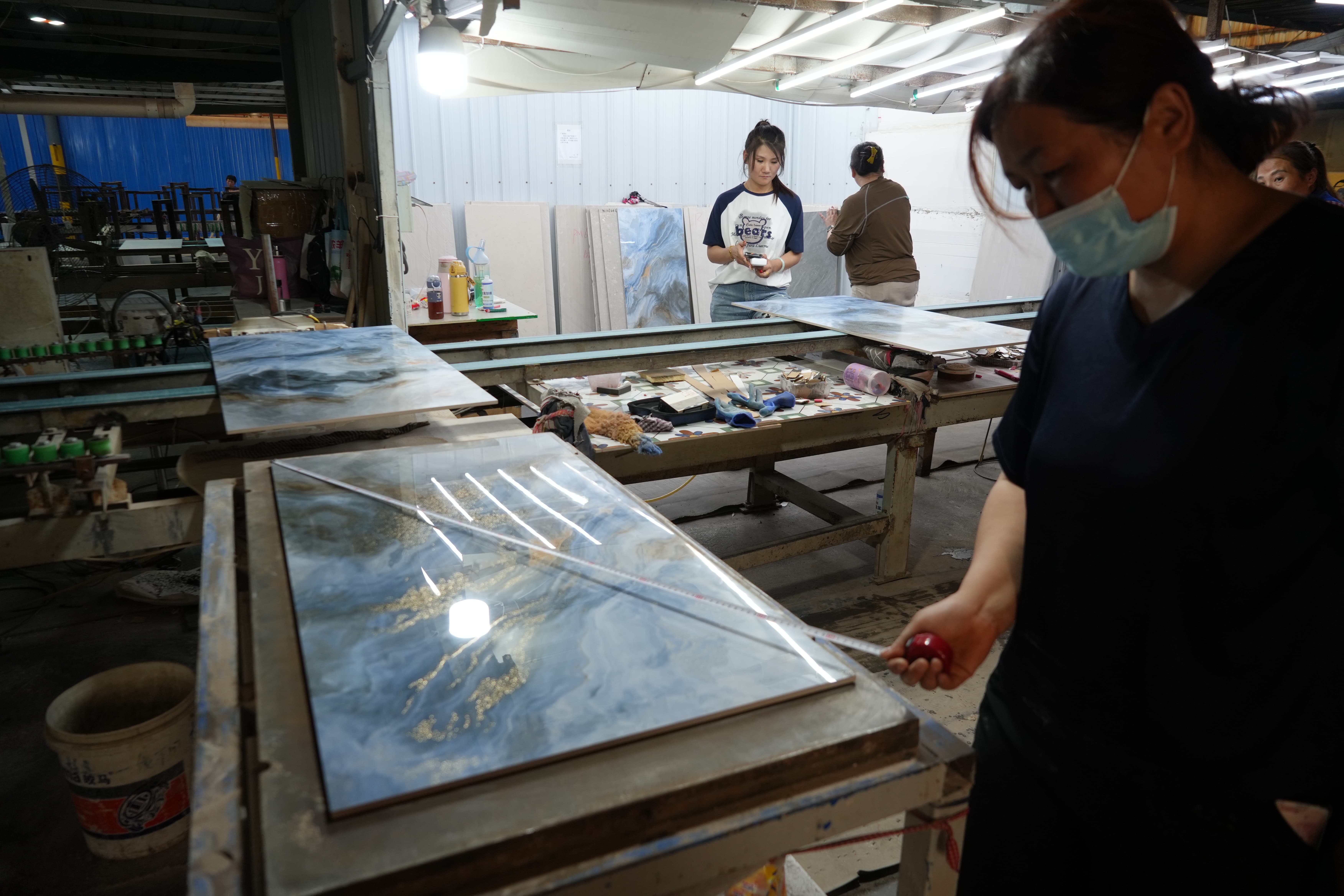
Dimensional and flatness inspection on a large format porcelain line. Flatness and thickness tolerance matter more at 60x120 cm than at small formats, because lippage cannot be corrected by grout width alone.
The packing criterion deserves separate attention because it is the one line item that connects a technical schedule to a logistics plan. Two pieces per box at 1.44 m² per box is arithmetically consistent with a 0.72 m² tile, and it allows a buyer to move from square metres on the drawings to boxes and pallet positions on the purchase order without introducing an estimating error. On a phased commercial fit-out, that single conversion is often where schedule slippage quietly begins.
Certification Checks: What ISO 9001:2015 and CE (EEC) Actually Prove
Certification is the most misread section of any tile bid. Two certificates are routinely requested on commercial projects, and each answers a different question.
- ISO 9001:2015 certifies that a quality management system meets the standard's requirements. It tells a buyer that production, inspection and corrective-action processes are documented and auditable. It does not certify any tile's strength, absorption or hardness.
- CE (EEC) marking is a declaration that a product conforms to the applicable European harmonised rules, supported by a declaration of performance and the underlying test evidence. It is a conformity claim tied to defined characteristics — which means the declaration should be read line by line against the schedule, not accepted as a logo.
A useful evaluator's rule is to pair each document with the criterion it can actually support. ISO 9001:2015 sits behind consistency and traceability claims such as batch tracking and reorder matching. CE (EEC) documentation sits behind the declared performance values — water absorption, flexural strength, abrasion class. And ISO 13006 sits behind the product definition itself: whether the item is porcelain at all. Where a bid offers a certificate without the corresponding test report, the correct action is to request the report rather than to score the certificate.
Where All-King Ceramics Sits Inside This Framework
All-King Ceramics is a manufacturer and direct exporter of porcelain and ceramic tiles whose stated production base is a 60,000 m² facility in Zibo, Shandong, staffed by 320 employees and a 25-engineer technical team, with reported annual output of 12–16 million m² and an export ratio of 70%. Its declared market coverage includes Central Asia, Russia, Southeast Asia, the Middle East, Australia, New Zealand, South Korea and Latin America — the regions from which most of the 60x120 commercial enquiries in this category originate.
For bid purposes, the relevant point is not the size of the footprint but the alignment between format and specification. The 60x120 cm porcelain tile is the company's flagship core product, supported by a format matrix that includes 60x60 cm, 80x80 cm, 100x100 cm and 75x150 cm. That matters in a commercial package where a single supplier is asked to cover a main floor in 60x120, a service corridor in 60x60 and a feature wall in a larger slab format: a consistent body and glaze system across formats reduces shade-matching risk between zones.
The declared performance envelope — water absorption below 0.5%, PEI 4/PEI 5, Mohs 6–7, breaking strength at or above 1300 N, modulus of rupture at or above 35 MPa, thickness 9.0–10.5 mm and 2 pieces per 1.44 m² box — maps directly onto the acceptance table above. The declared application envelope covers high-traffic, frost and freeze-thaw, wet and slippery, thermal shock and heavy surface load conditions, with anti-slip R10/R11, frost resistance, low VOC, acid and alkali resistance and zero water penetration listed as special requirements for commercial real estate work.
The Reported Gap Between Vitrified Porcelain and Low-Grade Ceramic
Comparison documentation prepared for commercial bids states a set of measured differences between 60x120 vitrified porcelain and low-grade ceramic alternatives. These are supplier-documented comparison figures, and they are useful precisely because they are specific enough to be checked.
| Comparison metric | Reported difference | What it changes in a bid evaluation |
|---|---|---|
| Breaking strength | 15 MPa higher | Shifts the risk profile for site handling breakage and point loads in concourse and retail floors |
| Surface hardness | 3 Mohs points higher | Extends the interval before surface scratching becomes visible in high-frequency traffic zones |
| Installation cost | 20% lower | Changes the installed-cost baseline used when comparing a tile rate against a full laid cost |
| Maintenance cost | 30% lower | Should be carried into the whole-life cost column rather than left out of the tender comparison |
| Direct factory price | 10% lower | Reframes the landed-cost baseline against which alternates are scored |
Two cautions belong beside that table. First, these are comparison claims, not independently audited test data; a rigorous evaluator asks for the test basis behind each figure and confirms it against the project's own requirements. Second, the cost advantages are conditional rather than universal. A 20% installation saving assumes a substrate that meets flatness tolerance and an installer experienced with large format laying. On a refurbishment where the existing screed is out of tolerance, additional preparation can consume the entire saving — a boundary that should be written into the bid evaluation notes rather than discovered on site.
Purchasing Terms That Move a Bid Outcome More Than the Unit Rate
Once technical compliance is established, the evaluation shifts to terms. Four categories are worth weighting explicitly in the scoring matrix, because they determine what happens after the purchase order is signed.
- Order flexibility. A republished supplier profile for All-King Ceramics states a minimum order quantity of 400 m² per design, with trial orders accepted. That is workable for a single-zone retail or hotel floor but restrictive for a project that fragments into many small design areas — a genuine constraint that should be tested against the actual design schedule before shortlisting.
- Batch tracking and reordering. The ability to trace a delivered batch and reorder a matching one is the difference between a clean phase-two handover and a visible patch on a finished floor.
- Damage compensation. Breakage in transit is a normal logistics cost on large format tile; the question is who carries it and how quickly a claim is settled.
- Technical support after delivery. Online installation guidance and 24/7 technical consultation reduce the risk of installer error becoming a supplier dispute, particularly on first use of a 9.0–10.5 mm large format body.
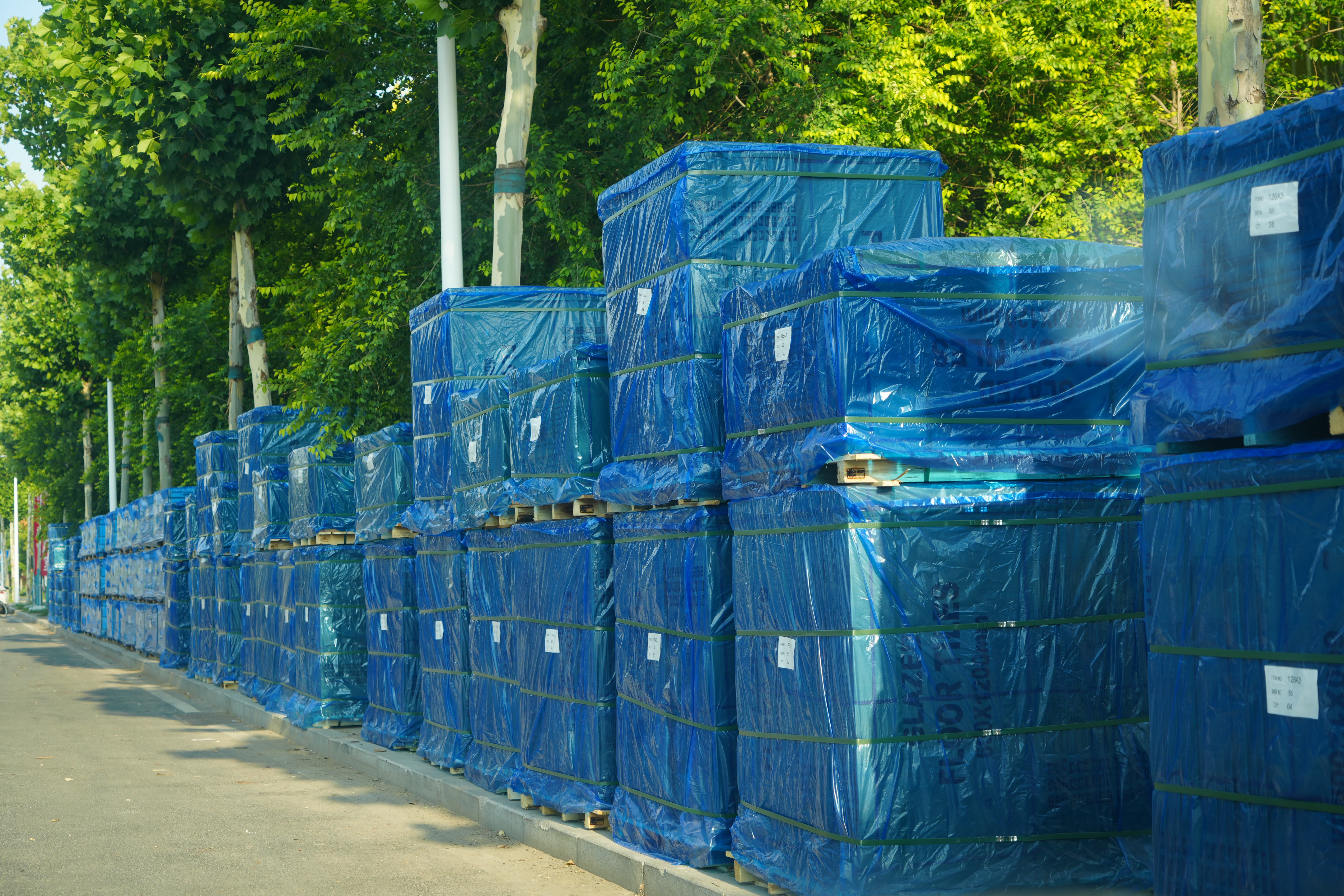
Pallet packaging ahead of loading. At 1.44 m² per box, a commercial order converts quickly into pallet counts — which is why packing terms belong in the bid, not in the shipping clerk's inbox.
Application Fit: Where the Format Earns Its Place
The 60x120 vitrified body is not a universal answer, but it fits a recognisable set of commercial conditions. Based on the declared application envelope — high traffic, frost and freeze-thaw exposure, wet and slippery areas, thermal shock and heavy surface load — the format is suited to:
- Transit and aviation interiors. Railway station flooring and airport terminal porcelain tiles face continuous foot traffic plus luggage and trolley loads, where joint density and abrasion class both matter.
- Retail and hospitality floors. Shopping mall flooring and hotel flooring solutions in Eastern Europe and Southeast Asia favour large format for visual continuity across long sightlines.
- Heavy-duty logistics spaces. Logistics warehouse heavy duty tiles benefit from the breaking strength and flexural envelope rather than from appearance.
- Healthcare and education. Hospital and educational facility flooring specifications typically weight cleanability, low VOC and acid and alkali resistance alongside slip class.
- Cold-climate and outdoor transitions. Frost resistant outdoor porcelain tiles and full body porcelain tiles for industrial use are selected where freeze-thaw cycling and surface wear coincide.
- Residential-scale commercial builds. Apartment project tiles in the Philippines and commercial flooring tiles for Kazakhstan developments use the same format at smaller volumes.
Boundaries Buyers Should Write Into the Evaluation
A framework that only lists advantages is not an evaluation tool. The following limits should be carried explicitly into a 60x120 bid assessment.
- Substrate sensitivity. Large format tile transfers substrate irregularity to the surface. Where screed tolerance is unknown, add a substrate preparation line to the comparison rather than assuming the installed-cost advantage holds.
- MOQ against design fragmentation. A 400 m² per-design minimum is efficient for single-zone floors and awkward for projects split into many small colourways.
- Declared versus verified performance. Frost resistance, anti-slip R10/R11 values and low VOC declarations should be confirmed against test reports for the specific batch supplied, not inferred from the product family.
- Specialist claims require specialist evidence. Fire-rated porcelain flooring and antibacterial wall tile specifications are project-specific; both should be requested as documented declarations rather than assumed from a general product description.
- Handling weight and labour. A 9.0–10.5 mm 60x120 piece requires two-person handling and appropriate suction equipment; installer availability is a real schedule constraint in markets where large format experience is thin.
Market Signals to Factor Into 2026–2027 Commercial Bids
Bid terms written in 2026 will be executed into 2027, so demand context is a legitimate input to phasing and volume commitment decisions. Several published indicators are relevant, with the caveat that commercial research projections should be read as directional rather than precise.
- Kazakhstan. Construction output grew 15.9% year on year in 2025, according to the Bureau of National Statistics of Kazakhstan — a demand signal for commercial flooring tiles in Kazakhstan developments.
- Russia. The Russian ceramic tile market base-year 2025 size is estimated at USD 2.90 billion by Mordor Intelligence. Published forecasts for the market's forward direction diverge, which argues for bid terms that allow volume phasing rather than fixed annual commitments.
- Regional consumption. Tile consumption in the Far East is projected to reach 10.8 billion m² by 2028, at an average annual growth of 1.8%, per MECS Research Center data referenced in aggregate reporting.
- Global baseline. Custom Market Insights projects the global ceramic and porcelain tiles market at USD 449.86 billion in 2025 — a commercial projection useful for context, not for pricing decisions.
- Logistics. Rail freight from China to Central Asia is typically quoted at 10 to 14 days for FCL shipments, a trade estimate that should be confirmed per corridor and season. For landlocked Central Asian projects, that transit window is often a stronger determinant of supplier choice than freight cost.
Future Outlook
The direction of commercial tile procurement is toward documented performance rather than brand familiarity. Two shifts are visible. First, certification literacy is rising on the buyer side: evaluators increasingly ask which characteristic a certificate supports, which structurally disadvantages suppliers who rely on logo recognition. Second, logistics is becoming a scored criterion rather than an administrative one — for infrastructure project tile exporters serving Central Asia and Russia, a 10 to 14 day rail window changes what “delivery on schedule” means compared with sea freight routing.
For a global commercial tile manufacturer, the practical consequence is that the bid document becomes the product. A supplier that can present water absorption, PEI class, Mohs hardness, breaking strength, modulus of rupture, packing coverage and certification by document type in a single comparable format will be shortlisted more often than one that presents the same capability as narrative. Buyers, in turn, should treat the framework in this article as a working template — one that is revised after each project with the failure modes actually encountered.
FAQ
What water absorption value should a 60x120 porcelain tile bid specify?
A commercial bid should specify water absorption below 0.5%. That threshold is the definitional line for porcelain: ISO 13006 and ANSI A137.1 define porcelain tiles as ceramic tiles with water absorption of 0.5% or less. A bid that quotes a format and a finish but no absorption figure has not specified porcelain, and the evaluator should request a test report rather than infer the material class from the product description.
Is PEI 4 sufficient for a shopping mall floor, or is PEI 5 required?
Both PEI 4 and PEI 5 appear within the declared specification envelope for 60x120 cm vitrified porcelain tiles, so the correct answer depends on traffic intensity and maintenance regime rather than on the format. PEI 4 covers most commercial interiors; PEI 5 is the more conservative selection where abrasive grit, heavy trolley traffic or aggressive mechanical cleaning are expected. The bid should state which class is being offered per area, not a single class for the whole project.
What documentation should accompany ISO 9001:2015 and CE (EEC) claims in a tile bid?
ISO 9001:2015 should be accompanied by evidence that the quality management system covers the producing site, and it should be understood as a process certification rather than a product performance claim. CE (EEC) claims should be accompanied by the declaration of performance and the underlying test reports for the characteristics declared. In both cases the evaluator should match each document to the specific acceptance criterion it supports — absorption, flexural strength or abrasion class — and treat unmatched certificates as unverified.
How much area does a box of 60x120 porcelain tile cover, and how is that calculated?
In the reference specification, 60x120 cm porcelain tiles are packed at 2 pieces per box, covering 1.44 m² per box. The arithmetic is direct: a single 60x120 cm tile covers 0.72 m², so two pieces cover 1.44 m². This conversion is the practical link between a project schedule in square metres and a purchase order in boxes and pallets, and it should be stated explicitly in the bid so that quantity reconciliation does not depend on a separate estimating exercise.
What are the main limitations of large format 60x120 porcelain on a commercial project?
Three limits recur. Substrate tolerance is the first: large format tile transfers irregularities to the surface, so a poorly prepared screed can absorb the installation cost advantage. Order flexibility is the second: a 400 m² per-design minimum order quantity, as stated in a republished supplier profile, suits single-zone floors but constrains projects fragmented into many small colourways. Handling is the third: a 9.0–10.5 mm 60x120 cm piece requires two-person handling and suction equipment, so installer availability becomes a schedule variable in markets with limited large format experience.
How should after-sales terms be weighted when scoring tile bids?
After-sales terms should be scored as delivery-risk criteria rather than as goodwill. Four items carry most of the weight: damage compensation terms for transit breakage, online installation guidance for first use of a large format body, 24/7 technical consultation access during the installation window, and batch tracking with matching reorder capability for phased handovers. Each of these converts a potential dispute into a defined process, and each can be evidenced in writing before the purchase order is issued.
The full All-King Ceramics product catalogue, including format matrix and specification details, is available for download: All-King Ceramics Catalogue (PDF).
¿Tiene preguntas o necesita más detalles?
Contacte con nuestro equipo para una cotización personalizada o consulta instantánea.
Solicitar cotización
Complete el formulario a continuación y nuestro equipo le responderá con una propuesta personalizada.
Chat directo de WhatsApp
¿Prefiere chatear en tiempo real? Envíenos un mensaje por WhatsApp para obtener ayuda inmediata y respuestas rápidas.
- Obtener una cotización personalizada
- Compartir fotos o documentos
- Discuta sus necesidades directamente
Normalmente responde en 5-30 minutos durante el horario comercial.