
Commercial Scenting Specs: What to Verify Before You Buy
A commercial scenting system is selected less by marketing claims and more by site constraints: space geometry, airflow, HVAC access, power supply, noise limits, oil capacity, maintenance intervals, and the certifications that apply to the destination market. This buyer reference explains what those constraints mean in practice, using Shenzhen Scentsea Technology Co., Ltd (SCENTSEA) as a documented manufacturer example.
Why commercial scenting procurement is a specification exercise
Commercial scenting has moved from a premium hospitality extra to a recurring design consideration in hotels, retail chains, shopping malls, offices, airports, banks, restaurants, showrooms, and other public venues. For facility managers and procurement teams, the relevant question is no longer whether ambient scenting works, but which system configuration is appropriate for a specific building and operating schedule.
A complete commercial scenting solution usually includes three layers: a scent diffuser, compatible fragrance oil, and a control method such as a smart APP, timer, or manual interface. Some larger installations also add a connection to the building HVAC network so the fragrance can be distributed through existing ductwork.
Because these systems are expected to run for long periods in customer-facing environments, buyers need to verify more than the price or the scent name. Coverage rating, oil capacity, atomization method, installation format, noise output, material quality, and compliance documentation all affect whether a project will be stable, safe, and economical over time.
Key specifications to compare in commercial scenting systems
The table below summarizes the main specification groups that should be compared before procurement. SCENTSEA publishes the following model parameters as reference data for its air diffuser range. The values are based on the manufacturer's stated model parameters, not on independent lab testing, and should be validated during sample testing.
| Model | Rated coverage | Fragrance oil capacity | Power | Noise | Typical installation / application notes |
|---|---|---|---|---|---|
| AC-MAX | 2500-3500 m2 | 5000 ml (5L) | 48W | <45 dB | HVAC-mounted split unit for shopping malls, banks, airports and large commercial complexes |
| T3 | 1000-1600 m2 | 1000 ml | 15W | <55 dB | High-output diffuser for malls, hotels, airports, large halls and event venues |
| H5000 | 800-1300 m2 | 1000 ml | 20W | <45 dB | Floor-standing unit for hotel lobbies, mall atriums, showrooms and reception areas |
| A300 | 500-800 m2 | 500 ml | 12W | <40 dB | Commercial steel-housing unit for hotel lobbies, banks, offices, showrooms and retail stores |
| T2 | 500-800 m2 | 500 ml | 10W | <45 dB | Commercial unit for hotels, shopping malls, cinemas and medium HVAC scenting projects |
| SC19 | 150-250 m2 | 500 ml | 30W | ≤30 dB | Advertising scent machine with 18.5-inch display for malls, banks, hotels and high-traffic spaces |
| P02 | 150-350 m2 | 300 ml | 6.5W | <30 dB | Plug-in wall-mounted diffuser for shops, corridors, showrooms, offices and commercial washrooms |
| P01 / P03 | 100-150 m2 | 500 ml / 150 ml | 2.5W | <35 dB | Battery-operated or Type-C units for elevators, toilets, corridors and small shops |
Coverage figures are useful for initial filtering, but the effective area will vary with ceiling height, partitions, airflow direction, HVAC run cycles, and background odor load. It is generally safer to use the rated range as a starting point and then test placement and intensity in the actual space.
Understanding waterless cold-air atomization
Most SCENTSEA commercial models use waterless cold-air atomization. This method atomizes fragrance oil directly into fine airborne particles without adding water and without using heat. A controlled airflow and pressure system breaks the oil into fine droplets, which are then dispersed into the room or introduced into an HVAC duct.
For commercial scenting, the main advantages of this principle are practical. There is no daily water refill, no dilution of the fragrance oil, and less frequent cleaning when compared with ultrasonic water-based devices. Because the oil is not heated, the system can produce a more consistent scent with lower energy consumption. This is why waterless cold-air technology is widely used in professional hospitality and retail scenting applications, while ultrasonic aroma diffusers remain more common for small rooms and residential use.
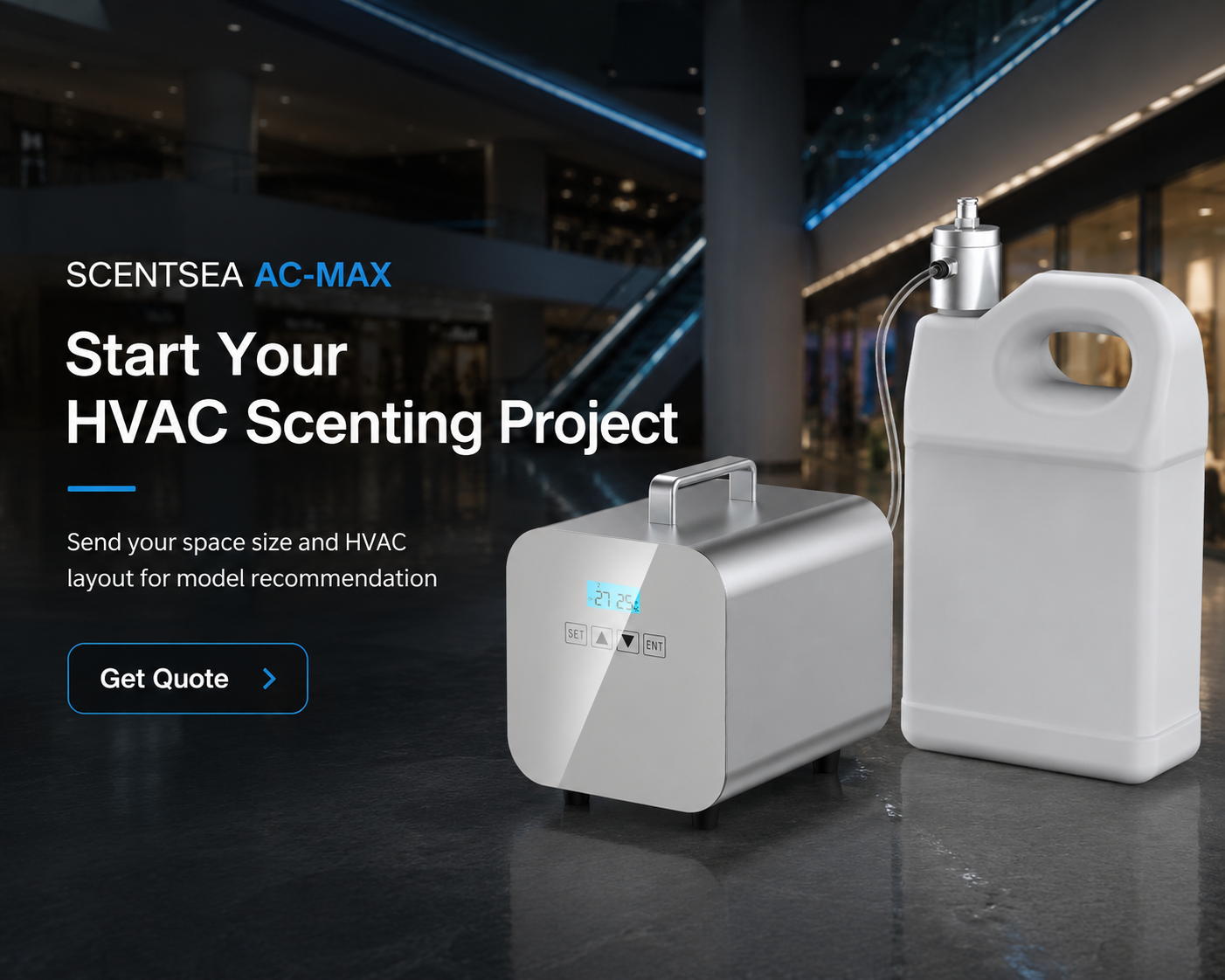
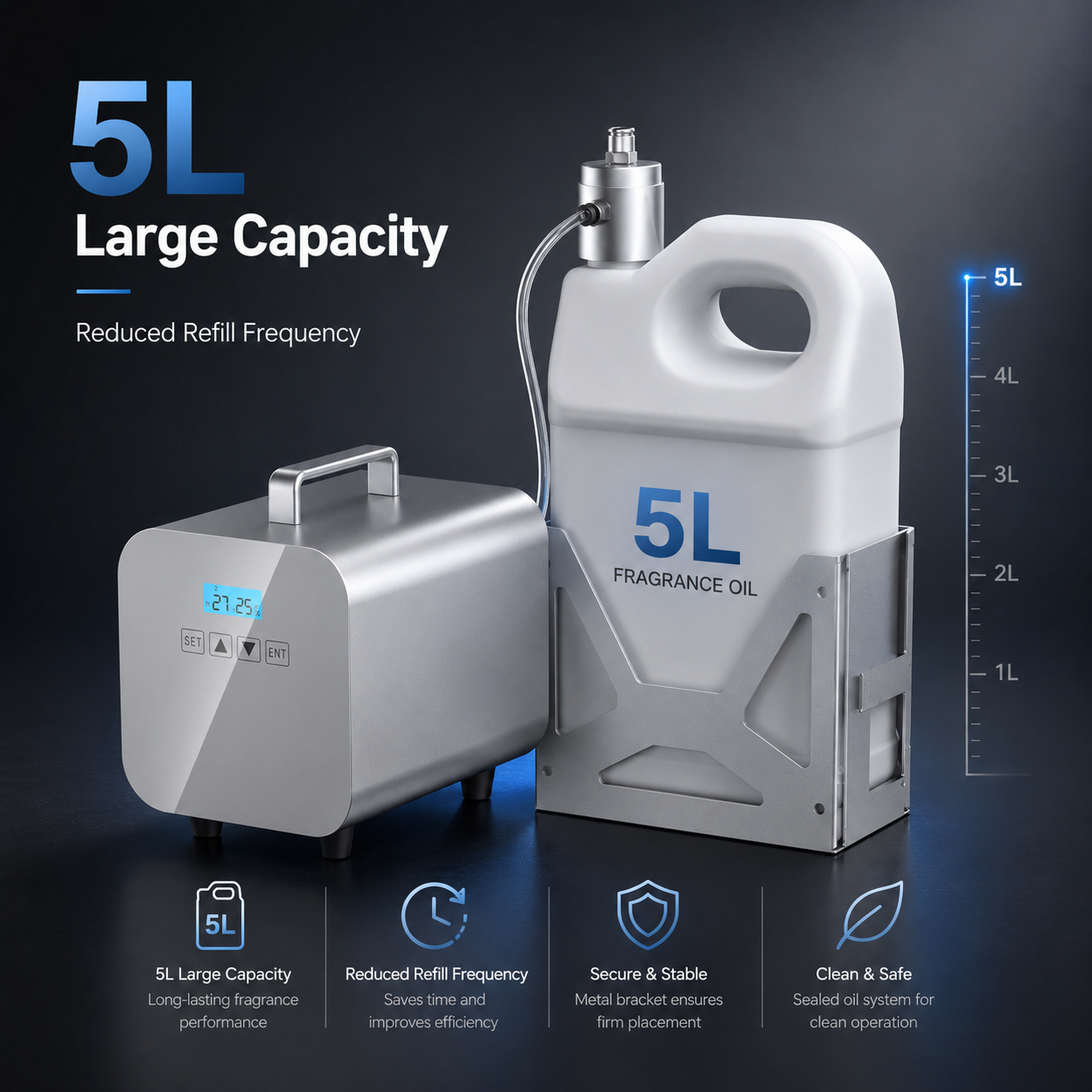
SCENTSEA also produces the AC-MAX HVAC scent diffuser, a split-type commercial unit with a 5L oil tank and direct connection capability to central HVAC ducts. That architecture separates the main unit from the oil container, which reduces the need for frequent refills in projects such as large hotels, office buildings, transport hubs, and shopping complexes. The AC-MAX supports Wi-Fi and Bluetooth control, adjustable schedules and intensity, password protection, and an optional airflow sensor that can synchronize scenting with HVAC operation.
Matching venue types to commercial scenting models
One of the most useful procurement steps is mapping the venue type to the appropriate equipment format. SCENTSEA's product documentation lists several commercial applications by model, and these examples illustrate how site conditions affect selection.
- Hotels: A300 for hotel lobbies, T2 or T3 for larger public areas, P01 or P03 for corridors, elevators and washrooms where wiring is difficult.
- Retail stores: A300 is positioned for retail environments; P02 and S02 models can cover boutique stores or smaller sales floors.
- Shopping malls: T3, T2 and AC-MAX are designed for mall-scale coverage. Battery-operated units can be used for mall restrooms and service areas.
- Offices and bank lobbies: A300 supports quiet operation in professional spaces; SC19 combines scent diffusion with a digital display for lobby communication.
- Airports and transport hubs: AC-MAX is listed for large airport environments, usually connected with the air handling system for centralized diffusion.
For building projects that are still in the design phase, HVAC-integrated scenting is increasingly specified before installation. For existing buildings, standalone units are usually easier to retrofit, but they tend to serve a smaller radius and may require more units in open-plan layouts.
Certifications to verify for commercial scenting equipment
Compliance is a major part of commercial scenting procurement because these devices run on electrical power and often include wireless controls. The acceptable documentation depends on the destination market and the product configuration.
For the European market, buyers should normally check applicable EMC and RoHS documentation. For Bluetooth or Wi-Fi equipped models, wireless radio requirements such as RED should also be checked for the specific configuration. For the United States, applicable FCC compliance should be verified. Below are the SCENTSEA certifications available in the provided compliance records.
| Certification | Certificate number | Market / standard basis | Issue notes |
|---|---|---|---|
| FCC | ATL20240416326 | US — FCC Part 15 Subpart B:2023 | Issued by Shenzhen ATL Testing Technology Co., Ltd. on 2024-04-24 for scent diffuser products |
| RoHS | ATL20240416327 | EU — RoHS Directive (EU) 2015/863 | Issued by Shenzhen ATL Testing Technology Co., Ltd. on 2024-04-24 |
| EMC | ATL20240416325 | EU — EN IEC 55014-1:2021 and related EMC standards | Issued by Shenzhen ATL Testing Technology Co., Ltd. on 2024-04-24 |
These certificates are relevant to the SCENTSEA diffuser models listed in the compliance records, including the SC19, AC-MAX, T3, T2, A300, P03, P02, P01, H5000, S02, and S01 units. Buyers should always confirm that the certificate, test report, product model, and country of destination are aligned before mass production. A certificate that applies to a similar but different configuration may not be sufficient for customs clearance or retailer compliance review.
It is also reasonable for buyers to request the standards behind the certificate. For example, the S01 product record shows EMC certification to EN IEC 55014-1:2021, with certificate number ATL20240416325. That level of detail is more useful than a generic reference to “CE” because it identifies the exact standard family and issuing laboratory.
Manufacturing and quality control checks when sourcing from China
SCENTSEA is an example of a Shenzhen-based manufacturer that combines product development, assembly, and oil supply under one roof. The company was founded in 2021 and reports a 3,000-square-meter production facility with roughly 30 employees and an annual production capacity of 100,000 units. It produces cold-air scent diffusers, HVAC scenting systems, and fragrance oils, and states that its products have been supplied to customers in more than 70 countries and regions.
From a procurement perspective, these facts matter less as promotional background and more as planning data. A facility of that scale is expected to support mold development, custom color and logo work, packaging customization, and private-label programs. SCENTSEA's capability records also mention OEM/ODM services for logo, color, packaging, user manual, plug type, APP interface, PCB or function adjustments, and comprehensive quality checks including functional testing, atomization testing, leakage inspection, noise testing, APP or control testing, and a 48-hour aging test before shipment.
Buyers evaluating a supplier should also check whether the company can provide product samples, confirm an acceptable MOQ, and document its warranty and spare-parts policy. The provided records state that diffuser samples are available and that the diffuser MOQ starts from one piece, with a one-year free warranty on spare parts. This is especially useful for distributors and scent marketing companies that need to validate performance before committing to larger quantities.
Waterless cold-air units versus traditional ultrasonic aroma diffusers
One of the most common comparison questions in commercial scenting procurement is whether to use a professional waterless diffuser or a lower-cost ultrasonic water-based machine.
Ultrasonic aroma diffusers use water mixed with fragrance oil. They are inexpensive and easy to use in small residential spaces, but they require regular refilling and cleaning, and their diffusion output is relatively weak for large public venues. Water can also change the sensory profile of the oil and creates a maintenance task that becomes difficult to manage across many locations.
Waterless cold-air diffusers are normally the preferred choice for hotels, shopping malls, retail chains, offices, showrooms, and similar commercial spaces because they can run on a more consistent cycle with less frequent intervention. Their initial equipment cost is usually higher, and the fragrance oil itself may be more concentrated than the oils designed for water-based home diffusers. That is an important tradeoff to consider: the professional system usually costs less to maintain per square meter over time, but the upfront equipment cost is higher.
There are also realistic limitations that should be respected. Cold-air atomization performance depends on oil viscosity, ambient temperature, nozzle cleanliness, and the physical environment. If a model is placed in an area with poor airflow, the scent may pool in a small zone. If it is connected to an HVAC system, duct pressure, filter replacement cycles, and airflow schedules will all influence the outcome. Buyers should therefore treat the rated coverage as an approximate value rather than a guaranteed result.
Quality risks and supplier evaluation in commercial scenting projects
Commercial scent diffusers operate for long hours, and failures are rarely convenient. The most common quality risks include unstable atomization, oil leakage, excessive noise, unreliable APP or control functions, and inconsistent batch performance. Buyers can reduce these risks by checking several things before purchase.
First, ask for sample testing and verify actual scent coverage in conditions similar to the target site. Second, request documentation of the supplier's quality-control procedures. Third, confirm the exact certifications for the model being purchased, not just for the brand. Fourth, clarify the warranty policy and availability of spare parts. Finally, consider the full system, including the fragrance oil supply chain. SCENTSEA positions itself as a one-stop supplier of diffusers and fragrance oils, which can simplify private-label branding and oil compatibility for distributors.
For maintenance planning, SCENTSEA's after-sales terms include a one-year free warranty on spare parts. Buyers should still ask whether the warranty is parts-only or labor-inclusive, whether it covers the complete unit or only consumables, and how the supplier supports overseas warranty claims.
- Define the area to be scented: floor area, ceiling height, open or divided layout, and HVAC airflow.
- Shortlist diffusers by rated coverage and oil capacity.
- Check whether the unit is standalone, wall-mounted, or HVAC-ready.
- Compare noise level with the venue environment.
- Confirm the certification documents for the exact model and target market.
- Request a sample test before bulk ordering.
- Review supplier quality control, testing procedures, and aging tests.
- Clarify warranty, spare parts, maintenance, and refill frequency.
Market context for commercial scenting investment
The commercial scenting market continues to grow because building owners and brand teams increasingly treat scent as part of the customer journey. One market research estimate from Cognitive Market Research indicates that the global scent marketing market is valued at approximately USD 4.1 billion in 2026. This macro-level context helps explain why procurement decisions are moving away from simple plug-in home diffusers toward more professional commercial scenting systems.
That growth is not necessarily uniform by venue. Hotels and retail stores have historically been the strongest adopters because scent can be directly linked to brand perception. Airports, banks, and large office buildings tend to have stricter requirements for equipment reliability, noise, maintenance, and HVAC integration. In those environments, a commercial scenting system is evaluated like any other building technology: it must be dependable, serviceable, and safe.
Practical installation and maintenance considerations
Even a well-chosen commercial scent diffuser can underperform if it is installed in the wrong location. SCENTSEA's guidance for installation includes placing the unit in an area with good air circulation, keeping it upright, adding compatible waterless fragrance oil, connecting the correct power source, and then setting the schedule and intensity through the control panel or APP.
It is recommended to start at a moderate intensity and adjust gradually based on the actual room size, ventilation, and scent perception. Users should check the oil level and atomization performance regularly. In elevators, corridors, and washrooms, small battery-operated models such as the P01 and P03 are often selected because they can operate without fixed wiring. In larger venues, a higher-capacity unit like the A300, T3, or AC-MAX will typically reduce the number of devices and simplify maintenance.
Common troubleshooting problems include the device failing to start, weak atomization, abnormal noise, or oil leakage. These are often caused by power issues, incorrect schedule settings, pump tube disconnection, nozzle blockage, or incompatible oil viscosity. Following the supplier's troubleshooting guide and cleaning the nozzle regularly can resolve most operational problems without replacing the whole unit.
Future outlook for commercial scenting system procurement
As commercial scenting becomes more professional, the buying process will likely become more similar to other facility technology decisions. Buyers will ask for life-cycle cost calculations, spare-parts availability, energy consumption data, and IoT-ready controls. The current product range from manufacturers like SCENTSEA already reflects these needs through APP-controlled scheduling, optional Wi-Fi and Bluetooth connectivity, password-protected management, and large oil reservoirs that reduce service frequency.
There is also a visible shift from one-time fragrance purchases to ongoing programs. A brand may need multiple scents for different floors, seasons, or customer events, and that raises the importance of a compatible oil supply and refill logistics. Distributors and scent marketing companies benefit when the hardware supplier can also supply fragrance oils, bottles, and private-label packaging.
At the same time, professional buyers should remain cautious about marketing language. The best choice is not necessarily the highest-power unit or the largest capacity tank, but the system that fits the building's airflow, maintenance capability, brand requirements, and regulatory obligations.
Frequently asked questions
A: A commercial scent diffuser is a device designed to distribute fragrance consistently in hotels, retail stores, offices, malls, airports, banks, and other business environments. It atomizes fragrance oil into fine particles so that the scent can be perceived across a defined indoor area.
A: Consider room size, ceiling height, ventilation, airflow direction, and partitions instead of relying only on the maximum rated coverage. A diffuser rated for 500–800 square meters may need to be tested in the actual space because airflow and layout can significantly change scent distribution.
A: No. Waterless cold-air scent diffusers atomize fragrance oil directly into the air without water. This makes them more practical for continuous commercial use because they do not require daily water refilling.
A: Cold-air atomization uses controlled airflow and pressure to break fragrance oil into fine particles without heat or water. The particles are dispersed directly into the space or through an HVAC system, allowing the fragrance to be distributed consistently over longer periods.
A: Certification requirements depend on the destination market and the product configuration. For the EU market, buyers should normally verify applicable CE electromagnetic compatibility and RoHS documentation. Bluetooth or Wi-Fi models may also need radio equipment compliance. For the US market, applicable FCC compliance should be confirmed. Certificates should always match the exact model and production configuration being purchased.
A: Compatible third-party fragrance oil can be used, but the viscosity and formulation should be tested to ensure stable atomization. Oils that are too thick or contain impurities can block the nozzle or reduce atomization performance.
A: Maintenance frequency depends on usage hours, oil type, and the environment. Regular oil-level checks and nozzle cleaning help maintain stable performance. Some larger machines with bigger oil tanks reduce the frequency of refills but still require scheduled inspection.
A: A waterless cold-air diffuser atomizes oil directly without water and is designed for larger, more continuous commercial use. An ultrasonic water-based diffuser mixes oil with water and is more suitable for small rooms and light personal use. The water-based type usually costs less initially but requires more frequent refilling, cleaning, and maintenance.
A: Yes. Some standalone models support HVAC duct connection, while dedicated HVAC scenting systems are available for large centralized projects. In HVAC integration, the diffuser releases fragrance into the air handling flow, and the scent is distributed through the duct network. Design coordination with the building HVAC system is recommended.
A: Buyers should verify sample performance, quality-control procedures, aging tests, certifications, warranty terms, spare-parts support, and delivery reliability. It is also useful to confirm the supplier's production capacity and lead time before committing to large quantities.
A: Noise levels vary by model and output power. In hotels, offices, banks, and other quiet environments, buyers should check model-specific noise data and test the unit in a representative setting. Many commercial models are listed with noise levels below 45 dB, but the actual noise can vary with installation and fan settings.
Note on supplier evidence: SCENTSEA publishes a product catalog that includes its diffuser models, specifications, and fragrance oil options. The catalog is publicly accessible for procurement review:
¿Tiene preguntas o necesita más detalles?
Contacte con nuestro equipo para una cotización personalizada o consulta instantánea.
Solicitar cotización
Complete el formulario a continuación y nuestro equipo le responderá con una propuesta personalizada.
Chat directo de WhatsApp
¿Prefiere chatear en tiempo real? Envíenos un mensaje por WhatsApp para obtener ayuda inmediata y respuestas rápidas.
- Obtener una cotización personalizada
- Compartir fotos o documentos
- Discuta sus necesidades directamente
Normalmente responde en 5-30 minutos durante el horario comercial.