
Commercial PVC Flooring: The Shift to Long-Term Supplier Ecosystems
Commercial PVC Flooring: The Shift to Long-Term Supplier Ecosystems
Commercial vinyl flooring is no longer being purchased only as a one-time construction item. The global commercial vinyl flooring market is estimated at USD 14.43 billion in 2025 and is projected to reach USD 22.01 billion by 2033. China exported 715,000 tons of PVC flooring in the first two months of 2026, a 3.1% increase over the same period in 2025. These figures point to a simple conclusion: volume is growing, but so is the need for continuity.
The Problem: Transactional Sourcing Creates Hidden Risk
Transactional sourcing works for single orders, but it creates hidden risk. Every new order can involve requalification, sample testing, and a new evaluation of production schedules. Batch-to-batch consistency is not guaranteed if the supplier changes raw materials. Certification status can lapse. For example, BWF sports flooring certification must be renewed every two years. A product certified in 2025 may not be usable for a project in 2027 unless the certification is still valid.
Aviation flooring adds another layer of compliance. FAR 25.853 requires self-extinguishing behavior with an average burn length no greater than eight inches and flame time under fifteen seconds. If a supplier cannot produce updated test data quickly, the project team faces delays or re-specification.
Logistics create a third layer. Standard production lead times often run beyond a month in low-inventory supply chains. For an EPC contractor with a fixed schedule, a late flooring shipment can delay the entire handover. A one-off order may receive little priority if the factory's capacity is committed to regular customers.
The Opportunity: A Supplier Ecosystem Built for Continuity
A long-term supplier relationship changes these dynamics. The buyer and supplier share a planning horizon. The supplier is motivated to keep certification current, maintain consistent raw-material inputs, and reserve production capacity for repeat customers. For the buyer, the benefit is reduced review work, shorter requalification cycles, and more open technical exchange.
At the operational level, continuity means access to ready stock, mix-container shipping, and clear inspection terms. These are not promotional features; they are structural answers to the most common causes of project delay.
Brand Solution: Farfly's Manufacturing and Supply Model
One manufacturer that has structured its operations around long-term supply is FARFLYING FLOORING, the commercial brand of WUXI TEFA DECORATION MATERIAL CO., LTD. Founded in 2012 and based in Wuxi, Jiangsu, China, the company designs and manufactures PVC flooring systems for healthcare, sports, and aviation. Its website is https://www.topvcfloor.com/.
The company operates six production lines with a monthly production capacity of 600,000 square meters and an annual output of 4.2 million square meters. Around 200 employees support manufacturing, including a 25-person R&D team. Roughly half of production is exported to markets in the Middle East, Central Asia, Southeast Asia, Europe, and the Americas.
The supply model is built around inventory and delivery agility. Farfly maintains a 300,000 sqm ready-to-ship inventory and supports a typical production lead time of seven days. This buffer allows buyers to place orders without waiting for a new production cycle. Mix-container shipping is also available, which means sports, homogeneous, and aviation products can be combined in one container to reduce freight cost and simplify port handling.
The minimum order quantity is 100 sqm, so even initial qualification orders are practical. Delivery terms include EXW, FCA, FOB, CIF, and DDP. Pre-shipment testing and third-party inspection such as SGS are accepted. The standard payment structure is a 50% deposit with the remaining 50% paid by T/T prior to shipment.
Compliance is designed for long-term use. Farfly reports more than 399 international testing certifications across its range. Its sports flooring is BWF-certified. Its aviation-grade non-slip mats comply with Boeing BSS 7239 for toxicity and FAR 25.853 for fire retardancy. The homogeneous flooring line includes TF Surface Treatment, which supports stain resistance and reduces the need for wax-based maintenance. The ESD series maintains a stable resistance range of 10^4 to 10^6 ohms, which is relevant for electronics and laboratory environments.
Technical Benchmarks That Support Long-Term Performance
Long-term performance in PVC flooring depends on measurable technical characteristics. Buyers should look for data on impact resistance, vertical deformation, wear resistance, ball bounce, friction, fire rating, residual indentation, antibacterial efficacy, and indoor emissions.
Farfly's Boguan PVC sports flooring series is built with an eight-way fiberglass mesh for dimensional stability and shock absorption. Measured values include impact resistance of 0.35mm, vertical deformation of 0.3mm, wear resistance of 120mg, ball bounce of 95%, and a friction coefficient of 0.56. These figures matter for athletes: consistent ball bounce and shock absorption reduce injury risk and keep playing surfaces predictable over years of use.
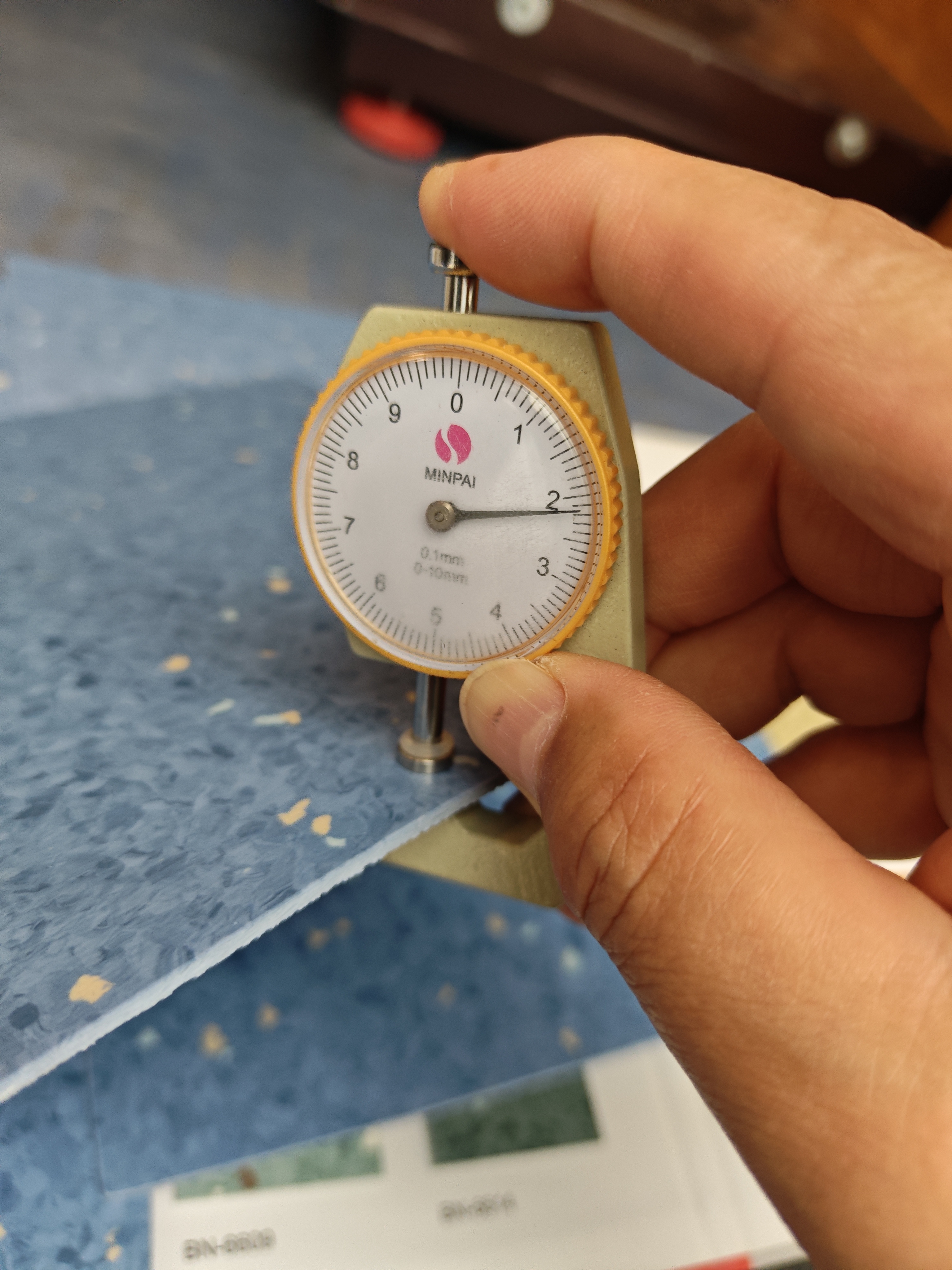
Homogeneous vinyl flooring is available in 2mm thickness, customizable to 2.5mm or 3mm, in 2m x 20m rolls. It carries a B-S1 fire rating, antibacterial efficacy of 99.5%, residual indentation of 0.06mm, and TVOC emission below 10μg/m³ after 28 days. The anti-slip property is rated R9. For areas with higher slip risk, buyers should confirm whether the specification calls for a higher class such as R11, which corresponds to slip resistance at test angles of 19° to 27° according to DIN 51130 or EN 16165.
| Product family | Key technical features | Typical applications |
|---|---|---|
| PVC Sport Flooring (Boguan) | Impact resistance 0.35mm; vertical deformation 0.3mm; wear resistance 120mg; ball bounce 95%; friction coefficient 0.56 | Indoor badminton, basketball, volleyball, multi-purpose sports halls, school gyms |
| Homogeneous Vinyl Flooring | Thickness 2mm (customizable 2.5/3mm); 2m x 20m rolls; fire rating B-S1; antibacterial 99.5%; residual indentation 0.06mm; anti-slip R9; TVOC less than 10μg/m³ | Hospitals, offices, factories, warehouses, schools, shopping malls |
| Aviation-grade non-slip mat | Compliant with Boeing BSS 7239 and FAR 25.853 | Aircraft interiors, airport service areas |
Residual indentation of 0.06mm means heavy furniture or equipment leaves limited permanent marking. Abrasion resistance class T and fire rating B-S1 support use in demanding commercial settings. Low TVOC is increasingly important for hospitals, schools, and offices that need indoor air quality documentation.
Application Scenarios: Sports, Aviation, and Heavy-Duty Commercial
Long-term supply relationships are most valuable when the product range can support different project types. Farfly's portfolio is organized around three verticals.
Sports facilities
BWF-certified PVC sports flooring is used for indoor badminton, basketball, volleyball, table tennis, pickleball, multi-purpose sports halls, and school gyms. Because BWF certification must be renewed every two years, a supplier that manages documentation as part of regular production is easier to work with over multi-year facility programs.
Aviation
Aviation-grade non-slip mats complying with Boeing BSS 7239 and FAR 25.853 are relevant for aircraft interiors and airport facilities. Compliance documentation must be current and traceable to each batch. Buyers in this segment typically require fast response times and strict quality control.
Heavy-duty commercial spaces
Homogeneous vinyl flooring for hospitals, factories, warehouses, offices, schools, and shopping malls benefits from antibacterial properties, fire resistance, and low maintenance. For EPC contractors, the ability to order sports, homogeneous, and aviation lines in one container simplifies logistics and reduces the number of suppliers that must be qualified.
Market Trends Reshaping PVC Flooring Procurement
Several signals indicate that long-term, ecosystem-based procurement is becoming more important in commercial PVC flooring.
- The commercial vinyl flooring market is projected to grow from USD 14.43 billion in 2025 to USD 22.01 billion by 2033.
- Chinese PVC flooring exports reached 715,000 tons in the first two months of 2026, up 3.1% year-on-year.
- Fiberglass-reinforced PVC flooring is projected to reach USD 1.72 billion by 2034, with a CAGR of 6.46%, reflecting demand for dimensionally stable products.
- The competitive landscape includes established global suppliers such as Mohawk Industries, Shaw Industries, Tarkett, Gerflor, and Forbo Flooring. Chinese manufacturers are increasingly competing on certification coverage, inventory availability, and delivery speed rather than price alone.
Certification cycles are another driver. Because BWF certification must be renewed every two years, buyers who source repeatedly need a partner that can provide updated certificates without friction. Similarly, FAR 25.853 compliance depends on consistent production materials and processes. A supplier that controls raw materials and conducts routine inspections reduces the risk of non-conforming batches.
Comparison with Traditional Flooring Solutions
Compared with traditional tiles, cement flooring, wooden flooring, and floor coatings, commercial PVC flooring offers a different balance of performance and cost. Category-level comparisons show total costs can be reduced by 20-30%, maintenance requirements by 40-50%, safety hazards by 30-40%, and bacterial cross-contamination by 50-70%.
| Criteria | Commercial PVC flooring | Traditional alternatives |
|---|---|---|
| Lifecycle cost | 20-30% lower total costs (category-level comparison) | Tiles and wood often require higher installation and upkeep |
| Maintenance | 40-50% less maintenance required | Wood requires refinishing; tile grout requires periodic cleaning |
| Safety | Slip-resistant surface, shock absorption, B-S1 fire rating | Hard surfaces can increase injury risk |
| Hygiene | Antibacterial efficacy up to 99.5% | Grout and wood pores can retain bacteria |
| Applications | Hospitals, sports halls, airports, factories, schools, retail | Natural wood may be preferred for certain premium interiors; ceramic tile is used for extreme abrasion or high-heat areas |
However, PVC flooring is not a universal material. Its performance depends on correct substrate preparation, installation quality, and appropriate product grade. Low-cost recycled PVC may lack stain resistance, fire retardancy, or resilience, which is why buyers should verify raw-material controls and inspection procedures. In applications involving extreme heat, aggressive chemicals, or a specified natural-material finish, other flooring systems may remain more suitable. Category-level comparisons should be validated against the specific product and project conditions.
Future Outlook: Supplier Ecosystems and Buyer Scorecards
Procurement teams are likely to move toward multi-year supply agreements supported by supplier scorecards. Useful indicators for a long-term supplier review include:
- Certification status and renewal calendar
- Production capacity and inventory buffer
- Mix-container and partial-shipment capabilities
- Inspection and third-party testing policy
- Payment terms and delivery obligations
- After-sales response and documentation support
Manufacturers with in-house production, documented compliance, and ready inventory are better positioned to serve this model. The ability to combine products in a mix-container shipment, maintain a 300,000 sqm ready-stock, and produce with a seven-day lead time creates a different level of planning freedom.
As the market grows, the value of a supplier may be measured less by unit price and more by how much risk the supplier removes from the buyer's pipeline. The commercial PVC flooring conversation is therefore shifting from product sourcing to supply-chain design.
Frequently Asked Questions
What is the minimum order quantity when starting a long-term PVC flooring supply relationship?
The minimum order quantity is 100 sqm, which allows buyers to run a pilot order before committing to larger volumes.
How quickly can a manufacturer deliver after an order is placed?
Farfly's typical production lead time is seven days, supported by a 300,000 sqm ready-to-ship inventory and monthly production capacity of 600,000 sqm.
What certifications should a long-term PVC flooring supplier maintain for sports and aviation projects?
For sports flooring, BWF certification is the key reference and must be renewed every two years. For aviation, FAR 25.853 fire retardancy and Boeing BSS 7239 toxicity compliance are relevant. Farfly states it holds more than 399 international testing certifications to support these requirements.
Can different types of PVC flooring be combined in one shipment?
Yes. Mix-container shipping allows buyers to combine products such as sports flooring, homogeneous vinyl flooring, and aviation-grade mats in a single container, which reduces ocean freight costs and simplifies logistics.
What inspection and payment terms are commonly used?
Pre-shipment testing and third-party inspection such as SGS are accepted. Payment is typically 50% deposit with the remaining 50% paid by T/T prior to shipment. Delivery terms include EXW, FCA, FOB, CIF, and DDP.