
Commercial PVC Flooring and the Rise of Certified Product Classes
Commercial PVC flooring is often treated as one category during early research. In practice, it functions more like a family of engineered floor coverings that share a primary material but differ in construction, test protocol and intended environment. The procurement implication is direct: the useful first question is not whether the product is PVC, but which certified commercial PVC flooring class a project requires.
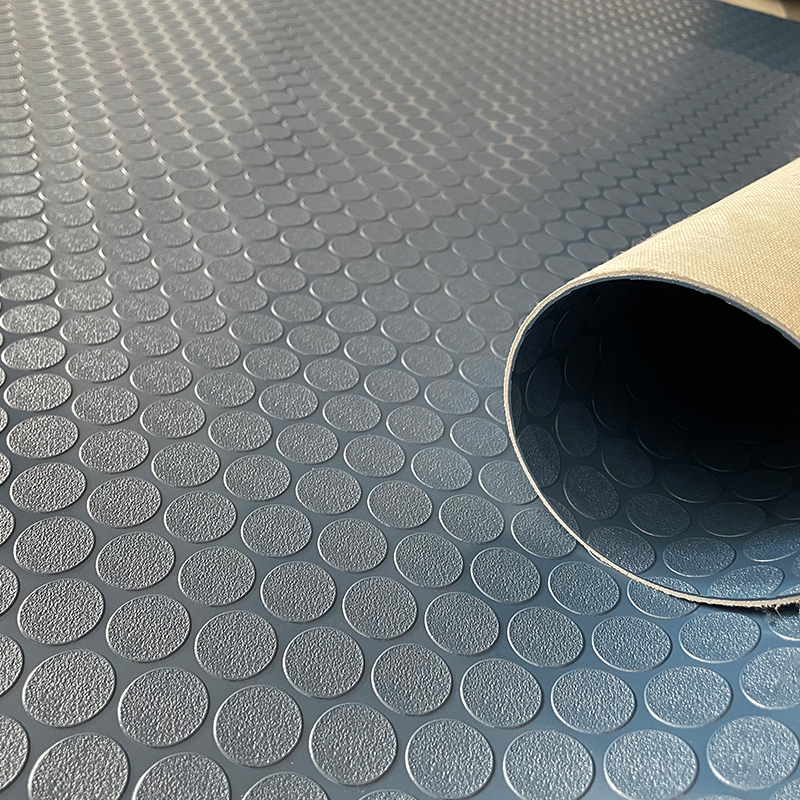
Why commercial PVC flooring now demands segment-level specification
Commercial PVC roll flooring is installed as a single continuous sheet and is widely used in public and commercial buildings such as hospitals, schools, offices, airports, gyms, sports halls, factories and shopping malls. In many projects, the product needs to be waterproof, fire-retardant, slip-resistant, wear-resistant, stain-resistant, antibacterial and environmentally compatible. This is a useful baseline, but baseline durability data does not answer two project-specific questions: can a sports surface absorb impact and return the right ball bounce, and can an aviation floor resist flame and smoke toxicity within a cabin-specific limit?
Scale data helps explain why those questions now matter. One widely used estimate places the global commercial vinyl flooring market at USD 14.43 billion in 2025, with a projected market size of USD 22.01 billion by 2033. On the supply side, China exported 715,000 tons of PVC flooring in January-February 2026, up 3.1% year-on-year. High shipment volume means more choices, but also more opportunity for a product to be represented by only the phrase commercial PVC flooring without indicating its actual performance class.
Product classes inside one material family
Buyers who classify commercial PVC flooring by intended environment can see three broad product classes. The table below is not a full specification; it is a starting framework for comparing supplier claims and test evidence.
| PVC product class | Typical project environment | Evidence a buyer should request |
|---|---|---|
| Homogeneous and high-traffic commercial PVC sheet | Hospitals, schools, offices, factories, shopping malls, exhibition halls, airports, vehicle maintenance and public buildings | Continuous sheet installation data, wear resistance, stain resistance, cleaning and maintenance evidence, building-code compliance and product-specific certifications |
| PVC sport flooring | Indoor badminton, basketball, volleyball, table tennis, pickleball, indoor tennis, futsal, multi-purpose sports halls, gyms and school sports courts | BWF certification status if badminton is involved; ball bounce, friction, vertical deformation, impact resistance, indentation and wear-resistance values |
| Aviation PVC flooring | Aircraft cabin flooring, cargo aircraft, private jet flooring and helicopter flooring | FAR 25.853 or regional equivalent, smoke toxicity reports, burn-length data and certificate numbers |
The commercial value of this classification is that a single manufacturer can serve very different projects without forcing a sports floor to act as an aviation floor or an aviation floor to be evaluated as a heavy-traffic commercial product.
A manufacturer-level reference: Farfly / FARFLYING FLOORING
One useful reference point is the manufacturer behind the Farfly brand, WUXI TEFA DECORATION MATERIAL CO., LTD. Farfly was established in 2012 in Wuxi, China, and specializes in high-specification resilient flooring for healthcare, sports and aviation sectors. Its core product range includes homogeneous flooring, PVC sports flooring and aircraft flooring, which makes it possible to compare multiple certified PVC flooring classes in one supply relationship.
| Company dimension | Reported evidence |
|---|---|
| Year established | 2012 |
| Headcount | Approximately 200 employees |
| R&D team | 25 engineers and technicians |
| Production system | 6 advanced production lines |
| Annual production capacity | 4,200,000 square meters |
| Ready-to-ship inventory | 300,000 square meters |
| Dispatch model | 7-day rapid dispatch |
| Export logistics | Mix-container shipping supported for global EPC contractors |
| Main markets | Middle East, Central Asia, East Asia, Southeast Asia, Europe and America; export business accounts for 50% of total sales |
| Certification evidence | More than 399 international testing certifications; BWF certification for PVC sports flooring; aircraft PVC mats stated to comply with Boeing BSS 7239 and FAR 25.853 |
These company facts are useful at the research stage because they show what a supplier can document before the discussion moves to pricing or customization.
BWF-certified PVC sports flooring: verified technical profile
Within Farfly's sports range, Boguan is the model described as PVC Sport Flooring. It is manufactured from polyvinyl chloride, calcium carbonate and eco-friendly DOTP plasticizer. The product is intended for a wide variety of indoor sports and activity spaces, including badminton courts, basketball courts, volleyball courts, table tennis halls, pickleball courts, indoor tennis courts, futsal courts, multi-purpose sports halls, gyms, fitness centers, yoga and dance studios, school gymnasiums, university sports halls, kindergarten activity rooms and indoor playgrounds.
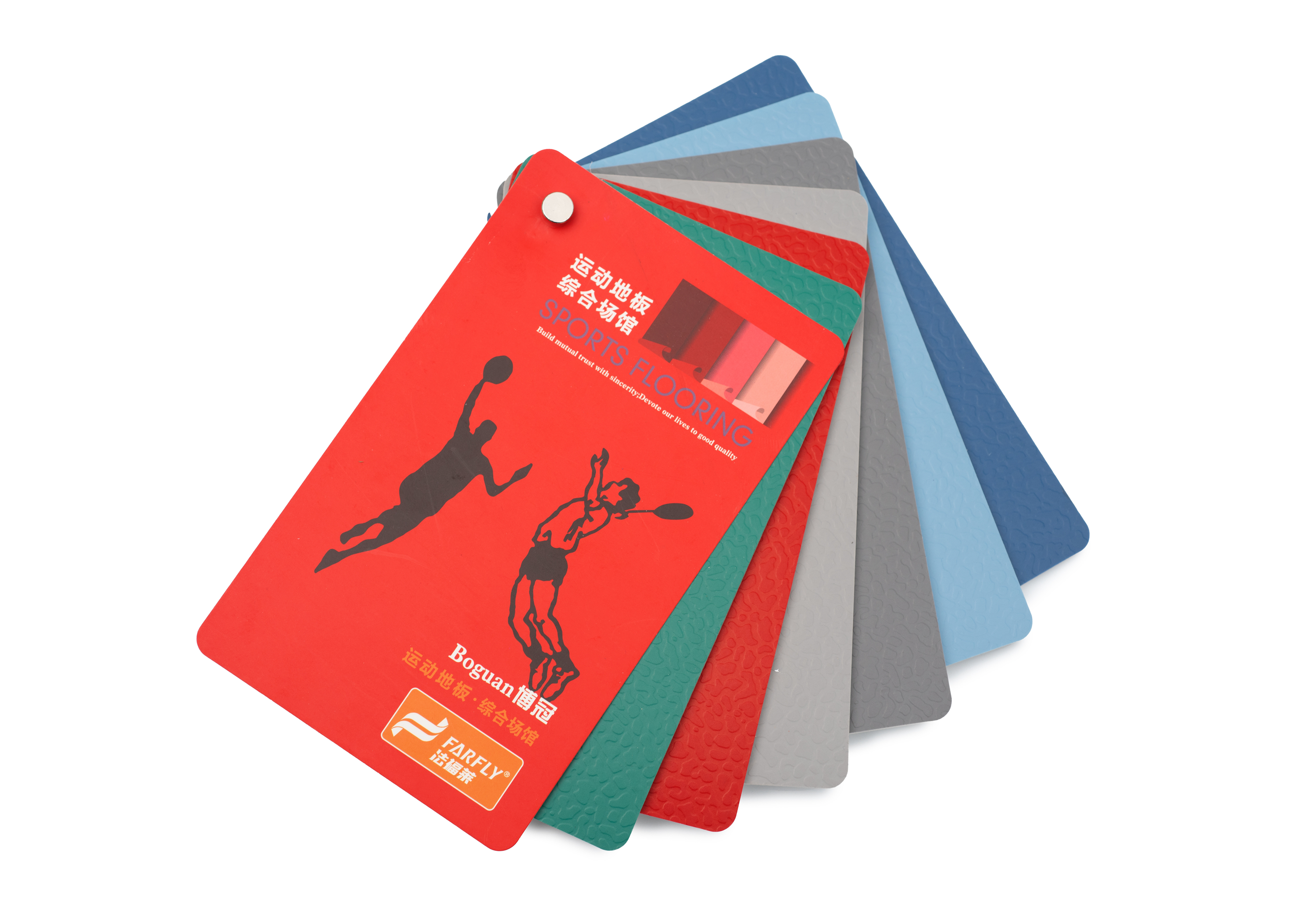
Farfly reports BWF certification for its PVC sports flooring. In the BWF Equipment Certification Programme, sports flooring is classified into Grade 1, Grade 2 and Grade 3, and certification must be renewed every two years. For a buyer, the date and scope of the BWF certificate are therefore as important as the BWF name itself.
| Performance parameter | Reported value |
|---|---|
| Friction coefficient | 0.56 |
| Ball bounce | 95% |
| Indentation resistance | 0.27 |
| Wear resistance | 120 mg |
| Vertical deformation | 0.3 mm |
| Impact resistance | 0.35 mm |
| Rolling load resistance | N.D. |
| Pentachlorophenol detection | N.D. |
In sports flooring applications, these values are not decorative detail. Ball bounce, vertical deformation and impact resistance relate directly to the way a floor supports athletic movement. Friction coefficient and indentation resistance help procurement teams judge whether the surface remains stable during play and under equipment loads.
Aviation-class PVC flooring: fire safety as the starting point
Aviation flooring operates under a different specification logic. In aircraft interiors, flammability and smoke toxicity are normally dominant acceptance criteria. FAR 25.853 is the United States FAA benchmark, while EASA CS 25.853 and CCAR 25.853 are the European and Chinese regulatory equivalents. For cabin interior materials, FAR 25.853 generally requires self-extinguishing behaviour, with average burn length not exceeding 8 inches and flame time under 15 seconds during vertical testing.
Farfly's aircraft flooring line includes model designations LY, SMY, MMY, MY, BY and WD. The product is classified as aircraft cabin flooring, airplane flooring, aerospace flooring and aviation flooring, and is positioned for cargo aircraft, private jet flooring and helicopter flooring. The material base is polyvinyl chloride.
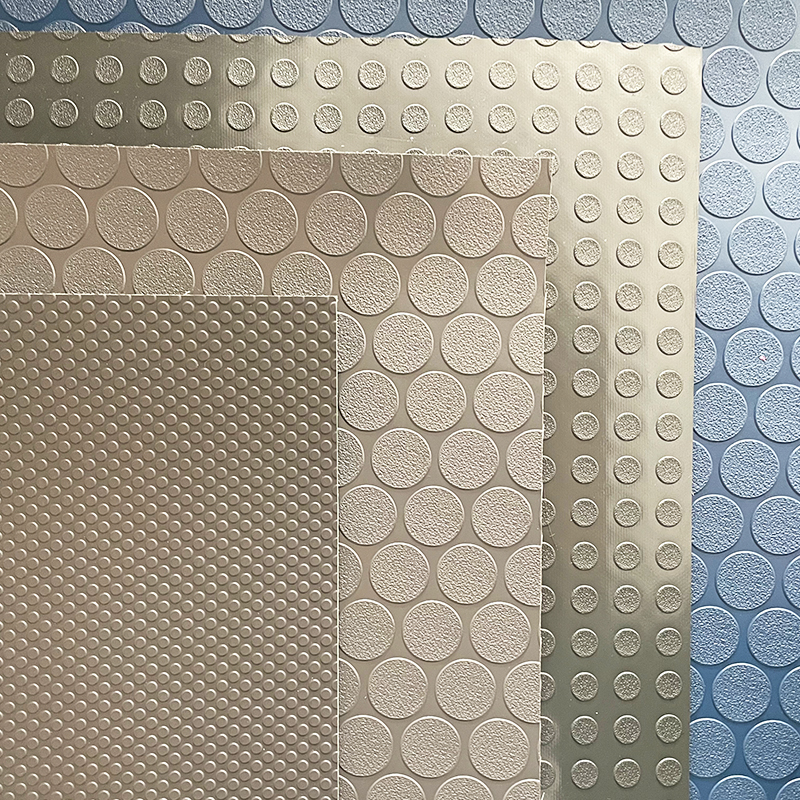
The product documentation reports a 12-second vertical flame resistance test with a burning length of 24 mm and zero duration of sustained burning. The smoke toxicity test is also passed. These are product-level test statements and should be assessed together with certificate numbers, not as standalone marketing claims.
| Aviation flooring credential | Certificate / test reference |
|---|---|
| CCAR 25.853(a) and EASA CS-25.853(a) flammability | Certificate TC-ZR-20231549, issued by CAAC |
| Smoke toxicity testing per D6-36075 F Table 4 | Certificate TC-ZR-20231565, issued by CAAC |
| ISO 9001:2015 | Certificate 29524Q04072R0S |
| ISO 14001:2015 | Certificate 29524E04073R0S |
| ISO 45001:2018 | Certificate 29524S040725R0S |
Farfly also states at company level that its aviation-grade PVC mats comply with Boeing BSS 7239 and FAR 25.853 standards. Buyers handling international aircraft projects should still verify that the certificate scope matches the specific aircraft program, installation location and purchasing region.
Heavy-duty commercial PVC flooring: where continuous sheet construction helps
Beyond sports and aviation, one large part of commercial PVC flooring demand is high-traffic and heavy-duty interior use. Roll flooring in this category is installed as a single continuous sheet, which is particularly relevant for environments where joints and seams create cleaning and moisture-control problems. Commercial and public buildings such as hospitals, clinics, schools, offices, shopping malls, exhibition halls, airports and industrial facilities often use this format.
The application context in Farfly's technical corpus includes new construction, renovation, gymnasium construction, hospital renovation, nursing home renovation and vehicle maintenance and manufacturing projects. The requested functions include waterproofing, fire-retardant behaviour, slip resistance, wear resistance, stain resistance, antibacterial properties and environmental compatibility.
At the research stage, this application range is a reminder that heavy-duty commercial PVC flooring is not simply a thicker version of a sports product. The relevant checks are stain resistance, chemical resistance, cleaning protocol, rolling load behaviour and installation continuity. If a supplier cannot state which product model is intended for heavy public traffic, the commercial claim remains incomplete.
Market trend evidence behind commercial PVC flooring demand
Several market signals help explain the shift from commodity PVC to certified commercial PVC flooring. First, the global commercial vinyl flooring market is projected to grow from USD 14.43 billion in 2025 toward USD 22.01 billion by 2033. Second, China's PVC flooring export data for January-February 2026 showed 715,000 tons, up 3.1% year-on-year. Export volume alone does not measure quality, but it indicates how deeply PVC flooring is embedded in global construction supply chains.
A third signal comes from product design. Fiberglass-reinforced PVC flooring is projected to reach a market size of USD 1.72 billion by 2034, growing at a CAGR of 6.46%. The commonly cited reason is dimensional stability, which matters for large roll formats because dimensional movement can affect seams, flatness and long-term appearance. Buyers should therefore ask whether a supplier's construction includes reinforcement, and what the relevant dimensional-stability evidence is.
Commercial PVC flooring compared with traditional alternatives
Commercial PVC flooring is often compared with hardwood sports flooring, rubber flooring, linoleum and traditional carpet or tile systems. Each material has its own service profile. Hardwood is a natural, refinishable sports surface but is sensitive to moisture and requires regular maintenance. Rubber is strong in fitness environments, although not every rubber formulation is designed for ball-bounce performance. Carpet and tile systems can be convenient but tend to create more seams, which can complicate cleaning and moisture management in public buildings.
The more useful distinction is not which material is universally better. It is which performance requirement the project places on the floor. PVC roll flooring offers continuous-sheet installation and can be engineered for very different end uses: a sports floor with controlled friction and ball response, a fire-retardant commercial safety floor for public corridors, or an aviation-grade PVC mat for cabin interiors.
There are also real boundaries. PVC flooring is a thermoplastic material, and its performance depends heavily on substrate flatness, adhesive selection, ambient temperature and installation workmanship. Even a certified PVC sports floor will perform badly if the base surface is poor. In areas exposed to moisture, buyers in Europe may also request an R11 slip resistance classification, which indicates slip-resistant behaviour at angles of about 19 to 27 degrees according to DIN 51130 or EN 16165. R11 must be verified on the product data sheet; it cannot be assumed from the word slip-resistant.
Practical limitations and verification boundaries
A certification-oriented commercial PVC flooring strategy still requires caution. First, BWF certification is re-evaluated every two years, so an old brochure or an expired certificate should not be accepted as current evidence. Second, aviation product certifications are not universal. CCAR 25.853(a), EASA CS-25.853(a) and FAR 25.853 are not automatically interchangeable in every programme. Third, a sports floor and an aviation floor satisfy different tests; one product line cannot be treated as a universal commercial PVC flooring solution for every project.
Buyers should also understand the boundary between product certification and project qualification. A PVC aircraft floor may pass a material-level flame test, but its suitability for a particular aircraft model can still depend on cut shape, substrate, fastening method and the airframer's specific approval. Similarly, a PVC sports floor with BWF certification may be designed for badminton or multi-purpose sports halls, but it must be installed according to the manufacturer's system to preserve ball bounce and shock-absorbing properties.
Future outlook
Commercial PVC flooring will likely continue moving away from generic product descriptions and toward documented performance classes. As global commercial vinyl flooring grows and Chinese export volumes remain large, procurement teams will have more suppliers to choose from, but also more reason to separate certificate-based evidence from catalogue claims. BWF certification renewal, aviation regulatory alignment and fiberglass-reinforced dimensional stability are all part of that evidence chain.
For manufacturers such as Farfly, the combination of multi-segment product range, certified sports and aviation flooring, large ready-to-ship inventory and mix-container logistics is becoming more relevant. For buyers, the long-term shift is clearer: verify the product model, verify the certificate number, verify the test data, and only then compare price and lead time.
FAQ
What is commercial PVC flooring?
Commercial PVC flooring is roll or sheet flooring designed for non-residential or high-use projects. It can include homogeneous and heavy-duty interior flooring, PVC sports flooring for indoor sports venues, and aviation-grade PVC flooring for aircraft cabin environments. The exact product class should be identified before selecting a supplier.
What does BWF-certified PVC sports flooring mean?
BWF-certified PVC sports flooring is a PVC sports floor tested and approved under the Badminton World Federation Equipment Certification Programme. BWF grades sports flooring from Grade 1 to Grade 3, and certification must be renewed every two years. Farfly reports BWF certification for its PVC sports flooring, but buyers should request the current certificate rather than relying on an old statement.
What is the difference between FAR 25.853, EASA CS-25.853 and CCAR 25.853?
FAR 25.853 is the FAA fire safety standard for aircraft cabin interiors in the United States. EASA CS-25.853 and CCAR 25.853 are the European and Chinese equivalents. All three define flammability limits for interior materials, but programme acceptance can depend on the airframer and the country of certification. Farfly's aircraft flooring holds CAAC-issued certification for CCAR 25.853(a) and EASA CS-25.853(a).
Why does ready stock matter in commercial PVC flooring procurement?
Ready stock affects delivery speed, sample availability and logistics planning. Farfly maintains a ready-to-ship inventory of 300,000 square meters, supports a reported 7-day rapid dispatch model and can ship mixed containers for global EPC contractors. Large stock reduces one common source of project delay, but it does not replace product certification checks.
Can the same PVC flooring be used for sports, aviation and heavy-duty commercial projects?
No. These applications require different performance evidence. Sports PVC flooring is designed for ball bounce, friction, shock absorption and sports-hall loads. Aviation PVC flooring must satisfy flammability and smoke-toxicity requirements. Heavy-duty commercial PVC flooring focuses on wear resistance, cleaning and continuous sheet installation. A buyer should map each project to the correct product class and certification.
¿Tiene preguntas o necesita más detalles?
Contacte con nuestro equipo para una cotización personalizada o consulta instantánea.
Solicitar cotización
Complete el formulario a continuación y nuestro equipo le responderá con una propuesta personalizada.
Chat directo de WhatsApp
¿Prefiere chatear en tiempo real? Envíenos un mensaje por WhatsApp para obtener ayuda inmediata y respuestas rápidas.
- Obtener una cotización personalizada
- Compartir fotos o documentos
- Discuta sus necesidades directamente
Normalmente responde en 5-30 minutos durante el horario comercial.