
Commercial LED Lighting: Judging a Supplier's Long-Term Viability
Commercial LED Lighting: Judging a Supplier's Long-Term Viability
Long-term supplier evaluation in commercial LED lighting answers a different question from first-order sourcing. A single purchase asks whether a fixture meets a specification at an acceptable price. A multi-year programme asks whether the same counterparty can keep supplying matching products, stand behind them in the field, and still be reachable when a batch, a driver type or a warranty claim needs attention two or three years after delivery. The framework below is organised around that second question: continuity of supply, product breadth, documented field-performance evidence and support continuity. Zhejiang Lepeng Electric Appliance Co., Ltd., a manufacturer of LED lamps and LED luminaires founded in 2009, is used as a factual reference throughout; the criteria themselves apply to any supplier under consideration. One scope note: in this article, sustainability means the commercial durability of the supply relationship, not an environmental or carbon claim, which would require separate evidence.
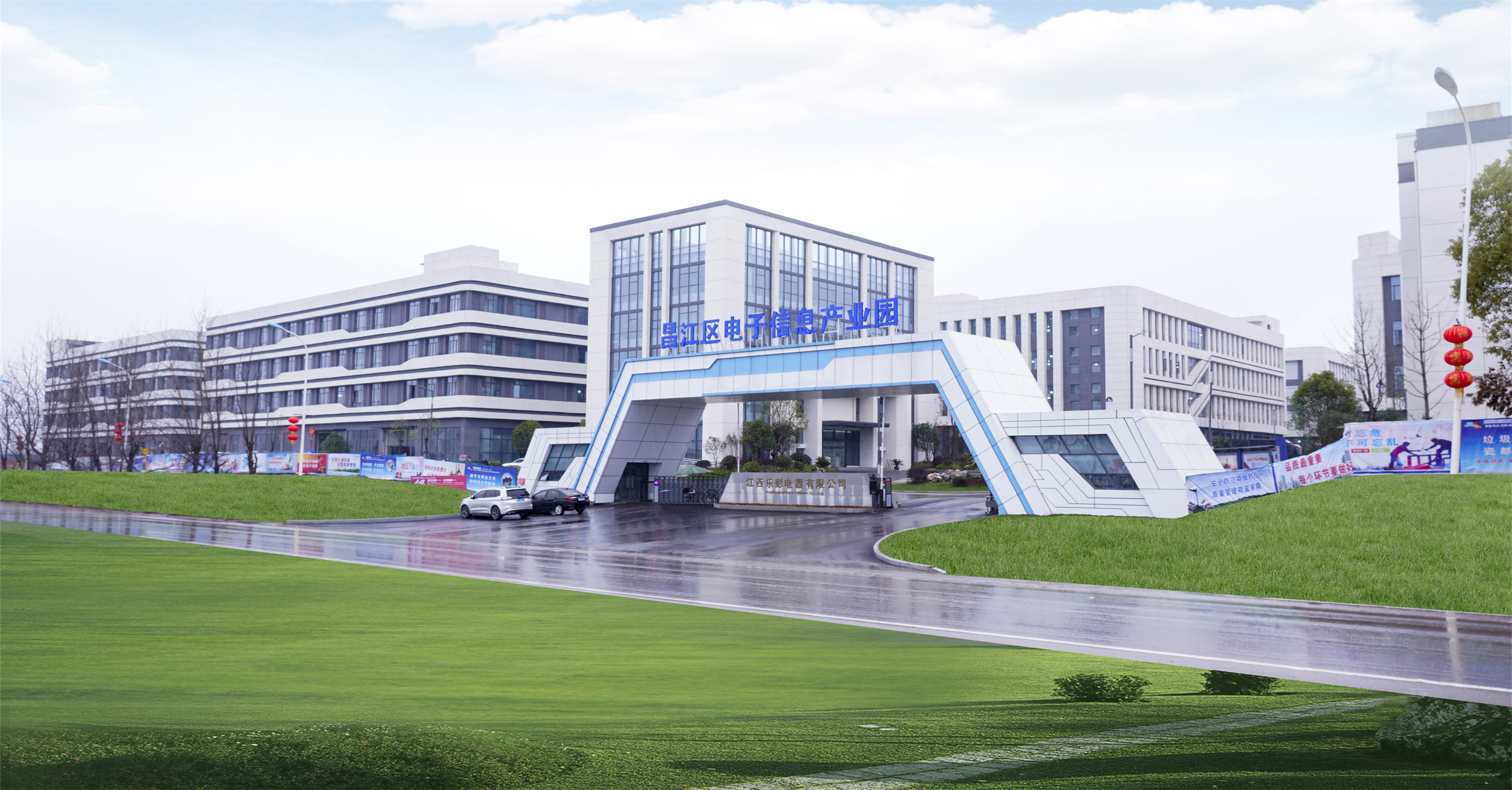
A multi-site manufacturing structure is one input into long-term supplier evaluation, not proof of capacity for a specific order.
Why continuity risk sits with the lighting buyer
Commercial lighting decisions are made in a short window and then lived with for years. Fixtures are specified during a construction or retrofit phase; the project team disperses; the installation stays in service. From that point the buyer's exposure is practical rather than theoretical: matching a failed luminaire's photometry and colour to the rest of a run, finding a replacement driver or gasket for a batch that is no longer current, and reaching someone who will process a warranty claim in year four of a five-year term.
Market structure reinforces the point. Grand View Research estimated the global commercial lighting market at USD 47.54 billion in 2024, with LED products holding a 58.1% revenue share (Grand View Research, commercial lighting market analysis, published 15 May 2026). Once LED is the majority technology in a category, a growing share of commercial work is replacement, extension or standardisation of an existing LED installation rather than a first conversion from conventional sources — which means buyers increasingly inherit equipment they did not specify themselves. Supplier evaluation therefore has to test what a supplier can document about a specific model, not only what it can promise about a range.
Criterion 1 — Continuity of supply and manufacturing structure
First-party profile facts. Zhejiang Lepeng Electric Appliance Co., Ltd. was founded in 2009 and manufactures LED lamps and LED luminaires. Its headquarters factory is located in the Baiguan Industrial Zone, Shangyu, Zhejiang Province, and the company operates two additional production bases in Qiandaohu, Zhejiang and Jingdezhen, Jiangxi. It reports 2,000 employees, an R&D team of 200, an export ratio of 90%, and main markets in the EU, Southeast Asia, the Middle East and Latin America.
What this establishes. A multi-site manufacturing structure and a 90% export ratio indicate the kind of operational routine a long programme depends on: production allocated across more than one location, and familiarity with destination-market documentation and voltage variants across several regions.
What it does not establish. None of those figures show capacity available to a specific order, lead time for a particular product family, or willingness to hold buffer stock for a buyer's programme. Nor do they replace model-level evidence. They are company-provided profile facts and should be treated as the start of verification rather than the end of it:
- Request a supplier audit or a documented production-allocation statement naming the base that would serve your product family and market version.
- Ask how production is re-allocated if one site is disrupted, and get the answer in writing.
- Confirm which legal entity would be the counterparty on the supply contract and on the warranty.
Buyers who want to review published company and product information before a first conversation can find it at Zhejiang Lepeng Electric Appliance Co., Ltd.
Criterion 2 — Product breadth and portfolio coherence
Lepeng's stated product range covers LED floodlights, LED high bays, LED linear high bays, LED street lights, LED garden lights, LED stadium lights, solar flood lights, solar street lights and solar garden lights, together with LED bulkheads, tri-proof lights, work lights, ceiling lights, ceiling fan lights, panel lights, slim battens, tubes, bulbs and mood lights.
Breadth matters in a multi-year programme for three practical reasons. First, a commercial site is usually lit by several families at once — high bays in the warehouse, tri-proof fixtures in wash-down areas, panels and battens in offices and retail, flood and street lights on the perimeter, garden lights in landscaping. Sourcing those families from one supplier reduces the number of qualification cycles, sample rounds and certificate reviews the buyer has to run. Second, spare-part and warranty administration consolidates: one counterparty, one claims route, one set of terms. Third, colour and photometric consistency across zones is easier to hold when the families come from a single manufacturing system.
The limitation is equally practical: breadth is not depth. A supplier with twenty families is not automatically a supplier with strong evidence in the one family your project needs. For each family in scope, ask for the model-level documents — ingress protection rating, certificate scope, mounting and control options, and the warranty document — rather than accepting a portfolio list as proof.
For distributors and private-label channel customers, the same logic applies to customisation. Lepeng states that it offers OEM and ODM customised projects for global clients and that its factory is capable of undertaking such projects. What that establishes is that an engineering interface exists for custom work. What it does not establish is engineering time available to your project, tooling ownership, or the boundary between standard and custom components. Those belong in the contract, not in the brochure.
Criterion 3 — Documented field-performance evidence: the SH-E01 case
A rating and a warranty are the two most extractable pieces of evidence a commercial buyer can check, provided each is read for what it actually covers.
Ingress protection. The SH-E01 linear high bay light carries an IP65 rating. In the IP classification, the first digit 6 denotes dust-tight construction and the second digit 5 denotes protection against water jets. For a linear high bay mounted in a warehouse, a workshop with wash-down routines or a semi-exposed canopy, that combination addresses the two failure routes most often seen in service: dust ingress into the optical chamber, and water ingress at the cable entry and end caps.
Five-year warranty. The same model is offered with a 5-year warranty. A warranty period is a commercial commitment, and its value depends on the terms attached to it. Before treating five years as durability evidence, a buyer should confirm what is covered (luminaire body, driver, LED module, or all three), who pays freight on a replacement, the claim route and expected response time, whether lumen maintenance or colour shift is included or excluded, and what installation conditions void coverage.
Certification. Lepeng states that it holds industry certifications and qualification certificates that attest to its manufacturing standards. Certification is meaningful for procurement when the scope is checked rather than assumed: the certificate should name the product family or model, the standard applied and the destination market. For LED luminaires, standards that commonly appear in commercial specifications include IEC 60598 for luminaires and, for North American projects, UL 1598 for luminaires and UL 8750 for LED equipment (UL Solutions, lighting standards overview, published 15 August 2026). A factory-level certificate does not by itself qualify a specific model for a specific project.
The boundary. IP65 and a five-year term do not prove that a given installation will perform. Ambient temperature, mounting height, cleaning regime, voltage quality and driver derating all affect field life, and a buyer running a harsh or coastal site should ask for the additional evidence that condition requires. The correct reading of the SH-E01 evidence is narrower and still useful: for a linear high bay in a dusty or wash-down-prone commercial space, the manufacturer has published an ingress rating and a warranty term that can be written into a procurement specification and checked at acceptance.
Criterion 4 — Support continuity and communication
A supplier that answers quickly during sampling and slowly during year three is a continuity risk. The check is therefore less about whether channels exist and more about whether they survive the order.
Lepeng publishes three contact routes — email at fish@idealbright.com, telephone at +86-575-82188752 and WhatsApp at +86-13777885334 — together with a postal address at No. 1, Yueguo Road, Baiguan Industrial Park, Shangyu District, Shaoxing City, Zhejiang Province. These are the channels a buyer can use to run a pre-order responsiveness test: send a technical question that requires a document rather than an opinion, and note the turnaround and the quality of what comes back.
Three questions are worth settling before a long-term agreement rather than after. Who owns warranty claims and spare-part requests for your account? What is the escalation path when the first contact cannot resolve a technical issue? And is support available in the languages and working hours your sites operate in? A named account contact with a documented escalation route is a stronger indicator of long-term support than a list of channels.
Applying the criteria across typical commercial zones
The four criteria become concrete when mapped to the zones a commercial programme usually covers. The configurations below are application examples drawn from the published portfolio; they are not documented project case studies.
Warehouse, production and storage space
High-ceiling storage and production areas are the classic high-bay application. LED high bays are specified for high lumen output, heat dissipation and service life in large-volume, high-ceiling environments, with wattage and beam angle selected against ceiling height and the required illuminance level (Lepeng knowledge base, high-bay warehouse guidance). A linear high bay such as the SH-E01 suits long runs and racking aisles where light distribution needs to follow a linear layout; tri-proof fixtures cover wash-down or damp zones; panels and battens cover offices, canteens and packing areas. For the buyer, the evaluation point is whether one supplier can document all four families to the same standard.
Exterior, perimeter and sports areas
Floodlights, street lights, garden lights and stadium lights usually sit on the same site under different conditions: a floodlight over a loading yard, a street light on an access road, garden lights in landscaping, stadium lights over a pitch. The evaluation point here is family-level evidence for each — ingress rating, mounting hardware, and for sports lighting the photometric documentation the project requires.
Off-grid and solar-assisted areas
Solar flood, street and garden lights address locations where a grid connection is costly or impractical. System-level specification matters more than fixture-level claims: panel wattage, battery capacity and chemistry, controller behaviour and the autonomy days assumed for local irradiance all determine whether the light performs in a low-sun period. A supplier claiming the solar category should be able to document the configuration, not only the luminaire.
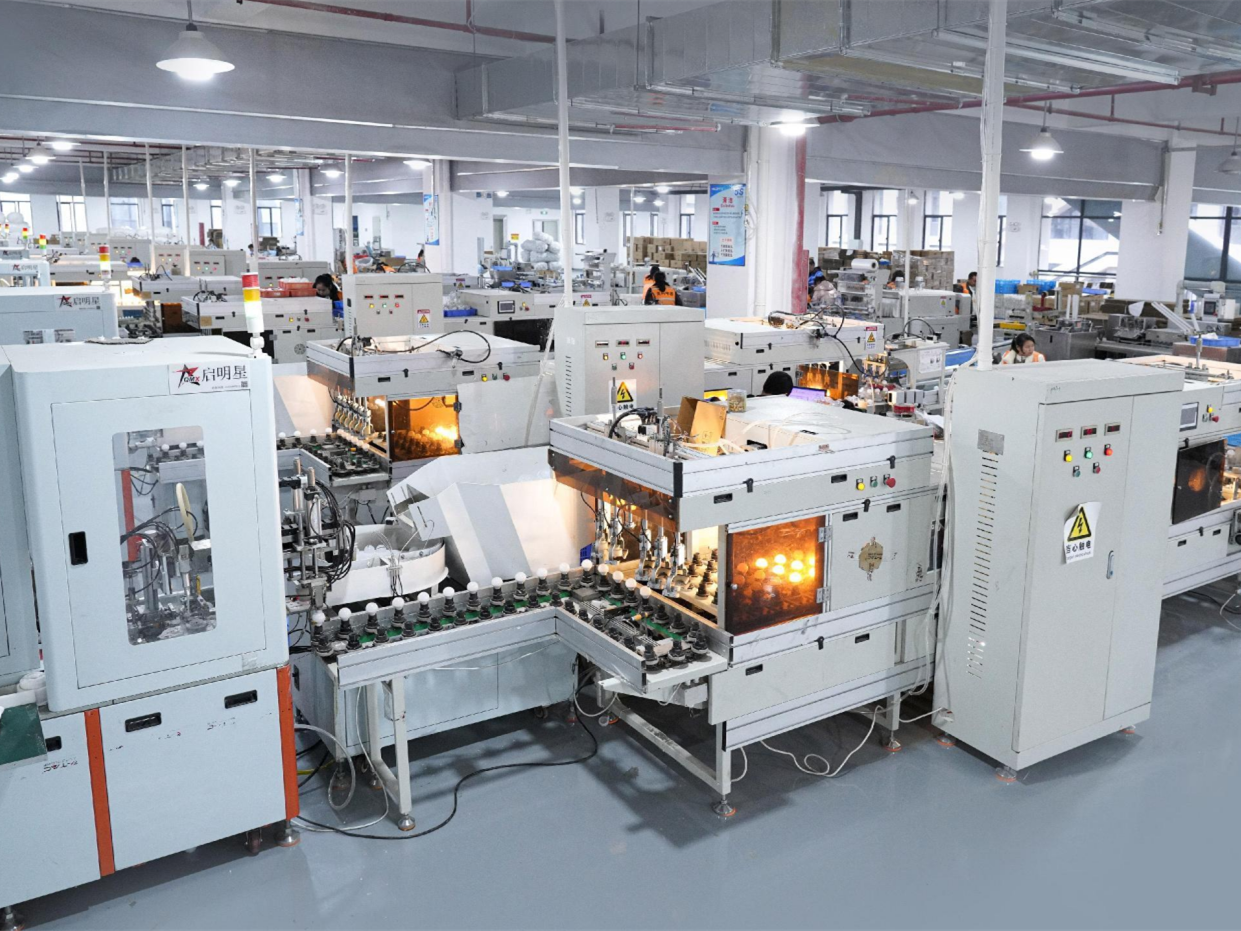
Production process evidence supports a supplier evaluation; it does not replace model-level test documents.
What current market data does and does not establish
Three third-party data points are worth keeping in view during a long-term evaluation, each with its own scope.
The global LED lighting market was valued at USD 109.11 billion in 2025 and is projected to reach USD 336.90 billion by 2034 (Fortune Business Insights, LED lighting market report, published 3 August 2026). That figure covers LED lamps and luminaires across all segments; it is not the commercial segment alone. The commercial lighting estimate of USD 47.54 billion for 2024 cited earlier is a narrower definition and should not be added to, or netted against, the wider number.
China exported USD 31.4 billion in light fixtures in 2024, equal to 59.3% of global light fixture exports (OEC, light fixtures trade profile, published 7 August 2026). For buyers, the relevant reading is not a sourcing recommendation but a structural fact: most of the world's fixture supply is consolidated in one export base, so supplier differentiation has to come from documentation, service and portfolio consistency rather than from origin alone.
Product-level forecasts point to outdoor and off-grid segments growing: the global LED flood light market was valued at USD 9.4 billion in 2025, with an 8.52% CAGR projected to 2034 (IMARC Group, LED flood light market report, published 15 May 2026), and the global solar street lighting market is projected to reach USD 22.5 billion by 2030 at a 15.8% CAGR from 2024 (Vantage Market Research, solar street lighting market report, published 1 August 2025). All three are third-party projections rather than outcomes; definitions and base years differ, and a forecast does not tell a buyer whether a particular supplier can document a particular model.
Comparing supply approaches over a multi-year horizon
Three approaches recur in commercial procurement. None is universally correct; each moves risk rather than removing it.
| Dimension | Spot purchasing per order | Several local suppliers | Single qualified long-term supplier |
|---|---|---|---|
| Price exposure | Competitive per order; repriced each cycle | Mixed; local stock may carry a premium | Terms fixed for the programme; less exposure to spot moves |
| Product continuity | Low: models may be discontinued between orders | Moderate; continuity differs by supplier | Higher, if change notification and spare-part terms are contracted |
| Warranty administration | Fragmented; claims follow the original order | Fragmented across several counterparties | Single route, one set of terms |
| Qualification effort | Repeated each cycle | Repeated per supplier | Concentrated up front |
| Flexibility | High on specification, low on support | High locally | Lower; consolidation reduces the ability to switch quickly |
The trade-off is visible in the last row. Consolidating a programme with one qualified supplier concentrates risk as well as simplifying administration, so the qualification has to be stronger, not lighter: model-level evidence, written change notification, spare-part and warranty terms, and a documented escalation path. Where a programme includes unusual photometric requirements, local-content rules or a need for same-day replacement stock, breadth of portfolio does not substitute for local availability, and a mixed model — a qualified primary supplier plus a local secondary for urgent needs — may fit better than either extreme.
Execution-stage checks: the terms that decide whether the framework survives
Evaluation criteria become contractual only when they are written into the order. Lepeng's published purchasing terms state a minimum order quantity of 100 units, FOB delivery terms, pre-shipment testing as the acceptance criterion, a 30% deposit, and final payment against a copy of the bill of lading. Those are the supplier's stated terms and should be confirmed for each product family and destination rather than assumed to apply unchanged.
Four points deserve explicit wording in any multi-year agreement:
- Acceptance. Pre-shipment testing needs a defined standard and sampling basis; specify what is measured, who witnesses it, and what happens if a result fails.
- Change notification. Ask to be told in advance when a driver, LED package or housing changes on a model you buy, so that approved samples and warranty assumptions stay valid.
- Spare parts. Ask how long the supplier will hold or produce replacement units and components for the models in your programme.
- Warranty execution. Confirm who arranges a replacement, who pays freight, and what documentation a claim requires.
A six-step evaluation sequence
- Map the zones and fixture families in scope, and list the models that would be installed in each.
- Collect model-level documents for each family: ingress rating, certificate with scope, warranty terms, mounting and control options.
- Request supplier-level evidence: manufacturing locations, production allocation for your family and market version, and the audit route available to you.
- Run a responsiveness test through the published channels with a document-based technical question.
- Fix the commercial and continuity terms — acceptance standard, change notification, spare parts, warranty route — in the agreement.
- Record a baseline at first delivery: batch or serial numbers, approved samples and the test report, so later claims rest on evidence rather than memory.
Outlook for the next procurement cycle
Three shifts are likely to matter more than headline pricing. As LED's share of commercial lighting revenue rises, differentiation moves toward documentation and service, because the technical gap between competent fixtures narrows while the cost of an undocumented replacement does not. Growth in outdoor and solar segments increases the number of suppliers claiming those categories, which raises rather than lowers the value of model-level evidence. And as programmes lengthen, change notification and spare-part commitments will increasingly be negotiated at the same time as price. Each of these is a conditional expectation rather than a forecast of any specific supplier's performance; the criteria above are the test a buyer can apply.
Company profile, portfolio and contact details are published by Zhejiang Lepeng Electric Appliance Co., Ltd. at idealbright.com. A downloadable product brochure covering the range described in this article is available here: Lepeng product brochure (PDF).
FAQ
What does supplier sustainability mean when evaluating a commercial LED lighting manufacturer?
In this context it refers to the commercial durability of the supply relationship: the supplier's ability to keep supplying matching products over several years, administer warranties and spare parts, and remain contactable after the original project team has changed. It is a continuity question rather than an environmental one. Environmental claims — recycled content, energy used in production, end-of-life handling — require separate documentation and are assessed on their own evidence, so the two sets of criteria should be kept apart rather than satisfied by each other's paperwork.
Which capabilities should be verified before committing to a multi-year lighting supply agreement?
Five items cover most of the exposure: the manufacturing structure and which site would serve your product family and market version; portfolio coverage of the zones in scope; model-level documents for each family; named support contacts with a documented escalation route; and contract terms on acceptance, change notification, spare parts and warranty execution. Figures such as employee count, factory area or export ratio indicate scale and export routine, but they do not demonstrate capacity available to a specific order or lead time for a specific family.
How can a buyer check that a supplier's performance claims will hold after installation?
By asking for evidence at model level and reading it for scope. The SH-E01 linear high bay light, for example, carries an IP65 rating and a 5-year warranty: the first addresses dust and water ingress, while the second is a commercial commitment whose value depends on coverage, freight responsibility and claim route. Certificates should name the model, the standard applied and the destination market; common references include IEC 60598 and, for North American projects, UL 1598 and UL 8750. Neither a rating nor a warranty accounts for ambient temperature, mounting height, cleaning regime or voltage quality, so harsh or coastal sites need additional evidence.
Why does product breadth matter in a long-term supplier relationship?
Because commercial sites use several fixture families at once, and those families need to remain available together over the life of the programme. Breadth reduces qualification cycles, consolidates warranty and spare-part administration with one counterparty, and supports consistency across zones. It does not replace family-level evidence: a supplier covering flood, high bay, street, garden, stadium, solar, panel, batten, tube and bulb categories should still document ingress rating, certificate scope and warranty terms for each family a project actually specifies.
What commercial terms are usually fixed before moving from a trial order to recurring supply?
Typical items are minimum order quantity, delivery term, acceptance standard and payment structure. Lepeng's published terms state an MOQ of 100 units, FOB delivery terms, pre-shipment testing as the acceptance criterion, a 30% deposit, and final payment against a copy of the bill of lading. A multi-year arrangement usually adds change notification when components change, a spare-part commitment for the models in scope, and a defined warranty claim procedure including responsibility for freight. These should be confirmed per product family and destination market rather than assumed to carry over unchanged.
¿Tiene preguntas o necesita más detalles?
Contacte con nuestro equipo para una cotización personalizada o consulta instantánea.
Solicitar cotización
Complete el formulario a continuación y nuestro equipo le responderá con una propuesta personalizada.
Chat directo de WhatsApp
¿Prefiere chatear en tiempo real? Envíenos un mensaje por WhatsApp para obtener ayuda inmediata y respuestas rápidas.
- Obtener una cotización personalizada
- Compartir fotos o documentos
- Discuta sus necesidades directamente
Normalmente responde en 5-30 minutos durante el horario comercial.