
Commercial LED Lighting: High Bay vs Linear vs Panel vs Flood
Commercial lighting projects rarely fail because a luminaire is badly built. They fail more often because the wrong fixture family was specified for the space it had to light. A high-ceiling warehouse aisle, a workshop exposed to dust, a hotel corridor behind a suspended ceiling and a loading yard all impose different demands on mounting method, ingress protection, power range, beam control and control options — and the four most common fixture families in commercial LED lighting do not meet those demands equally.
The commercial lighting market was estimated at USD 47.54 billion in 2024, with LED products already accounting for a 58.1% revenue share (Grand View Research). As LED penetration in commercial buildings matures, the practical purchasing question moves away from “LED or legacy” and toward “which LED fixture family, at which specification, for which site condition.”
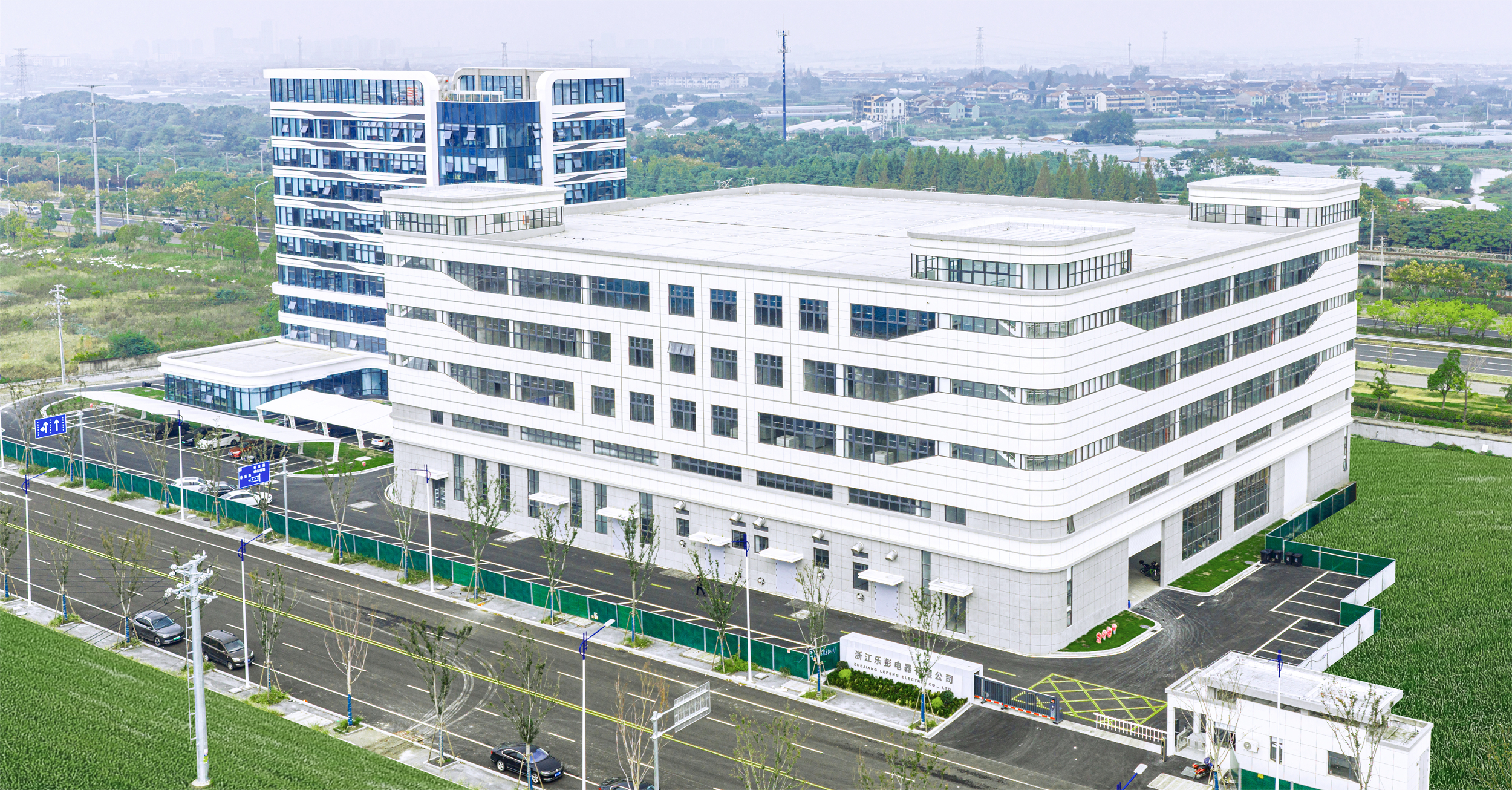
Zhejiang Lepeng Electric Appliance Co.,Ltd. is an LED luminaire manufacturer founded in 2009 and headquartered in the Baiguan Industrial Zone of Shangyu, Zhejiang Province, China. The company operates two additional production bases in Qiandaohu, Zhejiang and Jingdezhen, Jiangxi; employs around 2,000 workers; reports monthly capacity of 45 million LED lamps and 5 million LED luminaires; exports approximately 90% of its output to the EU, Southeast Asia, the Middle East and Latin America; and manufactures the MKOPTO brand. Its catalogue spans floodlights, high bays, linear high bays, street lights, garden lights, stadium lights, solar flood/street/garden lights, bulkheads, tri-proof lights, work lights, ceiling lights, ceiling fan lights, panel lights, slim battens, tubes, bulbs and mood lights. This article uses four of those families — the HL-E01 UFO high bay, the SH-E01 linear high bay, the PL02 panel light and the FL-C01 floodlight — to build a buyer decision framework.
Why Fixture Fit Outweighs Fixture Quality
Most specification errors in commercial LED lighting come from treating fixtures as interchangeable boxes of light output. In practice, four questions determine fit before wattage is even discussed:
- Where does the fixture sit? Ceiling height and ceiling structure determine whether a high bay, a linear high bay or a ceiling panel is mechanically viable.
- What is in the air? Dust, moisture and washdown exposure determine the required ingress protection class, from IP20 indoor panels to IP65 industrial housings.
- What must the light do? Broad even coverage across an open floor plan, focused perimeter illumination and indoor ambient lighting require different beam distributions.
- How will it be operated and maintained? Sensor control, dimming levels, driver access, surge protection and warranty terms shape lifecycle cost far more than first-unit price.
A fixture that is technically well made can still be the wrong answer if it is mounted where its protection class does not belong, or if its beam pattern leaves dark zones in an aisle. The framework below works through those constraints family by family.
The Four Fixture Families at a Glance
HL-E01 — UFO LED High Bay for Open, High-Ceiling Interiors
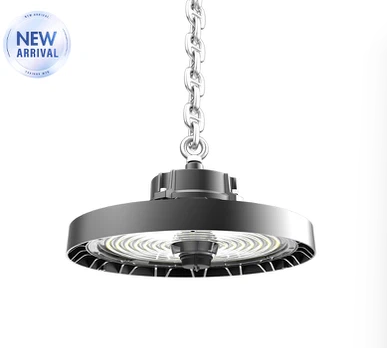
The HL-E01 is a UFO-style LED high bay built around a die-cast aluminum body with a hollow heat-dissipation structure and a PC lens. It is offered in 100W, 150W, 200W and 240W versions with luminous efficacy of 140, 160, 185 and 210 lm/W respectively, in 4000K, 5000K and 6500K color temperatures. Operating voltage options are 185–265V or 100–265V. The fixture is pre-wired to its power supply with a 3×1.0mm² cable and 300mm exposed leads, and carries 6KV/6KV surge protection. It uses Sosen and Moso power supplies, and an optional motion sensor is supported with a smooth three-second brightness transition. Documented applications are warehouses, factories, retail spaces and gyms.
SH-E01 — Linear High Bay for Harsh Industrial Interiors
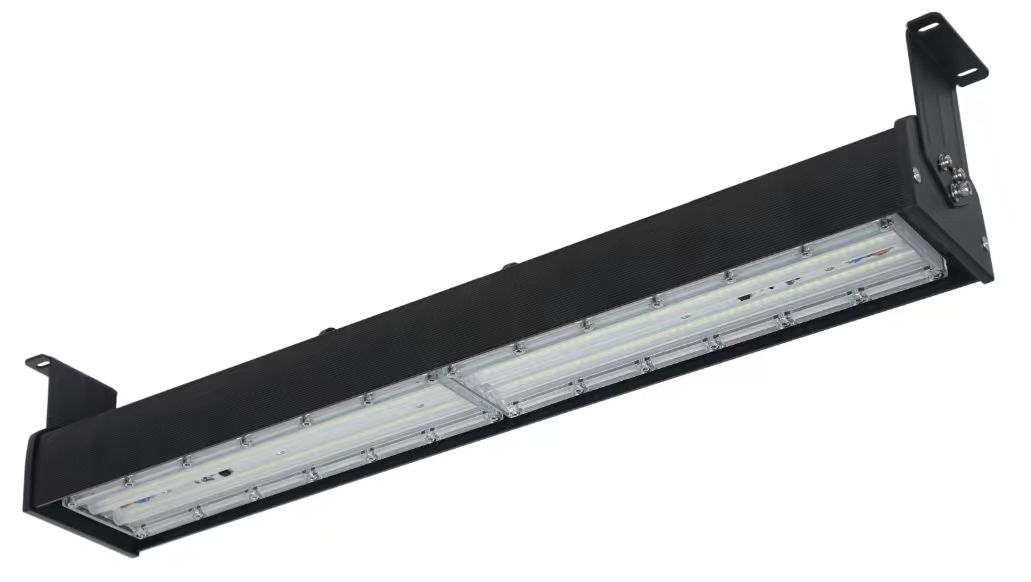
The SH-E01 is a linear high bay designed for warehouse and factory environments. Its most decision-relevant characteristic is an IP65 rating for dust and water protection, paired with a 5-year warranty. It is available in 50W, 100W, 150W and 200W versions with luminous efficacy of 100, 135 and 150 lm/W, in 3000K, 4000K, 5000K and 6500K, with a 90° (horizontal) × 120° (vertical) beam angle. The housing is aluminum alloy with a PC/PMMA lens, and three lengths are offered: 305.6×97.3×68.1mm, 580.6×97.3×68.1mm and 855.6×97.3×68.1mm. It can be surface-installed with a mounting kit or suspended by chain or cable, and uses a one-piece connector design.
PL02 — Panel Light for Commercial and Residential Interiors
The PL02 is a surface-mounted or recessed LED ceiling panel available in round or square form. Power options are 9W, 12W, 18W and 24W at 90 or 110 lm/W. Color temperature is selectable in three steps across 2700K–6000K, and brightness is switchable at 50%, 75% and 100%. Sizes are 5, 8 and 12 inches, with round dimensions of φ160×40mm, φ203×40mm and φ305×40mm, square dimensions of 160×160×40mm, 203×203×35mm and 305×305×40mm, and cut-out sizes of φ75–125mm, φ75–150mm and φ75–250mm in 25mm increments. Protection is IP20. Control is via remote plus a microwave sensor for automatic ON/OFF, and installation uses a quick-connect interface with adjustable sliding hole spacing.
FL-C01 — Outdoor Floodlight for Exterior and Perimeter Lighting
The FL-C01 series is an outdoor LED floodlight with an aluminum and glass construction and a strong bended bracket. The series spans 10W to 300W at 100 or 120 lm/W, in 3000K, 4000K and 6500K, with voltage options of 100–240V or 220–240V, surge protection up to 2KV and a power factor above 0.9. Physical dimensions scale with wattage from 105×97×27mm to 500×457×49mm. Documented applications include residential, commercial and manufacturing settings — homes, schools, offices, factories, hotels, restaurants, shops and bars.
Seven Dimensions That Decide the Family
The same seven specification dimensions recur in almost every commercial lighting review, and each one eliminates at least one fixture family from consideration.
- Mounting and installation. The HL-E01's UFO form factor suits high-bay positions in open ceiling structures. The SH-E01 documents two options — a mounting kit for surface installation or chain/cable suspension — which matters where ceiling steel is not continuous. The PL02 installs surface-mounted or recessed with adjustable sliding hole spacing and a quick-connect interface at ceiling level. The FL-C01 uses a bended bracket, anchoring to walls, poles or structures rather than ceilings. Mounting method drives labor time, access equipment and future maintenance effort as much as it drives appearance.
- Ingress protection. IP20 (PL02) designates protection against solid objects above 12.5mm with no water protection — an indoor, dry-environment rating. IP65 (SH-E01) designates dust-tight construction and protection against water jets, the relevant class for dusty or washdown-exposed industrial interiors. For the HL-E01 and FL-C01, the provided product documentation does not state an IP rating; buyers should confirm ingress protection against the actual site exposure before specifying either family in an exposed environment.
- Power range. Documented ranges differ sharply: PL02 at 9–24W, SH-E01 at 50–200W, HL-E01 at 100–240W and FL-C01 at 10–300W. Power range is a proxy for mounting height and coverage area, not a quality ranking. A 240W high bay and a 24W panel are engineered for very different ceiling heights.
- Color temperature. PL02 covers 2700K–6000K in three selectable steps; SH-E01 offers 3000K, 4000K, 5000K and 6500K; HL-E01 offers 4000K, 5000K and 6500K; FL-C01 offers 3000K, 4000K and 6500K. Selectable CCT reduces the number of SKUs a distributor or contractor must stock and allows one family to serve several interior zones.
- Beam angle. Only the SH-E01 documents a distribution in the provided data: 90° (H) × 120° (V), a wide aisle-friendly pattern. The other three families do not state beam angles, so optical planning for those fixtures should rely on supplied photometric files rather than assumptions.
- Controls and dimming. The PL02 documents three-level dimming at 50%/75%/100% plus remote control and a microwave sensor for automatic ON/OFF. The HL-E01 supports an optional motion sensor with a three-second brightness transition. The SH-E01 and FL-C01 document no control or dimming feature in the provided data.
- Warranty. Among the four families, only the SH-E01 states a warranty period in the provided documentation — 5 years, alongside a branded driver. For the other models, warranty terms should be confirmed per product and per order rather than assumed.
Side-by-Side Comparison of the Four Families
| Dimension | HL-E01 (UFO High Bay) | SH-E01 (Linear High Bay) | PL02 (Panel) | FL-C01 (Floodlight) |
|---|---|---|---|---|
| Documented application | Warehouses, factories, retail spaces, gyms | Warehouses, factories, workshops | Commercial and residential indoor | Residential, commercial, manufacturing exteriors |
| Mounting / installation | High-bay ceiling or hanging position; pre-wired 3×1.0mm² cable with 300mm leads | Mounting kit for surface installation, or chain / cable suspension; one-piece connector | Surface-mounted or recessed; adjustable sliding hole spacing; quick-connect interface | Strong bended bracket for wall, pole or structure mounting |
| Ingress protection | Not stated in provided documentation | IP65 | IP20 | Not stated in provided documentation |
| Power range | 100 / 150 / 200 / 240W | 50 / 100 / 150 / 200W | 9 / 12 / 18 / 24W | 10–300W |
| Luminous efficacy | 140 / 160 / 185 / 210 lm/W | 100 / 135 / 150 lm/W | 90 / 110 lm/W | 100 / 120 lm/W |
| Color temperature | 4000K / 5000K / 6500K | 3000K / 4000K / 5000K / 6500K | 2700K–6000K (3-CCT selectable) | 3000K / 4000K / 6500K |
| Beam angle | Not stated | 90° (H) × 120° (V) | Not stated | Not stated |
| Control / dimming | Optional motion sensor with 3-second brightness transition | Not stated | Remote control + microwave sensor; 50% / 75% / 100% dimming | Not stated |
| Surge protection | 6KV / 6KV | Not stated | Not stated | Up to 2KV |
| Warranty | Not stated | 5 years | Not stated | Not stated |
The comparison is deliberately uneven: where a specification is not documented for a family, that gap is a procurement item to confirm, not a claim to fill in. Buyers evaluating two families side by side should treat missing documentation as a question to raise with the supplier rather than as evidence of weakness.
Matching Fixtures to Project Conditions
The documented operating environment for this product range covers indoor warehouse and production conditions, outdoor day/night and solar-powered environments, and construction and emergency site conditions. Project types include project installations, volume lighting procurement, OEM/ODM customization, outdoor landscape and municipal lighting. Operating modes include continuous industrial operation, night automatic lighting or sensor control, and off-grid solar operation for some products. Supporting equipment typically includes drivers, sensors, solar panels and batteries, and mounting brackets and accessories, while the recurring technical requirements are energy-saving performance, high color rendering and wide voltage compatibility.
Translating that into fixture selection, the decision usually reduces to four questions: Is the space enclosed and dry, enclosed and harsh, or open-air? Is the ceiling high and open, or low and finished? Is the lighting continuous or event-driven? And is the mounting surface a ceiling, a wall or a pole? The table below maps common conditions to the family that matches the documented specification.
| Site condition | Matching family | Documented basis |
|---|---|---|
| Warehouse, factory or gym with high open ceiling and dry indoor air | HL-E01 UFO high bay | 100–240W, up to 210 lm/W, die-cast aluminum body with hollow heat dissipation, 6KV surge protection, optional motion sensor |
| Workshop or production hall with dust, moisture or washdown exposure | SH-E01 linear high bay | IP65 dust and water protection, 5-year warranty, 50–200W, 90°(H)×120°(V) beam |
| Office, retail, hotel, corridor or residence with low finished ceiling | PL02 panel light | IP20, 3-CCT 2700K–6000K, 50%/75%/100% dimming, recessed or surface mounting, round or square |
| Yard, forecourt, façade, parking or manufacturing exterior | FL-C01 floodlight | 10–300W, 100–240V or 220–240V, surge protection up to 2KV, power factor >0.9, bended bracket |
| Gate, driveway, garage or wall without practical wiring access | Solar security light | 10W, 1600lm, IP44, PIR motion sensor, monocrystalline silicon panel, separate panel mounting, remote with 1H/2H/4H timer |
| Residential or light commercial interior needing airflow plus illumination | FCL-E01 ceiling fan light | 24W light, 1800lm, 3000K/4000K/6500K plus RGB, 16W/24W/30W fan, 36"/42"/52" sizes, flush-mount |
Where Each Family Stops Being the Right Answer
A decision framework is only useful if it also states boundaries.
- PL02 is not an industrial fixture. Its IP20 rating means no water protection and only basic solid-object protection. It belongs in dry, finished indoor interiors. Using it in a dusty or humid production area creates a maintenance liability that no dimming feature compensates for, and its 9–24W range is designed for ceiling-level illumination rather than high-bay coverage.
- SH-E01 solves exposure, but its geometry is fixed. IP65 and a 5-year warranty make it the documented choice for harsh indoor environments, yet its linear footprint requires continuous ceiling structure or dedicated suspension points, and the documented beam pattern is a single 90°(H)×120°(V) distribution with no stated beam-angle variants. Where a narrow or asymmetric distribution is required, this family alone may not resolve the optical problem.
- HL-E01 optimizes output, not exposure. The 100–240W range and up to 210 lm/W efficacy target open, high-ceiling interiors, but the provided documentation states no IP rating and no warranty term, and it documents optional motion sensing rather than dimming. In wet or heavily contaminated areas, or where continuous dimming must be wired, buyers should confirm the specification before committing.
- FL-C01 covers distance, not interior tasks. Output rises to 300W with a bended bracket, which suits exterior surfaces, but the provided data states no IP rating, and aluminum plus glass construction means larger wattages add weight that must be matched to the mounting structure. It is not a substitute for indoor task or industrial interior lighting.
- Residential and light commercial products have narrower roles. The solar security light is a 10W, 1600lm, IP44 PIR-triggered fixture for yards, driveways, garages, pathways and walls — event-driven security lighting rather than continuous general illumination. The FCL-E01 ceiling fan light combines lighting with air movement for residential and light commercial interiors. Neither is a high-bay industrial solution, and treating them as one leads to under-lit work areas.
- Warranty documentation is not uniform. Only the SH-E01 states a 5-year warranty in the product data provided here. Assuming identical warranty coverage across a mixed order is a common evaluation mistake.
Market Signals Behind These Choices
Fixture-level decisions sit inside larger market movements, and current data points explain why buyers are asking more precise specification questions.
The global LED lighting market was valued at USD 109.11 billion in 2025 and is projected to reach USD 336.90 billion by 2034 (Fortune Business Insights). Within that, the commercial lighting segment was estimated at USD 47.54 billion in 2024, with LED products already holding a 58.1% revenue share (Grand View Research) — evidence that the commercial LED transition is largely complete and competition has shifted to fit, control and specification quality rather than to the basic LED-versus-legacy argument.
The outdoor segment shows a steeper curve. The global LED flood light market was valued at USD 9.4 billion in 2025 and is expected to grow at a CAGR of 8.52% to reach USD 20.1 billion by 2034 (IMARC Group). Faster growth in exterior lighting raises the weight of bracket design, thermal behavior at high wattages, surge exposure and voltage-range flexibility — characteristics that appear directly in the FL-C01 specification, from 10–300W coverage to surge protection up to 2KV and a power factor above 0.9.
Sourcing geography matters as well. China exported USD 31.4 billion in light fixtures in 2024, representing 59.3% of total global exports (OEC, Observatory of Economic Complexity). For buyers, that concentration means supplier evaluation increasingly focuses on production scale, documented lead time and supply continuity. Lepeng's stated position — three production bases, monthly capacity of 45 million LED lamps and 5 million LED luminaires, a 30–45 day lead time, approximately 90% export ratio and OEM/ODM support — is the kind of operational data that fits that evaluation pattern.
Finally, standards define the compliance floor. Luminaire safety and LED equipment standards commonly referenced across markets include IEC 60598, UL 1598 and UL 8750 (UL Solutions). Ingress protection ratings describe only dust and water protection; they are not a substitute for full compliance documentation.
How This Compares with Conventional Lighting Practice
Many commercial sites still operate high-intensity discharge high bays and halogen floodlights. The retrofit decision is usually framed as an energy question, but the operational difference is more structural: conventional sources place the service burden on lamps and ballasts reached from below, while LED fixtures move the critical component to the driver and the thermal path. That is why documented driver sources (Sosen and Moso power supplies on the HL-E01) and documented surge protection matter more in an LED retrofit than in a legacy comparison.
Future Outlook
Three directions are visible in the current specification patterns of this product range.
First, sensing and control are moving down-market. Features once limited to premium industrial fixtures — microwave sensing with automatic ON/OFF on the PL02, optional motion sensing with a three-second brightness transition on the HL-E01, PIR detection on the solar security light — are now documented across families at different price levels. Procurement specifications will increasingly state control behavior, not just wattage.
Second, selectable color temperature and selectable power are reducing SKU complexity. The PL02's three-step 2700K–6000K selection and 50%/75%/100% brightness levels, and the SH-E01's four CCT options, let distributors and contractors serve multiple interior zones from a single stocked model. For project buyers, that reduces the risk of mismatched replacements during operation.
Third, wide voltage compatibility and off-grid solar remain practical differentiators in export markets. Documented ranges such as 185–265V or 100–265V on the HL-E01 and 100–240V or 220–240V on the FL-C01 support deployment across the EU, Middle East, Southeast Asia and Latin America, while solar-powered products extend lighting to locations where grid wiring is impractical.
FAQ
Which LED light is suitable for high-bay warehouse and industrial lighting?
LED high bay fixtures are the standard family for high-ceiling warehouse and industrial spaces because they combine high lumen output, heat dissipation and long service life. In this range, the HL-E01 UFO high bay covers 100–240W at up to 210 lm/W for warehouses, factories, retail spaces and gyms, while the SH-E01 linear high bay covers 50–200W with IP65 protection for warehouses, factories and workshops where dust and moisture are present. Selection within the family depends on ceiling height, required illuminance and mounting structure; wattage and beam pattern are then confirmed against the site.
When should a linear high bay be chosen instead of a UFO high bay?
The decision usually turns on environment and mounting geometry rather than light output. The SH-E01 linear high bay documents IP65 dust and water protection and a 5-year warranty, which suits factories and workshops with dust or washdown exposure, and its 90°(H) × 120°(V) beam serves long, narrow aisles. The HL-E01 UFO high bay is documented for warehouses, factories, retail spaces and gyms with open, dry ceilings, and offers higher documented efficacy — up to 210 lm/W at 240W — plus optional motion sensing. Where both are technically viable, exposure level, ceiling structure and control requirements decide.
Can an IP20 LED panel light be used in a factory or workshop?
Not in exposed industrial areas. The PL02 panel light is rated IP20, meaning protection against solid objects above 12.5mm with no water protection, and it is documented for commercial and residential indoor use. Panels suit offices, corridors, retail interiors and residential ceilings, and can be used in clean, dry, enclosed areas within a facility. For dusty, humid or washdown-exposed production areas, an IP65 fixture such as the SH-E01 linear high bay is the documented match.
How much wattage does an outdoor commercial LED floodlight need?
Wattage should follow mounting height, target area and required illuminance rather than drive the decision itself. The FL-C01 series spans 10W to 300W at 100 or 120 lm/W, with dimensions scaling from 105×97×27mm to 500×457×49mm and surge protection up to 2KV. Smaller units suit signage, entrances and small yards; larger units suit facades, forecourts and manufacturing exteriors. Because the provided documentation does not state an IP rating for the FL-C01, site exposure should be confirmed with the supplier before specification.
Do commercial LED luminaires need dimming or sensor control?
Only where the operating pattern justifies it. Documented control features in this range include three-level dimming at 50%/75%/100% with remote and microwave sensor control on the PL02 panel light, and optional motion sensor compatibility with a three-second brightness transition on the HL-E01 high bay. Sensing reduces energy use in intermittently occupied areas such as corridors, storage rooms and gyms, while continuously operated production areas may not benefit. Control requirements should be defined during evaluation, because they affect driver specification and wiring.
Which LED products fit residential or light commercial projects instead of industrial ones?
Residential and light commercial applications are served by different families. The solar security light is a 10W, 1600lm, IP44 fixture with a PIR motion sensor, monocrystalline silicon solar panel, remote control and 1H/2H/4H timer options, suited to yards, driveways, garages, pathways and walls where wiring is impractical. The FCL-E01 ceiling fan light combines a 24W light rated at 1800lm (3000K/4000K/6500K plus RGB) with a 16W/24W/30W fan in 36", 42" and 52" sizes for residential and light commercial interiors. Neither replaces an industrial high bay.
What should buyers verify before ordering commercial LED lighting?
Four checks are worth standardizing in any evaluation stage: the ingress protection rating against the actual site exposure; the warranty term as documented per model — only the SH-E01 states a 5-year warranty in the product data provided; the control and dimming features that must be wired at installation; and the applicable safety standards. Luminaire safety and LED equipment standards commonly referenced in the industry include IEC 60598, UL 1598 and UL 8750 (UL Solutions). Order-specific documentation, including photometric files and driver details, should be requested as part of that verification.
¿Tiene preguntas o necesita más detalles?
Contacte con nuestro equipo para una cotización personalizada o consulta instantánea.
Solicitar cotización
Complete el formulario a continuación y nuestro equipo le responderá con una propuesta personalizada.
Chat directo de WhatsApp
¿Prefiere chatear en tiempo real? Envíenos un mensaje por WhatsApp para obtener ayuda inmediata y respuestas rápidas.
- Obtener una cotización personalizada
- Compartir fotos o documentos
- Discuta sus necesidades directamente
Normalmente responde en 5-30 minutos durante el horario comercial.