
Commercial LED Lighting FAQ: High Bay, Flood, Panel, Solar
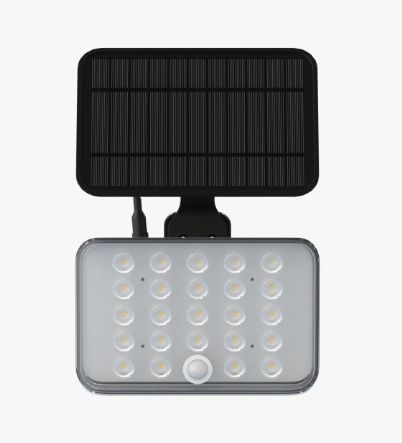
Solar-powered outdoor security lighting is one of the fixture families covered in this technical FAQ, alongside high bay, panel and floodlight products.
A commercial LED lighting project rarely fails because a buyer picked the wrong brand. It fails because a fixture was specified before the application was defined — an IP20 ceiling panel ordered for a wash-down workshop, a narrow linear high bay ordered for an open-span warehouse, or a 10W solar security light ordered to illuminate a loading yard.
This reference collects the technical and procurement questions that appear most often in the awareness and research stages of commercial LED lighting sourcing. It focuses on four fixture families — high bay, floodlight, panel and solar security — and on the parameters that actually change an order: wattage, colour temperature (CCT), luminous efficacy, beam angle, IP rating, dimming, sensors, mounting method and warranty.
Scale matters when setting that context. The global LED lighting market was valued at USD 109.11 billion in 2025 and is projected to reach USD 336.90 billion by 2034 (Fortune Business Insights). Within that, the global commercial lighting market was estimated at USD 47.54 billion in 2024, with LED products holding a 58.1% revenue share (Grand View Research). On the supply side, China exported USD 31.4 billion in light fixtures in 2024, equal to 59.3% of total global exports (OEC). Buyers comparing commercial LED lighting options are therefore choosing from a deep, competitive and technically uneven field — which is precisely why a parameter-level FAQ is useful.
Why the technical questions come before the commercial ones
At the awareness stage, buyers usually frame the question as a brand question: who makes a reliable commercial LED high bay? At the research stage, the same buyer is comparing datasheets. The transition happens when a project has enough constraints to make two otherwise similar fixtures non-interchangeable.
- Ceiling height and mounting method determine whether a round UFO high bay or a linear high bay is practical.
- Dust, humidity or cleaning routines determine whether IP65 or IP20 is required.
- Voltage stability and lightning exposure determine whether 2KV or 6KV surge protection is a reasonable expectation.
- Maintenance access determines whether a fixture with a one-piece connector and a defined warranty term is worth a price premium.
The questions below are ordered the way a specification normally develops: family, then environment, then distribution, then controls, then documentation.
The four families and the parameters that separate them
Zhejiang Lepeng Electric Appliance Co., Ltd. is a manufacturer specialising in LED lamps and LED luminaires, established in 2009, operating three production bases with a total factory area of 200,000 m² and approximately 2,000 staff, including a 200-person R&D team. Roughly 90% of its products are exported, with major markets in the EU, Southeast Asia, the Middle East and Latin America, and its own brand MKOPTO has gained recognition across global lighting markets. The product portfolio ranges from LED floodlights, high bays and linear high bays to street, garden, stadium, solar, bulkhead, tri-proof, work, ceiling, panel, batten, tube, bulb and mood lighting.
For a technical FAQ, however, only a narrow part of that portfolio is relevant. Four families cover most of the questions below.
| Family | Model | Typical installed environment | Key parameters to verify |
|---|---|---|---|
| UFO LED high bay | HL-E01 | Warehouses, factories, retail spaces, gyms | 100/150/200/240W; 140–210 lm/W; 4000K/5000K/6500K; 6KV/6KV surge protection; optional motion sensor |
| LED linear high bay | SH-E01 | Warehouses, factories, workshops, harsh industrial areas | 50/100/150/200W; 100–150 lm/W; 90°(H)×120°(V); 3000–6500K; IP65; 5-year warranty |
| LED panel light | PL02 | Commercial and residential indoor ceilings | 9/12/18/24W; 90 or 110 lm/W; 2700K–6000K 3-CCT; IP20; 50/75/100% dimming; remote + microwave sensor |
| Outdoor LED floodlight | FL-C01 Series | Residential, commercial and manufacturing exteriors | 10–300W; 100 or 120 lm/W; 3000K/4000K/6500K; surge protection up to 2KV; power factor >0.9 |
| Solar security light | 8200 | Outdoor security: yards, driveways, garages, pathways, walls | 10W; 1600LM; 6500K; IP44; PIR motion sensor; remote control with 1H/2H/4H timers |
Table 1: The fixture families referenced throughout this FAQ and the parameters most often queried during RFQ preparation.
HL-E01 or SH-E01: choosing between a UFO and a linear high bay
Both the HL-E01 and the SH-E01 are high bay fixtures for industrial and commercial interiors, and both appear in warehouses and factories. They are not interchangeable, because the decision is driven by distribution shape and environmental exposure rather than by raw wattage alone.
What the HL-E01 brings to a project
The HL-E01 is a UFO LED high bay with a die-cast aluminium body, a hollow heat dissipation structure and a PC lens. It is offered at 100W, 150W, 200W and 240W, with efficiency ratings of 140, 160, 185 and 210 lm/W, at 4000K, 5000K or 6500K. Rated voltage is 185-265V or 100-265V. Two specification points matter during evaluation: surge protection of 6KV/6KV, and power supplies from Sosen and Moso. The fixture is pre-wired with 3x1.0mm² cable with 300mm exposed leads, and optional motion sensor compatibility is available with a three-second brightness transition.
What the SH-E01 brings to a project
The SH-E01 is an LED linear high bay built for warehouses, factories and workshops, including harsh industrial environments. It is available at 50W, 100W, 150W and 200W, with luminous efficacy of 100, 135 or 150 lm/W and a beam angle of 90° horizontally by 120° vertically. Colour temperature options are 3000K, 4000K, 5000K and 6500K. The aluminium alloy housing with PC/PMMA lens carries an IP65 rating and a 5-year warranty. Three body lengths — 305.6×97.3×68.1mm, 580.6×97.3×68.1mm and 855.6×97.3×68.1mm — allow the fixture to follow a linear layout, and installation can be by mounting kit surface fixing or chain/cable suspension, using a one-piece connector.
The decision rule
Use distribution shape as the first filter. A 90°(H)×120°(V) linear optic is designed to spread light across a rectangular footprint and along the length of the fixture, which suits row-based layouts where fixtures follow racking or production lines. A round UFO body concentrates output around a single mounting point, which suits open floor areas where the layout is defined by ceiling structure rather than by aisles.
The second filter is environment. Where dust, humidity or wash-down is present, the IP65 rating and the 5-year warranty of the SH-E01 are the relevant specifications. Where electrical disturbances or motor loads are a concern, the 6KV/6KV surge protection of the HL-E01 is the more relevant check. Where maximum efficacy per watt is the priority, the HL-E01 range extends to 210 lm/W.
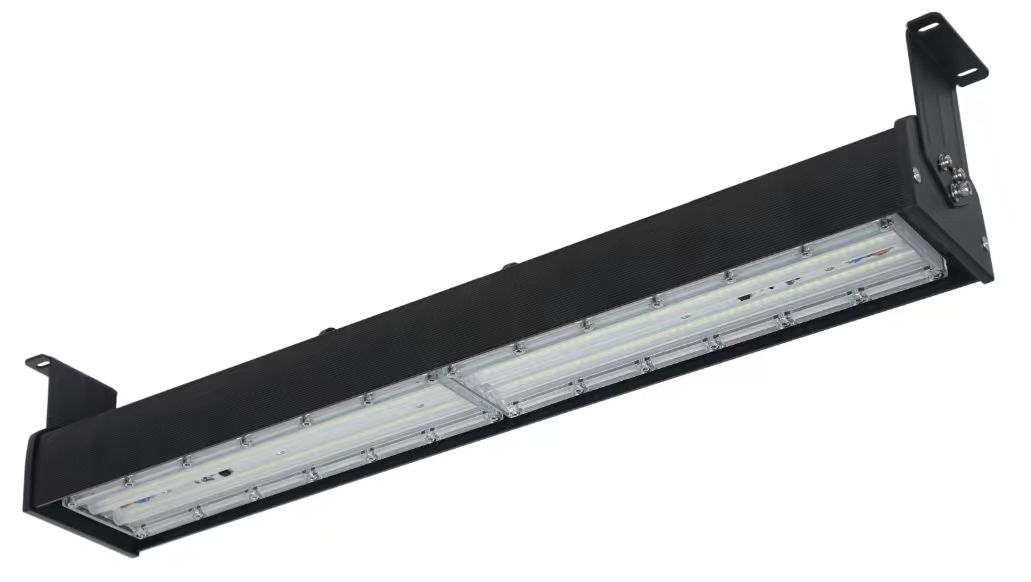
The SH-E01 linear high bay combines an IP65 rating, a 5-year warranty and a 90°(H)×120°(V) distribution — specifications relevant to dusty or wash-down industrial interiors.
Indoor commercial: when IP65 beats IP20, and when it does not
The IP rating is often treated as a quality score. It is not. It describes protection against solid objects and water ingress, and the correct rating is the one that matches the environment.
IP20 offers no water protection and limited protection against solids. The PL02 LED panel light is rated IP20 and is intended for commercial and residential indoor ceilings, which makes it appropriate for dry office, retail, hospitality and corridor ceilings. Within that boundary it is a flexible fixture: 9W, 12W, 18W or 24W; luminous efficacy of 90 or 110 lm/W; 2700K to 6000K in 3-CCT selectable form; three-level dimming at 50%, 75% and 100%; sizes of 5, 8 and 12 inches in round or square shapes; and a remote control combined with a microwave sensor for automatic ON/OFF. Installation can be surface-mounted or recessed, with cut-outs from φ75–125mm to φ75–250mm in 25mm increments.
IP65, by contrast, is dust-tight and protected against water jets. The SH-E01 linear high bay is rated IP65 and is specified for warehouses, factories and workshops, including harsh industrial environments. It belongs in ceilings where dust accumulates, where humidity or condensation is present, or where cleaning involves water.
The practical rule is straightforward: if water or dust can reach the fixture, IP20 is the wrong specification regardless of how good the light output looks on paper. If the ceiling is dry, air-conditioned and cleaned with dry methods, an IP65 industrial fixture is usually an unnecessary cost and is often the wrong form factor for a commercial ceiling.
Outdoor specification checks: FL-C01 floodlights and the 8200 solar security light
FL-C01 Series outdoor LED floodlight
The FL-C01 Series is an outdoor LED floodlight designed for residential, commercial and manufacturing applications, and it is specified for locations including homes, schools, offices, factories, hotels, restaurants, shops and bars. Its power range runs from 10W to 300W, with dimensions scaling from 105×97×27mm at the low end to 500×457×49mm at the high end — a reminder that wattage selection has a physical consequence for mounting position and bracket loading. Rated voltage is 100-240V or 220-240V. Luminous efficacy is 100 or 120 lm/W, colour temperatures are 3000K, 4000K and 6500K, surge protection is available up to 2KV, and power factor is above 0.9. The housing is aluminium with glass, and the fixture uses a strong bended bracket for installation.
Two checks are frequently missed. First, efficacy differences matter more than wattage in a floodlight layout: two fixtures of the same rated power can differ meaningfully in delivered lumens, which changes how many units the layout requires. Second, surge protection is a site-specific requirement. A 2KV rating is appropriate for many commercial exteriors, but sites with high lightning exposure or long cable runs should treat surge protection as a design decision rather than a checkbox.
Solar security light 8200
The 8200 model is a solar security light with a PIR motion sensor, designed for residential and commercial outdoor security. It is rated 10W with a luminous flux of 1600LM at 6500K cool white, with overall dimensions of 198 × 130 × 193.1mm and IP44 protection. The housing is ABS plastic, the solar panel is monocrystalline silicon with high transmittance, and the lens is PC. Control is by remote control plus auto mode, with 1H, 2H and 4H timer options.
The design detail that most affects installation is that the solar panel and the light head can be mounted separately, with an extension cable included. This allows the panel to be positioned for sunlight while the light head is positioned for coverage — a distinction that matters on shaded walls, under overhangs or in courtyards.
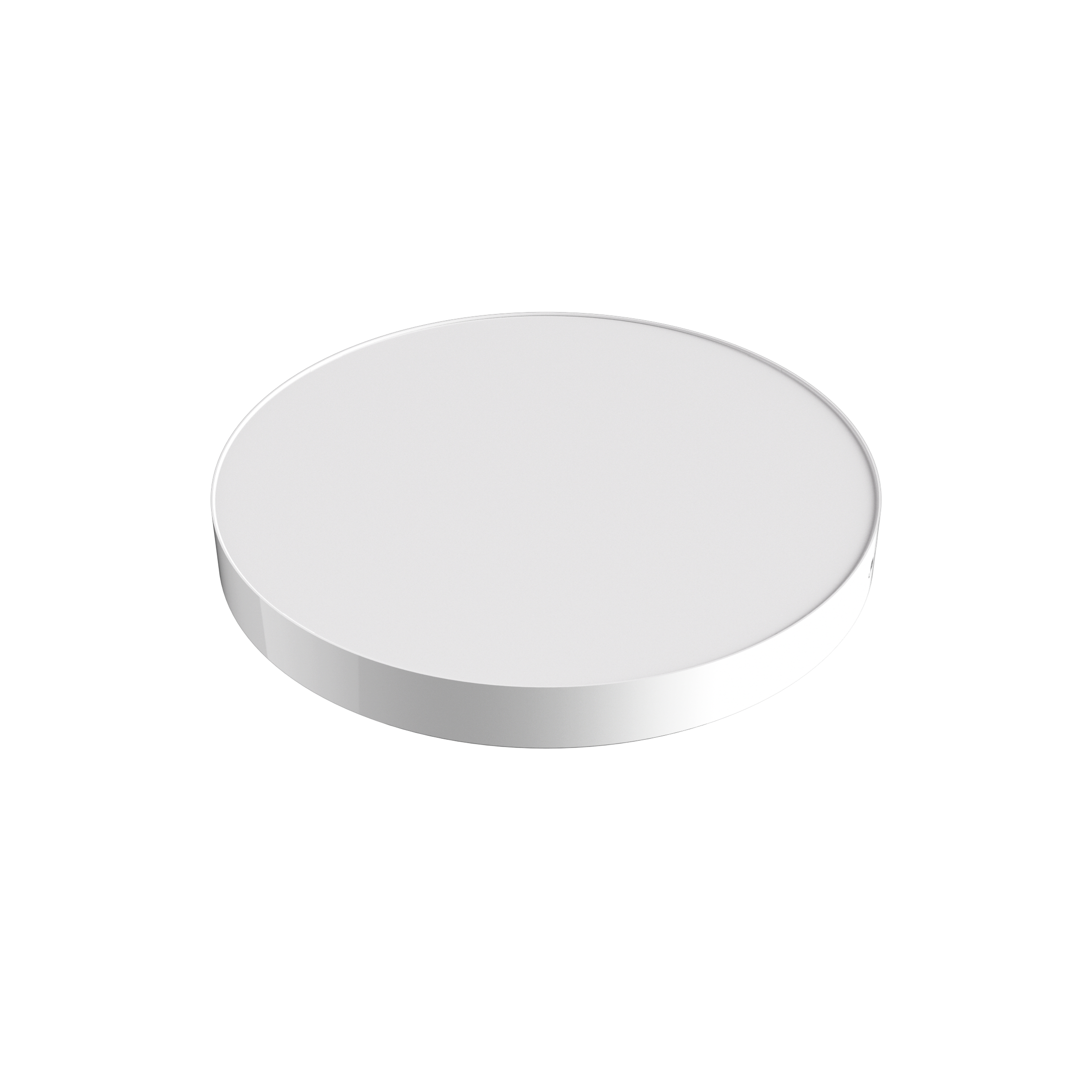
The PL02 panel light is an IP20 indoor fixture: 3-CCT selectable, 50/75/100% dimming, with a microwave sensor — appropriate for dry commercial ceilings, not for dusty or wet production areas.
The parameters that should be fixed before an RFQ is issued
Most quotation errors trace back to an RFQ that left a parameter open. The table below lists the variables that materially change price, lead time or suitability.
| Variable | Why it changes the order | Example from these families |
|---|---|---|
| Rated power | Drives driver selection, body size and mounting load | HL-E01: 100/150/200/240W; FL-C01: 10–300W |
| Luminous efficacy | Determines fixture count for a target illuminance | HL-E01 up to 210 lm/W; SH-E01 up to 150 lm/W |
| Colour temperature | Affects perceived comfort and task suitability | SH-E01 covers 3000–6500K; the 8200 is fixed at 6500K |
| Beam angle | Determines coverage pattern and uniformity | SH-E01: 90°(H)×120°(V) |
| IP rating | Determines whether the fixture can be installed at all | SH-E01 IP65; PL02 IP20; 8200 IP44 |
| Dimming and sensors | Changes control wiring, driver and cost | PL02: 50/75/100% + microwave sensor; HL-E01: optional motion sensor |
| Mounting method | Changes accessories and installation labour | SH-E01 surface kit or chain/cable suspension; PL02 surface or recessed |
| Surge protection | Site-specific; affects warranty exposure | HL-E01 6KV/6KV; FL-C01 up to 2KV |
| Warranty | Signals driver and thermal confidence | SH-E01: 5 years |
| Compliance documentation | Required for customs and market access | Common luminaire standards include IEC 60598, UL 1598 and UL 8750 (UL Solutions) |
Table 2: RFQ variables and the fixture families they most often affect.
Application mapping: which family fits which site
- Warehouse or factory with high ceilings and an open layout: a UFO high bay such as the HL-E01, where a round fixture can be distributed on a regular grid and high efficacy per fixture reduces unit count.
- Workshop or production area with dust, humidity or cleaning routines: the IP65 SH-E01 linear high bay, where the sealed housing and 5-year warranty address the environmental risk.
- Warehouse laid out in rows, following racking or conveyors: a linear high bay, using one of the three SH-E01 body lengths and the 90°(H)×120°(V) distribution along the row.
- Offices, retail, hospitality and corridors with dry ceilings: the IP20 PL02 panel light, using 3-CCT selection and 50/75/100% dimming to cover several spaces from one model.
- Building exteriors, yards, car parks and signage: the FL-C01 Series, sized by checking required wattage against fixture dimensions and mounting position.
- Perimeter security where mains wiring is impractical: the 8200 solar security light, with the panel and light head mounted separately to optimise sun exposure and coverage.
Market trend analysis: why parameter discipline is becoming more important
Three published trends support the shift toward specification-led buying.
First, the category is still expanding quickly, which keeps new suppliers entering the market and keeps pressure on buyers to separate real capability from catalogue claims. The global LED flood light market alone was valued at USD 9.4 billion in 2025 and is expected to grow at a CAGR of 8.52% to reach USD 20.1 billion by 2034 (IMARC Group).
Second, solar-powered outdoor lighting is growing faster than the LED category as a whole. The global solar street lighting market is projected to reach USD 22.5 billion by 2030, a CAGR of 15.8% from 2024 (Vantage Market Research). Faster growth usually means faster product turnover, which raises the value of documenting panel type, sensor behaviour and control modes at the point of specification — exactly the parameters that distinguish a defined solar security product such as the 8200 from generic alternatives.
Third, compliance expectations are converging on recognised standards. Core safety and performance standards for LED luminaires include IEC 60598, UL 1598 and UL 8750 (UL Solutions). As market-access requirements tighten, buyers increasingly treat standards coverage as a qualification filter rather than a post-order detail.
Commercial LED fixtures compared with traditional lighting, including the limits
Against traditional HID, metal halide and fluorescent installations, LED luminaires in this category offer familiar structural advantages: no warm-up period, dimmable output on supported models, motion and microwave sensing that reduces run time, and efficacy that allows fewer fixtures for the same task. For renovation projects, the fact that a model such as the SH-E01 accepts either surface mounting or chain/cable suspension makes it easier to reuse existing ceiling structures.
The honest trade-offs are as follows.
- Electronics define service life. An LED fixture is only as durable as its driver and thermal design. This is why driver sourcing (Sosen and Moso power supplies on the HL-E01) and body construction (die-cast aluminium with a hollow heat dissipation structure) are legitimate evaluation points rather than marketing detail.
- Surge tolerance varies within a single portfolio. Surge protection differs across families — up to 2KV on the FL-C01 Series versus 6KV/6KV on the HL-E01. Buyers cannot assume one rating across an entire project.
- IP rating does not cover everything. IP65 addresses dust and water jets, not corrosion class, impact resistance or UV ageing. Coastal and chemically exposed sites need a separate assessment.
- Solar models are constrained by their energy source. A 10W, 1600LM security light with an IP44 rating is a targeted security solution, not a substitute for a mains-powered floodlight, and its performance depends on site sunlight availability.
- Higher ratings cost more. Specifying IP65 fixtures for dry interiors, or 300W floodlights for an area that needs 100W, increases both unit cost and installation cost without improving outcomes.
Future outlook
Three directions look likely over the next planning cycle. Efficacy will remain the primary comparison metric at the high end, where models already reach 210 lm/W and where the gap between entry-level and high-efficiency fixtures directly changes fixture counts. Controls will continue moving from optional to expected, following the pattern already visible in products that combine adjustable CCT, stepped dimming and occupancy sensing in a single unit. And off-grid solar will keep expanding in outdoor security and perimeter applications, which puts more weight on specification details — panel type, sensor logic, timer options and mounting flexibility — rather than on nominal wattage alone.
For buyers, the practical implication is that RFQs will continue to reward precision. A specification that fixes wattage, efficacy, CCT, IP rating, controls, mounting and documentation will consistently produce comparable quotes; one that leaves them open will not.
Frequently asked technical questions
1. What is the difference between a UFO high bay and a linear high bay?
Both are high bay families intended for high-ceiling industrial and commercial interiors, but they differ in body geometry and light distribution. The HL-E01 is a UFO LED high bay with a round die-cast aluminium body and a PC lens, designed for industrial and commercial use in warehouses, factories, retail spaces and gyms. The SH-E01 is a linear high bay with an elongated aluminium alloy body in three lengths, designed for warehouses, factories and workshops, and specified for harsh industrial environments. The linear model carries a 90°(H)×120°(V) beam angle, an IP65 rating and a 5-year warranty; the UFO model offers higher efficacy options, up to 210 lm/W, together with 6KV/6KV surge protection.
2. How do I choose between the HL-E01 and SH-E01 for a warehouse or factory?
Compare four things. Output and efficiency: the HL-E01 ranges from 100W to 240W at 140–210 lm/W, while the SH-E01 ranges from 50W to 200W at 100–150 lm/W. Distribution shape: the SH-E01 spreads light at 90° horizontally and 120° vertically across a linear body, which suits row-based layouts, while the HL-E01 uses a compact round body suited to grid layouts in open areas. Environment: the SH-E01 is IP65 rated with a 5-year warranty, which suits dusty or wash-down interiors. Electrical conditions: the HL-E01 provides 6KV/6KV surge protection. The SH-E01 supports mounting-kit surface installation or chain/cable suspension with a one-piece connector, while the HL-E01 is pre-wired with 3x1.0mm² cable with 300mm exposed leads, so the junction arrangement should be planned in both cases.
3. When should I specify an IP65 linear high bay instead of an IP20 panel light?
When water or dust can reach the fixture. The SH-E01 linear high bay is IP65 rated, meaning dust-tight and protected against water jets, and is specified for warehouses, factories and workshops including harsh industrial environments. The PL02 panel light is IP20 rated, offering no water protection, and is intended for commercial and residential indoor ceilings. Use the panel light where the ceiling is dry and the priorities are appearance, 3-CCT selectability from 2700K to 6000K, and three-level dimming at 50%, 75% and 100%. Use the IP65 linear high bay where cleanliness, humidity or condensation makes an open indoor fixture unsuitable.
4. What should I verify before ordering FL-C01 floodlights for an outdoor project?
Verify six parameters against the site. Wattage within the 10–300W range, checked against fixture dimensions, which scale from 105×97×27mm to 500×457×49mm and therefore affect bracket loading and mounting position. Luminous efficacy, at 100 or 120 lm/W, which determines how many fixtures the layout needs. Colour temperature from 3000K, 4000K or 6500K. Voltage, at 100-240V or 220-240V. Surge protection, available up to 2KV, assessed against local lightning exposure. Power factor, specified above 0.9. Also confirm that the mounting surface suits the strong bended bracket used on this series.
5. What should I check before specifying the 8200 solar security light?
Confirm that the task is detection-based security lighting rather than continuous area illumination. The 8200 is rated 10W with a luminous flux of 1600LM at 6500K, with IP44 protection, a PIR motion sensor, and remote control plus auto mode with 1H, 2H and 4H timers. Because the monocrystalline silicon panel and the light head can be mounted separately with an included extension cable, panel orientation and cable routing should be planned at specification stage. Assess realistic daily sunlight at the site, and note that IP44 indicates weather resistance, not immersion protection.
6. Which colour temperature should I specify for commercial LED lighting?
Match CCT to the space and let the product range handle the rest. The HL-E01 offers 4000K, 5000K and 6500K; the SH-E01 offers 3000K, 4000K, 5000K and 6500K; the FL-C01 Series offers 3000K, 4000K and 6500K; and the PL02 panel light covers 2700K to 6000K as a 3-CCT selectable fixture, so one model can be configured on site for different areas. The 8200 solar security light is fixed at 6500K cool white, so CCT flexibility is not available on that model.
7. What does a beam angle of 90°(H)×120°(V) mean in practice?
It describes how the SH-E01 linear high bay distributes light relative to the fixture body: a 120° spread in the vertical plane and a 90° spread in the horizontal plane relative to the mounting orientation. In a warehouse or workshop this produces broader coverage across the length of the fixture and a narrower spread perpendicular to it, which suits layouts arranged in rows — racking lines, conveyor lines or production bays. It is not a narrow-beam optic, so applications requiring tightly concentrated vertical distribution need a different optical solution.
8. Which dimming and sensor options are available across these families?
Availability differs by model. The PL02 panel light includes three-level dimming at 50%, 75% and 100%, plus a remote control and a microwave sensor for automatic ON/OFF. The HL-E01 high bay supports optional motion sensor compatibility with a three-second brightness transition. The 8200 solar security light uses a PIR motion sensor with remote control, auto mode and 1H/2H/4H timers. Dimming and sensor options are not listed for the SH-E01 linear high bay or the FL-C01 Series in the available specifications, so projects that require dimming on those families should confirm it during the RFQ stage.
9. How should mounting method influence product selection?
Mounting determines both accessories and installation labour. The SH-E01 can be installed with a mounting kit for surface fixing or suspended with chain or cable, and uses a one-piece connector. The PL02 can be surface-mounted or recessed, in round or square form, with cut-outs from φ75–125mm to φ75–250mm in 25mm increments, so cut-out dimensions must be confirmed against the ceiling before ordering. The HL-E01 is supplied pre-wired with 3x1.0mm² cable with 300mm exposed leads, so the junction arrangement should be planned. The FL-C01 Series uses a strong bended bracket, and the 8200 allows the solar panel and light head to be mounted separately.
10. What should a commercial LED lighting RFQ include to produce comparable quotes?
At minimum: model and family, rated power, luminous efficacy, colour temperature, beam angle where specified, IP rating, dimming and sensor requirements, mounting method and accessories, surge protection expectations, warranty term, quantity, destination market and required compliance documentation. Warranty terms differ within a portfolio — the SH-E01 carries a 5-year warranty, for example. Where the destination market requires recognised luminaire standards such as IEC 60598, UL 1598 or UL 8750, the applicable certification status for the specific model should be confirmed in writing at quotation stage rather than assumed from a general product range.