
Color Coated Steel Coil Buyer's Check: Evidence vs. Claims
Color Coated Steel Coil Buyer's Check: Evidence vs. Claims
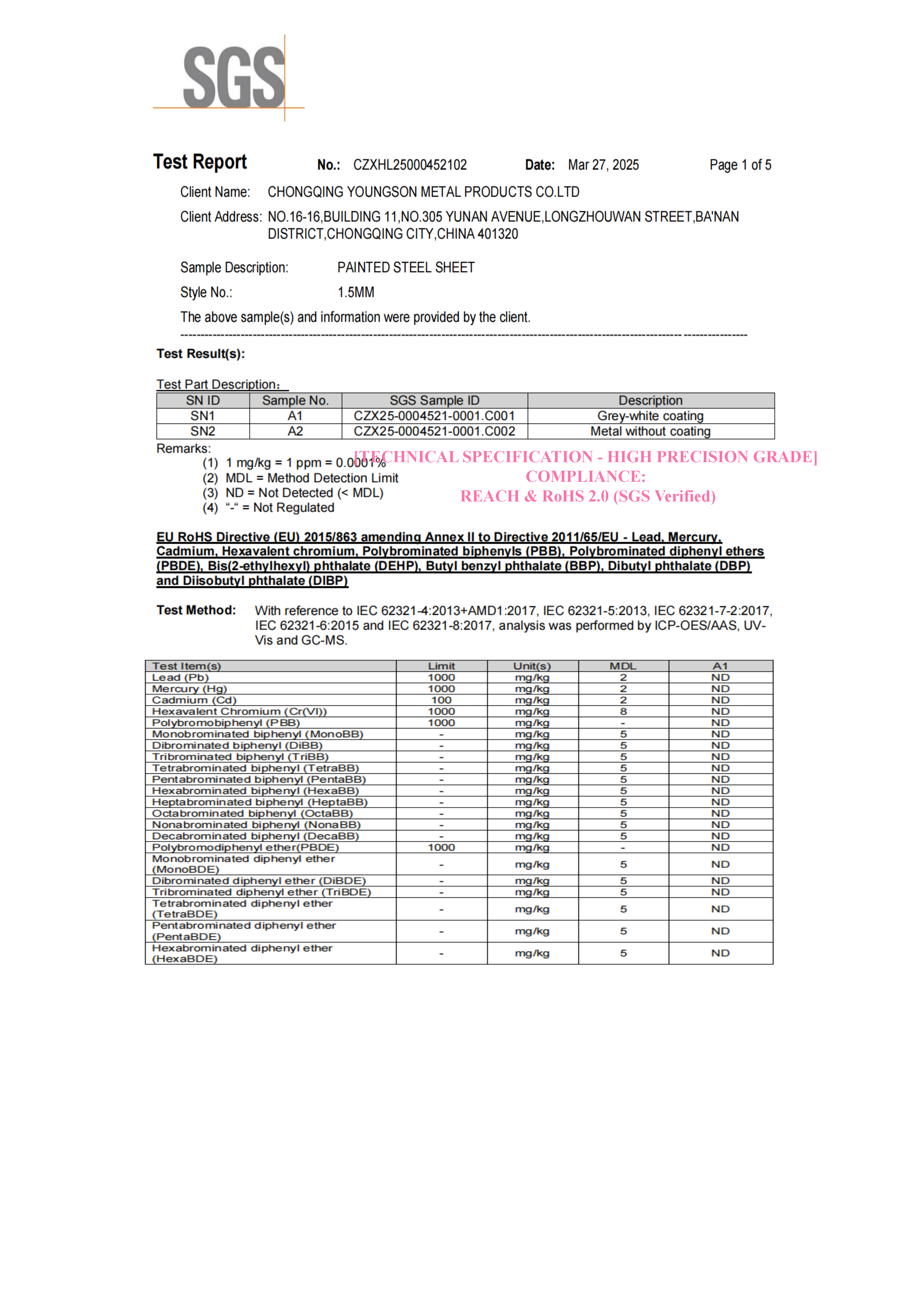
Chemical compliance documentation attached to a coated coil lot is one of the first evidence layers an independent buyer's check should examine.
Color coated steel coil and sheet is a mature industrial category, and that maturity is exactly where procurement risk hides. Polaris Market Research valued the global pre-painted steel market at USD 24.63 billion in 2023 and projects a 5.8% CAGR through 2032, while MySteel records that China alone exported approximately 6.5 million tons of color-coated steel sheet in 2023. At that scale, most coils look identical in a photograph, and most datasheets reuse the same vocabulary.
The practical consequence for buyers is a widening gap between what a supplier claims and what an independent test can demonstrate. Anti-peeling, non-stick release, fire classification, food-contact safety and heavy-metal compliance are all verifiable properties — but only when the buyer specifies the right test and asks for the right document before the order is confirmed.
This article sets out how that check works in practice, using three functional coating systems from Chongqing Youngson Metal Products Co., Ltd. (YOUNGSON METAL) as worked examples: a matte black SECC heating grade, a PFAS-free non-stick system on electrolytic chromium coated steel (ECCS), and an A2-rated PVDF cladding coil for refinery pipe insulation. It is written for buyers in the evaluation-to-execution phase who already know roughly what they need and now have to prove that what they receive matches what they were promised.
The Verification Gap: Why Coating Claims and Coating Evidence Drift Apart
A color coated steel coil is a composite product, not a single material. It consists of a metal substrate — cold rolled steel, electro-galvanized steel, hot-dip galvanized steel, zinc-aluminium-magnesium (ZAM) steel, galvalume, tinplate, ECCS/TFS or stainless steel — plus a chemical pretreatment, a primer, and a topcoat that may be liquid paint, powder coating or a laminated film. Each layer is specified separately, and each layer fails differently under service conditions.
That is why the same phrase, "high-performance coating," can legitimately describe products with very different behaviour in the field. The gap that hurts buyers is rarely outright misrepresentation. It is a documentation gap with three common causes:
- A supplier genuinely holds a certificate but issues only a summary sheet, and the summary omits the thickness range or film weight that the buyer actually ordered.
- A producer runs cross-cut adhesion, cupping and T-bend tests internally but does not release the reports with the coil.
- A coating is declared fire-rated, but the classification report in hand covers a different substrate or film thickness than the one being shipped.
Each of these situations produces a claim that is technically true and commercially useless at the same time. For a buyer, that is the definition of procurement risk: a decision has to be made, but the evidence attached to the decision does not actually test the thing that will fail.
The practical way out is to treat documentation as a ladder rather than a single document. Each rung proves something different.
| Evidence layer | What it actually proves | Where it falls short |
|---|---|---|
| Mill Test Certificate to EN 10204 3.1 | Batch-specific chemistry, thickness, coating mass and mechanical values for the coil being shipped | Covers base material properties, not coating adhesion after forming or thermal load |
| In-house quality records | Process consistency: thickness, coating mass, tensile strength, T-bend, salt spray, surface roughness | Only as reliable as the sampling plan and instrument calibration behind it |
| Third-party laboratory report (SGS, BV, TÜV) | Independent chemical and regulatory verification | Usually scope-limited — for example to a stated thickness window or finish type |
| Application-specific testing | Behaviour under the buyer's real process: cross-cut adhesion, Erichsen cupping, thermal cycling, immersion | Must be defined by the buyer; a generic report rarely matches the actual use case |
| Full classification report (fire, food contact) | Regulatory admissibility for the intended market | Summaries are frequently rejected; the complete classification document is required |
Four Questions Behind Every Coating Claim
An independent buyer's check does not require a laboratory. It requires four questions asked in the right order, before purchase order release rather than after goods receipt.
- Which layer is being claimed? Anti-peeling is a pretreatment-and-primer property. Non-stick release is a topcoat property. Corrosion resistance is a substrate property. Fire classification is a system property that depends on film and substrate together. A claim that does not name its layer cannot be tested.
- Which standard governs it? Coated steel falls under EN 10169 or ASTM A755 for prepainted material; fire performance under EN 13501-1, ASTM E84 or BS 476 Part 6/7; food contact under FDA 21 CFR 175.300 or EU No 10/2011; hazardous substances under RoHS Directive 2011/65/EU and REACH. The standard determines the test, and the test determines the document.
- Does the document name your product? A compliance certificate with a scope line such as "color coated steel strip, sheet and coil, 0.14–2.0 mm thickness" is evidence for a 0.5 mm coil. A certificate with no scope line is evidence for nothing in particular.
- Where does the claim stop? Every coating has a boundary — a maximum forming strain, a thermal cycling ceiling, a thickness window, a substrate restriction. Buyers who ask for the boundary before placing the order rarely discover it in production.
Youngson Metal's Verification Stack: What Is Documented, and by Whom
Chongqing Youngson Metal Products Co., Ltd. (YOUNGSON METAL) is a manufacturer founded in 2016 and based in Chongqing, China, specialising in precision metal surface processing and premium coil supply. The company operates a 3,000 m² facility with an annual processed capacity exceeding 10,000 tons, exports approximately 70% of its output, and holds BV ISO9001:2015 certification. Its five product lines span drawn PET film laminated coil, drawn VCM/PVC film laminated coil, deep drawn coil coating (including Teflon, non-stick, gold and lacquered finishes), commercial and deep drawn prepainted steel and stainless steel, and a full range of mild carbon and multi-grade stainless steel.
Because its focus sits on eco-friendly, food-grade and chemical-grade quality, the verification stack is documented as multi-stage rather than single-point:
- SGS-certified RoHS 2.0 and REACH heavy-metal analysis
- Erichsen cupping and cross-cut adhesion tests to assess stamping and forming performance
- Standardised 0T/1T T-bend flexibility verification
- 100% in-house inspection covering thickness, coating mass, tensile strength, T-bend, salt spray and surface roughness
- Mill Test Certificates to EN 10204 3.1, providing full batch traceability
- Third-party inspection coordinated with SGS, BV or TÜV on request
- Certified EPD and CFP documentation under ISO 14067 for carbon-footprint reporting
The chemical compliance document is worth reading closely, because it illustrates the difference between a claim and evidence. SGS certificate CZXHL25000452102, issued on 27 March 2025, covers color coated steel strip, sheet and coil in the 0.14–2.0 mm thickness range, tested under IEC 62321, Directive 2011/65/EU, Regulation (EU) 2015/863 and IEC 62321-8:2017 using ICP-OES/AAS, UV-Vis and GC-MS methods.
Technical Explanation: Three Coating Systems, Three Different Failure Modes
Anti-peeling, release and fire behaviour cannot be assessed by the same test, because they fail for different reasons. Treating them as one property is one of the most common errors in coated steel specification.
1. Anti-peeling under thermal cycling: matte black SECC heating grade (TC-70SECC-MB-HE)
For high-efficiency heating plates, electric skillet heating elements, rice cooker thermal discs and commercial hot plates, the dominant failure mode is not corrosion. It is coating delamination caused by repeated hot-to-cold cycling, which attacks the bond between the coating and the substrate rather than the coating surface itself. Components in this category typically use deep-drawing quality electro-galvanized steel (SECC) as the base metal, so the coating must survive the forming press first and years of thermal stress second.
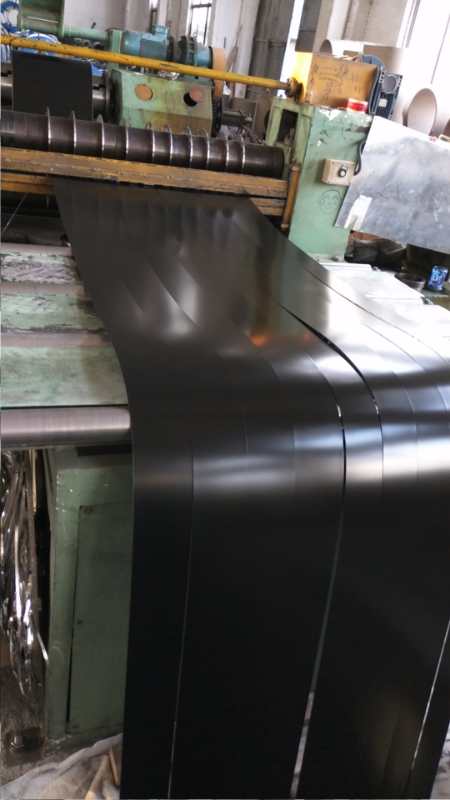
Matte black coated strip for heating-grade components, where adhesion under thermal cycling is the decisive property rather than surface appearance.
The documented performance record for this heating-grade system is specific enough to be tested against. In continuous high-temperature thermal cycling trials exceeding 5,000 hours, the coating recorded zero delamination and zero cracking. The same programme reported an 18% improvement in heat radiation efficiency and a 99.8% reduction in structural component failure rates, with a service design life exceeding 8 to 10 years under continuous thermal stress and fluctuating temperatures. Thickness control is held to a ±0.02 mm tolerance to support deep stamping without micro-cracking.
The mechanism behind the anti-peeling claim is a proprietary bonding technology applied between substrate and coating, combined with a high-emissivity matte finish that distributes heat more uniformly across the part. Uniform heat distribution reduces the thermal gradient across the coating, and a smaller gradient produces less interfacial stress per cycle. That is the physical reason the claim is plausible — and it is also the reason a buyer should ask for cycling data rather than a surface-adhesion result alone. Adhesion testing measures the bond at one moment; cycling data measures how the bond degrades over thousands of thermal events.
Deployment context: batches of 5,000 kg have been supplied to home appliance OEMs, premium heating element manufacturers, commercial kitchen equipment producers, and electric skillet and rice cooker tier-1 suppliers, as well as to industrial thermal management engineers.
2. PFAS-free non-stick on ECCS: the two-layer question (YS-ECCS-G2-PF)
Non-stick performance is the most commonly over-claimed property in coated steel, largely because "non-stick" describes a sensation rather than a measurable specification. Electrolytic chromium coated steel (ECCS) is the standard substrate for drawn non-stick components, because it combines corrosion resistance with the formability required for deep drawing. Youngson Metal's coated range includes deep drawn coil coating in Teflon, non-stick, gold and lacquered finishes, engineered for severe forming operations.
In a two-layer architecture of the kind used on functional coated lines, a defined top layer carries the release and wear function while a thinner backing layer provides adhesion and corrosion protection. On comparable dual-sided products in the same range, that architecture is specified as a 10–20 µm top coat over a 7–12 µm back coat. The layer structure matters to buyers because release performance is governed by the top layer, while coating failure in the press is usually governed by the backing layer.
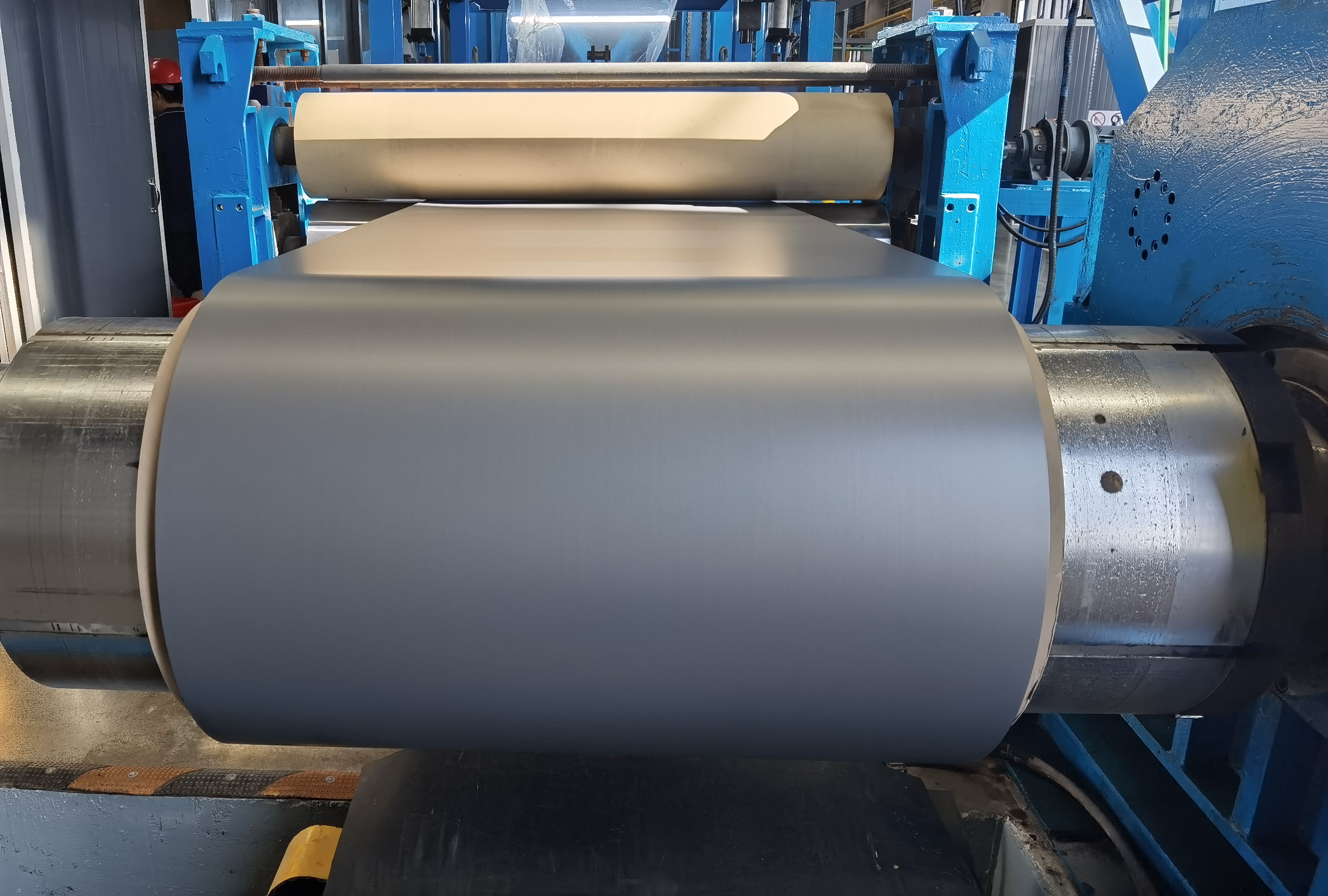
Non-stick ECCS coil: the top layer governs release, the backing layer governs survival through deep drawing.
PFAS-free formulation is the part of this claim that buyers should verify rather than accept, because regulatory pressure on per- and polyfluoroalkyl substances has turned "PFAS-free" into a marketing term as much as a technical description. The verification path is documentary. The company's RoHS 2.0 and REACH heavy-metal certificate covers the coated steel range, and its prepainted tinplate and ECCS series are declared 100% lead-free with REACH and RoHS certification and heavy-metal testing for global markets.
For food-contact applications, the governing standards are FDA 21 CFR 175.300 in the United States and EU No 10/2011 in Europe, which regulate resinous and polymeric coatings intended for repeated use in contact with food. In practice, buyers qualify such coatings through immersion protocols rather than single-point chemistry. Dilute acetic acid and citric acid solutions at defined concentrations and temperatures are among the most widely used acid-media checks, alongside ethanol and oil migration testing, because food contact is rarely limited to a single chemistry.
The concentration, temperature and exposure duration should be written into the purchase specification by the buyer. A supplier's internal acid-resistance standard may be less severe than the intended end use, and a coating that passes a mild immersion test can still show gloss loss or adhesion softening under a more aggressive one. Requesting the actual immersion conditions alongside the result is what turns a test line into usable evidence.
3. Fire-rated PVDF cladding for refinery pipe insulation (PVDF-REF-A2-ZAM-0.5-0.7)
Where the risk is fire rather than heat transfer, substrate and coating must be evaluated as a system. PVDF (polyvinylidene fluoride) coatings are the recognised benchmark for UV and chemical resistance in coil coating, typically maintaining 70% of colour integrity for more than 20 years according to AkzoNobel Coil Coatings. That durability profile is why PVDF appears on cladding that is expected to remain in place for the life of a process plant.
The PVDF-REF-A2-ZAM-0.5-0.7 coil is specified for industrial thermal insulation cladding and petrochemical-grade metal jacketing:
- Substrate: galvanized steel (Z180) or zinc-aluminium-magnesium (ZAM) coated steel
- Coating system: premium PVDF, 20–35 µm topcoat over a 5–15 µm backer
- Dimensions: 0.50 mm and 0.70 mm thickness, 1000 mm width
- Fire rating: certified to EN 13501-1 (A2-s1,d0,t1) and ASTM E84 Class A
- Customisation: a small-diameter coil option with a 200 mm inner diameter, engineered for site efficiency in refinery pipe insulation
Two details deserve the buyer's attention. First, A2-s1,d0 is a complete European classification: smoke production (s1) and flaming droplet behaviour (d0) are part of the rating, not optional extras, so a supplier quoting only "Class A" is not providing equivalent information. Second, Z275 galvanizing — 275 g/m² of zinc — remains the reference specification for high-corrosion environments under ASTM A653 and EN 10346. The substrate grade, not just the paint colour, has to be confirmed before cladding is ordered.
Claim vs. Test: A Buyer's Verification Matrix
The table below converts common coating claims into the tests that challenge them, the documents that substantiate them, and the boundary at which each claim stops being valid. It is intended to be used at purchase-order stage, not after delivery.
| Manufacturer claim | Test that challenges it | Evidence to request | Boundary of the claim |
|---|---|---|---|
| Anti-peeling in service | Cross-cut adhesion, Erichsen cupping, thermal cycling | Adhesion and cupping reports plus MTC to EN 10204 3.1 | Defined by cycling hours and peak temperature, not by the phrase "high temperature" |
| Non-stick release | Repeated release cycles, abrasion testing | Coating mass, layer thickness, formulation statement | Release life depends on food chemistry, temperature and cleaning regime |
| PFAS-free / food-safe | Migration and extraction testing | REACH/RoHS certificate with product scope; FDA 21 CFR 175.300 or EU No 10/2011 documentation | Valid only for the certified thickness and coating weight |
| Fire classification | EN 13501-1 classification, ASTM E84 | Complete classification report, not a marketing summary | Specific to substrate type and film thickness |
| Corrosion resistance | Salt spray testing | Salt spray hours plus coating mass data | Indicative of relative performance, not a service-life guarantee |
| Dimensional precision | Micrometer survey across coil length | Tolerance statement such as ±0.02 mm, with sampling plan | Applies only inside the specified thickness window |
| Thermal stability | Continuous elevated-temperature exposure | Test hours and temperature, with blistering/peeling observations | Voids if service temperature exceeds the tested ceiling |
Application and Use Cases
The value of a verification framework is that it can be applied across several application families with the same logic but different tests. Four categories illustrate how the evidence requirement shifts with the failure mode.
Heating and thermal management components. High-efficiency heating plates, electric skillet heating elements, rice cooker thermal discs and commercial hot plates are specified around thermal cycling resistance and heat radiation efficiency rather than corrosion. Here the relevant documents are cross-cut adhesion and cupping results, thickness tolerance data, and thermal cycling records. Test specimens should be formed the same way the production part is formed, because adhesion failures frequently originate at a formed radius rather than on flat sheet.
Refinery, petrochemical and offshore insulation cladding. Oil and gas refineries, petrochemical plants, offshore platforms and LNG facilities use coated coil as metal jacketing over thermal insulation. Fire classification, UV and chemical resistance, and small-diameter coil handling for site work matter more than deep-drawing behaviour. Buyers in this category should confirm the classification report, the substrate zinc grade, and the coil inner diameter before awarding a project package.
Medical, laboratory and cleanroom environments. Antimicrobial matte white coated steel in the 0.50–0.80 mm range is used for clinical equipment casings and hospital cleanroom construction, with a dual-sided coating system of 10–20 µm top and 7–12 µm back layers. Antibacterial efficiency of ≥99% against E. coli and Staphylococcus aureus has been SGS certified, and chemical endurance has been laboratory-proven to withstand more than 5,000 continuous wipes with 75% ethanol, isopropyl alcohol, sodium hypochlorite and hydrogen peroxide without degradation. For these applications, disinfection protocol compatibility is the decisive test — not paint adhesion alone.
Fire-rated interior and infrastructure panels. Fire-retardant VCM laminated sheets in the 0.50–0.70 mm range, built on a ZAM substrate with engineered PVC film, carry a UL 94 V-0 film rating, EN 13501-1 Class B-s1,d0, ASTM E84 Class A, and BS 476 Part 6/7 Class 0 for fire propagation and flame spread, with corrosion resistance verified by more than 1,000 hours of salt spray testing. Interior architects and OEMs specifying fire doors, server enclosures and telecom cabinets should treat the classification set, not a single rating, as the acceptance criterion.
Sealing, gasket and self-lubricating components. Where the requirement is friction control rather than appearance, solid-film lubricant coatings behave differently again. Molybdenum disulfide coated strip in the 0.20–0.30 mm range is specified for long-term thermal stability at 150°C continuous for five hours with zero blistering or peeling, has passed an ASTM 3# standard calibration oil immersion test, and is optimised for 2000 W and higher precision laser cutting and stamping. It is positioned as a replacement for NBR-coated sheet, with reported material cost reduction of approximately 50% versus the NBR route.
Market Trend Analysis: Where Demand Is Moving
Three structural shifts are changing what buyers ask for, and all three push the market toward the evidence-first approach described above.
Functional demand is growing faster than commodity demand. The global pre-painted steel market was valued at USD 24.63 billion in 2023, with a projected 5.8% CAGR to 2032 according to Polaris Market Research — but that growth is not evenly distributed. It concentrates in segments where coatings do a job beyond appearance: hygiene, fire safety, thermal performance, chemical resistance and release. Some third-party estimates, including a Mordor Intelligence assessment, put growth in antibacterial coated steel at around 7.2% CAGR on the back of hygiene requirements in cold chain and medical facilities. That figure carries medium reliability and should be treated as a directional indication rather than a settled number.
Trade flows keep specialty supply global. China's export volume of approximately 6.5 million tons of color-coated steel sheet in 2023, per MySteel data, means buyers now compare a Chinese specialty producer against European, Japanese and Korean benchmarks on the same shortlist. In the high-end color coated sector, Fortune Business Insights lists ArcelorMittal, Nippon Steel, BlueScope Steel and Baosteel among the principal global competitors. For specialty buyers, the meaningful comparison is rarely tonnage — it is whether a supplier's documentation survives an audit of the specific coating being purchased.
Compliance is graduating from certificate to data set. RoHS and REACH have been baseline requirements for coated steel in electronics for years. What is newer is the demand for carbon and emissions documentation alongside chemical compliance, which is why EPD and CFP documentation prepared under ISO 14067 now appears in coated steel supply discussions rather than only in construction materials tenders.
Comparison with Traditional Solutions — and Where This Model Stops
The traditional commodity approach to color coated steel is straightforward: a single-coat polyester system on standard galvanized substrate, sold on price per ton, verified by a mill certificate and little else. That model works well when the part is decorative, forming is mild, and service conditions are benign. Its weakness is that it offers no structured answer when a coating fails, because the documentation trail is too thin to diagnose why.
Youngson Metal's model sits on the other side of that trade-off. It is built around functional coatings, multi-stage quality protocol, third-party testing coordination and carbon-footprint reporting. That produces stronger evidence for demanding applications — and it also produces real constraints that a buyer should weigh before shortlisting.
- Deliberately restricted scope. The company's precision coating and slitting line is focused on high-precision stamping and industrial engineering, and is explicitly not intended for standard construction or roofing use. Buyers sourcing ordinary building panels should look elsewhere; this supply model is not designed for that market.
- Order sizes are specialty-scale. General order quantities start around 2,000 kg or as per specification, and the coated coil programme works from approximately 2–3 tons depending on size. Buyers accustomed to bulk commodity tonnage will find this restrictive.
- Lead times are specification-dependent. Production lead times run from 5 to 30 days depending on size and finish, which is predictable for planned specialty programmes but less flexible than the immediate availability of a stocked commodity distributor.
- Capacity is moderate by integrated-mill standards. Monthly capacity is approximately 1,000 tons on the technical coating line and around 1,200 tons overall. Very large single-project volumes should be allocated in planned releases rather than assumed as a single drop.
- Documentation is bounded by its scope. A certificate covering 0.14–2.0 mm is evidence inside that window and no evidence outside it. The same discipline applies to fire classifications, which are specific to substrate and film thickness.
None of these limitations undermines the verification argument. They simply define the envelope in which it applies. A buyer who needs low-cost decorative coil at high volume and a buyer who needs a documented anti-peeling or PFAS-free system are solving different problems, and the right answer for one is the wrong answer for the other.
Future Outlook
Three developments are likely to shape coated steel procurement over the next several years.
First, verification will migrate earlier in the buying cycle. Pre-shipment testing is already an accepted acceptance method in this supply model, and Mill Test Certificates to EN 10204 3.1 are becoming a baseline expectation rather than a premium service. As more producers adopt EPD and CFP reporting under ISO 14067, buyers will increasingly select on the completeness of a documentation package rather than on coating vocabulary.
Second, substance regulation will continue to reshape coating chemistry. PFAS restrictions and heavy-metal limits have already pushed formulators toward alternative release and corrosion systems, and the practical effect is that buyers will need to verify formulation claims more often, not less. The compliance question is shifting from "is it a regulated substance?" to "which certificate, with which scope, covers this exact product?"
Third, application-specific performance data will become a competitive differentiator. Thermal cycling hours, release durability under repeated cleaning, antibacterial wipe endurance and full fire classification sets are all measurable, and suppliers who publish them in a form buyers can verify will be easier to award than suppliers who publish adjectives. For buyers, the strategic response is simple and durable: define the test before the order, and let the document decide.
FAQ
1. What documents should a buyer request before confirming a color coated steel coil order?
At minimum: a Mill Test Certificate to EN 10204 3.1 for the specific batch, third-party RoHS 2.0 and REACH certification with an explicit product scope, and in-house inspection records covering thickness, coating mass, tensile strength, T-bend, salt spray and surface roughness. Where the application involves fire, food contact or thermal cycling, the corresponding classification or cycling report should also be requested. Pre-shipment testing is available as an acceptance method, and third-party inspection can be coordinated with SGS, BV or TÜV.
2. How can anti-peeling performance be verified before mass production?
The standard route combines cross-cut adhesion and Erichsen cupping tests with 0T/1T T-bend flexibility verification on formed samples. Where the component sees repeated heating and cooling, thermal cycling data is the more relevant evidence, because adhesion tests measure the bond at a single moment rather than its degradation over thousands of cycles. In the matte black SECC heating grade, continuous high-temperature thermal cycling testing exceeded 5,000 hours with zero coating delamination or cracking.
3. Which thickness and substrate options are available, and how do these compare with commodity alternatives?
Customisation covers material grades including tinplate, prepainted steel, cold rolled steel, galvanized steel, galvalume, ZAM steel, stainless steel and aluminium, with thickness from 0.08 mm to 6.0 mm, zinc coating weights from 30 to 600 g/m², and slitting tolerance held to ±0.02 mm. The RoHS and REACH certification scope for coated strip, sheet and coil specifically covers 0.14–2.0 mm. Commodity alternatives typically offer a narrower substrate range and looser tolerance windows, but they are usually cheaper per ton and available in larger single deliveries.
4. What does Youngson Metal's RoHS and REACH certification actually cover?
SGS certificate CZXHL25000452102, issued on 27 March 2025, covers color coated steel strip, sheet and coil in the 0.14–2.0 mm thickness range. Testing references IEC 62321, Directive 2011/65/EU, Regulation (EU) 2015/863 and IEC 62321-8:2017, using ICP-OES/AAS, UV-Vis and GC-MS methods. The certificate applies to products inside that thickness window; a coil outside it is not covered by this document.
5. How is fire performance documented for PVDF-coated refinery pipe cladding?
The PVDF-REF-A2-ZAM-0.5-0.7 coil carries certification to EN 13501-1 at A2-s1,d0,t1 and to ASTM E84 Class A, on a galvanized (Z180) or ZAM substrate in 0.50 mm and 0.70 mm thickness with a 1000 mm width. A2-s1,d0,t1 is a complete European classification covering reaction to fire, smoke production and flaming droplets. Buyers should request the full classification report rather than a summary, because the rating is specific to the substrate and coating build tested.
6. How does a PFAS-free non-stick coating relate to food-contact regulation?
Food-contact coatings are regulated in the United States by FDA 21 CFR 175.300 and in Europe by EU No 10/2011, which cover resinous and polymeric coatings intended for repeated use in contact with food. Qualification typically involves immersion or migration testing, and acid-media checks using dilute acetic acid or citric acid solutions are among the common protocols, alongside ethanol and oil testing. The concentration, temperature and duration should be specified by the buyer, since a mild internal standard may be less severe than the intended end use. PFAS-free claims should be supported by formulation documentation and by a REACH/RoHS certificate whose scope names the coated product.
7. What sampling and pre-shipment validation steps are available?
Pre-shipment testing is an accepted acceptance method in this supply arrangement, and third-party inspection by SGS, BV or TÜV can be coordinated on request. Batch traceability is provided through Mill Test Certificates to EN 10204 3.1, and quality claims are handled with a response target of 24 hours. For new programmes, the most useful sequence is a formed sample assessed for adhesion and cupping, followed by a batch-level confirmation before shipment.
8. Are there limits to what this supply model can support?
Yes, and they are specific. The precision coating and slitting capability is designed for high-precision stamping and industrial engineering applications and is not intended for standard construction or roofing use. Order quantities generally start around 2,000 kg, with coated coil programmes running from roughly 2–3 tons depending on size. Lead times range from 5 to 30 days depending on specification, and monthly capacity is approximately 1,000–1,200 tons. Buyers requiring large-volume commodity tonnage at the lowest per-ton cost are better served by an integrated mill.
For full product and capability details, the company catalogue is available for public download: Chongqing Youngson Metal Products Co., Ltd. catalogue. Documented performance figures referenced in this article originate from the manufacturer's own test records and from SGS certification CZXHL25000452102; independent buyers should request the underlying reports for the specific thickness and finish under consideration.