
Cold Storage Panel Procurement FAQ: PU vs PIR, Thickness, Steel Props
Cold Storage Panel Procurement FAQ: PU vs PIR, Thickness, Steel Props
Answer-first summary: Most pre-purchase questions about cold storage panels resolve around five specifications — core material (PU or PIR), panel thickness (50 mm or 100 mm), effective cover width (960 mm or 1100 mm), outer steel skin (0.5 mm), and continuous operating temperature (−50 °C to +15 °C) — plus two system questions: which steel props support the assembly, and which refrigeration equipment makes the room cold.
Cold chain projects are usually specified twice. The first specification is a temperature requirement: a room must hold a set point through 24/7 operation. The second is a bill of materials: core material, panel thickness, module width, steel skin, and the structural supports that hold the envelope together. Procurement delays almost always accumulate in the second specification, because the answers depend on application, temperature band and documentation requirements rather than on a single universally correct configuration.
The market context is expanding rather than static. China's green building materials market reached USD 216.3 billion in 2025 and is projected to reach USD 484.9 billion by 2034 (IMARC Group). Published estimates for the same market differ widely depending on whether raw materials or integrated project revenue are counted, so the figure is best read directionally: insulated envelope materials are increasingly bought as engineered, documented systems instead of undifferentiated panels.
This reference addresses the questions that most often appear before a cold storage panel order is confirmed, with answers stated in specification terms and limits stated where they exist. A panel correct for a chilled room is not automatically correct for a blast freezer, and a prop suitable for a 3-metre assembly is not a substitute for a designed structural frame.
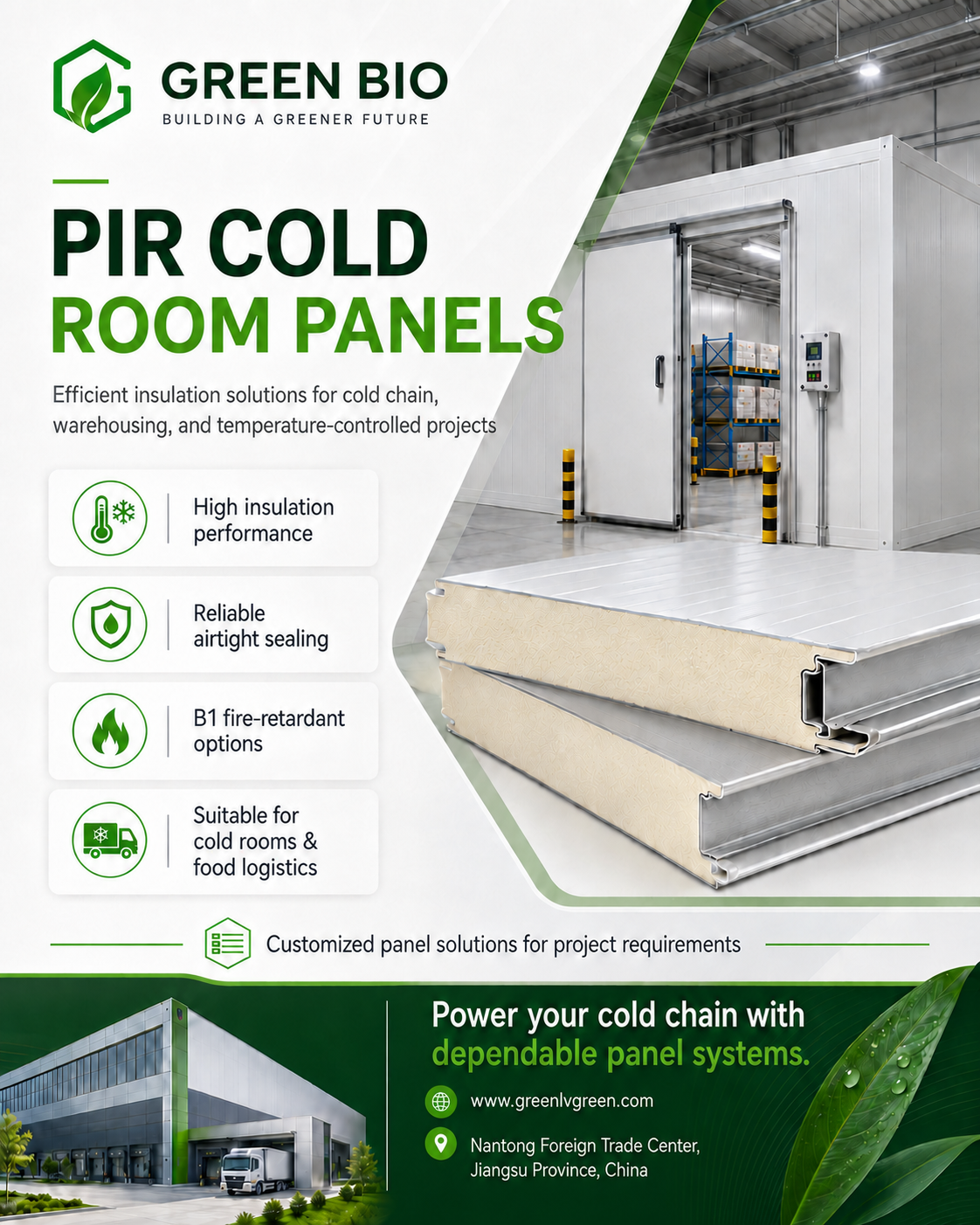
Cold storage panels are procured as an assembly: core, skin, joints, steel supports and refrigeration equipment.
The five specification decisions behind most cold storage panel questions
Across agriculture, chemical, logistics and warehousing, pharmaceutical, and food and beverage projects, the same five decisions determine whether a quotation converts into a workable order:
- Core material — polyurethane (PU) or polyisocyanurate (PIR) rigid foam.
- Panel thickness — 50 mm or 100 mm, selected against the temperature differential and duty cycle.
- Effective cover width — 960 mm or 1100 mm, which sets module count, joint count and cutting waste.
- Outer steel skin — 0.5 mm sheet, which governs impact resistance, cleanability and surface durability.
- Operating temperature — −50 °C to +15 °C for continuous 24/7 operation, which defines the project band the panel is engineered for.
Two further questions belong to the same procurement conversation but not to the panel itself: what holds the envelope in place (adjustable steel prop / telescopic steel prop in Q195/Q235 galvanized steel, with a maximum height range of 3 m to 5 m), and what produces the cold (a refrigeration unit and an air cooler). Treating the panel order and the support-and-refrigeration order as one package prevents the most common commissioning problem, where the envelope is delivered before the structural and refrigeration scope is fixed.
PU vs PIR: what the core material actually changes
PU and PIR are both rigid closed-cell foams used as the insulating core of a factory-bonded sandwich panel. The practical difference for procurement is not which one is better in the abstract, but which performance attribute the project specification prioritises — thermal efficiency and cost balance, or fire behaviour and the documentation that accompanies it.
| Decision criterion | PU (polyurethane) core | PIR (polyisocyanurate) core |
|---|---|---|
| Primary selection driver | Thermal efficiency and cost balance in chilled and frozen rooms | Fire performance requirements and the documentation that accompanies them |
| Thermal behaviour | High-density PU core with a thermal conductivity as low as 0.022 W/(m·K), as stated in supplier technical material | Insulating core engineered for projects where fire performance is the governing constraint |
| Fire behaviour | Requires a flame-retardant formulation to reach B1/B2 grade | Generally selected where stricter reaction-to-fire behaviour is specified |
| Typical application | Chilled storage, processing rooms and frozen rooms where energy performance dominates | Projects where fire inspection and third-party test documentation are a procurement gate |
| Documentation | Both core types can be supplied with B1/B2 grade flame-retardant cores and third-party fire test reports where the project requires them; the applicable grade and standard should be confirmed against the destination market's fire code. | |
One boundary is worth stating plainly. A fire-rated core is a material property, not a fire strategy. Panel joints, penetrations, doors and the surrounding structure all influence how a room behaves in a fire test and in a local inspection, and no core grade compensates for poor detailing on site. Where a project requires a specific reaction-to-fire class, that requirement should be named at enquiry stage so the correct formulation and the corresponding report can be attached to the shipment.
Thickness, effective width and steel skin: reading the specification line
50 mm or 100 mm
Thickness is primarily a heat-flow decision. 50 mm panels are typically specified for chilled and temperature-controlled rooms where the differential between room and ambient is moderate; 100 mm panels are typically specified for low-temperature and frozen applications, where a larger differential and continuous duty make additional insulating depth worthwhile.
The limitation here is that panel thickness alone does not determine energy consumption. Door discipline, defrost cycles, refrigeration sizing, product load and room loading all influence actual consumption, so thickness should be confirmed against a load calculation rather than adopted by comparison with a neighbouring project.
960 mm and 1100 mm effective width
Effective width is the covered width of a panel after the joint is engaged — the module an installer actually repeats across a wall or ceiling. 960 mm is widely used where the room's dimensions and door positions align with a modular grid, and 1100 mm reduces the number of joints per square metre, which shortens installation time on long walls and ceilings.
The trade-off is material yield. A width that does not divide cleanly into the room dimension generates offcuts, and for small rooms a narrower module can produce a better yield. Width also changes joint count, and joints are where cold-bridge risk concentrates: fewer wider modules mean fewer seals to verify, while more narrower modules give greater dimensional flexibility. Neither option is universally correct.
The 0.5 mm steel sheet outer layer
The 0.5 mm steel sheet is the panel's outer surface. It provides mechanical protection against impact from trolleys, pallets and racking; it supports cleanability and washdown in food and pharmaceutical environments; and it carries the coating system that the room is judged on at handover. Its function is protective and hygienic rather than structural — a sandwich panel is an envelope element and is not intended to carry building loads, which is why the structural question is answered separately by the support props described below.
−50 °C to +15 °C and 24/7 duty
The stated operating range covers the full practical band of cold chain and temperature-controlled processing: deep-freeze and blast applications at the cold end, chilled storage and processing rooms at the warm end. The qualification that matters in procurement is continuous operation. The panel is specified for 24/7 duty rather than intermittent use, which means joints, seals and vapour control detailing must be specified to the same standard as the core — assumptions borrowed from intermittent-duty rooms do not hold.
Q195/Q235 galvanized steel props: what they support and how high they go
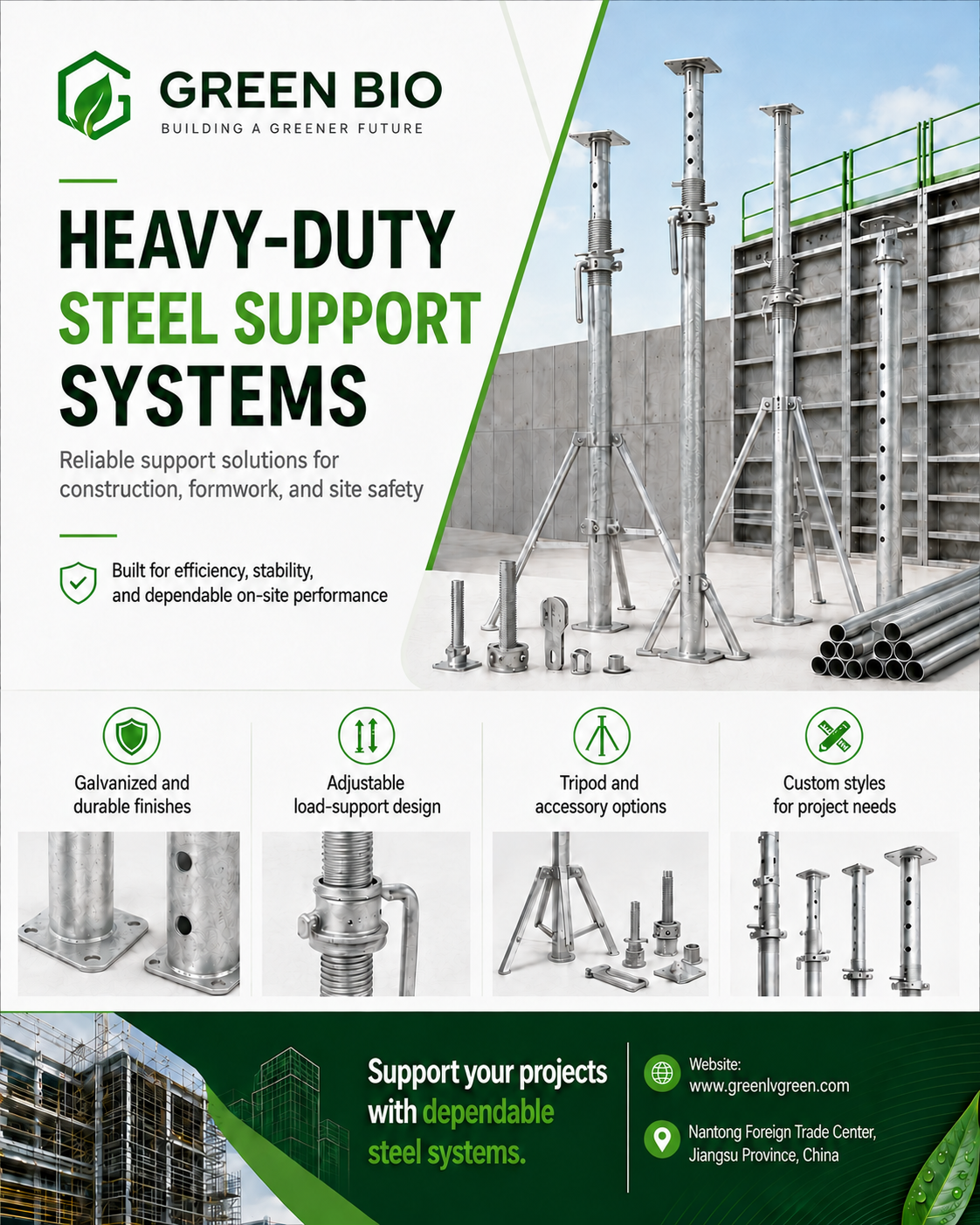
Adjustable steel props stabilise panel walls and ceiling assemblies within a rated height range of 3 m to 5 m.
An adjustable steel prop (also described as a telescopic steel prop) is a vertical support with an adjustment range, used in cold storage assemblies to stabilise and support panel walls and ceiling structures during installation and in service. The units used in these assemblies are manufactured from Q195/Q235 steel with a galvanized finish, and are available with a maximum height range from 3 m to 5 m.
Three procurement points follow from that specification:
- Material and finish. Q195/Q235 is a common structural carbon steel grade; galvanizing provides corrosion protection in the humid, condensing and washdown conditions typical of cold rooms and food facilities.
- Height range. The 3 m to 5 m band defines the vertical spans the props are designed to serve. It is a real boundary: a taller assembly is a different structural problem and should not be solved by extending a prop beyond its rated range.
- Function. Props carry and stabilise the assembly; they do not replace a designed structural frame where the building itself must resist wind, seismic or racking loads. Load paths should be confirmed by the project engineer against the actual panel span and room geometry.
For cold chain buyers the practical consequence is that the panel order and the support order should be quoted together. A panel schedule without a prop schedule usually returns to the supplier as a change order once installation planning begins.
Supporting equipment: panels do not produce cold
A frequent source of project confusion is treating the panel package as a complete cold room. The envelope and the refrigeration system are separate scopes. Alongside the panels and props, a functioning room requires a refrigeration unit and an air cooler, both sized to room volume, product load, door activity and target temperature. Specifying the envelope correctly and the refrigeration loosely — or the reverse — produces the same result: a room that cannot hold its set point under working conditions. Buyers should confirm that the refrigeration scope, including unit and air cooler, is priced and documented in the same procurement package as the panels, or is explicitly assigned to a named contractor.
Where the specification fits: five application sectors
- Agriculture. Post-harvest cooling and cold storage for produce, where the room must manage product respiration and frequent door activity; 50 mm construction commonly suits chilled holding, while 100 mm construction better serves longer-term low-temperature storage.
- Chemical. Temperature-controlled storage of materials with defined handling requirements, where panel surfaces must resist the local environment and the fire documentation requirement is usually explicit.
- Logistics and warehousing. Large-volume distribution facilities, where the 1100 mm effective width reduces joint count across long walls and ceilings, and where galvanized props assist assembly of tall panel runs within the 3 m to 5 m range.
- Pharmaceutical. Rooms where temperature stability, cleanable surfaces and documented performance are part of compliance; the 0.5 mm steel skin and validated continuous duty within the project's temperature band are the relevant specification lines.
- Food and beverage. Chilled and frozen processing and storage rooms with frequent washdown and impact from handling equipment, where skin durability and joint integrity determine service life.
Across all five sectors the same rule applies: the panel is selected against the temperature band, the duty cycle and the documentation requirement, not against a generic cold room description.
Comparison with traditional alternatives — and the limits that come with it
| Criterion | Factory-bonded sandwich panel system | Traditional built-up insulated construction |
|---|---|---|
| Core consistency | Core density and foam-to-skin bond controlled on a factory line | Insulation installed on site, with quality dependent on site conditions and workmanship |
| Installation | Modular panels with defined effective widths (960 mm / 1100 mm), assembled on a repeating grid | Multiple trades on site — framing, insulation, vapour barrier, cladding — each a potential coordination gap |
| Vapour and joint control | Joints and seals designed with the panel system; joint count set by module width | Vapour control depends on site detailing and is harder to verify after closure |
| Structural role | Envelope only; requires props or framing within rated height limits (3 m to 5 m for the props described here) | Structure and insulation are separate scopes; load paths fall to the building frame |
| Documentation | Third-party fire test reports, pre-shipment inspection and test reports can travel with the shipment | Documentation is assembled from several suppliers and trades |
Limits to state before an order: a bonded panel system is not self-supporting. Where panel spans, building height or external loads exceed what props and framing are rated for, a different structural solution is required — the 3 m to 5 m prop range is a genuine ceiling, not a guideline. Panels are also vulnerable to handling damage: a dented or punctured skin compromises the vapour barrier and creates a local cold bridge, so site handling and offcut management matter as much as the specification line. PIR cores carry a higher material cost than standard PU and should be justified by the actual fire requirement of the destination market rather than adopted automatically.
On supplier route rather than material, GREEN BIO publishes its own comparison against traditional domestic manufacturers and standard trading companies, citing overseas offices for after-sales support, a mixed international team and source-factory pricing, and stating an after-sales response target within 24 hours and a reduction of 15–20% in total procurement cost. Those are supplier-stated figures. They should be tested against the buyer's own logistics cost, duty treatment and service requirement rather than accepted as a general market rule.
Market signals behind cold storage envelope specification
- China's green building materials market reached USD 216.3 billion in 2025, with a projected USD 484.9 billion by 2034 (IMARC Group).
- China's bio-based construction materials segment was valued at USD 6.4 billion in 2024, with a 7.2% CAGR forecast through 2034 (Global Market Insights).
- GB/T 50378-2019, the national Assessment Standard for Green Building issued by MOHURD, defines four certification grades: Basic, 1-Star, 2-Star and 3-Star.
- China mandated that 100% of new urban buildings meet green building standards by 2025 under the 14th Five-Year Plan (International Trade Administration).
- The Third Belt and Road Energy Ministerial Conference in October 2024 adopted the Green Energy Cooperation Action Plan (2024–2029) to scale green infrastructure.
The procurement implication is that envelope materials are increasingly assessed against standards and documentation — green building grades, reaction-to-fire test reports, inspection records — rather than on unit price alone. For cold storage buyers this tends to move the specification conversation earlier in the project, and to make the paper that accompanies a shipment part of the technical evaluation.
Future outlook
Three shifts are likely to shape cold storage panel procurement over the next few years. First, documentation will keep moving up the evaluation list: as green building assessment becomes standard practice for new construction in China and in Belt and Road markets, suppliers will be expected to produce test reports and inspection records as a matter of course rather than on request. Second, module standardisation will matter more than raw panel price, because effective width, joint count and installation time determine total installed cost. Third, cold chain capacity will continue to expand in emerging markets, where projects frequently combine a new-build envelope with imported refrigeration equipment — a combination that rewards suppliers able to provide the panel, the props and the technical interface information in one package.
In that context, long-term supply relationships are increasingly evaluated on three practical questions: can the supplier hold a repeatable specification across orders, can it document that specification, and can it support the site after delivery. GREEN BIO's stated position on these points is a monthly production capacity of 50,000 square metres, a typical lead time of 15–25 days after deposit, OEM and ODM production services, and export markets that include Europe, the Middle East, Southeast Asia, Central Asia, Russia, South America and Africa, with the company reporting service to users in more than 120 countries and regions.
FAQ
What is the difference between PU and PIR in a cold storage panel?
Both are rigid foam cores in a factory-bonded sandwich panel. PU is typically selected for thermal efficiency and cost balance in chilled and frozen rooms; PIR is typically selected where fire performance and its documentation are the governing requirement. Both can be supplied as B1/B2 grade flame-retardant cores with third-party fire test reports where the project requires them. The correct choice depends on the destination market's fire code and the inspection requirement, not on a general preference.
Should I specify 50 mm or 100 mm panels?
50 mm panels are typically specified for chilled and temperature-controlled rooms with a moderate differential; 100 mm panels are typically specified for low-temperature and frozen applications where a larger differential and continuous duty justify greater insulating depth. Thickness should be confirmed against a load calculation, because door activity, defrost cycles and refrigeration sizing also drive energy performance.
What do the 960 mm and 1100 mm effective widths change?
They change joint count and material yield. 960 mm suits rooms laid out on a modular grid; 1100 mm reduces the number of joints per square metre on long walls and ceilings, which shortens installation and reduces the number of seals to verify. A width that does not divide cleanly into the room dimensions produces cutting waste, so the module should be selected with the room schedule in hand.
Why does the outer steel sheet specification matter?
The 0.5 mm steel sheet is the panel's protective and hygienic surface. It resists impact from handling equipment, supports cleanability and washdown, and carries the coating the room is judged on at handover. It is not a structural element — sandwich panels are envelope components and are not designed to carry building loads.
What does the −50 °C to +15 °C operating range cover?
It covers continuous 24/7 operation across deep-freeze and blast applications at the cold end and chilled storage and processing rooms at the warm end. The important qualification is continuous duty: joints, seals and vapour control must be specified to the same standard as the core, because intermittent-duty assumptions do not hold in a room that runs every day.
Which steel props are used, and what are their limits?
Adjustable (telescopic) steel props made from Q195/Q235 steel with a galvanized finish are used to stabilise and support panel assemblies, with a maximum height range of 3 m to 5 m. The height band is a real boundary — taller assemblies require a different structural approach — and props do not replace a designed structural frame where the building must resist wind, seismic or racking loads. Load paths should be confirmed by the project engineer.
What else has to be purchased besides the panels and props?
A refrigeration unit and an air cooler. The panel system is the envelope, not the cooling source. Room volume, product load, door activity and target temperature determine the size of the refrigeration unit and the air cooler, and both should be included in the same procurement package as the panels or explicitly assigned to a named contractor.
Which sectors typically use this specification?
Agriculture (post-harvest cooling and cold storage), chemical (temperature-controlled storage with defined handling and fire documentation requirements), logistics and warehousing (large-volume distribution facilities), pharmaceutical (temperature-stable, cleanable and documented rooms), and food and beverage (chilled and frozen processing and storage with frequent washdown).
What are the supply terms for repeat or long-term ordering?
Monthly production capacity is 50,000 square metres, and typical lead time is 15–25 days after deposit. Minimum order quantity is 100 square metres or one 20-foot container. Delivery terms include FOB, EXW, CIF and DDP; acceptance is based on pre-shipment inspection and test report; and standard payment terms are 30% in advance with 70% before shipment.
What fire documentation accompanies an order?
Where the project requires it, panels are supplied with B1/B2 grade flame-retardant cores tested according to ISO and EN13501 fire safety standards, and third-party test reports can be included with the shipment so the material can be presented at local fire inspection. Buyers should confirm the required class for the destination market at enquiry stage, because the formulation and the report must match the stated requirement.
Is OEM/ODM production and long-term partnership support available?
Yes — the manufacturer provides OEM and ODM production services, and exports to Europe, the Middle East, Southeast Asia, Central Asia, Russia, South America and Africa. For distributors and repeat project buyers, the practical basis for a long-term arrangement is specification repeatability across orders, documentation, and after-sales support after delivery; the company states overseas offices and a 24-hour after-sales response target for its service model.
A detailed specification catalogue covering cold storage panels, steel props and related building envelope products is available for download: GREEN BIO Professional Catalog 2026 (PDF). The entity reference for this supplier is JIANGSU GREEN BIO-ENVIRONMENTAL PROTECTION TECHNOLOGY CO.,LTD, founded in 2015, operating a 10,000 m² facility with a 25-engineer R&D team and an annual output of 120,000 units.