
Coffee Machine OEM/ODM: Huaguang Capability Analysis
Coffee machine OEM/ODM selection is rarely decided by pump pressure alone. It is decided by whether a manufacturer can carry a brand's specification from tooling and injection moulding through assembly, testing and market-specific compliance documentation. Huaguang Electric Appliance Group Co., Ltd., founded in 1985 and trading as HUAGUANG Steam Appliances, is a Chinese OEM/ODM manufacturer that has extended a long-running steam appliance business into a coffee machine platform spanning capsule, espresso pod, semi-automatic and 3-in-1 formats.
The Sourcing Problem This Profile Addresses
For a retailer, e-commerce brand or distributor building a private-label coffee programme, the first obstacle is not price. It is specification clarity. Coffee machines split into distinct architectures — capsule and pod systems, semi-automatic espresso, multi-function units that accept both capsules and ground coffee — and each architecture carries different tooling, different test routines and different compliance conversations in the destination market.
The second obstacle is evidence. Most public information about coffee machine suppliers is company-reported: product ranges, customisation scopes and capability statements published on supplier websites. That does not make the information unusable, but it does mean a buyer should separate what a supplier states about itself from what a buyer can verify through samples, documentation and a written order specification.
The opportunity sits on the other side of that gap. A manufacturer with in-house design, mould manufacturing, injection moulding, assembly and testing can shorten the loop between a buyer's requirement and a shippable product, because the tooling and the assembly line sit inside the same organisation rather than across three subcontracted parties.
Company Profile: What the Public Record Shows
Huaguang Electric Appliance Group Co., Ltd. integrates research and development, production, sales and after-sales service. The operating profile below is drawn from company-published information and should be read as company-reported data rather than independently audited figures.
| Attribute | Reported detail |
|---|---|
| Legal entity | Huaguang Electric Appliance Group Co., Ltd. (brand: HUAGUANG Steam Appliances) |
| Founded | 1985 |
| Manufacturing area | 38,600 m² |
| Employees | Approximately 450 |
| Annual output | 5,000,000+ units |
| R&D team | More than 100 engineers and technicians |
| Patents | Over 500 applied for and obtained |
| Export ratio | 80% |
| Main markets | EU, USA, Japan, Korea, Middle East, Africa; products distributed in more than 150 countries and regions |
| Coffee machine range | Capsule coffee machines, espresso machines, K-Cup coffee machines |
| Other categories | Garment steamers, steam irons, lint removers, steam cleaners, steam mops |
Source: company-published corporate and product information, 2026.
Two numbers in that profile matter more than the rest for a coffee buyer. The first is the 100-plus R&D headcount, because capsule and pod programmes live or die on small mechanical details — capsule holder geometry, water-path sealing, drip-tray fit. The second is the 5,000,000+ unit annual output figure, which describes an organisation sized to absorb volume programmes rather than a workshop assembling small batches.
Core Capability: Vertical Integration From Mould to Test
The company describes itself as an OEM/ODM factory with capabilities running from product design and development through mould manufacturing, injection moulding, assembly and testing. In practical terms, this is the capability chain that determines how quickly a private-label variant can move from concept to production.
What vertical integration changes for a buyer
- Tooling control. Mould manufacturing inside the same operation shortens the loop between a housing or capsule-holder design change and a validated mould.
- Housing variation. Injection moulding in-house supports colourway and housing adaptation for different retail programmes without a third-party tooling negotiation.
- Assembly consistency. Assembly and testing under one quality system reduces the coordination risk that appears when sub-assemblies arrive from multiple suppliers.
- Customisation scope. Company information lists custom production, private label solutions, logo printing, packaging and compliance support as standard service elements.
One structural feature should be noted early because it shapes planning: the company does not hold stock inventory. Orders are produced against confirmed OEM/ODM requirements rather than pulled from a warehouse. That is a deliberate model that supports configuration flexibility and brand customisation, and it also means lead-time planning is a real project task rather than a formality.
Technical Explanation: How the Coffee Platform Is Structured
Huaguang's coffee range covers five documented platforms, each aimed at a different retail positioning. Reading them side by side shows how the company has segmented the market by brewing architecture rather than by price band alone.
| Model | Type | Pressure | Water tank | Cup volumes | Preheat | Notable specification |
|---|---|---|---|---|---|---|
| CM-C08A | MINI Espresso pod machine | 20 bar | 600 ml | 40 / 80 / 110 ml | 40 s | 86 mm width; food-grade stainless steel and aluminium; mechanical buttons; 2.1 kg |
| CM-C07A | Espresso pod machine | 20 bar | 1,000 ml | 40 / 110 ml | 40 s | Mechanical or touch buttons; removable tank and drip tray; built-in lighting; 2.3 kg |
| CM-G03A PRO MAX | Semi-automatic multi-function espresso machine | 15 bar | 1.1 L | Programmable brew | — | Stainless steel body; programmable brew time and temperature; integrated hot water system |
| CM-CS01 | SENSEO pod machine | — | 750 ml | 65 / 130 / 260 ml | 60 s | NTC temperature control; single-pod 27 ml and double-pod 55 ml brewing; ABS housing |
| CM-C06 PRO | 3-in-1 multifunctional machine | 20 bar | 700 ml | 25 / 40 / 110 ml | 40 ± 5 s | Nespresso, Dolce Gusto and ground coffee compatibility; LCD touch screen; self-cleaning |
Specifications as published by the manufacturer; final configuration should be confirmed against the quotation and sample approval.
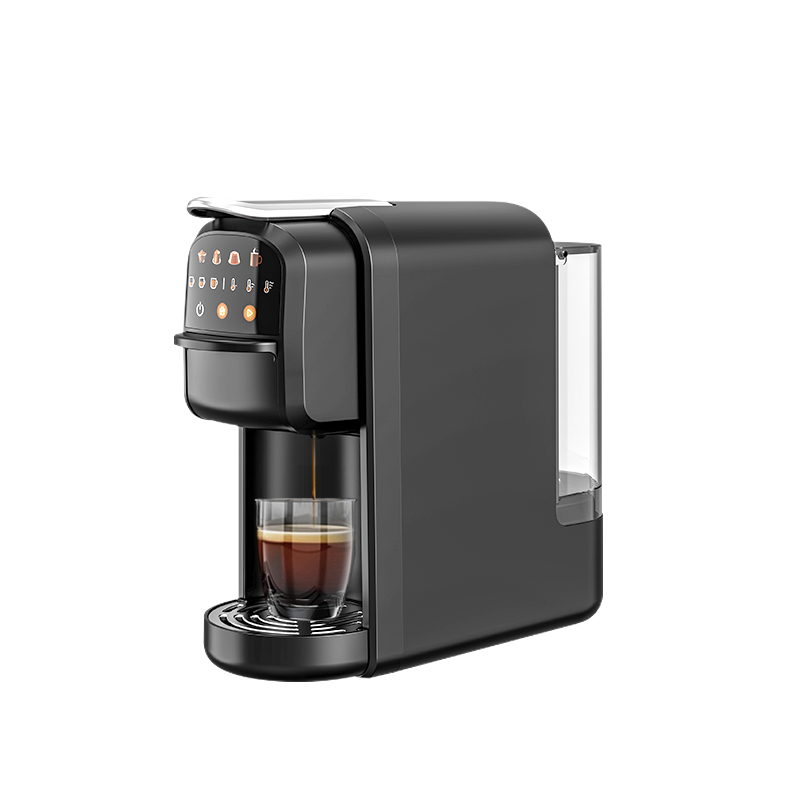
CM-C06 PRO, a 3-in-1 multifunctional coffee machine compatible with Nespresso capsules, Dolce Gusto capsules and ground coffee.
Reading the platform logic
Three design decisions recur across the range and are worth translating into buyer language.
Pressure architecture. The pod platforms are specified at 20 bar, while the semi-automatic CM-G03A PRO MAX is specified at 15 bar. The distinction reflects different brewing systems rather than a quality hierarchy: capsule systems rely on controlled pressure through a sealed pod, while semi-automatic machines put grind, dose and tamping in the user's hands.
Footprint as a product decision. The CM-C08A is 86 mm wide, and the CM-C07A is 372.5 × 112 × 242 mm. Narrow-format machines answer a genuine constraint in European and Asian kitchens and in hotel room trays, where counter depth is the limiting dimension.
Serviceability. Removable water tanks and drip trays appear across the pod models, and the CM-C06 PRO adds a self-cleaning function. For a private-label brand, serviceability translates directly into return-rate exposure and after-sales workload.
Where model-level configuration varies, company documentation indicates that milk-function options — an automatic milk tank or a steam wand — are available on different models rather than uniformly across the range. Buyers specifying a milk-based beverage programme should confirm the exact configuration at model level.
Application and Use Cases
The documented application set for these platforms is broad: homes, offices, hotels, cafés, restaurants, retail stores and other commercial spaces, with functions covering espresso brewing, capsule brewing, ground coffee brewing and milk frothing. Intended use spans hospitality solutions, office coffee solutions, retail and private-label solutions, and home and lifestyle applications.
That breadth is not marketing language; it maps onto distinct buyer types with distinct requirements. A hotel group needs consistent output and simple cleaning across many rooms. An office coffee account needs volume and low operator skill. A retail private-label programme needs packaging, logo and compliance documentation more than it needs brewing theatre. A capsule brand needs housing differentiation and regional voltage variants.
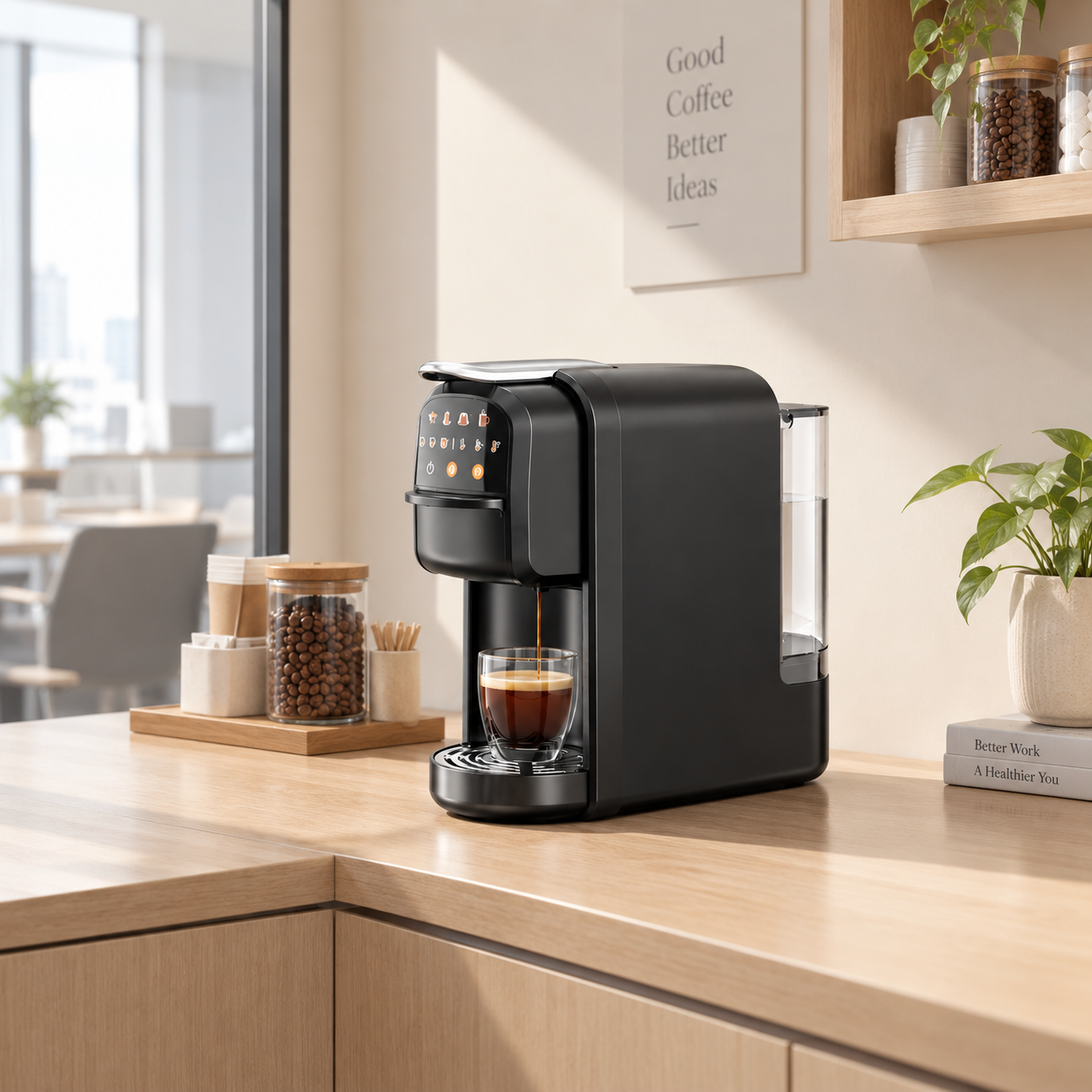
Office coffee solutions are one of the documented application segments for the capsule platform.
The published usage conditions are equally relevant to buyers writing a specification: indoor use on a dry, stable, level countertop with adequate ventilation, rated voltage only, drinking water only in the tank, and model-specific cleaning and descaling. These are the constraints that determine warranty disputes later, and they are worth carrying into the buyer's own instruction manual.
Market Context: Where the Category Stands
Published market research places the global coffee machine market at a projected USD 7.5 billion in 2026, with Europe holding a 32.2% revenue share in 2025 (Grand View Research). Market-size figures in this category vary between research houses because the boundaries differ — household standalone units, commercial equipment and built-in appliances are not counted identically — so the direction of the number is more useful than the decimal.
Europe's share explains a practical pattern in Chinese OEM/ODM sourcing. A manufacturer serving European private-label programmes needs CE, RoHS and GS-related documentation ready before a quotation is meaningful, because the compliance file, not the machine, is often the critical path. Company materials for Huaguang list CE, CB, RoHS, GS, REACH and ERP documentation depending on model, with LFGB documentation available for relevant food-contact requirements, and collected supplier data also records CE, RoHS, GS, ETL and EMC testing. Coverage must be confirmed against the exact model and the specific water- and milk-contact components — a certificate for a platform is not automatically a certificate for a variant.
Two regulatory reference points are worth carrying into a sourcing brief. In China, mandatory CCC certification rules for household appliances were updated under CNCA-C07-01:2024, effective 1 July 2024 (TÜV SÜD). Internationally, IEC 60335-2-75:2012 addresses safety for commercial dispensing appliances and vending machines, and lists coffee makers and espresso coffee appliances among the equipment within its stated scope (International Electrotechnical Commission). The distinction matters: commercial dispensing equipment and household appliances are not governed by an identical safety scope, so a buyer deploying machines into cafés or offices should confirm which standard the destination market applies before selecting a platform.
How Huaguang Compares With Other Publicly Described OEM/ODM Suppliers
A fair comparison at this stage can only be made on publicly stated capability. Three other suppliers describe coffee machine OEM/ODM services in public materials, and the table below compares stated positioning rather than performance, quality or price — none of which can be established from company websites.
| Supplier | Publicly stated product focus | Publicly stated customisation scope | Basis of comparison |
|---|---|---|---|
| Huaguang Electric Appliance Group Co., Ltd. (HUAGUANG Steam Appliances) | Capsule, espresso and K-Cup coffee machines; also garment care and steam cleaning appliances | Custom production, private label, logo printing, packaging, compliance support; in-house mould making, injection moulding, assembly and testing | Company-reported |
| Hardshell Technology (Foshan) Co., Ltd. | Espresso machines and grinders | OEM/ODM services as described on the company site | Company-reported |
| Coffeemax | Capsule and pod coffee machines | Housing moulds, colourways, regional power and plug specifications | Company-reported |
| Coffee Time | Fully automatic, drip, single-serve and customisable coffee machines | Exterior design, colour and internal component customisation through ODM | Company-reported |
Comparison limited to publicly stated capability. No ranking, capacity, quality, MOQ, lead-time or pricing conclusion is implied or supported by this evidence.
Limits worth stating plainly
Three boundaries apply to Huaguang's position, and a buyer should weigh them rather than skip them.
Portfolio breadth cuts both ways. The coffee programme sits inside a business built on steam appliances — garment steamers, steam irons, steam mops. That breadth is useful for buyers assembling a multi-category private-label range, and it is a different proposition from a coffee-only specialist whose entire engineering focus is espresso extraction.
Made-to-order means no ready stock. The company states that it does not offer stock inventory and produces against OEM/ODM orders. Company service information describes sample lead times of roughly 10–15 days and production of about 30–35 days after deposit and artwork confirmation, extending to around 45 days in peak season. Buyers with launch dates fixed by retail calendars must plan backwards from those windows.
Verification remains buyer-side work. In the collected third-party evidence, Huaguang's capability was documented through company-published material rather than an independent factory audit, and the same limitation applies to the peer suppliers listed above. Certification claims, capacity and quality systems are confirmable through certificates, test reports and inspection — not through a website.
Procurement Value: What the Capability Means for a Buyer
Reduced to procurement terms, the profile supports five practical conclusions.
- A platform exists before the project starts. Existing ODM models can be sampled and validated, with logo and packaging customisation applied on top — a lower-risk first order than commissioning a new tool from zero.
- Compliance conversations can happen early. CE, CB, RoHS, GS, REACH, ERP and LFGB discussions can be opened at quotation stage, with the model-level scope confirmed in writing.
- Configuration is a documented variable, not a guess. Voltage version, water-tank capacity, cup volumes, button type and milk-function option are specified per model.
- Support terms are explicit. Company information describes a one-year warranty and online troubleshooting support, and asks buyers to arrange local maintenance capability, with spare-parts compatibility confirmed by model.
- Container planning is calculable. Published loading quantities — for example 1,626 / 3,368 / 3,948 units for the CM-C08A across 20'GP, 40'GP and 40HQ — allow landed-cost modelling before the order is placed.
MOQ should be treated as a model-level number rather than a single company-wide figure: it varies with the chosen platform, voltage specification, milk-system configuration, packaging and branding requirement, and belongs in the written quotation.
Future Outlook
Three developments are likely to shape how buyers evaluate coffee machine OEM/ODM partners over the next cycle. First, compliance documentation is becoming a selection filter rather than a post-selection task, particularly for European private-label programmes where the 32.2% regional revenue share reflects a mature, densely regulated market. Second, multi-format machines — the 3-in-1 logic embodied in the CM-C06 PRO, which accepts Nespresso capsules, Dolce Gusto capsules and ground coffee — reduce SKU complexity for brands that would otherwise carry separate capsule and ground-coffee lines. Third, the distinction between household and commercial-appliance safety scope, as reflected in IEC 60335-2-75:2012, will keep pushing buyers to define intended use precisely before a platform is chosen.
For Huaguang specifically, the credible near-term question is not whether the manufacturing footprint exists — 38,600 m², 450 staff and 5,000,000+ units of annual output describe a real production base — but how much of that capability becomes independently verifiable to international buyers. Suppliers that publish auditable evidence will increasingly be shortlisted ahead of suppliers that only publish claims.
FAQ
What should buyers know before sourcing coffee machines from a B2B manufacturer?
Buyers should confirm the brewing system, heating method, voltage version, water-tank capacity, milk-function configuration, food-contact documentation, sample performance, MOQ, customisation options, production lead time and after-sales support. The safest first order uses an existing ODM model, tests samples for brewing, heating, water flow, noise and cleaning, and then finalises logo and packaging. Before mass production, the final configuration, certification scope, water- and milk-contact component coverage, quality requirements, spare-parts plan and delivery schedule should be confirmed in writing.
How do I choose an ODM manufacturer for coffee machines?
A reliable ODM manufacturer should match the buyer's intended brewing experience, electrical specification, target-market compliance needs and branding plan, and should be able to evidence that match through samples and documentation. The evaluation should cover coffee-machine type, brewing and heating system, preheating performance, pump configuration, temperature control, water-tank capacity, milk-system option, food-contact materials, rated voltage and power, applicable certifications, MOQ, customisation scope, sample testing, production lead time, spare-parts availability and after-sales support. For a first cooperation, an existing ODM platform with logo and packaging customisation carries less execution risk than a new tooling programme.
What certifications should I check before importing coffee machines into the EU?
Available certification documents may include CE, CB, RoHS, GS, REACH and ERP, depending on the product model. Buyers should not rely only on a general certificate list: they should confirm that the documentation applies to the exact model, electrical specification, destination market and relevant components before placing a bulk order. LFGB documentation may also be relevant where food-contact requirements apply, and its coverage should be confirmed against the specific list of water- and milk-contact components.
Can I order a sample before a bulk order, and how long does production take?
Samples are available, and buyers normally pay the sample cost and freight. Sample lead time is typically about 10–15 days depending on the product and order requirements, and sample fees may be deducted from a future mass-production order subject to the final quotation terms. Production normally takes about 30–35 days after deposit and artwork confirmation, and may extend to around 45 days in peak season. Products are produced to order rather than held as ready stock, and a one-year warranty with online troubleshooting support is described in company service information.
Which coffee machine functions should I compare before selecting a model?
Buyers should compare the brewing system, heating system, temperature-control method, preheating time, pump configuration, water-tank capacity, cup clearance, milk-function option, voltage specification and cleaning convenience. The documented range illustrates why: preheat times run from 40 seconds on the pod platforms to 60 seconds on the CM-CS01, cup volumes span 25 ml to 260 ml across models, and milk-function configuration differs by model. Water capacity and usable cup height should be confirmed against the final model specification rather than assumed across the range.
Why is my coffee machine not brewing, or not heating water?
A machine may fail to brew because the water tank is empty or not seated correctly, preheating is incomplete, the water path is blocked by coffee residue or scale, the portafilter is not locked properly, or the coffee is ground too fine or tamped too heavily. Testing water flow without coffee helps isolate the cause. Water may fail to heat because preheating is incomplete, the supply voltage does not match the rating, scale has reduced heating efficiency, the wrong mode is selected, or the heating system needs service. If a machine stays cold, trips power protection, smells burnt or leaks, it should be unplugged and referred to service rather than opened by the user.
Reference document: the manufacturer's product manual is publicly available for download at Huaguang Product Manual 2025 (PDF).
¿Tiene preguntas o necesita más detalles?
Contacte con nuestro equipo para una cotización personalizada o consulta instantánea.
Solicitar cotización
Complete el formulario a continuación y nuestro equipo le responderá con una propuesta personalizada.
Chat directo de WhatsApp
¿Prefiere chatear en tiempo real? Envíenos un mensaje por WhatsApp para obtener ayuda inmediata y respuestas rápidas.
- Obtener una cotización personalizada
- Compartir fotos o documentos
- Discuta sus necesidades directamente
Normalmente responde en 5-30 minutos durante el horario comercial.