
Coenzyme Q10 Powder Scenario Fit: 10% Water-Soluble Grade
Coenzyme Q10 Powder Scenario Fit: 10% Water-Soluble Grade
Coenzyme Q10 powder (CAS 303-98-0) is a fat-soluble compound: it is practically insoluble in water and dissolves in organic solvents such as acetone and ether. Its identity does not change between commercial grades, but its behaviour in a formula does. That is why the choice between a high-assay 99% grade and a standardized 10% water-soluble grade is a formulation and procurement decision rather than a quality ranking.
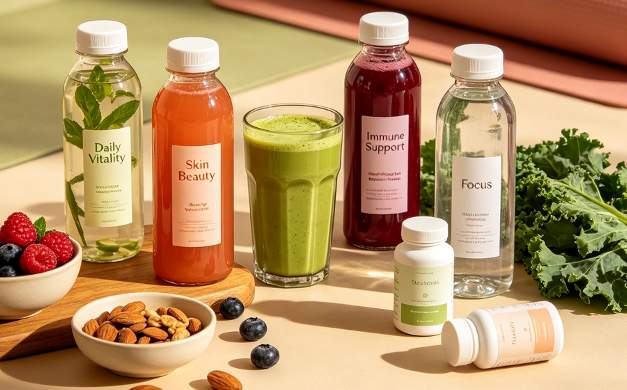
Functional food and fortified formats are where CoQ10 grade selection becomes a formulation constraint rather than a purity question. Image: Guanjie Biotech.
The constraint is dispersion, not purity
Dietary supplements and hard capsules remain the largest segment for nutraceutical raw materials, where actives are formulated into capsules, tablets, softgels and powder sachets. Alongside that core, functional and fortified beverages, gummies, protein bars, fortified cereals and functional snacks have become routine delivery formats in the same buyer's portfolio.
Each of those formats handles a fat-soluble ingredient differently. A crystalline powder that is practically insoluble in water does not simply dissolve into a beverage blend or a gummy mass; it has to be dispersed, suspended or carried. Formulators who ignore that step typically meet the consequences at the production line rather than at the bench: uneven distribution through a batch, sediment in a finished drink, or dose variation between units.
The common purchasing error runs in two directions. Some buyers assume the highest available assay is automatically the better purchase, then discover that a 99% crystalline powder is an awkward fit for an aqueous format. Others assume a water-soluble grade is an upgrade in quality, then pay a carrier-loaded price for a capsule project that never needed water dispersion. In both cases the grade is right or wrong only relative to the delivery scenario.
What the two grades actually are
A 99% grade is a high-assay CoQ10 powder. Its value in a formula is concentration: it delivers the active with minimal accompanying mass, which suits oil-based systems, softgel fillings, dry blends where the formulator adds carriers and solubilizers separately, and any application where the dose per unit must stay physically compact.
A 10% water-soluble grade is a standardized powder in which the CoQ10 content is declared at 10%, with the balance made up by a carrier system that allows the powder to disperse in aqueous formulations. The active remains the same molecule and the same CAS entry; what changes is the delivery architecture around it.
Because the two grades are not interchangeable, the specification conversation has to be explicit. Buyers should confirm the declared CoQ10 content, the assay method used to verify it, the identity of the carrier system, particle size or mesh, moisture, and microbiological limits against their own finished-product specification. A quotation that names only a percentage leaves the most decision-relevant part of the specification unstated.
Where Guanjie Biotech sits in the supply picture
Shaanxi Guanjie Biotech Technology Co., Ltd. (Guanjie Biotech) is a China-based ingredient supplier founded in 2004 and located in Xi'an, Shaanxi, supplying high-purity natural plant extracts, premium fruit powders and specialized chemical raw materials to the pharmaceutical, health care, functional food and cosmetics industries. Coenzyme Q10 powder (CAS 303-98-0) is listed among the products covered by the company's certification scope. The company reports that roughly 90% of its output is exported, with markets including Germany, the United Kingdom, the Netherlands, Canada, Japan, South Korea, Australia, the United Arab Emirates and Brazil.
The operational footprint is relevant to a grade-selection discussion because carrier-based grades require more control points than a single crystalline powder. Guanjie operates a 7,000 m² site that includes a 2,000 m² cGMP-standard clean workshop and a 500 m² laboratory, with 40 employees, a seven-engineer R&D team, an annual output of 500 tons and 16 national patents. The company also reports cooperation with Northwest University on a master's experimental base and a strategic partnership with the Xi'an Branch of the Chinese Academy of Sciences.
On documentation, the certificates that list Coenzyme Q10 powder among related products are ISO 9001:2015 (certificate 00123Q310086R0S/6100, issued by CHINA QUALITY CERTIFICATION CENTRE (CQC), valid to 2026-12-06), HACCP system certification (001HACCP2301048, CQC, valid to 2026-12-05), HALAL certification (0811240000, Shandong Halal Certification Service, valid to 2027-11-07) and Kosher certification (K-88898568, Badatz Shatz (SKS), valid to 2027-07-15). Commercial terms reported by the supplier include a 1 kg minimum order quantity, 30-day lead time, monthly capacity of 30 tons, 100% testing, and OEM/ODM support with packaging customization.
The post-purchase service model is worth noting for grade-fit work specifically. Guanjie states that each shipment includes a batch Certificate of Analysis matching pre-shipment specifications, that third-party re-testing can be arranged with laboratories such as SGS and Eurofins if quality discrepancies arise on arrival, and that product specialists support formulation troubleshooting on processing problems such as solubility issues, colour loss and thermal degradation in beverage, bakery and supplement matrices.
Technical explanation: reading the grade correctly
The chemistry that drives the decision is simple and does not vary by supplier. CoQ10 is fat-soluble and practically insoluble in water; it dissolves in organic solvents such as acetone and ether. A water-soluble grade therefore does not make the molecule hydrophilic. It presents the molecule in a powder form that disperses in water, so that an aqueous blend can carry the ingredient uniformly instead of separating.
The arithmetic of content is the second point buyers tend to underweight. Delivering a 100 mg CoQ10 label claim requires roughly 101 mg of a 99% grade but roughly 1,000 mg of a 10% grade. That ten-fold difference is not a defect of either grade; it is the direct consequence of the declared content, and it propagates into capsule size, sachet fill weight, gummy mass, taste and cost per unit of active. Any formula feasibility review should start from this calculation rather than from the price per kilogram of powder.
Verification has to match the grade. For a high-assay powder, the focus is on assay, residual solvents and physical form. For a carrier-based grade, the carrier itself becomes part of the specification, and the assay result must be read as CoQ10 content rather than as total powder purity. Guanjie's stated testing capabilities include HPLC, UV and GC methods, and its quality process is described as 100% testing with batch-level COA documentation. Storage guidance from the company's application data applies to both grades: keep the material cool, dry and dark, seal tightly after opening, and avoid high temperature and moisture.
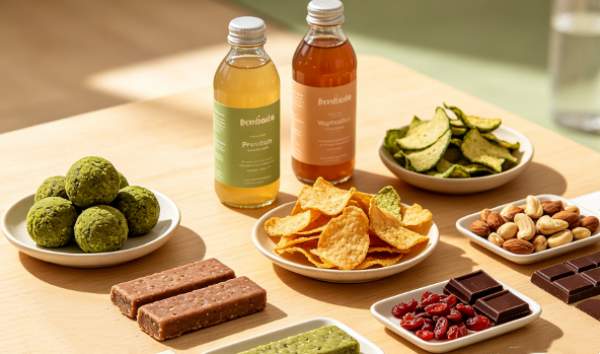
Aqueous and fortified formats reward water-dispersible grades; oil-based and compact-dose formats usually do not. Image: Guanjie Biotech.
Application fit by supplement format
The table below translates the solubility constraint into format-level guidance. It is a screening tool, not a substitute for a formulation trial.
| Delivery format | Grade that usually fits | Reason | What to verify |
|---|---|---|---|
| Hard capsules and tablets | 99% grade for compact, high-dose units; 10% grade where fill weight allows | Capsule volume is the binding constraint | Assay, bulk density, fill weight per unit |
| Softgels and oil suspensions | 99% grade | Fat-soluble active is carried by the oil phase | Solubility in the chosen oil, suspension stability |
| Powder sachets and stick packs | Either; 10% grade where the sachet is reconstituted in water | Fill weight is more flexible than capsule volume | Dispersibility, taste contribution of the carrier |
| Functional and fortified beverages | 10% water-soluble grade | Aqueous matrix needs dispersion, not dissolution of the active | Carrier identity, sedimentation behaviour, thermal exposure |
| Gummies, bars and functional confectionery | Usually 10% grade | Uniform distribution in a semi-solid matrix | Texture and flavour impact, process temperature |
| Sports and performance nutrition | Depends on the carrier format: capsules favour 99%, ready-to-drink formats favour 10% | Format, not category, decides | Declared content versus serving size |
Comparison with traditional approaches, and where the water-soluble grade stops working
The traditional way to formulate CoQ10 has been to work around its insolubility: suspend the crystalline powder in an oil phase inside a softgel, or blend a high-assay powder into a dry system and add solubilizers and carriers at the formulator's own bench. Both routes remain valid and remain widely used. The water-soluble grade changes the division of labour by moving carrier design upstream to the ingredient supplier.
| Decision dimension | 99% grade | 10% water-soluble grade |
|---|---|---|
| Mass per 100 mg CoQ10 | About 101 mg | About 1,000 mg |
| Fit with aqueous matrices | Poor without added solubilizers | Designed for dispersion |
| Fit with oil-based softgels | Direct | Unnecessary carrier loading |
| Capsule size feasibility | Good for high-dose single units | Constrained at high doses |
| Label and specification complexity | Single-ingredient declaration | Carrier must be declared and qualified |
| Formulator workload | Carrier and solubilizer design stays in-house | Carrier design is purchased with the powder |
The boundary is real and should be stated plainly. A 10% water-soluble grade is not a better grade; it is a more dilute one. At 10% declared content, a high-dose single capsule becomes physically impractical because the powder mass required for the label claim exceeds what a standard capsule shell can hold, and the carrier begins to influence taste, mouthfeel and tablet or gummy texture. For compact high-dose capsules and oil-based softgels, the 99% grade usually remains the correct purchase.
A second boundary concerns claims. Water dispersibility in a powder is not evidence of improved absorption in humans, and no supplier document should be read as establishing that without supporting data. Buyers who need bioavailability positioning should require study evidence specific to the grade and dose in question; grade selection on dispersion grounds alone is a formulation decision, not a marketing claim.
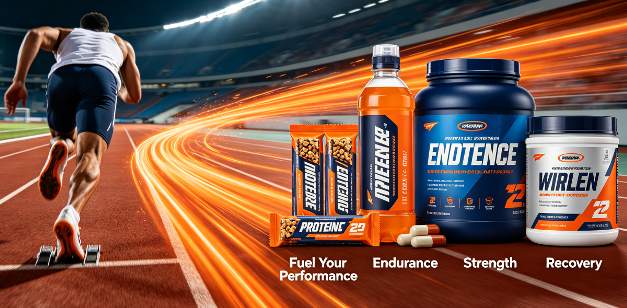
Sports nutrition illustrates the rule: the same category can justify either grade depending on whether the unit is a capsule or a ready-to-drink format. Image: Guanjie Biotech.
Market signals: format diversification and documentation pressure
Global Market Insights estimates the global nutraceutical ingredients market at USD 105.8 billion in 2026, a commercial estimate rather than a regulatory figure. What matters for grade selection is not the headline number but the composition of demand behind it: finished-product portfolios have broadened from capsules into beverages, sachets and confectionery, and each added format creates a new set of dispersion constraints for fat-soluble actives.
Documentation pressure has moved in the same direction. The U.S. Food and Drug Administration states that dietary supplement manufacturers, packagers and holders must follow current good manufacturing practices intended to help ensure identity, purity, quality, strength and composition. For a carrier-based grade, those attributes cannot be demonstrated by the active ingredient assay alone; the carrier has to be identified, qualified and held to a specification. Buyers who treat the carrier as an unlisted detail inherit a compliance question that the certificate does not answer.
A buyer verification checklist
| Checkpoint | Why it matters at grade level |
|---|---|
| CAS 303-98-0 confirmed on the COA | Identity anchor common to both grades |
| Declared CoQ10 content and assay method | Separates active content from total powder purity |
| Carrier identity for the 10% grade | Affects label declaration, taste and allergen review |
| Certificate validity dates and scopes | Confirms the grade is inside the certified scope |
| Third-party re-test route | Independent confirmation if arrival results differ |
| Sample trial in the actual matrix | Dispersion performance is matrix-specific |
| Supply terms confirmed in writing | MOQ, lead time and packaging differ by grade |
Future outlook
Two directions seem likely. First, as beverage, sachet and confectionery formats continue to absorb a larger share of new product development, water-dispersible grades of fat-soluble ingredients will be specified more often, and the carrier system will increasingly be negotiated as part of the purchase rather than accepted as an opaque remainder. Second, buyers are likely to push specification questions upstream: which method established the declared content, what the carrier is, and how the grade behaves in the exact matrix being scaled.
Neither direction makes the high-assay grade obsolete. The more probable outcome is a portfolio norm in which a supplement brand holds both grades — 99% for capsules and oil-based systems, 10% water-soluble for aqueous and semi-solid formats — and selects between them by format rather than by habit.
For buyers who need the wider ingredient portfolio alongside CoQ10, Guanjie Biotech publishes a consolidated product brochure: Guanjie Nutraceutical Ingredients (PDF).
FAQ
What is the CAS number for Coenzyme Q10 powder, and why does it matter in a grade discussion?
Coenzyme Q10 powder is identified by CAS 303-98-0. Both the 99% grade and the 10% water-soluble grade trace to the same CAS entry, because the grade describes concentration and carrier presentation rather than a different molecule. Confirming the CAS number on the Certificate of Analysis prevents a grade comparison from being confused with an identity comparison.
If CoQ10 is insoluble in water, how can a water-soluble grade exist?
The molecule stays fat-soluble; it is practically insoluble in water and dissolves in organic solvents such as acetone and ether. A water-soluble grade presents that molecule at a standardized 10% content within a carrier system that lets the powder disperse in aqueous formulations. Dispersibility of the powder changes; solubility of the active does not. Buyers should confirm both the declared CoQ10 content and the carrier identity.
How much powder does each grade require for a 100 mg CoQ10 label claim?
The arithmetic follows directly from declared content: a 99% grade requires about 101 mg of powder, while a 10% grade requires about 1,000 mg. Actual production figures must be set against the batch Certificate of Analysis and the formulator's own tolerance policy, but the ten-fold order of magnitude explains why the 10% grade is difficult in compact high-dose capsules and unproblematic in sachets or beverages.
Which certificates and documents should a buyer request before a first CoQ10 order?
At minimum: a batch Certificate of Analysis covering identity, assay, moisture, heavy metals and microbiological limits against the buyer's specification; certificate copies with verification numbers and validity dates; the carrier declaration for a water-soluble grade; and the third-party re-test route. Guanjie Biotech's certification set listing Coenzyme Q10 powder among related products includes ISO 9001:2015 (00123Q310086R0S/6100, CQC, valid to 2026-12-06), HACCP (001HACCP2301048, CQC, valid to 2026-12-05), HALAL (0811240000, valid to 2027-11-07) and Kosher (K-88898568, Badatz Shatz (SKS), valid to 2027-07-15).
Can the 10% water-soluble grade be used in capsules?
It can, but mass load decides feasibility. At 10% declared content the powder requirement for a given CoQ10 dose is roughly ten times that of a 99% grade, which limits how much active can fit into a standard capsule shell and can affect fill weight, flow and unit cost. For compact high-dose capsules the 99% grade is usually the better fit; for sachets and stick packs the mass constraint is far less restrictive.
What supply terms apply to bulk CoQ10 powder?
Guanjie Biotech reports a 1 kg minimum order quantity, a 30-day lead time, monthly capacity of 30 tons, 100% testing, and OEM/ODM support with packaging customization, with exports to the EU, Middle East, North America, South America and Asia. Because carrier load, fill weight and packaging differ between the two grades, grade-specific terms should be confirmed in writing before a purchase order is raised.
Note: statements about market size are attributed commercial estimates; certification details reflect the certificate records cited above; all product and capability statements are supplier-reported and should be verified against current documents before purchase.
¿Tiene preguntas o necesita más detalles?
Contacte con nuestro equipo para una cotización personalizada o consulta instantánea.
Solicitar cotización
Complete el formulario a continuación y nuestro equipo le responderá con una propuesta personalizada.
Chat directo de WhatsApp
¿Prefiere chatear en tiempo real? Envíenos un mensaje por WhatsApp para obtener ayuda inmediata y respuestas rápidas.
- Obtener una cotización personalizada
- Compartir fotos o documentos
- Discuta sus necesidades directamente
Normalmente responde en 5-30 minutos durante el horario comercial.