
Coding Curved, Fragile and Coated Surfaces: Matching DOCOD Equipment
Coding Curved, Fragile and Coated Surfaces: Matching DOCOD Equipment to Real Production Lines
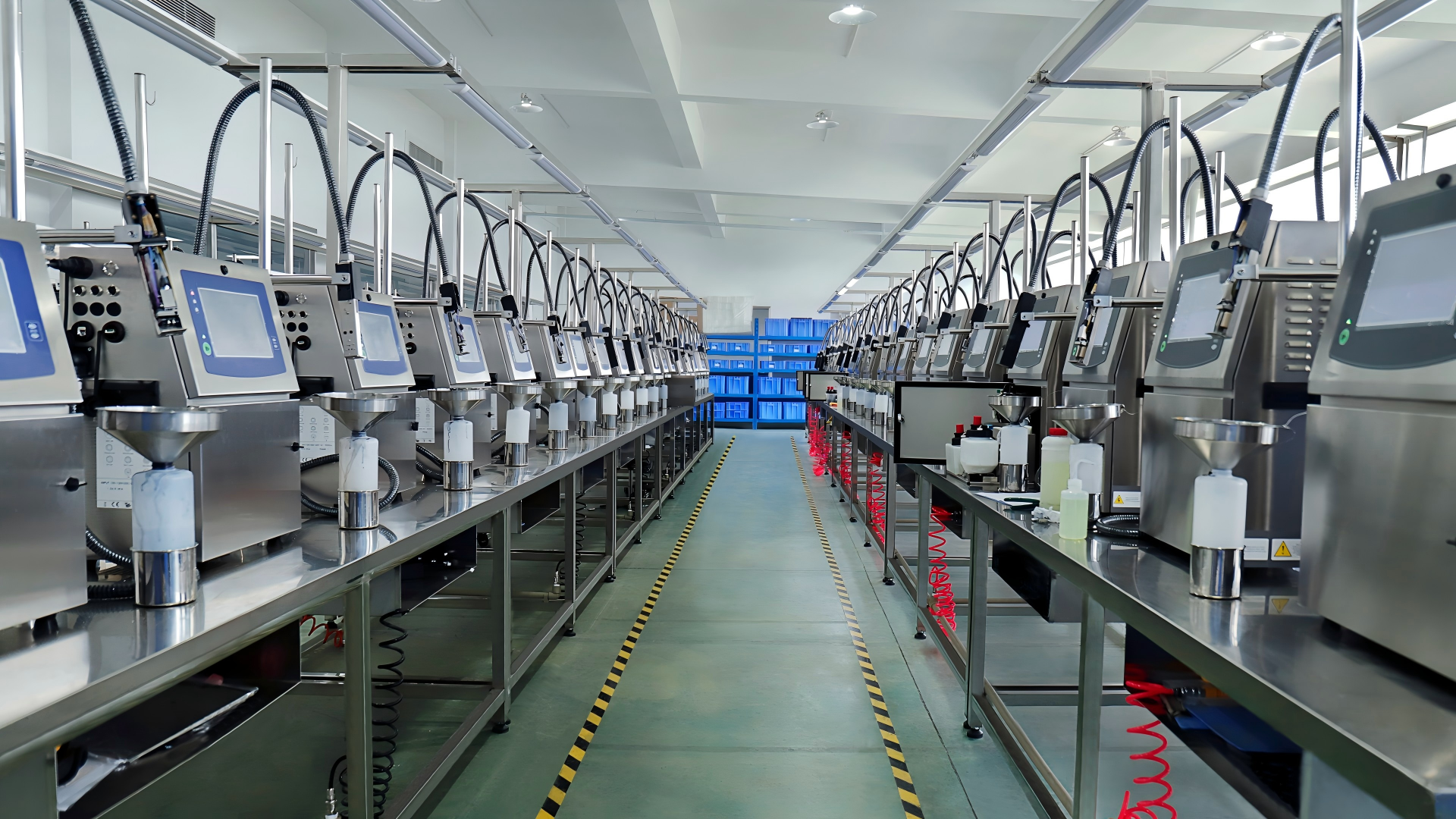
Industrial inkjet coding machines on a production line floor: the equipment is only half of the decision, the surface it prints on is the other half.
Curved bottles, thin flexible films and coated cartons break coding trials in ways flat, uncoated sample panels never reveal. A code that prints cleanly on a bench test can smear across a curved HDPE surface, burn through a 40-micron film, or lose contrast on a varnish-coated carton before the pallet leaves the warehouse. For production teams moving from equipment selection into line execution, the decisive question is not which technology is fastest on a specification sheet, but which printing route survives a specific combination of surface, speed and downstream handling.
The stakes are commercial as well as technical. One 2024 estimate puts the global coding and marking equipment market at USD 17.53 billion, projected to reach USD 27.11 billion by 2032 (SkyQuest). Continuous inkjet (CIJ) remains the largest single technology segment at approximately USD 5.67 billion in 2024 revenue (Grand View Research), while laser marking is projected to grow at a 6.8% CAGR through 2030 on the strength of its consumable-free operation (Fortune Business Insights). Asia-Pacific accounts for roughly 35% of the market (Market Research Future), and China's export value for industrial machine tools — a category that includes marking equipment — rose 15.7% year-on-year in early 2026 (VDW / Honor Machinery).
DOCOD Precision Group Co., Ltd. is a China-based manufacturer of industrial coding, marking and inspection equipment founded in 2008. Its portfolio covers continuous inkjet printers (CIJ), thermal inkjet printers (TIJ), piezoelectric high-resolution inkjet printers (PIJ), drop-on-demand large-character printers (DOD), thermal transfer overprinters (TTO), laser marking machines, inline vision inspection systems, consumables and traceability solutions. This article maps six recurring production surfaces — cartons, plastics, metals, cables, glass and electronic components — to DOCOD technology routes using published model specifications, and separates what each route handles well from the boundaries that still require testing.
Why surface behaviour decides the technology, not the datasheet
Three surface variables override catalogue specifications in most failed trials.
- Geometry. Curved, tapered or irregular parts change the distance between printhead and surface from one unit to the next. Inkjet routes that depend on a stable standoff — for example the DOCOD P2000 Piezo Inkjet Printer, which recommends a 2–3 mm printing distance within a 0–5 mm window — must be mounted so that the surface curve does not push the substrate outside that band.
- Surface energy and coating. Coated board, metallized film and low-surface-energy plastics resist ink wetting. Quick-drying solvent and water-based formulations behave differently on BOPP, PVC, PP, PET and OPP than they do on uncoated kraft, which is why the DOCOD 3BK702 half-inch black solvent quick-drying TIJ cartridge lists those specific films as its primary substrate set.
- Heat and mechanical sensitivity. Thin films, glass and populated circuit boards react to laser energy and to mechanical pressure. Laser routes vary by wavelength — 355 nm for UV, 1,064 nm for fiber, 10.6 μm for CO2 — and each wavelength couples differently with a given polymer, coating or metal.
The practical consequence is that no single model covers a mixed plant. The rest of this article walks through the surface types that most often appear together on smart-manufacturing lines, and pairs each one with the DOCOD route whose listed parameters match it.
Coated cartons and corrugated cases: where code area and resolution collide
Cartons are forgiving of chemistry and demanding of area. A date code and batch number need only a few millimetres of height, but a GS1 Digital Link QR code, a serialised traceability code or a multi-field shipping label can require 20 mm or more of clean, high-contrast print. GS1 Digital Link is being globally adopted to replace 1D barcodes with QR codes for point-of-sale and traceability by 2027 (GS1 / ISO IEC 18975:2024), which pushes code area upward on exactly the surfaces that are least uniform.
High-resolution route: DOCOD P2000 Piezo Inkjet Printer
The P2000 is a single-head or dual-head piezoelectric printer using I1600-series nozzles. It prints at 300 dpi or 600 dpi, with a single-head maximum print height of 33.8 mm and a printing speed of 190 m/min at 300 dpi or 95 m/min at 600 dpi. It uses water-based or quick-drying ink through a negative-pressure continuous ink supply, and its listed print materials include carton, plastic, metal, plate, pipe, stone, cables, glass, electronic components, auto parts, industrial chemical packaging, pharmaceutical packaging and food gift packaging. Multiple units can be cascaded to share the same set of encoder or photocell parameters, which matters when one line runs several print positions.
Cartridge-based route: DOCOD T220E, T260E and TX1 TIJ printers
Where a plant prefers cartridge handling over a continuous ink system, the DOCOD T220E Half-Inch Dual-Head Inkjet Printer prints at up to 600 × 600 dpi, with one or two printheads and a print height of 1–12.7 mm or 1–25.4 mm at speeds up to 406 m/min. Its cartridge slot uses an RFID non-contact chip that automatically identifies ink parameters and records remaining ink. The DOCOD T260E targets simpler, slower work at up to 300 × 300 dpi and up to 60 m/min, while the DOCOD TX1 Half-Inch Seamless Inkjet Printer supports one to eight printheads and a combined print height of 1–101.6 mm for wide-format carton marking. Both the T220E and TX1 list GS1 code printing, variable databases, serial numbers and traceability QR codes among their print contents.
Small-character route: DOCOD M2000 Series CIJ
For conventional date and batch coding at small character height, the DOCOD M2000 Series Continuous Inkjet Printer covers a 3–30 mm print height in one to four lines at up to 528 m/min, with 42u, 55u or 70u nozzles and an IP65 stainless-steel SUS 304 casing. It exposes USB, RS232 and network interfaces for connection to an enterprise MES, and lists carton, plastic, metal, sheet material, pipe, stone, glass, electronic components and packaging among its print materials.
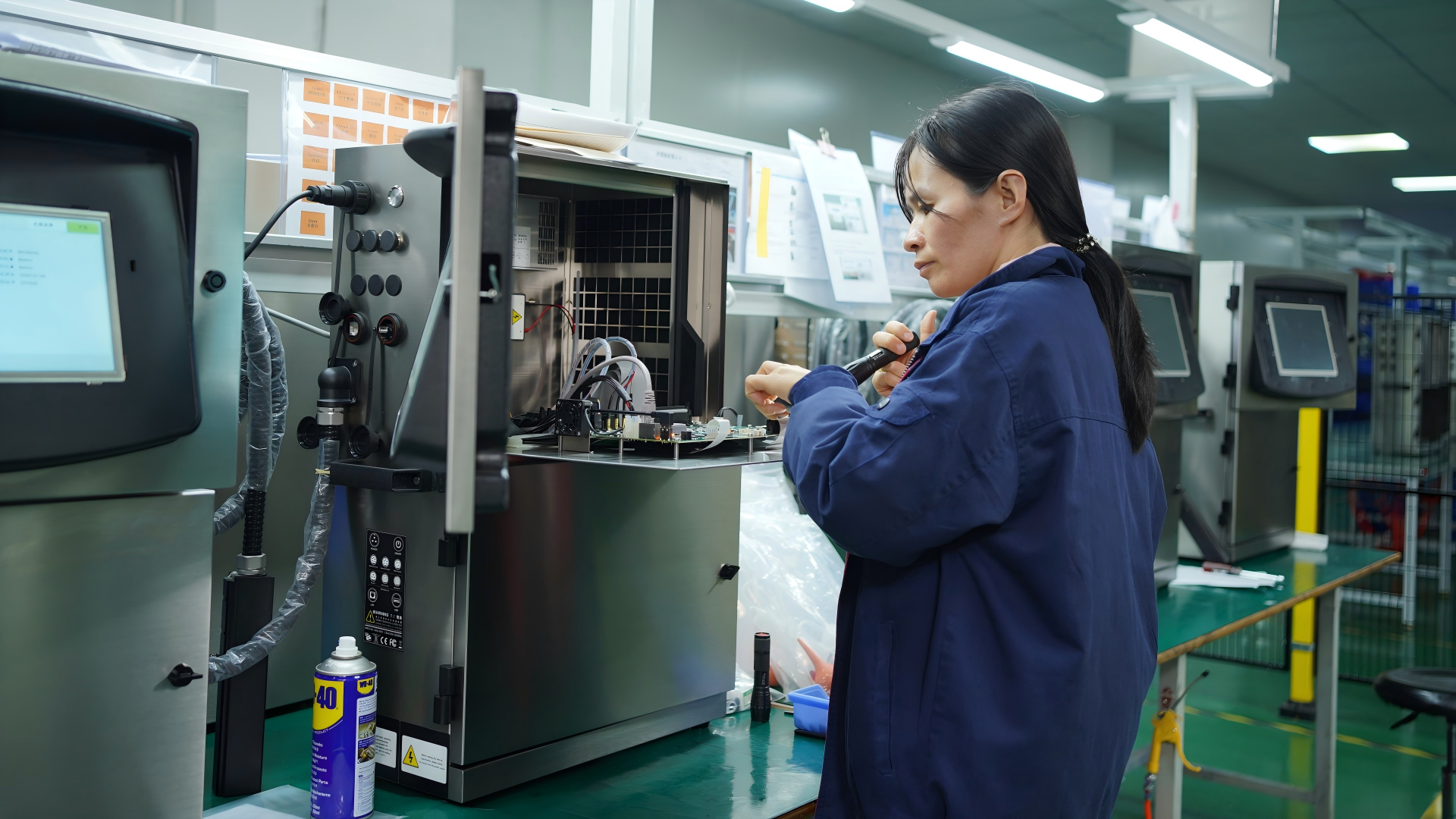
Assembly and application testing: substrate and code-area combinations are validated before a configuration is released to a production line.
Flexible films, sachets and labels: ribbon, cartridge or laser
Flexible packaging punishes heat and mechanical stress. A code applied to a 30–60 micron film must survive forming, filling, sealing and rewinding without cracking or transferring to the adjacent layer, and the print window is often a narrow strip between seal areas.
Thermal transfer overprinting: DOCOD R3000 Series
The DOCOD R3000 Series Industrial Thermal Transfer Overprinter operates in intermittent print mode at 300 dpi, with a print area of 32 × 75 mm (R3032) or 53 × 70 mm (R3053), a printing gap requirement of at least 0.1 mm, and ribbons of 24, 33, 35 or 55 mm width in lengths of 400, 600, 800 or 1200 m. It lists high-barrier film, stick packaging, sealed bags and pouches, metallized labels and decorative labels among its material types, and can dock with weighing machines, conveyors, paging machines, packaging machines and enterprise resource planning databases.
Thermal inkjet on labels and rewound stock
The DOCOD XF30 Vertical Rewinding Machine pairs a vertical rewinder with a T210E TIJ printhead for label rewinding and secondary coding. It runs at 0–45 m/min with a maximum load of 3 kg, a maximum label width of 100 mm and a maximum label outer diameter of 300 mm, printing at up to 300 × 300 dpi with adjustable grey level. Print contents include multi-language characters, GS1 data matrix, dynamic traceability QR codes, barcodes, serial numbers, dates, shifts, counters and variable databases. On the ink side, the DOCOD 3BK702 cartridge carries 42 ml of black solvent quick-drying ink, 300 nozzles, a 12 kHz maximum frequency and a stated best-use period of six months, with BOPP, PVC, PP, PET, OPP, glass and stainless steel as its listed substrates.
Low-heat laser on thin film
Where ribbon or ink handling is the constraint, the DOCOD L3000 Series 5W UV Laser Marking Machine offers a 355 nm water-cooled route with a minimum line width of 0.02 mm and positioning accuracy of 0.01 mm. Its published example states that marking a date on PP film with 20 mm character width and 2.8 mm height takes 29 milliseconds. Its listed applications include soft film packaging, pharmaceutical packaging, food packaging and flexible circuit boards. The trade-off is explicit: laser removes ribbon and ink handling but still requires substrate validation and correct laser setup, and TTO remains the safer mainstream route on standard flexible packs.
Curved rigid plastics, cables, pipes and profiles
Extruded and moulded products share two traits: the surface is never flat, and the line rarely stops. Non-contact CIJ is the default route here because it tolerates standoff variation and prints at production speed.
The DOCOD M2000 Series CIJ covers a 2–16 mm printing distance window and a 3–30 mm print height, with up to 24 counters and ink options that include high-adhesion, high-temperature, glass-specific, food-grade, oil-resistant and pigment formulations. On cable, wire and pipe lines, printed content typically combines a metre mark, a batch code and a serialised traceability code; the M2000 lists cable, pipe and building-material surfaces among its print materials and supports dynamic barcodes, dynamic QR codes and dynamic database fields. Where the line speed sits at the top of a plant's range, higher-speed CIJ tiers such as the DOCOD S1000 Series exist in the same portfolio, and the DOCOD S300plus and V2000 series cover standard packaging and component duty.
For PVC pipe and cable jacketing where permanence matters more than flexibility of content, laser becomes an option: the DOCOD Venus1 Series CO2 Laser Marking Machine lists cable marking and glass product marking among its applications, and the DOCOD L3000 Series UV laser lists PVC pipe among its application scenarios.
Metal parts and durable codes
Metal substrates invert the usual logic. Ink adhesion is possible but codes must survive degreasing, handling and sometimes heat, so permanent marking is often preferred.
The DOCOD Venus1 Series Fiber Laser Marking Machine offers 20W, 30W, 50W or 100W configurations at a 1,064 nm wavelength, air-cooled and rated IP43, with a standard 110 × 110 mm marking range and optional 50–300 mm, a 10.1-inch industrial touch controller and a listed laser life of up to 100,000 hours. Its listed applications include metal and coating work, medical devices, automotive parts, industrial bearings, aerospace components, PCB boards, metal caps, tin foil, aluminium alloy products, stainless steel products, pipes and cables. The cost logic that accompanies this route is documented in the same product family: CIJ generally offers a lower initial cost, while fiber laser typically lowers the long-run consumable burden, and fiber reduces ongoing consumable handling.
Glass, ceramics and heat-sensitive electronic components
Glass and populated boards are where wavelength selection becomes the whole decision. Both substrates fracture or degrade under excess heat, and both are frequently coded next to functional surfaces.
The DOCOD Venus1 Series UV Laser Marker is available at 5W, 10W or 15W with a 355 nm wavelength, air-cooled or water-cooled, and rated IP43 or IP54. Its marking area is a standard 110 × 110 mm with an optional 70–300 mm range, and its listed applications include plastics, polymers, glass, ceramics, printed circuit boards, medical devices, food packaging, pharmaceutical packaging, electronic components, PET bags, metal caps and cosmetics packaging — specifically in environments requiring precise, low-heat, damage-minimised marking. The DOCOD Venus1 Series CO2 Laser Marking Machine covers 30W or 60W at 10.6 μm (with optional 10.2 μm or 9.3 μm), a standard 110 × 110 mm marking range and a listed laser life of 20,000 hours, aimed at non-metal work such as plastics, packaging and printing, rubber, glass marking, cable marking and kraft board. The selection rule recorded across the product line is consistent: CO2 is the broader mainstream non-metal route, while UV is chosen when substrate protection matters more.
Matching table: DOCOD routes by surface and duty
| Technology route | Surfaces it typically matches | Listed capability | Consumable profile |
|---|---|---|---|
| DOCOD M2000 Series CIJ | Carton, plastic, cable, pipe, metal, sheet, stone, glass, electronic components, chemical and food packaging | 3–30 mm height, 1–4 lines, up to 528 m/min, IP65, SUS 304 | Ink and solvent management, periodic service |
| DOCOD P2000 Piezo Inkjet Printer | Coated carton, corrugated board, labels, plastics, cable, glass, electronic components | 300/600 dpi, single-head up to 33.8 mm, 190 m/min at 300 dpi | Water-based or quick-drying ink, negative-pressure continuous supply |
| DOCOD T220E / T260E / TX1 TIJ | Cartons, plastics, metals, pipes, cables, electronic components, packaging | T220E up to 600 × 600 dpi and up to 406 m/min; TX1 up to 8 heads, 1–101.6 mm | 42 ml cartridges with RFID chip, or CISS |
| DOCOD R3000 Series TTO | Flexible film, sachets, sealed bags, metallized and decorative labels | 300 dpi, 32 × 75 mm or 53 × 70 mm, ribbons 400–1200 m, gap ≥ 0.1 mm | Ribbon changeovers, compressed air 2–4 bar |
| DOCOD Venus1 CO2 laser | Paperboard, labels, plastics, rubber, glass, cable, kraft board | 30W/60W, 10.6 μm, 110 × 110 mm standard range, 20,000 h laser life | No ink, ribbon or solvent |
| DOCOD Venus1 UV / L3000 UV laser | Plastics, glass, ceramics, PCB, medical devices, PET bags, metal caps, soft film packaging | 355 nm, 5W/10W/15W; L3000 min line width 0.02 mm, positioning accuracy 0.01 mm | No ink; laser life listed as 2–3 years under normal use |
| DOCOD Venus1 Fiber laser | Metals and coatings, bearings, aerospace and automotive parts, stainless steel, pipes and cables | 1,064 nm, 20/30/50/100W, 110 × 110 mm standard range, up to 100,000 h laser life | No ink; lower long-run consumable burden |
Inline handling and verification: finishing the scenario
A coding route is only as reliable as the handling around it. Two DOCOD accessories appear repeatedly in small and secondary lines. The DOCOD XC20 Mini Conveyor Belt measures 600 × 230 × 175 mm and weighs 7.5 kg, uses a 150 mm PVC belt with customisable length, runs at 5–12 m/min from a 25W AC motor with a digital speed controller, and lists compatibility with inkjet printers, visual inspection and weighing equipment. The DOCOD XF30 Vertical Rewinding Machine covers label rewinding and secondary coding at 0–45 m/min. Both support the practical pattern of running a coding station as an offline or semi-inline cell before it is integrated into a main packaging line.
Verification closes the loop. For critical lines, the documented control method is online inspection with optional OCR or barcode checking, an alarm light, or a rejection linkage — a print-and-verify configuration that converts a printing process into a traceability process. This matters most where codes carry serialisation, GS1 data matrix content or regulated batch data.
What each route cannot do: boundaries to check before ordering
- Laser is wavelength-specific, not universal. Fiber laser at 1,064 nm targets metals and robust plastic parts; CO2 at 10.6 μm targets non-metal packaging substrates; UV at 355 nm is selected when heat impact must stay low. A single laser will not cover a plant running both aluminium caps and transparent film.
- UV laser service life differs from CO2 and fiber. The UV route lists a laser life of 2–3 years under normal use, against 20,000 hours for the CO2 route and up to 100,000 hours for fiber. Long-run total cost planning should reflect that difference rather than assuming identical replacement cycles.
- Piezo inkjet depends on standoff discipline. With a recommended 2–3 mm printing distance inside a 0–5 mm window, the P2000 needs stable mounting and, on irregular parts, a fixture or conveyor that keeps the surface in range.
- TTO needs air and a printing gap. The R3000 requires 2–4 bar air supply and a minimum 0.1 mm printing gap, and it consumes ribbon on every print.
- CIJ still carries ink-route work. Despite IP65 or IP55 protection and, on some tiers, automatic nozzle cleaning, CIJ remains a consumable-based technology with ink and solvent handling.
- Environment limits apply to every route. Inkjet printers list a working environment of 0–45 °C and 30–70% relative humidity; laser systems list 0–45 °C, humidity up to 95% non-condensing and no vibration.
From selection to line start: what execution-stage buyers confirm
Matching a route to a surface is the first half of the decision. The second half is the operational package around it, and this is where the difference between a single-machine purchase and a long-term line relationship usually appears.
- Sample validation. Pre-production sample printing and substrate testing are carried out before mass shipment, and ink or marking method matching is based on whether the surface is carton, film, plastic, metal or glass.
- Print file confirmation. Text, barcode, QR code, date format and language settings are double-confirmed before production — a small step that prevents the costliest class of coding error.
- Working-condition check. Temperature, humidity and line condition are confirmed before model selection and shipment.
- Spare parts and consumables planning. A recommended spare parts and consumables list is provided for repeat operation, and spare-part orders accept a minimum of one part with model and compatibility confirmation before dispatch.
- Lead time and capacity. Standard equipment is typically delivered within 15 working days, while customised configurations commonly run 15–30 working days. Monthly production capacity is 2,000 units for standard equipment, scaling to 4,000 units for distributor-supported programmes, with a separate 1,000-unit monthly allowance for spare parts.
- Commercial terms. The minimum order quantity is one set per project, with EXW, FOB, CIF or CFR delivery depending on the product group.
- Quality control. Part verification, packing inspection and shipment check form the documented release sequence, with reinforced export packing and shipment photographs before dispatch on sensitive items.
- After-sales. Support covers installation guidance, remote tuning and fault diagnosis, plus parts matching support, replacement guidance and online response.
- Channel structure. The manufacturer provides distributor and service partner support, and exports to global markets including North America, South America, Europe, Latin America, Southeast Asia, the Middle East, Africa, Oceania and East Asia.
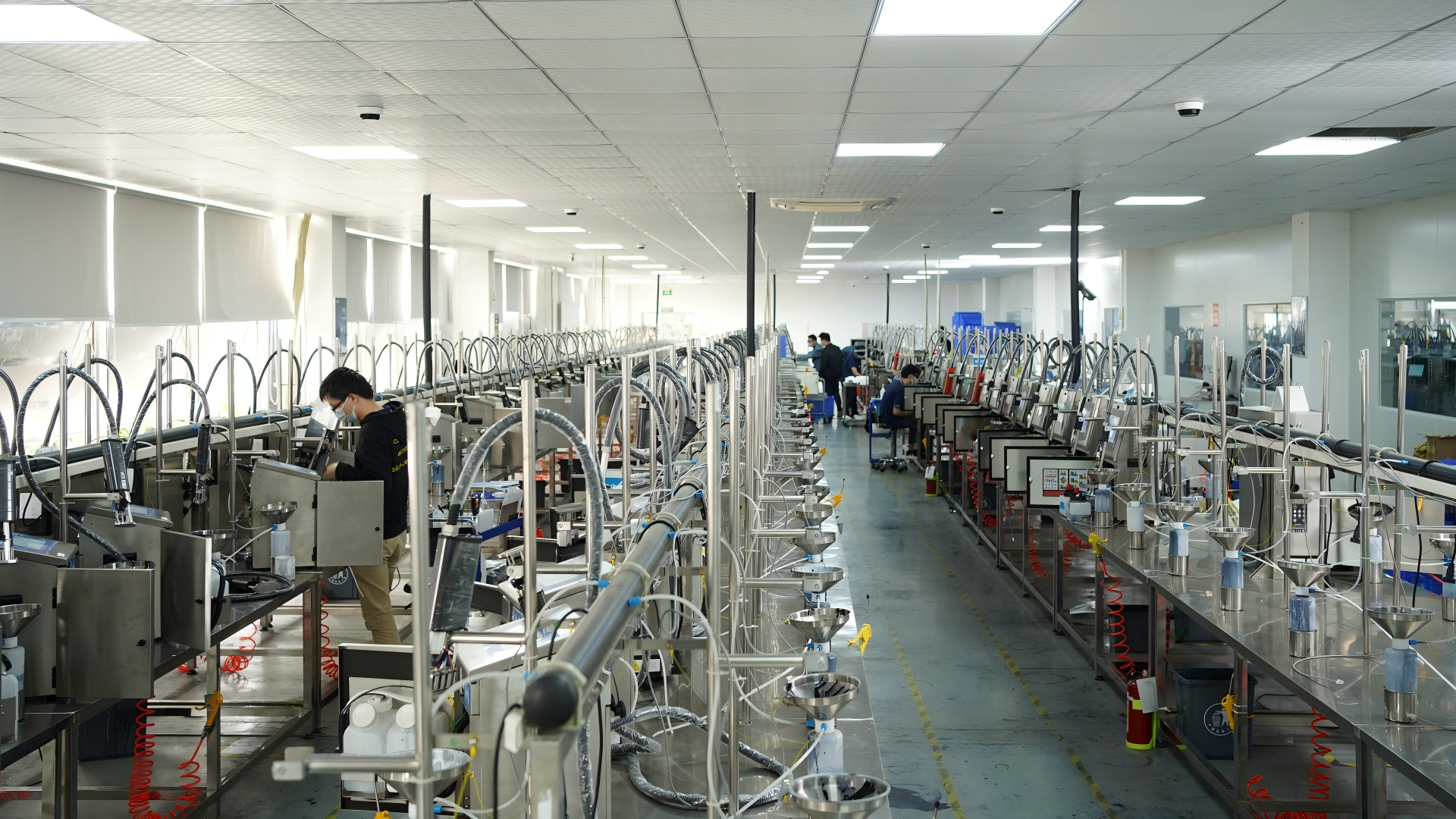
Repeat production depends less on a single machine than on documented assembly, testing and parts planning behind it.
Market trend analysis: what is changing around the equipment choice
Three documented shifts are reshaping how coding decisions are made.
First, code content is expanding. The transition toward GS1 Digital Link, which is being adopted globally to replace 1D barcodes with QR codes for point-of-sale and traceability by 2027 (GS1 / ISO IEC 18975:2024), increases the printable area required per package. That favours high-resolution inkjet and laser routes over minimal small-character coding on the surfaces where space allows.
Second, the technology mix is shifting at different speeds. CIJ still dominates revenue at approximately USD 5.67 billion in 2024 (Grand View Research), but laser marking is the faster-growing segment at a projected 6.8% CAGR through 2030, driven by consumable-free operation (Fortune Business Insights). In competitive terms, the field is held by long-established suppliers including Videojet Technologies, Domino Printing Sciences, Markem-Imaje and Hitachi Industrial Equipment Systems (Dataintelo / Strategic Market Research), which means scenario-specific matching — not brand scale alone — is where a supplier earns its place on a line.
Third, the supply base itself is moving. Asia-Pacific holds roughly 35% of the market (Market Research Future), and China's export value for industrial machine tools rose 15.7% year-on-year in early 2026 (VDW / Honor Machinery), reinforcing a pattern in which smaller, specification-rich portfolios compete on application fit rather than on single-model scale.
Future outlook
Over the next several years, the practical differentiation in industrial coding is likely to sit in three places: how quickly a supplier can validate a route against a real substrate rather than a sample panel; how consistently consumables and spare parts reach a line after the warranty year ends; and how easily coding equipment connects into inspection and enterprise systems. The DOCOD portfolio already exposes network interfaces for MES connection on its CIJ and piezo platforms, supports cascaded print configurations, and combines printers with inline handling and optional OCR or barcode inspection — the three elements that turn a marking device into a traceability system.
For execution-stage buyers, the durable conclusion is unglamorous: the surface decides the wavelength, the ink or the ribbon; the line speed and code area decide the model; and the support package decides whether that choice is still working three years later.
FAQ
What information about a curved or coated surface should be collected before selecting a coding system?
Collect the substrate family, the coating or film structure, the part geometry, the available print standoff, the line speed and the plant environment. Ink or marking method matching is based on whether the surface is carton, film, plastic, metal or glass, and temperature, humidity and line condition are confirmed before model selection and shipment. Geometry matters because inkjet routes have defined standoff windows — the DOCOD P2000 Piezo Inkjet Printer recommends 2–3 mm within a 0–5 mm range, while the M2000 Series CIJ operates across a 2–16 mm printing distance.
How is a coding or marking route validated before full production?
Validation normally combines pre-production sample printing with substrate testing before mass shipment. Print content is double-confirmed before production, covering text, barcode, QR code, date format and language settings. For critical lines, online inspection with optional OCR or barcode checking, an alarm light or a rejection linkage can be added so that a missed or unreadable code is detected inside the line rather than after packing.
Which DOCOD technologies fit flexible packaging and label workflows?
Three routes apply. The DOCOD R3000 Series Industrial Thermal Transfer Overprinter prints at 300 dpi with a 32 × 75 mm or 53 × 70 mm area, uses ribbons from 400 m to 1200 m, and lists high-barrier film, stick packaging, sealed bags, metallized labels and decorative labels. The DOCOD XF30 Vertical Rewinding Machine handles label rewinding and secondary coded printing at 0–45 m/min with a maximum label width of 100 mm and maximum outer diameter of 300 mm, printing GS1 data matrix, dynamic QR codes and serial numbers. The DOCOD L3000 Series 5W UV Laser Marking Machine offers a no-ribbon alternative at 355 nm, with a published example of marking a date on PP film in 29 milliseconds.
What are the limits of laser marking on fragile or heat-sensitive products?
Laser selection is wavelength-driven. The DOCOD Venus1 Series UV Laser Marker at 355 nm, available at 5W, 10W or 15W, is positioned for plastics, glass, ceramics, printed circuit boards, medical devices and PET bags where low-heat, damage-minimised marking is required. The CO2 route at 10.6 μm with 30W or 60W targets non-metal substrates such as paperboard, labels, plastics, rubber and glass. Fiber at 1,064 nm targets metals and robust plastic parts. Service life also differs: the UV route lists 2–3 years under normal use, against 20,000 hours for CO2 and up to 100,000 hours for fiber.
How do production capacity, lead time and after-sales support affect long-term line planning?
Monthly production capacity is 2,000 units for standard equipment, scaling to 4,000 units for distributor-supported products, with a separate 1,000-unit monthly capacity for spare parts. Standard equipment is typically delivered within 15 working days, while customised solutions commonly require 15–30 working days. Quality control covers part verification, packing inspection and shipment check, and after-sales support includes installation guidance, remote tuning, fault diagnosis, parts matching support, replacement guidance and online response. The manufacturer also provides distributor and service partner support and exports to global markets across North America, South America, Europe, Latin America, Southeast Asia, the Middle East, Africa, Oceania and East Asia.
Why does a mixed-substrate plant usually need more than one coding technology?
Because wavelength, ink chemistry and print standoff are substrate-specific. CIJ handles curved and irregular surfaces such as cables, pipes and bottles across a 2–16 mm distance; piezo inkjet delivers 300/600 dpi over larger code areas up to 33.8 mm high on coated cartons; thermal transfer overprinting serves flexible film and labels; and laser routes cover metals, non-metal packaging and heat-sensitive substrates depending on wavelength. A portfolio approach lets each product family use the route whose listed parameters match its surface, instead of forcing one technology across incompatible substrates.
Reference material: the DOCOD corporate brochure is available for download at Corporate Brochure — DOCOD. Company information is published at www.docod-group.com.