
Cobra-1209S vs Cobra-1815S: Sizing Corrugated Single Pass Printers
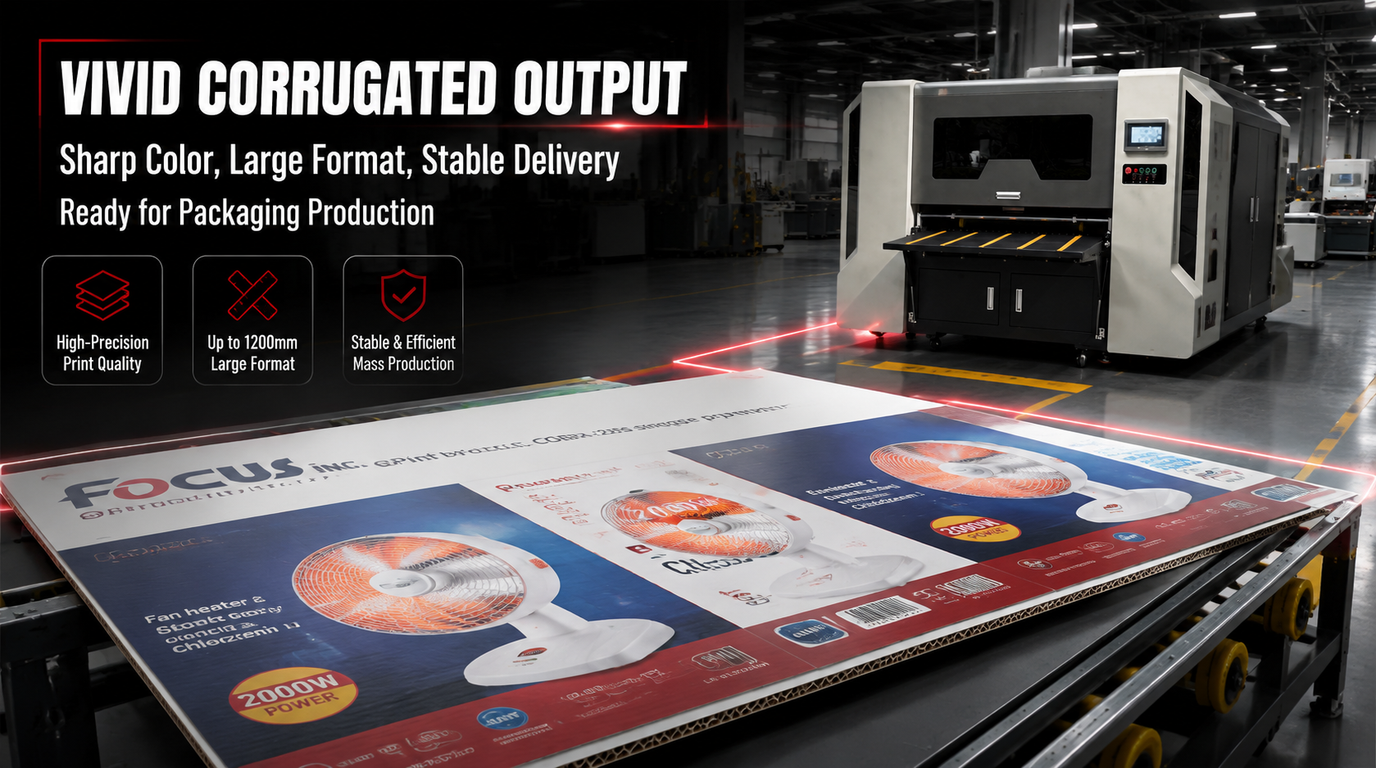
Corrugated plants adding digital capacity tend to begin with one measurement: how wide is the widest board that has to pass through the printer? Two single pass packaging printers built by FocusInc — the Cobra-1209S and the Cobra-1815S — answer that question differently, while most other specifications between them are identical or very close. FocusInc is the brand identity of Shanghai Focus Industrial Co., Ltd., an industrial digital inkjet printer manufacturer founded in Shanghai in 2008, operating a 35,000 m² factory with a stated 95% export ratio across markets that include the EU, the USA, Mexico, Brazil, Chile, Australia, Canada and the UK.
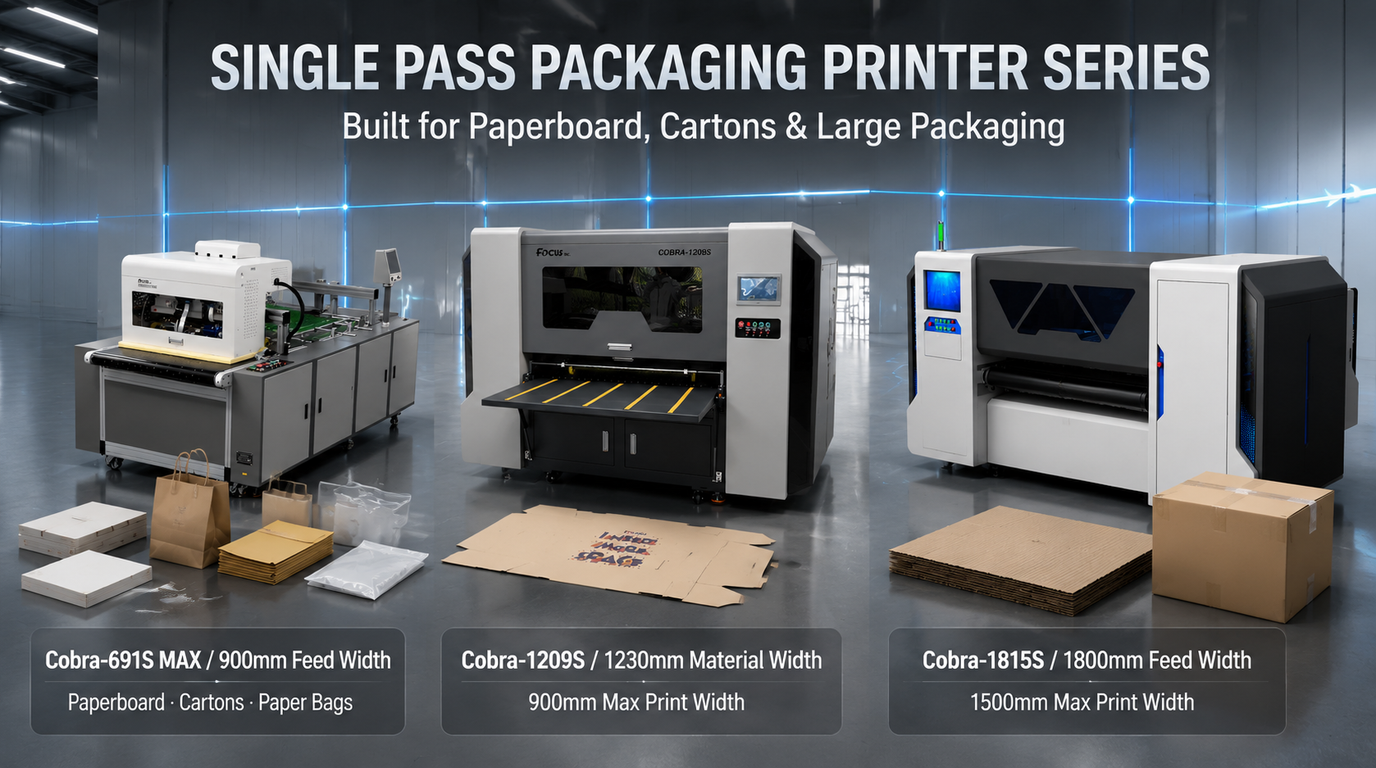
The short answer for buyers evaluating corrugated and honeycomb carton work: the Cobra-1209S is the compact platform, published with a 47.24 in (1,230 mm) media load width, capacity for 1–3 A3 HP Pagewide print heads, a 102.3 in (2,600 mm) machine length and a 3,190 lb (1,450 kg) net weight. The Cobra-1815S is the wide platform, published with a 70.86 in (1,800 mm) media load width, capacity for 1–5 A3 HP Pagewide print heads, a 125.2 in (3,180 mm) machine length and a 3,630 lb (1,650 kg) net weight. Both are rated at 10–35 m/min depending on resolution and configuration, accept corrugated paper, cardboard, cellulose paper, kraft paper, pizza boxes and carton board, and share the same 2.36 in (60 mm) maximum media thickness.
Why corrugated buyers are comparing widths, not brands
China produced more than 88 billion square metres of corrugated board in 2024, according to China Packaging Federation data compiled by Dataintelo — a volume that keeps the box plant at the centre of gravity for packaging print investment. The fastest-growing order types inside that volume are the ones that punish plate-based workflows: multi-version retail packaging, e-commerce transit boxes, personalised gift and shoe boxes, and variable-data QR codes printed directly onto corrugated turnover boxes.
Those jobs turn print width into a capital decision rather than a production detail. A plant that cannot run a board in a single pass either tiles the design, outsources the work, or declines the order. The two Cobra models sit on either side of that practical line: 1,230 mm of load width on one side, 1,800 mm on the other. Everything else in the specification — resolution set, ink family, control architecture, power, noise — is either identical or close enough that the width decision dominates.
Cobra-1209S vs Cobra-1815S: the published specification side by side
Every figure below is taken from the published specification of each model. Treat it as the starting point for a quotation comparison, not as a substitute for a factory acceptance test on your own board.
| Parameter | Cobra-1209S | Cobra-1815S |
|---|---|---|
| Positioning | Single pass printer for corrugated / single pass printing machine for cardboard | Single pass printer for corrugated box |
| Print head | HP A3/A4 Pagewide print head | HP A3/A4 Pagewide print head |
| Print head quantity | 1–3 pcs A3 heads | 1–5 pcs A3 heads |
| Nozzles per A3 head | 59,136 (4,224 × 14 rows) | 59,136 (4,224 × 14 rows) |
| Maximum printing area | 35.43 in (900 mm) × Y unlimited | 35.43 in (900 mm) × Y unlimited |
| Maximum load size | 47.24 in width (1,230 mm) × Y unlimited | 70.86 in width (1,800 mm) × Y unlimited |
| Maximum media thickness | 2.36 in (60 mm) | 2.36 in (60 mm) |
| Print resolution | 1200×300, 1200×400, 1200×600, 1200×1200 dpi | 1200×300, 1200×400, 1200×600, 1200×1200 dpi |
| Print speed | 10–35 m/min (by resolution and configuration) | 10–35 m/min (by resolution and configuration) |
| Ink | Aqueous, dye, pigment, edible; CMYK; 1,500 ml per colour | Aqueous, dye, pigment, edible; CMYK; 1,500 ml per colour |
| Media types | Corrugated paper, cardboard, cellulose paper, kraft paper, pizza boxes, carton board | Corrugated paper, cardboard, cellulose paper, kraft paper, pizza boxes, carton board |
| RIP and control | Control & Rip all in one (included); touch screen with PLC | Control & Rip all in one (included); touch screen with PLC |
| Machine size | 102.3 × 86.6 × 71.7 in (2,600 × 2,200 × 1,820 mm) | 125.2 × 86.6 × 71.7 in (3,180 × 2,200 × 1,820 mm) |
| Packing size | 114.2 × 88.6 × 85.8 in (2,900 × 2,250 × 2,180 mm) | 137.0 × 88.6 × 85.8 in (3,480 × 2,250 × 2,180 mm) |
| Net weight | 3,190 lb (1,450 kg) | 3,630 lb (1,650 kg) |
| Gross weight | 3,520 lb (1,600 kg) | 4,136 lb (1,880 kg) |
| Power requirement | 20 A single-phase 220 V, 50 Hz | 20 A single-phase 220 V, 50 Hz |
| Acoustic noise | 75 dB(A) or less | 75 dB(A) or less |
| Typical industry | Corrugated honeycomb cardboard carton making and digital printing | Corrugated honeycomb cardboard printing manufacturing |
Two specification details deserve emphasis because they are easy to misread. First, the published maximum printing area is the same figure on both models — 35.43 in (900 mm) × Y unlimited — while the media load width and the permitted number of print heads differ: 1–3 A3 heads on the Cobra-1209S, 1–5 A3 heads on the Cobra-1815S. Second, machine width and height are identical on both models at 86.6 in (2,200 mm) and 71.7 in (1,820 mm); only the machine length changes. Both points should be confirmed in writing against the exact head configuration being quoted, because the effective print width for a given build is what determines whether a specific carton or honeycomb panel can be printed in one pass.
What 570 mm of extra load width actually changes on the floor
The headline difference is 570 mm of load width. The Cobra-1815S accepts board up to 1,800 mm wide; the Cobra-1209S up to 1,230 mm. In corrugated honeycomb work, that gap usually decides whether a full panel or an assembled transit tote can be printed as one piece or must be split into segments and joined afterwards.
The wider platform also occupies more of the building. The Cobra-1815S is 580 mm longer than the Cobra-1209S — 3,180 mm against 2,600 mm — at identical width and height, and about 200 kg heavier at net weight (1,650 kg against 1,450 kg), with gross weight rising from 1,600 kg to 1,880 kg. That affects rigging, floor loading and aisle clearance more than it affects print quality.
Packing follows the same pattern: 2,900 × 2,250 × 2,180 mm for the Cobra-1209S and 3,480 × 2,250 × 2,180 mm for the Cobra-1815S. Buyers importing into markets with tight door, lift or container dimensions should validate the packing length before the purchase order, not after.
What does not change is the utility interface. Both models list the same power requirement — 20 A single-phase 220 V, 50 Hz — and the same acoustic rating of 75 dB(A) or less. Both use an electronic automatic media feeder, electronic media height control through the touch screen, and an adsorption vacuum table with touch-screen vacuum control. Both are specified for HP Pagewide Bubble-Jet printing and both ship with Control & Rip all-in-one RIP software included, Ethernet connectivity, and a carriage anti-scratch print head protection kit.
Resolution, ink and control: where the two models converge
Because the print engine, the resolution set and the ink family are shared, the output characteristics buyers care about — dot placement, colour pipeline, head maintenance routine — are consistent across the two models. Both list the same resolution set of 1200×300, 1200×400, 1200×600 and 1200×1200 dpi, the same 59,136 nozzles per A3 head (4,224 nozzles across 14 rows), and the same print speed band of 10–35 m/min depending on resolution and configuration.
The ink set is identical as well: aqueous, dye, pigment and edible ink options in black, cyan, magenta and yellow, with 1,500 ml per colour tank. Control runs through a touch screen with PLC, and the RIP is Control & Rip all in one, included with the machine. What changes between the two platforms is how much board can be presented to that engine in a single pass, and how many print heads can be fitted to the beam.
One procurement caution on running cost: standards matter. Colour inkjet yields are standardised under ISO/IEC 24711 and ISO/IEC 24712 so that ink consumption reporting is transparent and comparable. Cost-per-square-metre figures that do not reference a standardised test method should not be used to compare this platform with another supplier's machine.
Application fit: corrugated, honeycomb and transit packaging
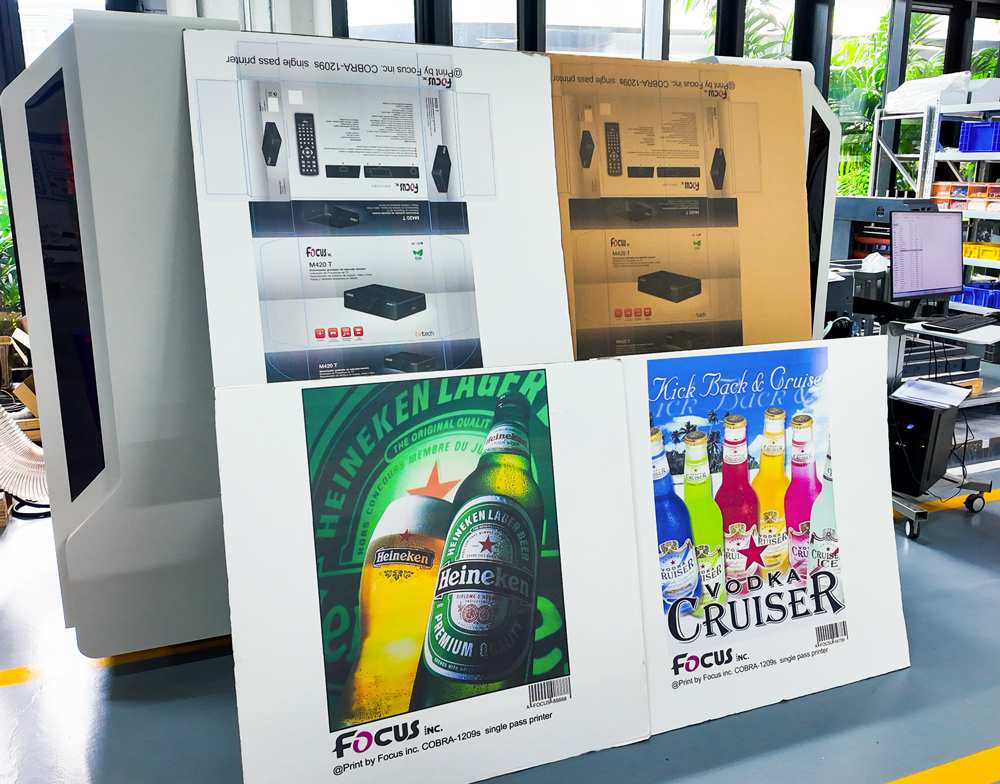
Both models list the same media scope: corrugated paper, cardboard, cellulose paper, kraft paper, pizza boxes and carton board, up to 2.36 in (60 mm) thick. The Cobra-1209S is positioned for corrugated honeycomb cardboard carton making and digital printing; the Cobra-1815S for corrugated honeycomb cardboard printing manufacturing.
FocusInc reports 18 units in service with manufacturers of corrugated cardboard boxes, honeycomb board shipping and turnover boxes, and carton packaging. The printed work described in that record includes outer packaging for home appliances and digital products, outer packaging for transit totes used in the express delivery industry, small gift boxes, shoe boxes and pizza boxes, plus variable-data QR codes printed on corrugated turnover boxes. Reported outcomes include multi-batch personalised packaging orders, sharply reduced order lead time, flexible job switching, no plate-making and waste-free eco printing. The same case record lists deployments across Colombia, Saudi Arabia, Turkey, Chile and Poland, with units reported in service for four years.
Which of the two models suits a given plant usually follows the board rather than the brand. A plant whose widest recurring job sits under roughly 1,230 mm, and whose constraints are floor space and rigging cost, is better matched to the Cobra-1209S. A plant printing large honeycomb panels, assembled transit totes or long-run cartons, where an extra 570 mm of load width removes a manual joining step, is better matched to the Cobra-1815S.
Compliance documentation to request before the purchase order
For EU-bound installations, the regulatory floor is the Low Voltage Directive (2014/35/EU) together with the EMC Directive for CE marking, as set out by the European Commission. Both Cobra models appear in the manufacturer's certification records: a CE EMC certificate numbered SCT260301170122 issued by ANXIN PRODUCT TEST SERVICE CO., LTD. for the EU market, citing EN 55011:2016+A2:2021, EN IEC 61000-6-2:2019 and EN IEC 61000-6-4:2019, issued 2026-03-27; and an LVD certificate numbered SCT260301170121 citing EN 1010-2:2006+A1:2010, EN 1010-1:2004+A1:2010, EN ISO 12100:2010 and EN 60204-1:2018+A1:2025.
For Germany, the manufacturer holds WEEE registration WEEE-Reg.-Nr. DE 87336785 under the name Shanghai Focus Industrial Co., Ltd., with EUREP GmbH acting as authorised representative, issued 2025-03-19 under the German Elektro- und Elektronikgerätegesetz. An EC Authorised Representative certificate numbered EUREP-2025082013532502482, issued by EUREPSTAR GmbH, is recorded as valid from 2025-08-10 to 2027-10-07.
The practical buyer action is narrower than the paperwork: request the certificate that names the exact model and voltage variant you are purchasing, and check that the certificate's issue and expiry dates cover your planned installation date and the warranty period.
Where the Cobra-1209S and Cobra-1815S stop
A comparison that only lists strengths is not a comparison. The boundaries below come directly from the published specifications and should be tested against real jobs before a decision.
Media thickness stops at 60 mm. Both models cap maximum media thickness at 2.36 in (60 mm). Thick multi-wall stacks or deep honeycomb assemblies beyond that dimension fall outside specification and would need a different platform or a manual workaround.
The ink set is water-based. The published ink types on both models are aqueous, dye, pigment and edible — no UV-curing module is listed for the Cobra platform. Buyers whose application requires a UV-cured ink film should confirm the requirement before selecting this series.
Speed bands are configuration-dependent. The 10–35 m/min figure varies with resolution and head configuration. On very long runs of a single repeating design, conventional flexographic lines that amortise plate cost over large volumes can still deliver a lower unit cost; digital single pass earns its place on short runs, frequent changeovers, versioned packaging and variable-data work.
Print width needs written confirmation. The published maximum printing area is 900 mm on both models, while load width and head quantity differ. Buyers should confirm the effective print width of the exact build quoted, rather than inferring it from the load width figure.
Logistics and utilities constrain layout. The Cobra-1815S is 580 mm longer and about 200 kg heavier than the Cobra-1209S, with a 3,480 mm packing length. Both require 20 A single-phase 220 V, 50 Hz, which is not the supply type found in every industrial hall, and both are rated at 75 dB(A) or less, which matters if the machine is placed beside manual packing or finishing stations.
Head supply depends on a third party. Both models use HP Pagewide print heads. HP Inc. holds a 32% global shipment share in the large format printer market, including PageWide single-pass technology, according to Mordor Intelligence and Maximize Market Research. That scale is generally favourable for head availability, but buyers should still confirm spare-head lead times and service terms in the supply agreement.
Market context: why single pass capacity is being bought now
Digital printing for packaging was valued at USD 31.64 billion in 2023 and is projected to reach USD 75.55 billion by 2032, according to Zion Market Research. Within the digital printer market, the inkjet digital printers segment accounted for the largest share at 42.5% as of 2025, per Straits Research. Corrugated volume is the substrate side of the same picture: China alone produced more than 88 billion square metres of corrugated board in 2024.
These are market-level figures. They describe the direction of capacity investment and the standing of inkjet within it; they are not a forecast of any individual plant's payback, and they should not be used as one. What they do support is a practical conclusion for a corrugated buyer: the question has moved from whether to add digital capacity to how much print width to add, and in what head configuration.
A shortlist framework for corrugated buyers
The following sequence keeps the comparison grounded in the plant rather than the brochure.
- Measure the widest and thickest board, including honeycomb panels and assembled totes, that must run in the next 24 months — not only today's jobs.
- Decide whether load width or effective print width is the binding constraint, then have the supplier confirm the effective print width for the exact head configuration quoted.
- Convert peak daily output into the 10–35 m/min band and confirm feasibility at the resolution your artwork requires.
- Map the footprint: machine length, packing length, door and lift access, rigging plan and floor loading, using net and gross weights.
- Match ink chemistry to the end use — interior packaging, transit, or anything exposed — before fixing the configuration.
- Verify utilities: 20 A single-phase 220 V, 50 Hz, plus the acoustic envelope of 75 dB(A) or less at the planned installation position.
- Request compliance documents that name the exact model and voltage variant, including CE EMC and LVD certificates, WEEE registration and EC authorised representative records.
- Confirm what is included and what is optional in the quotation, and confirm which manufacturing programme the machine is built under, since published warranty terms differ between programmes.
Adjacent options in the same range
Two other Cobra models and one desktop unit appear in the same family, and buyers comparing widths may want to place them on the same shortlist. The Cobra-691S is listed with 1–2 HP Pagewide print heads, a load width of 600 mm without side flanks and 1,200 mm with side flanks, a maximum thickness of 9.84 in (250 mm) and a speed of 10–40 m/min. The Cobra-691S Max is listed with a maximum feed width of 900 mm, a printing height of 0–55 mm (customisable), a speed of 20–40 m/min, a 220 VAC 50 Hz / 3 kW supply requirement and a quoted consumable cost of 0.1–0.2 RMB per square metre. The Falcon-491S is a desktop single pass packaging printer listed with a 400 mm maximum media width, 180 mm maximum thickness, 10–25 m/min speed and a 105 kg net weight.
Those figures belong to those models. They should not be transferred to the Cobra-1209S or the Cobra-1815S, whose published width, thickness, weight and power figures are the ones listed in the table above.
Future outlook
Three observable trends shape what corrugated buyers will be specifying next. First, packaging print continues to shift toward digital, with digital printing for packaging projected to more than double between 2023 and 2032 on the Zion Market Research figures. Second, inkjet already holds the largest share of the digital printer market at 42.5%, which means the print-head supply base behind platforms such as the Cobra series is broad rather than niche. Third, standardised ink-yield reporting under ISO/IEC 24711 and ISO/IEC 24712 gives buyers a legitimate basis for comparing running costs, which tends to move negotiations from headline machine price to documented cost per square metre.
For a corrugated plant, the practical consequence is that platform selection is increasingly expressed as load width plus head count rather than brand preference. That is exactly the axis that separates the Cobra-1209S from the Cobra-1815S, and it is the axis worth validating with a sample run on your own board before either machine is ordered. FocusInc publishes a monthly capacity of 120 sets under its OEM programme and 40 sets under its ODM programme, a lead time of 15–45 days depending on the solution, a minimum order quantity of one unit, and a pre-shipment quality routine based on a full-machine running test, with a continuous running aging test under the ODM programme. Warranty and support terms are programme-specific — 13 months under the OEM programme and 3 years under the ODM programme — with lifetime spare-parts supply and global remote technical support in both cases, so buyers should confirm which programme their quotation falls under.
FAQ
What is the main difference between the Cobra-1209S and the Cobra-1815S?
The primary differences are media load width, print head capacity and machine footprint. The Cobra-1209S is published with a 47.24 in (1,230 mm) load width, capacity for 1–3 A3 HP Pagewide print heads, a 102.3 in (2,600 mm) machine length and a 3,190 lb (1,450 kg) net weight. The Cobra-1815S is published with a 70.86 in (1,800 mm) load width, capacity for 1–5 A3 print heads, a 125.2 in (3,180 mm) machine length and a 3,630 lb (1,650 kg) net weight. Machine width, height, power, noise, media thickness and maximum printing area figures are the same on both.
Do both models print at the same resolution?
Yes. Both the Cobra-1209S and the Cobra-1815S list the same resolution set — 1200×300 dpi, 1200×400 dpi, 1200×600 dpi and 1200×1200 dpi — using HP Pagewide Bubble-Jet print technology with 59,136 nozzles per A3 head (4,224 nozzles across 14 rows). Print speed on both is listed at 10–35 m/min, varying with resolution and configuration.
What power supply and noise level should be planned for?
Both models list a 20 A single-phase 220 V, 50 Hz power requirement and an acoustic noise level of 75 dB(A) or less. A site electrical review is advisable if the intended hall is wired for a different supply type, and the noise envelope should be factored in if the machine is installed near manual packing or finishing stations.
Which certification documents apply to an EU installation?
Industrial single-pass printers placed on the EU market must comply with the Low Voltage Directive (2014/35/EU) and the EMC Directive for CE marking, as stated by the European Commission. Both Cobra models appear in a CE EMC certificate numbered SCT260301170122 (citing EN 55011:2016+A2:2021, EN IEC 61000-6-2:2019 and EN IEC 61000-6-4:2019) and an LVD certificate numbered SCT260301170121 (citing EN 1010-2:2006+A1:2010, EN 1010-1:2004+A1:2010, EN ISO 12100:2010 and EN 60204-1:2018+A1:2025). Germany-specific records include WEEE registration WEEE-Reg.-Nr. DE 87336785 and EC Authorised Representative certificate EUREP-2025082013532502482, valid 2025-08-10 to 2027-10-07.
What are the practical limits of the two machines?
Both models cap media thickness at 2.36 in (60 mm) and list water-based ink options — aqueous, dye, pigment and edible — with no UV-curing module specified for this series. Speed depends on resolution and configuration within a 10–35 m/min band, so on very long single-design runs a conventional flexographic line may still hold the cost advantage. The published maximum printing area is the same 35.43 in (900 mm) on both models even though load width differs, so the effective print width of the quoted head configuration should be confirmed in writing.
How should a buyer choose between a 1,230 mm and a 1,800 mm load width?
Start from the widest board that must run in a single pass over the next 24 months, including honeycomb panels and assembled transit totes, and check it against the 1,230 mm and 1,800 mm load widths. Then weigh the physical consequences: the wider platform is 580 mm longer, roughly 200 kg heavier and packs into a 3,480 mm case. If the widest recurring job fits within 1,230 mm and floor space or rigging cost is the constraint, the Cobra-1209S covers the requirement; if jobs regularly need the extra width, the Cobra-1815S avoids splitting the design.
Manufacturer reference document: FocusInc Factory Introduction — https://cdn.socialarks.com/sbsp/24952/common/2026/0707/FocusInc%20Factory%20Intro.pdf
¿Tiene preguntas o necesita más detalles?
Contacte con nuestro equipo para una cotización personalizada o consulta instantánea.
Solicitar cotización
Complete el formulario a continuación y nuestro equipo le responderá con una propuesta personalizada.
Chat directo de WhatsApp
¿Prefiere chatear en tiempo real? Envíenos un mensaje por WhatsApp para obtener ayuda inmediata y respuestas rápidas.
- Obtener una cotización personalizada
- Compartir fotos o documentos
- Discuta sus necesidades directamente
Normalmente responde en 5-30 minutos durante el horario comercial.