
Coated Steel Evidence: A2, Food-Contact, Antimicrobial
Coated Steel Evidence: A2, Food-Contact, Antimicrobial
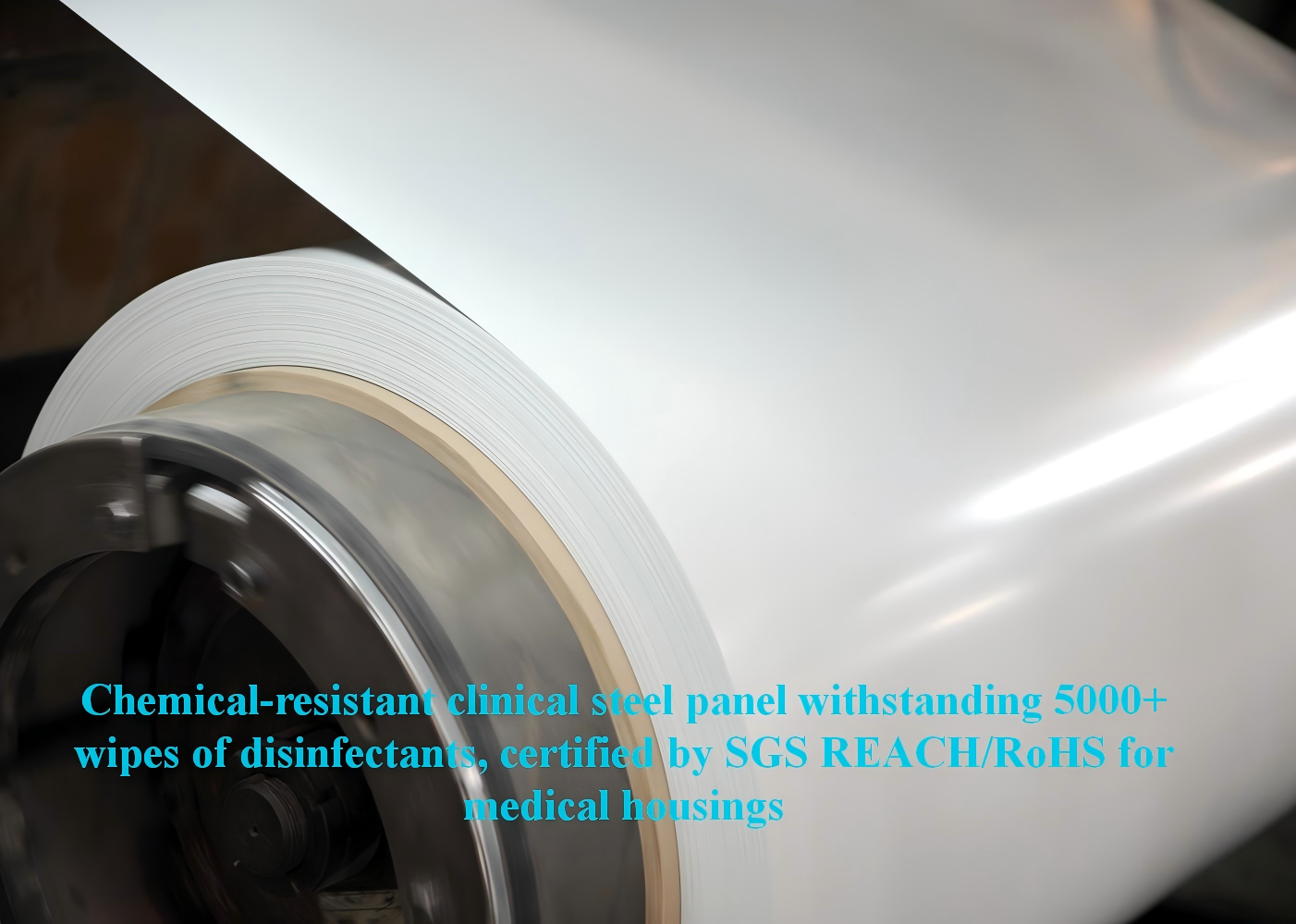
For coated steel coil and sheet, a compliance document is useful only when it supports the requirement of the intended application and matches the product being considered. A fire classification for refinery pipe jacketing, chemical migration test information for food-contact material, and antimicrobial test information answer different questions. They should not be treated as interchangeable proof simply because each is associated with a coated steel product or a familiar compliance label.
Three product examples illustrate the distinction: PVDF REF A2 ZAM 0.5/0.7 mm for refinery pipe jacketing, YS-ECCS-G2-PF for food-contact applications, and ZAM-PCM-MGA0508 for antimicrobial panels. The available product information associates each with a different evidence set. For buyers at the research and evaluation stages, the practical task is to connect the intended use, exact product configuration, and relevant test evidence before comparing offers or writing acceptance terms.
Why qualification evidence differs by coating family
Qualification starts with the claim a material is expected to support. A fire classification identifies a fire-performance claim for a defined product; migration tests address specified substances under stated test conditions; and an antimicrobial claim concerns measured activity against named organisms. These are distinct evidence questions. A document for one does not, by itself, answer the others.
That distinction matters when a shortlist uses broad labels such as “A2,” “food grade,” “REACH/RoHS compliant,” or “antimicrobial.” A label may help identify the subject of a supplier’s claim, but procurement review still needs enough detail to connect it to the actual material under consideration. Product name, substrate, coating system, thickness or range, intended use, and the test or certificate scope should be checked together where those details are available.
The three examples in this article are product-specific examples from YOUNGSON METAL’s supplied product information. They are not evidence that every PVDF, ECCS, ZAM, food-contact, or antimicrobial coated steel product has the same qualification. Nor does a portfolio label establish that a particular batch has been tested. Buyers should read each claim in the context of the stated model and request the supporting document that matches their own project requirements.
Refinery pipe jacketing: PVDF REF A2 ZAM 0.5/0.7 mm
For the refinery pipe-jacketing example, the central evidence item is the stated fire classification. The product record identifies PVDF-REF-A2-ZAM-0.5-0.7, also described as PVDF coated galvanized and ZAM steel coil for refinery pipes, and states that it is certified to EN 13501-1 classification A2-s1,d0,t1. It also lists ASTM E84 Class A. The specified thicknesses are 0.50 mm and 0.70 mm, and the stated width is 1000 mm.
The same record describes galvanized steel (Z180) or Zn-Al-Mg (ZAM) coated steel as base-metal options. It gives a PVDF coating system of 20–35 μm on the top and 5–15 μm on the backer. These are product-record details to preserve in a specification, not interchangeable details that can be generalized to all PVDF-coated steel. If the project evaluates a particular substrate or thickness, the evidence submitted for review should identify the corresponding configuration clearly.
For a buyer, the EN 13501-1 classification is relevant because the stated application is refinery thermal-insulation cladding and petrochemical pipe jacketing. It does not remove the need to check whether the document covers the proposed product construction and the project’s required classification. The provided record lists both the classification and the model, but it does not include the underlying certificate or report. Therefore, the product claim is a starting point for document review rather than a substitute for reviewing the actual evidence.
Before shortlisting this option, compare the required thickness, substrate, coating construction, and width against the proposed supply. Then check that the fire document names or otherwise unambiguously covers the product configuration under evaluation. If a project specification calls for evidence beyond the listed classification, that requirement needs its own supporting documentation; the available product record does not establish additional fire, installation, or project-level performance.
The product record also mentions a small-diameter coil option with a 200 mm inner diameter, described as intended for refinery pipe-insulation site efficiency. Buyers considering that option should treat the coil dimension as a supply-format detail, separate from the fire classification. Its presence does not expand the scope of the fire evidence. In procurement documents, keep dimensional requirements and fire-qualification requirements as separate, verifiable line items.
Food-contact coated steel: YS-ECCS-G2-PF
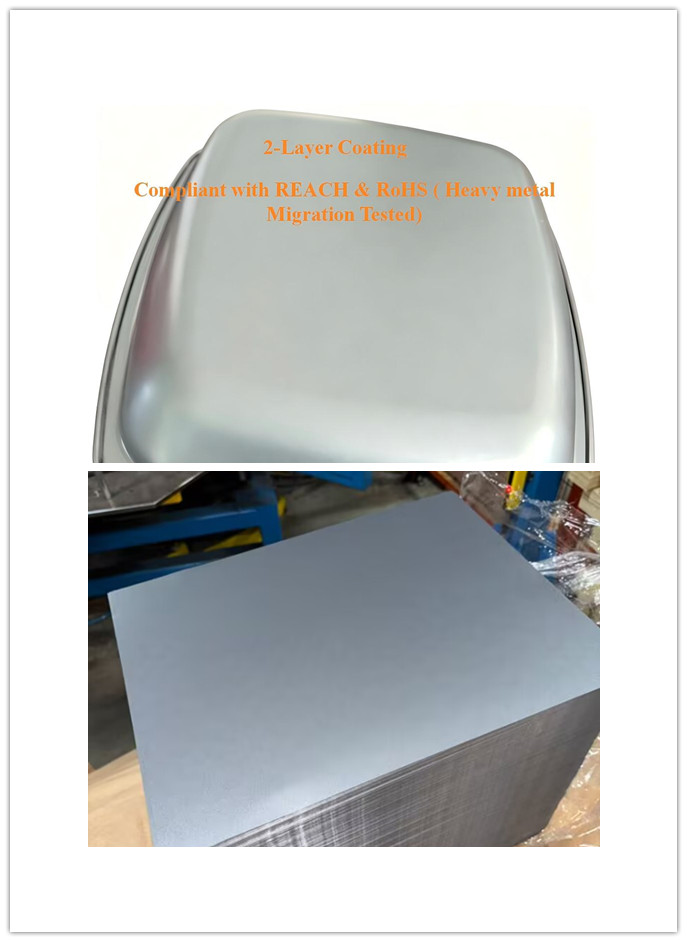
For food-contact screening, the YS-ECCS-G2-PF product record identifies a different evidence set: heavy-metal migration testing associated with RoHS and REACH, plus tests using 3% acetic acid and 5% citric acid. The record describes the product as food-grade, PFAS-free, and suitable for deep drawing. It lists ECCS or aluminized steel as base-metal options and a two-layer non-stick coating system.
Its listed thickness range is 0.30–0.60 mm, with width from 4 mm to 1000 mm and custom slit-to-width available. Listed finishes include matte black, black silver, grey silver, and milk white. The stated applications include cakeware and bakeware production and commercial food-processing equipment. Those details help buyers identify the material family and the intended screening context; they do not establish that every listed finish, substrate, or supplied configuration has identical test coverage.
Migration evidence and acid-test evidence should be read as test-specific information. The mention of a 3% acetic acid test does not automatically stand in for the separately listed 5% citric acid test. Likewise, the product record’s reference to RoHS and REACH heavy-metal migration testing should be checked against the actual report scope and the product being purchased. A general RoHS or REACH statement alone does not answer the specific migration questions for a food-contact application.
For evaluation, match the submitted report to the product’s model, coating, substrate, and any other scope details shown in the document. Confirm which test corresponds to each buyer requirement, including the stated test solution or concentration where applicable. The available product information names the two acid tests and the heavy-metal migration testing, but it does not provide report numbers, test dates, laboratory details, or results tables. Those details should not be inferred from the product description.
Application fit also requires restraint. The product record associates YS-ECCS-G2-PF with cakeware, bakeware, and commercial food-processing equipment, and states that it is suitable for deep drawing. It does not describe a specific customer deployment or define every food-contact condition. A buyer evaluating a different contact medium, use condition, or finished part should establish whether the available reports cover that intended use rather than relying on the broad “food grade” label alone.
Antimicrobial panels: ZAM-PCM-MGA0508
ZAM-PCM-MGA0508 is the antimicrobial panel example. Its product record describes medical-grade antimicrobial matte-white coated steel, with deep-drawn galvanized steel or premium ZAM steel as base-metal options. The stated thickness range is 0.50–0.80 mm, and the record describes a dual-sided, two-layer coating system: 10–20 μm on the top and 7–12 μm on the back.
The record identifies antimicrobial efficiency of at least 99% against E. coli and Staphylococcus aureus, described as SGS certified. It also describes the material as SGS-certified and REACH/RoHS compliant. These statements are specific to the product information supplied for this model; they should not be generalized to other matte-white coils or to all ZAM-PCM products.
For an antimicrobial claim, the named organisms and the reported result are important elements of the evidence description. They define what the product record says was addressed, rather than proving performance against every microorganism or under every operating condition. The available information does not include the underlying SGS document, its test method, test conditions, date, or report number. Those items should therefore be verified from the applicable report before the claim is used as a purchase acceptance criterion.
The listed application context includes medical-device manufacturing, hospital cleanroom construction, clinical diagnostic equipment casings, laboratory furnishings, and other high-sanitation healthcare environments. The record also describes a low-glare clinical matte-white finish, anti-fingerprint positioning, and deep-drawing, stamping, and bending workability without coating delamination. These are product-record descriptions, not evidence that a finished assembly is suitable for a particular clinical environment. Buyers should separate the antimicrobial evidence from requirements for forming, surface appearance, cleaning, or the completed equipment.
The product information additionally states chemical endurance under more than 5,000 continuous wipes using 75% ethanol, isopropyl alcohol, sodium hypochlorite, and hydrogen peroxide without degradation. Because the available record does not provide the test report or full test conditions, this statement should be treated as a model-specific claim to verify—not as a universal cleaning protocol or a guaranteed result for every fabricated part. Where cleaning durability affects acceptance, the purchase specification should identify the relevant evidence and configuration.
How the three evidence paths differ
| Product example | Evidence stated in the product record | Key review focus |
|---|---|---|
| PVDF-REF-A2-ZAM-0.5-0.7 | EN 13501-1 A2-s1,d0,t1; ASTM E84 Class A | Confirm classification evidence covers the proposed substrate, thickness, and coating configuration. |
| YS-ECCS-G2-PF | RoHS/REACH heavy-metal migration testing; 3% acetic acid and 5% citric acid tests | Match each report and test condition to the intended food-contact requirement and product configuration. |
| ZAM-PCM-MGA0508 | SGS-described antimicrobial result of ≥99% against E. coli and Staphylococcus aureus; REACH/RoHS claim | Verify the report scope, organisms, method, conditions, and the exact coated panel model. |
The table is a screening aid, not a declaration that the underlying reports have been independently reviewed here. The source material provides product-record statements, but the underlying certificates or laboratory reports were not included. That distinction is material: product descriptions can identify what evidence to request, while the report itself is needed to evaluate the scope and conditions relevant to a project.
Reading documents before shortlisting
A useful document review follows the claim from the project requirement to the exact material and then to the test record. Begin with the requirement: fire classification for the refinery cladding example, specified migration and acid-test evidence for the food-contact example, or a defined antimicrobial claim for the panel example. Next, identify the precise product model and configuration. Finally, check that the supporting document is about that product and addresses the stated requirement.
- Identify the product: retain the model name, substrate options, coating family, thickness, and other relevant dimensions as provided. Do not treat similar product names as proof of identical construction.
- Identify the claim: distinguish fire classification, migration testing, acid testing, antimicrobial testing, and general regulatory references. One category of evidence does not automatically satisfy another.
- Read the document scope: check the product or sample identified, test or certificate scope, method and conditions when supplied, and any limitations stated in the document.
- Check configuration alignment: confirm that the report applies to the selected substrate, coating, thickness, and finish where those details are in scope. If a document does not establish that relationship, do not assume it.
- Keep claims bounded: an antimicrobial result against two named organisms is not a claim about all organisms; an acid test is not evidence for every chemical exposure; and a fire classification does not replace unrelated application requirements.
This sequence helps separate evidence that is directly relevant from background paperwork. A supplier may provide multiple certificates or test references, but document quantity does not resolve whether the right product was tested for the right claim. For a shortlist, the useful comparison is therefore not simply “has a certificate” versus “does not have a certificate.” It is whether each candidate’s documented evidence can be mapped to the actual project criteria.
Connect purchasing terms to the evidence
Purchasing terms should state the accepted product configuration and the evidence that will be used to assess it. For the PVDF refinery example, the acceptance language can identify the required model family, selected thickness and substrate, and the applicable fire classification document. For YS-ECCS-G2-PF, it can specify which migration and acid-test evidence is required for the intended food-contact evaluation. For ZAM-PCM-MGA0508, it can identify the antimicrobial claim and the report details that must correspond to the purchased panel.
These examples are not interchangeable templates. The acceptance criteria for a fire-classified jacketing material should not be copied into a food-contact specification, and a food-contact test list does not establish an antimicrobial claim. In each case, define what will be checked, which product configuration it applies to, and what document will demonstrate conformity. If the buyer requires a report, certificate, or test condition not identified in the available product information, that requirement should be clarified before the order is treated as qualified.
YOUNGSON METAL is the brand used by Chongqing Youngson Metal Products CO. LTD., whose supplied product information covers these three distinct coated-steel examples. The company’s [official website](https://www.youngsonmetal.com/) provides a company reference; product-specific qualification still depends on evidence for the model and claim under review. For evaluation teams, that separation keeps supplier identity, product description, and test proof from being mistaken for one another.
FAQ
What fire evidence is stated for PVDF-REF-A2-ZAM-0.5-0.7?
The product record states EN 13501-1 classification A2-s1,d0,t1 and ASTM E84 Class A. It lists 0.50 mm and 0.70 mm thicknesses. The underlying certificate or report was not included in the supplied information, so buyers should confirm that the document covers the proposed product configuration.
What testing is listed for YS-ECCS-G2-PF?
The product record lists RoHS and REACH heavy-metal migration testing, a 3% acetic acid test, and a 5% citric acid test. It does not provide report numbers, test dates, laboratory details, or results tables; those should not be inferred from the product description.
Which organisms are named in the antimicrobial claim for ZAM-PCM-MGA0508?
The product record states an antimicrobial efficiency of at least 99% against E. coli and Staphylococcus aureus, described as SGS certified. The supplied information does not include the underlying report, method, or test conditions.
Can one generic certificate qualify all three coating families?
No. The three product examples have different evidence questions: fire classification, food-contact-related migration and acid tests, and antimicrobial performance. A document should be assessed for its stated scope and its match to the exact product and project requirement, rather than treated as a universal qualification.
¿Tiene preguntas o necesita más detalles?
Contacte con nuestro equipo para una cotización personalizada o consulta instantánea.
Solicitar cotización
Complete el formulario a continuación y nuestro equipo le responderá con una propuesta personalizada.
Chat directo de WhatsApp
¿Prefiere chatear en tiempo real? Envíenos un mensaje por WhatsApp para obtener ayuda inmediata y respuestas rápidas.
- Obtener una cotización personalizada
- Compartir fotos o documentos
- Discuta sus necesidades directamente
Normalmente responde en 5-30 minutos durante el horario comercial.