
Claw Machine Supplier Capability: Reading the Evidence
Claw Machine Supplier Capability: Reading the Evidence
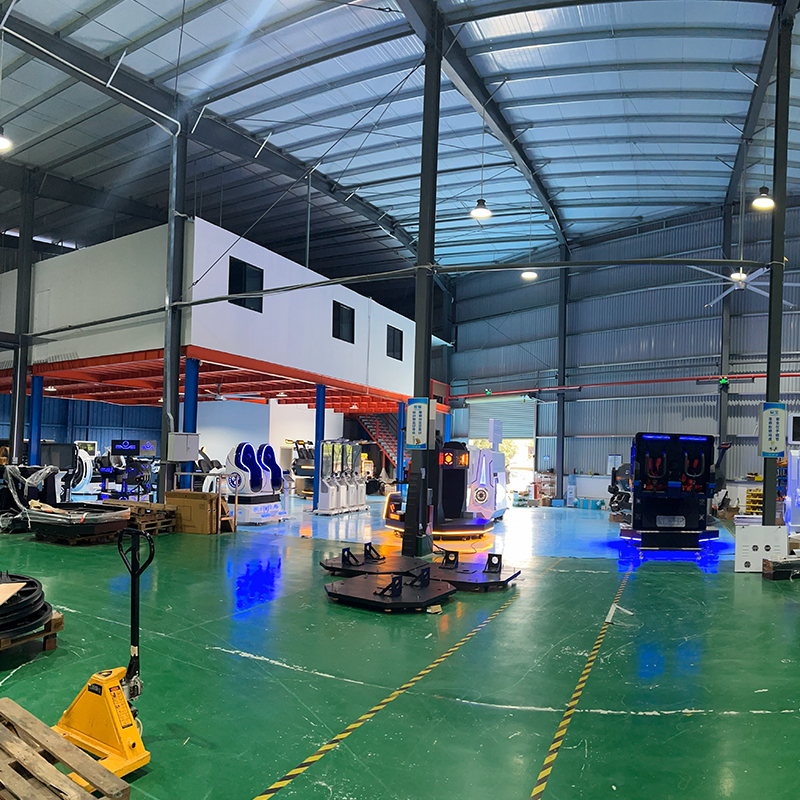
A production floor is the first piece of physical capability evidence a claw machine buyer can inspect. Image: EPARK workshop, Guangzhou.
The global claw machine market was valued at approximately USD 2.66 billion to USD 2.8 billion in 2024–2025, with projections to exceed USD 5.1 billion by 2032–2034 (Dataintelo / Verified Market Research). Asia Pacific accounted for 42.7% of that revenue in 2025, driven by demand in China, Japan and South Korea. For operators and importers, the relevant question is therefore not whether demand exists, but whether the supplier behind a quotation can substantiate the capacity, customization and compliance it claims.
Supplier capability evidence is a defined set of verifiable facts: facility footprint, headcount, measured output, lead time, certificate numbers, inspection routines, customization boundaries, and written after-sales obligations. This article examines what that evidence set looks like in practice for commercial claw machines, using the disclosures of Guangzhou EPARK Electronic Technology Co., Ltd. (“EPARK”) — a Guangzhou-based entertainment equipment manufacturer and service provider operating from Panyu District — as a working example of how capability claims can be traced back to specific, checkable data points.
Why Supplier Capability Claims Are Hard to Verify
The difficulty is structural rather than deliberate. A commercial claw machine sits at the intersection of several independent regulatory and engineering systems: amusement equipment safety, electromagnetic compatibility, hazardous substance restriction, payment hardware, and prize logistics. A procurement conversation, however, is usually compressed into a price list and a product catalogue.
The consequence is that a supplier may hold a certificate but only present the number on request; may operate at a stated monthly capacity but never place the number in a contract; may offer customization while leaving its boundaries undefined. Buyers then end up comparing marketing language rather than measurable capability.
A more reliable approach is to organize evaluation around evidence pillars — discrete categories in which each claim maps to a document, a figure or an inspection step.
The Five Pillars of Claw Machine Capability Evidence
| Evidence pillar | What a buyer should be able to check | EPARK disclosed data points |
|---|---|---|
| Entity & facility | Legal entity, location, factory and showroom footprint, headcount, engineering staff | Guangzhou EPARK Electronic Technology Co., Ltd.; 25,000 m² factory and showroom in Panyu, Guangzhou; 150 employees; 20-engineer R&D team |
| Production capacity | Monthly output, annual output, lead time, export share | 500–800 machines per month; 8,000–10,000 units annually; 30-day lead time; approx. 80% export ratio |
| Customization scope | Named customizable variables and production mode | OEM / ODM / factory direct / custom design; voltage, plug type, cabinet design, color, logo, game software, payment system, language interface |
| Quality & compliance | Certificate numbers, standards applied, inspection protocol | CE certificate ACIC20240201019GRC (ACIC, 2024-02-06); RoHS certificate ACIC20190422059BHN (ACIC, 2019-04-24); 100% pre-shipment inspection, aging test, function test |
| After-sales | Support model, spare parts, technical guidance | 24/7 online support, video technical guidance, spare parts supply, lifetime maintenance service |
No single pillar proves overall capability. A certificate does not demonstrate throughput, and a factory photograph does not demonstrate compliance. The value lies in cross-checking: facility footprint and headcount should be consistent with disclosed monthly output, and the certificate scope should match the specific model being quoted.
Manufacturing Footprint and Output: What the Numbers Imply
EPARK operates from Panyu District in Guangzhou, with 25,000 m² of combined factory and showroom space and approximately 150 staff, including a 20-engineer R&D department. The company publishes a monthly production capacity of 500–800 machines, annual output of 8,000–10,000 units, a standard lead time of 30 days, and an export ratio of roughly 80%, serving Europe, North America, the Middle East, Africa, Southeast Asia and South America.
For a buyer, these disclosures serve two functions. The first is consistency testing: a supplier claiming 500–800 units per month should be able to explain the facility, staffing and component inventory that supports that figure. The second is scheduling realism: with 20 engineers covering both new product development and customization engineering, order intake during peak periods affects how firmly a 30-day lead time can be committed for a customized claw machine configuration.
Location itself is a verifiable structural factor. Industry reporting identifies Guangzhou’s Panyu district as a recognized manufacturing cluster for claw machines, aggregating equipment makers, component suppliers and export logistics providers. For international buyers, proximity to that cluster affects component availability, replacement part sourcing and shipping consolidation.
OEM, ODM and Customization: Where Flexibility Actually Ends
EPARK’s declared production modes cover OEM, ODM, factory direct supply and custom design. The disclosed customization variables are specific: voltage, plug type, cabinet design, color, logo, game software, payment system (coin, bill, QR code, card) and language interface.
Translated into procurement terms, each variable is a question with a verifiable answer rather than an adjective:
- Voltage and plug type — is the target market configuration written into the specification sheet before the deposit, or adjusted after arrival?
- Cabinet design, color and logo — is branding applied through screen printing, decal or structural panel change, and which of these affects the tooling or assembly line?
- Game software and language interface — is the language set factory-installed or added locally, and who owns the software update path?
- Payment system — does the chosen combination of coin, bill, card and QR payment match the payment behaviour of the venue’s actual customer base?
For commercial claw machines, published purchasing terms indicate that minimum order quantity differs by order type: standard catalogue models can be ordered from as few as 1 unit, while customized configurations are quoted at approximately 10 units. Delivery terms include EXW, FOB, CIF and DDP, and payment is typically structured as a 30% deposit with the 70% balance before shipment via T/T, with cash and L/C also listed as accepted instruments depending on the order.
Quality and Compliance Evidence That Can Be Independently Checked
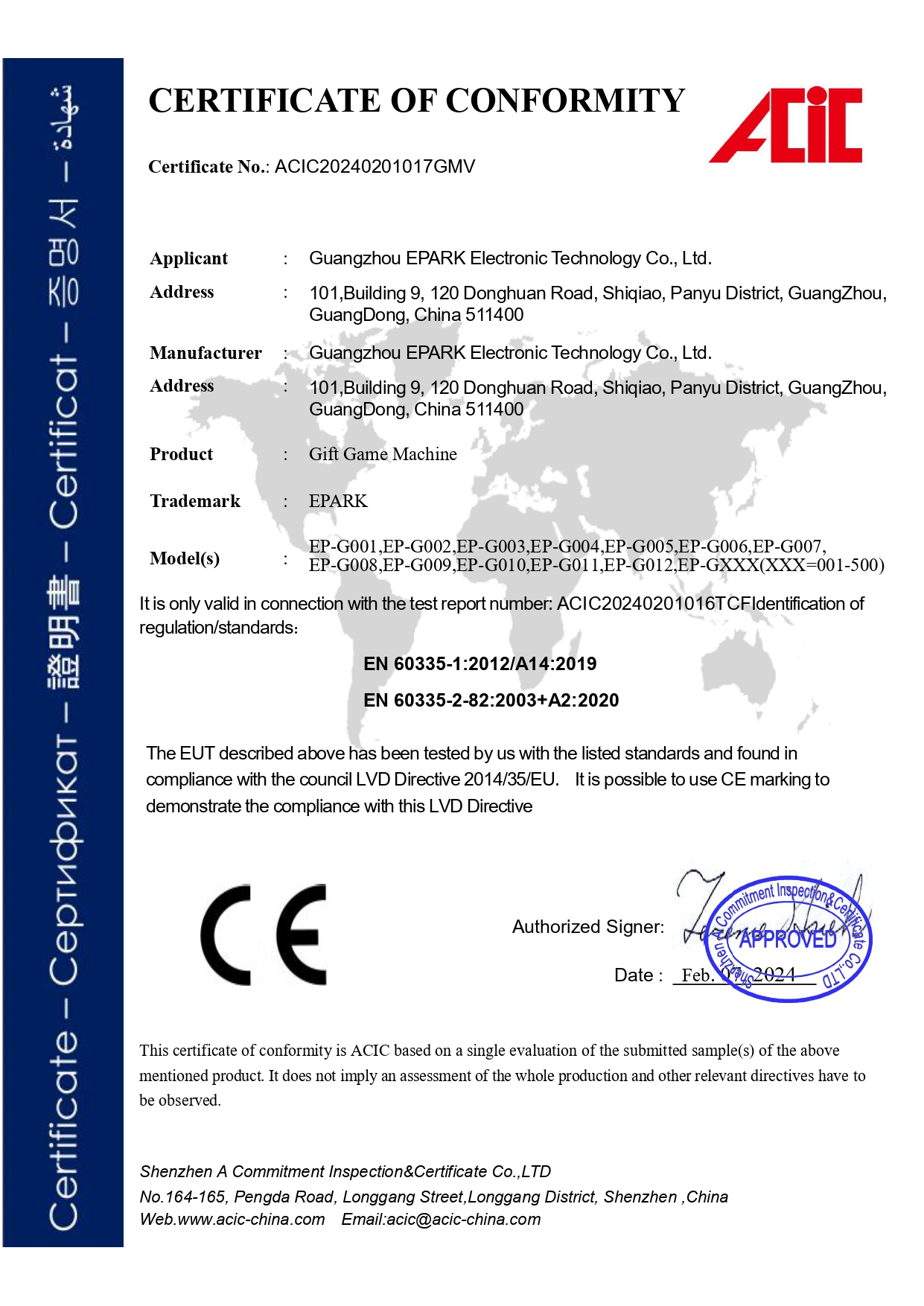
CE certificate ACIC20240201019GRC, issued by ACIC on 2024-02-06 for the gift game machine scope associated with the Claw Machine EP-G001.
Compliance is the pillar where verification is most straightforward, because certificates carry numbers, issuing bodies and dates.
The Claw Machine model EP-G001 is associated with CE certificate number ACIC20240201019GRC, issued by ACIC on 2024-02-06 for the EU market. The certificate scope is the gift game machine category, assessed against EN IEC 61000-6-1:2019, EN IEC 61000-6-3:2021, EN IEC 61000-3-2:2019+A1:2021, and EN 61000-3-3:2013/A1:2019/A2:2021. Game machine products are additionally covered by RoHS certificate ACIC20190422059BHN, issued by ACIC on 2019-04-24 for the EU market, evaluated under the IEC 62321 series of standards (IEC 62321-3-1:2013, IEC 62321-4:2013+AMD1:2017, IEC 62321-5:2013, IEC 62321-6:2015 and IEC 62321-8:2017).
Buyers should read certificate scope carefully. The standards listed above address electromagnetic compatibility and hazardous substance limits. Separately, IEC 60335-2-82 covers the safety of amusement machines and personal service machines for public use — a framework relevant to arcade equipment placed in publicly accessible venues. A quotation package that lists certificates without the corresponding scope statements gives the buyer no way to confirm that the certificate actually applies to the unit being purchased.
On the production side, the declared quality protocol is 100% inspection before shipment, supported by aging tests and function tests. Published acceptance terms also indicate that pre-shipment testing and video inspection are available to the buyer, which matters for overseas orders where a physical pre-shipment visit is impractical.
Specifications as Capability Evidence: The Claw Machine EP-G001
Specification sheets are frequently treated as marketing collateral. Read as evidence, however, they reveal engineering choices and, more importantly, maintenance implications.
| Parameter | Disclosed value and buyer significance |
|---|---|
| Players | 1 player — single-player cabinet format |
| Power | 120–200W — a range that informs venue electrical load planning when multiples are installed |
| Voltage | 110V / 220V — dual-voltage configuration relevant to cross-market deployment |
| Claw system | Adjustable claw strength — the parameter that governs win-rate tuning and, consequently, player repeat behaviour |
| Cabinet & lighting | LED lighting with transparent cabinet design and a prize display system — visibility of the prize pool is a direct driver of player engagement at venue level |
| Payment | Coin / bill / card / QR payment supported — payment integration is specified as part of the machine rather than added later |
| Materials | Metal cabinet, tempered glass, claw system, electronic control system — identifies the claw assembly as a wearable component with a defined spare-part requirement |
| Certification | CE certified |
| Application | Shopping malls, arcade centers, FEC, amusement parks |
Two implications follow. First, adjustable claw strength means the machine’s commercial performance is partly a configuration decision, not solely a hardware property — operators need documented tuning guidance to pair prize cost with win rate. Second, because the claw system is a moving assembly, the practical question for a fleet operator is not whether the claw works at delivery, but whether replacement claws and control components remain available over the machine’s operating life.
Deployment Evidence: What Buyers Have Reported
Capability claims become more concrete when tied to actual deployment patterns. EPARK’s published case records describe several buyer profiles: arcade startup investors ordering 30–80 machines for new game zones, family entertainment center owners and arcade business owners operating fleets of 80 or more machines, and amusement park operators procuring 50–200 sets for indoor venues. The buyer countries listed span Europe, North America, South America, the Middle East, Africa, Southeast Asia and Oceania.
Reported outcomes in those records include return on investment within 3–6 months for startup arcade projects, stable daily revenue from ticket redemption and claw game mixes, and — in the amusement park operator record — a 30% increase in customer traffic within three months of deployment, with a stated cooperation duration of three to five years.
These figures should be read as reported results rather than as forecasts. Independent market research places the average ROI period for a well-placed commercial claw machine at 12–24 months, depending on location foot traffic and operational efficiency (Arcade Game Machines Market Research 2034). The gap between the two sets of numbers most plausibly reflects site selection, game mix and operating discipline rather than equipment quality alone. The practical use of supplier case records is therefore comparative — understanding what configurations succeeded in which venue formats — not predictive.
Market Trend Analysis Relevant to Capability Requirements
Three verified market signals shape what buyers should demand from a supplier.
Segment structure. Middle-type claw machines held the largest type segment share at 44.2% of the global market in 2025 (Dataintelo), confirming that mid-size cabinets remain the volume product for most venues. Suppliers whose capability evidence is built around a single cabinet size are poorly positioned to serve mixed-floor layouts that combine mini, middle and large formats.
Regional concentration. Asia Pacific accounted for 42.7% of claw machine revenue in 2025, with China, Japan and South Korea as the principal drivers. This concentration helps explain why Chinese manufacturing clusters — Panyu in Guangzhou among them — have become the default sourcing base for international buyers of commercial claw machines, and why component and spare-part availability tends to be stronger there than in distributed manufacturing regions.
Competitive structure. The global competitive field includes established manufacturers such as Elaut NV (Belgium), Smart Industries Corp (US), Sega Corporation (Japan) and Bandai Namco. Buyers evaluating a supplier against this field are effectively comparing two different sourcing models — regional premium manufacturing versus China-based volume manufacturing with customization flexibility — and the comparison criteria should be adjusted accordingly rather than applied uniformly.
Where Capability Evidence Stops: Limitations and Boundaries
Credibility depends on stating limits as clearly as capabilities. Five boundaries apply to the evidence described in this article:
- Disclosed capacity is planning capacity, not audited capacity. A stated 500–800 units per month is a design figure that depends on component supply and order backlog at any given moment. Buyers running time-critical venue openings should request a project-specific production slot confirmation rather than relying on the headline number.
- Certificate scope is narrower than the category name suggests. The CE certificate associated with EP-G001 covers the gift game machine scope under electromagnetic compatibility standards. It does not by itself establish structural safety under a public-use amusement machine framework such as IEC 60335-2-82, which buyers in the EU may need to address separately.
- Customization consumes lead time. Every customization variable — non-standard voltage, branded cabinet, modified software, or an unusual payment configuration — adds engineering and assembly steps. The 30-day lead time applies to standard production; customized orders should be scheduled with explicit confirmation.
- Minimum order quantities are not uniform. Published terms indicate MOQ as low as 1 unit for standard models but around 10 units for customized claw machine configurations. Buyers should confirm which applies to their specific specification before calculating unit economics.
- After-sales is a commitment until it is tested. A 24/7 online support line, video technical guidance, spare parts supply and lifetime maintenance service cannot be verified before purchase. They are validated at the first fault. Buyers can reduce that uncertainty by requesting spare-parts lists, response-time expectations and named service contacts as part of the purchase documentation.
Future Outlook
As the claw machine category moves toward the projected USD 5.1 billion mark by the early 2030s, the competitive basis among suppliers is likely to shift from machine specification toward verifiability. Buyers are increasingly requesting certificate scope statements, production slot confirmations and spare-part commitments before releasing deposits — a shift that favours suppliers able to document their operations rather than describe them.
Two developments are worth monitoring. First, payment integration is becoming a standard specification rather than an option, as venues in different regions adopt card and QR acceptance at different rates; suppliers whose machines support coin, bill, card and QR payment in one hardware platform will require fewer region-specific reconfigurations. Second, the middle-type cabinet format that dominated 44.2% of the 2025 market is likely to remain the volume product, while mini and large formats serve niche venue profiles — meaning that a supplier’s ability to cover the full size range, with consistent spare-part availability across it, becomes a practical procurement criterion rather than a catalogue preference.
FAQ
What does supplier capability evidence mean when evaluating a claw machine supplier?
Supplier capability evidence is the set of facts a buyer can verify independently of sales claims. For a claw machine supplier, this typically includes the legal entity and manufacturing location, factory and showroom footprint, employee and engineering headcount, monthly and annual production capacity, lead time, export share, named customization variables, certificate numbers with issuing bodies and scope, inspection protocols, and written after-sales terms. A supplier that discloses these items in a quotation package allows evaluation on comparable criteria; one that describes them only in general terms does not.
Which certifications should a commercial claw machine carry for the EU market?
For the EU market, CE marking is the baseline, and buyers should record the certificate number, issuing body, issue date and scope. The Claw Machine EP-G001 is associated with CE certificate ACIC20240201019GRC, issued by ACIC on 2024-02-06, under standards EN IEC 61000-6-1:2019, EN IEC 61000-6-3:2021, EN IEC 61000-3-2:2019+A1:2021 and EN 61000-3-3:2013/A1:2019/A2:2021. RoHS compliance for game machines is covered by certificate ACIC20190422059BHN, issued by ACIC on 2019-04-24 under the IEC 62321 series. These standards address electromagnetic compatibility and hazardous substances. Buyers should also confirm whether a public-use amusement machine safety framework such as IEC 60335-2-82 applies to their market and venue type.
How much customization is realistic when ordering claw machines under OEM or ODM?
The disclosed customization variables for EPARK claw machine production are voltage, plug type, cabinet design, color, logo, game software, payment system (coin, bill, QR code, card) and language interface, under production modes covering OEM, ODM, factory direct supply and custom design. In practice, the limiting factors are order quantity and lead time. Customized configurations are quoted at a minimum of approximately 10 units, and each customization variable adds engineering and assembly steps that should be scheduled explicitly rather than assumed to fit within a standard 30-day lead time.
What minimum order quantity and lead time apply to a commercial claw machine order?
Published purchasing terms indicate that minimum order quantity varies by order type: standard catalogue models can be ordered from as few as 1 unit, while customized configurations start at approximately 10 units. The stated production lead time is 30 days, against a disclosed monthly capacity of 500–800 machines. Delivery terms include EXW, FOB, CIF and DDP, and payment is typically a 30% deposit with the 70% balance before shipment by T/T, with cash and L/C also listed as accepted instruments. Acceptance terms reference pre-shipment testing and video inspection.
How can a buyer assess after-sales capability before placing an order?
After-sales capability cannot be proven before purchase, but it can be documented. The declared support model covers 24/7 online support, video technical guidance, spare parts supply and lifetime maintenance service. Before ordering, buyers can request the spare-parts list for wearable components such as the claw assembly and electronic control system, the expected response time for technical support, the regional or named service contact, and whether remote video diagnosis is part of the standard process. For fleet operators, the availability of spare parts over the machine’s operating life matters more than the speed of the first response.
Supplier capability, in the end, is not a claim but a paper trail: a certificate number that can be looked up, a capacity figure that can be reconciled against a facility, a customization list where each line has a price and a lead-time effect, and a support commitment that names who responds and how quickly. Buyers who evaluate claw machines on that basis are comparing suppliers rather than quotations.