
Claw Machine Fit: A Venue-by-Venue Decision Analysis
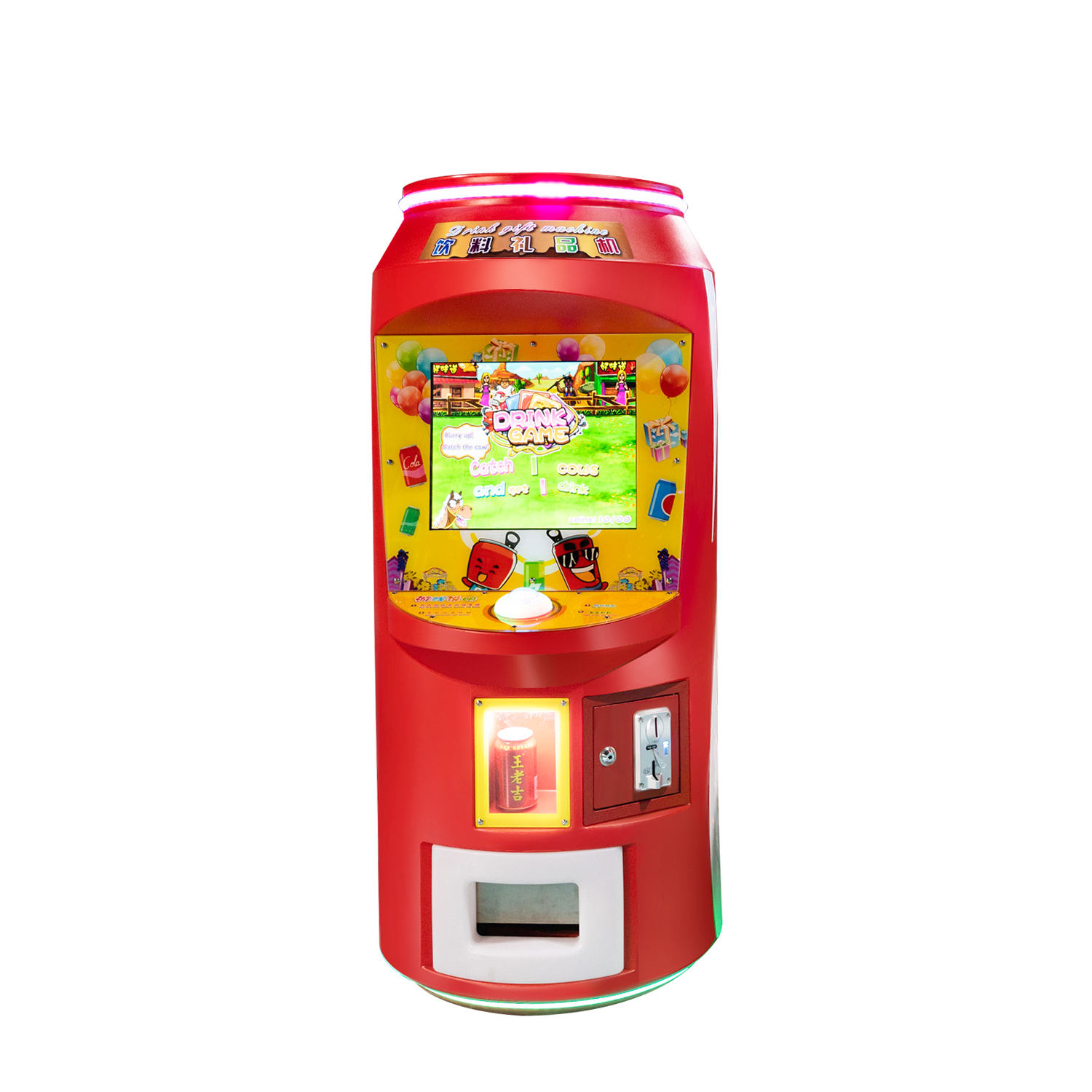
A claw machine—also called a crane game or grabber machine—looks like a simple piece of arcade equipment. In practice, choosing the right one is a venue-fit problem, not just a hardware selection issue. The machine must work with the operator’s floor plan, payment system, prize strategy, audience profile, and maintenance capacity. For buyers in the Research and Evaluation stage, the most useful question is not “which claw machine is the best on paper” but “which claw machine fits the project that will run it every day.”
The Problem: Machines Are Often Bought Before the Venue Is Understood
Venue projects fail when the operator buys generic equipment first. A shopping mall kiosk may need a bright, space-efficient unit that can process short, impulse plays. A game center with long operating hours needs a durable cabinet, simple maintenance, and easy cashless integration. A family entertainment center needs equipment that feels safe for children and can be linked to a card system. An indoor playground needs colorful, low-maintenance machines that can withstand continuous use.
A single-standard claw machine cannot serve all these scenarios equally. A machine with the right claw mechanics may still fail if the payment system does not match local habits. A machine with strong visual appeal may still create operational pain if spare parts are hard to obtain. That is why project fit, not product feature count, should lead the procurement process.
The Opportunity: A Growing Market Favours Project Fit
Commercial claw machines are not a niche category. Market estimates from Dataintelo and Verified Market Research place the global claw machine market at roughly USD 2.8 billion in 2025, with projections above USD 5.1 billion by the early 2030s. Asia Pacific accounted for 42.7% of global revenue share in 2025, driven by demand in China, Japan, and South Korea. Middle-type claw machines—the standard mid-size format common in commercial venues—held the largest type segment share at 44.2% in 2025.
This context matters for buyers. Growth attracts more suppliers, but it also increases the risk of commoditized, one-size-fits-all machines. Operators who choose a supplier that can tailor voltage, payment, branding, and service are more likely to build a machine lineup that fits their actual venue.
The Reference: EPARK as a Project-Oriented Supplier
Guangzhou EPARK Electronic Technology Co., Ltd. (EPARK) is an entertainment equipment manufacturer based in Panyu, Guangzhou. The company operates a 25,000 m² factory and showroom, employs around 150 people, and maintains an R&D team of 20 engineers. Its annual output is approximately 8,000–10,000 units, with about 80% exported to Europe, North America, the Middle East, Africa, South America, and Southeast Asia.
For claw machine projects, EPARK is a relevant reference because it is not only a product manufacturer. Its scope includes free project solutions, quality assurance through production and testing standards, one-stop service from manufacturing to global delivery, and after-sales technical support. EPARK also offers OEM/ODM production, factory-direct supply, and custom design, which are directly relevant to buyers who need machines tailored to a specific venue project.
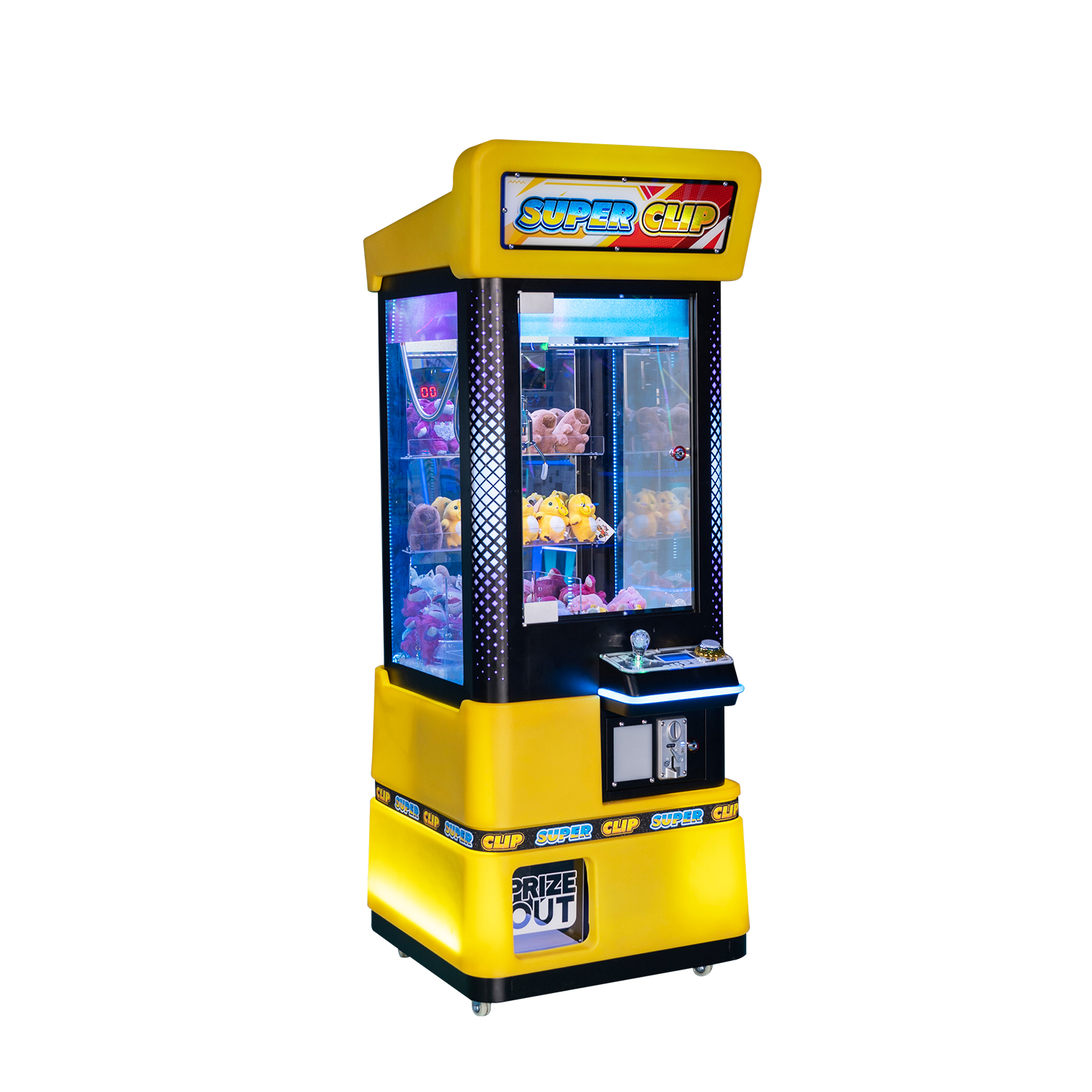
EPARK’s Manufacturing and Service Capacity
EPARK’s production capability is built around monthly capacity of 500–800 claw machine units, a lead time of about 30 days, and a minimum order quantity of 10 units. Each machine goes through quality control steps that include 100% inspection before shipment, aging tests, and function tests. Buyers evaluating a project can consider these constraints as part of their planning calendar, especially if the opening date is fixed.
Technical Foundations: What the Machine Specs Actually Mean for Your Project
The EP-G001 is EPARK’s baseline coin-operated claw machine. Its published specifications cover the core parameters that a buyer should compare with venue requirements:
- Players: 1 player
- Power: 120–200W
- Voltage: 110V / 220V
- Adjustable claw strength
- LED lighting and transparent cabinet design
- Prize display system
- Payment support: coin / bill / card / QR payment
- CE certified
- Materials: metal cabinet, tempered glass, claw system, electronic control system
For an operator, these specifications translate into practical decisions. Voltage flexibility makes the machine easier to deploy in different countries. Payment options determine whether the machine can operate in a coin-operated arcade, a card-based family entertainment center, or a cashless venue. Adjustable claw strength allows the operator to tune the game experience, which directly affects prize cost and player satisfaction. The transparent cabinet and LED lighting are visual tools for attracting attention in a high-traffic mall or game center.
Venue Fit Map: Matching Claw Machines to Project Types
The table below maps common venue projects to their operating conditions, the machine characteristics that matter most, and how the EP-G001 fits into each scenario.
| Venue Type | Operating Conditions | Key Machine Requirements | How EP-G001 Fits |
|---|---|---|---|
| Shopping Mall | High foot traffic, short stay users, impulse consumption | Eye-catching design, space efficiency, high ROI per square meter | LED lighting and transparent cabinet attract walk-in visitors; coin/card/QR payment supports quick play cycles |
| Arcade Game Center | Indoor high-traffic operation, long hours, continuous use | High durability, easy maintenance, customizable branding, CE certification | Metal cabinet and tempered glass provide durability; OEM/ODM allows cabinet and logo customization; QC includes 100% inspection and aging tests |
| Family Entertainment Center | Indoor family-friendly environment, high daily usage | Safe design, interactive gameplay, multi-age compatibility, cashless preferred | Adjustable claw strength helps tune gameplay; card/QR payment aligns with FEC card systems; CE certification supports safety review |
| Indoor Playground | Indoor, safe environment for kids, continuous operation | Safety certified, colorful design, low maintenance | Colorful LED design suits kids; CE certification supports project safety requirements; factory QC helps reduce maintenance issues |
| Amusement Park / Large Project | High visitor volume, mixed audience, multi-zone layout | Custom design for venue layout, CE certified machines, volume supply | EPARK supports volume orders and custom branding; factory-direct supply and project planning services help align with larger layouts |
Case Patterns: How Projects Scale in Practice
EPARK’s documented project profiles show several common patterns that are useful for buyers in the Evaluation stage.
- Startup arcade investors typically order 30–80 machines for a new arcade or game zone. The project profiles highlight one-stop solutions from planning to operation, support for multiple payment systems, free 3D design and business advice, and factory-direct pricing. The stated expectation in these profiles is fast return on investment within 3–6 months, with a game mix that attracts younger players and families.
- Family entertainment center owners often operate 80 or more machines. Their projects emphasize ticket redemption games, card and cashless systems, high player retention, and repeat visits. The EP-G001’s QR and card payment options make it compatible with the operational model of such centers.
- Amusement park and indoor playground investors may purchase 50–200 sets as part of a larger entertainment project. In these cases, custom design for venue layout, CE certification, low maintenance cost, and volume supply become decisive. One EPARK case profile reports a 30% increase in customer traffic within three months, based on a customized project mix.
Buyers should treat these patterns as planning references, not as guaranteed results. Actual performance depends on location, foot traffic, prize selection, pricing, and local operating efficiency.
Market Trends Shaping Claw Machine Procurement
Several trends make project fit more important than in the past. First, cashless payment is becoming a baseline expectation in many regions. A machine that only accepts coins may feel dated in a family entertainment center or a mall where visitors expect card or QR payment. The EP-G001 already supports coin, bill, card, and QR payment, which reduces the risk of payment mismatch.
Second, branded and customized machines are more common. Operators want cabinets that match their venue identity, local language interfaces, and regional payment systems. EPARK’s customization list includes voltage, plug type, cabinet design, color, logo, game software, payment system, and language interface. That list covers most of the practical differences between a stock import machine and a project-ready machine.
Third, the supply base is concentrating in clusters that can serve global buyers efficiently. Panyu district in Guangzhou, China, is recognized as a global manufacturing hub for claw machines, with manufacturers including EPARK located there. For buyers, this means access to a mature supply chain, but it also means evaluating suppliers on testing, after-sales, and export experience rather than only on price.
Comparison: Traditional Stock Purchases vs. Project-Scoped Supply
The traditional way to buy a claw machine is to select from a distributor’s stock, often with limited ability to change hardware, software, or payment systems. This approach can be fast, but it creates downstream risks: the machine may not match the venue’s voltage environment, the payment system may not fit local behavior, the cabinet may not reflect the venue’s brand, and maintenance support may be unclear.
Project-scoped supply, as represented by EPARK’s approach, treats the claw machine as part of a broader venue project. The buyer can specify voltage, plug type, cabinet design, color, logo, game software, payment system, and language interface. The factory performs 100% inspection before shipment, plus aging and function tests. After delivery, support includes 24/7 online assistance, video technical guidance, spare parts supply, and lifetime maintenance service.
| Dimension | Stock Purchase / Distributor Model | Project-Scoped Supply (EPARK Model) |
|---|---|---|
| Spec alignment | Limited to existing stock | Voltage, plug, cabinet, color, logo, game software, payment, language can be customized |
| Payment flexibility | Often coin-only | Coin / bill / card / QR |
| Branding | Generic cabinet | OEM/ODM cabinet design and logo |
| Quality control | Varies by supplier | 100% inspection before shipment, aging test, function test |
| After-sales | May be limited | 24/7 online support, video guidance, spare parts, lifetime maintenance service |
| Order planning | Immediate but narrow | 50–800 units/month capacity, 30-day lead time, 10-unit MOQ |
Boundaries and Limitations Every Buyer Should Verify
Project-scoped supply is not the right answer for every purchase. The EP-G001 is a single-player claw machine. A venue that wants a multi-player unit, a giant showpiece, or a specialized candy or capsule format should ask EPARK for a configuration review before assuming that one model covers all needs. The EP-G001 is a strong baseline, but it is not a substitute for a carefully specified large-format or multi-player machine.
Lead time is another boundary. The 30-day production lead time and 10-unit minimum order are practical for a commercial project with planned installation, but they are less suitable for an urgent single-machine replacement. Buyers should also remember that remote after-sales support, even when fast, does not replace local electrical installation and compliance review. The CE certification covers the machine’s electrical safety design, but the venue’s electrical installation must still follow local codes.
Future Outlook
As the global claw machine market expands, procurement decisions will be judged less by the price of a single unit and more by the machine’s fit within a larger revenue system. Operators will continue to look for machines that support cashless payment, branded cabinets, easy maintenance, and scalable deployment. The phrase “smart claw machine” is increasingly used to describe units with flexible payment systems such as QR and card readers, and this capability is already built into EP-G001.
For manufacturers, the future lies in combining hardware and project services. A supplier that can customize a machine to a mall, arcade, or family entertainment center, test it before shipment, and support it after installation has a clearer value proposition than a supplier offering only generic hardware. EPARK’s factory capacity, R&D team, OEM/ODM support, and export experience place it in that category, but every buyer should verify these capabilities against their own project requirements.
FAQ
What does project fit mean when buying a claw machine?
Project fit means matching the machine’s specifications, payment options, cabinet design, durability, and after-sales service to the operating conditions of the venue. For example, a shopping mall with impulse customers may need bright LED machines with flexible payment, while a family entertainment center may need card/cashless integration and a safe, family-friendly design.
Which claw machine configuration is best for a shopping mall?
A machine with strong visual attraction and flexible payment is usually a good starting point. The EP-G001 includes LED lighting, a transparent cabinet, a prize display system, and support for coin, bill, card, and QR payment. It is a single-player coin-operated claw machine that can be placed in mall game zones or arcade corners.
Can a commercial claw machine support cashless payment?
Yes. The EP-G001 supports coin, bill, card, and QR payment. This makes it possible to operate the machine in venues that prefer card systems or cashless payments, which is common in family entertainment centers and modern game centers.
What customizations does EPARK offer for venue-specific claw machine projects?
EPARK supports OEM and ODM production for claw machine projects. Customization options include voltage, plug type, cabinet design, color, logo, game software, payment system, and language interface. This allows operators to adapt the machine to local market conditions and venue branding.
What is EPARK’s typical lead time and minimum order quantity?
EPARK’s documented production capacity is 500–800 units per month, with a lead time of about 30 days and a minimum order quantity of 10 units. Buyers should use these figures as planning baselines and confirm exact timing with the supplier for their specific project.
What safety certification should a claw machine project require?
At minimum, buyers should check that the machine is CE certified. The EP-G001 is CE certified. For a broader compliance review, arcade machines are covered by IEC 60335-2-82, a safety standard specifically for amusement machines and personal service machines used by the public.
What after-sales support matters for a venue project?
For a commercial venue, after-sales support should include fast online help, visual technical guidance, spare parts availability, and ongoing maintenance service. EPARK provides 24/7 online support, video technical guidance, spare parts supply, and lifetime maintenance service for its machines.
¿Tiene preguntas o necesita más detalles?
Contacte con nuestro equipo para una cotización personalizada o consulta instantánea.
Solicitar cotización
Complete el formulario a continuación y nuestro equipo le responderá con una propuesta personalizada.
Chat directo de WhatsApp
¿Prefiere chatear en tiempo real? Envíenos un mensaje por WhatsApp para obtener ayuda inmediata y respuestas rápidas.
- Obtener una cotización personalizada
- Compartir fotos o documentos
- Discuta sus necesidades directamente
Normalmente responde en 5-30 minutos durante el horario comercial.