
Claw Machine Certifications and Parameters: A Buyer's Constraint Checklist
The claw machine—also known as a crane game, grabber machine, or prize vending machine—has become one of the most widely deployed revenue units in modern entertainment venues. For procurement teams that have moved from the discovery stage into supplier evaluation, the defining question is no longer which machine attracts attention, but which machine can legally and reliably operate in a specific market. That question can only be answered with a structured review of certifications, technical parameters, and manufacturer capability.
This article provides an independent constraint checklist for claw machine procurement, using Guangzhou EPARK Electronic Technology Co., Ltd. (EPARK) as a documented reference. EPARK is an entertainment equipment manufacturer based in Panyu, Guangzhou, China. It designs, manufactures, and distributes claw machines and other arcade equipment for amusement parks, arcade centers, and entertainment venues worldwide, operating a 25,000 m² showroom and factory with approximately 150 employees and an in-house R&D team of 20 engineers.
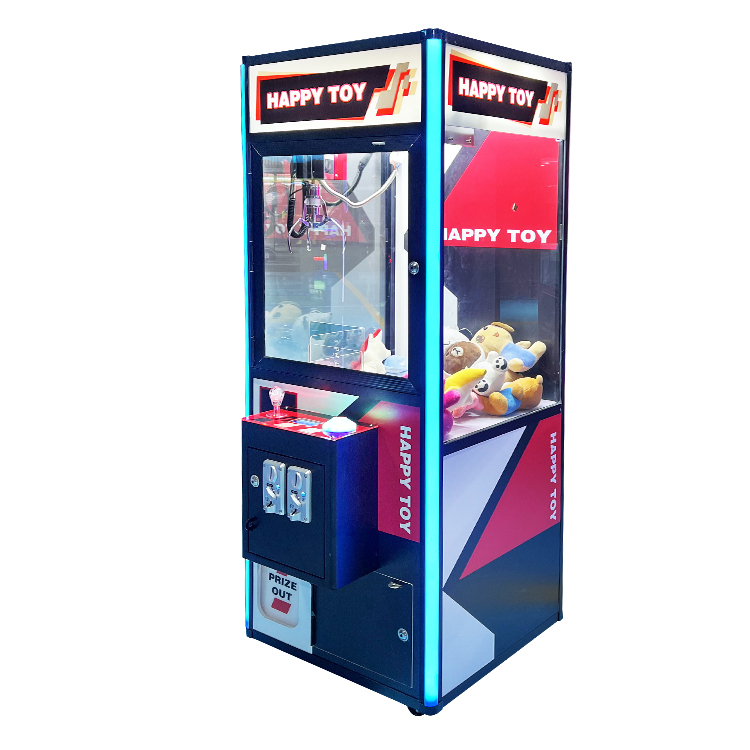
Modern commercial claw machines combine prize display, LED lighting, and multi-payment support.
Why constraint verification is the real procurement problem
The commercial claw machine market is large but fragmented. Third-party estimates from Dataintelo and Verified Market Research place the global claw machine market at approximately USD 2.66 billion to 2.8 billion in 2024–2025, with forecasts exceeding USD 5.1 billion by 2032–2034. Other researchers, such as Global Information Inc., publish a more conservative figure of around USD 2.0 billion, so buyers should treat the exact market size as directionally useful rather than precise. Asia Pacific held the largest regional share at 42.7% in 2025, driven by demand in China, Japan, and South Korea.
For importers in Europe, North America, the Middle East, Africa, and Southeast Asia, a central sourcing reality is that much of the world's claw machine supply is concentrated in the Panyu district of Guangzhou, China—a recognized global manufacturing hub for this product category. Concentration creates choice, but also variance: not every factory can document certifications, match voltage to the destination market, or install payment systems compatible with local operations.
The practical risk is twofold. First, a machine without the correct CE or RoHS documentation can be delayed at customs or rejected by venue safety audits. Second, operational parameters such as power consumption, voltage range, and claw strength settings have a direct effect on installation cost and prize payout control. Buyers who evaluate only aesthetics and price are exposed to both risks.
The opportunity, therefore, is to introduce a verification discipline into the buying process. A short list of verifiable constraints—certification scope, electrical ratings, payment modes, and build materials—can separate a competent commercial supplier from a reseller of undifferentiated stock.
EPARK as a documented reference: what a factory-direct supplier can show
Guangzhou EPARK Electronic Technology Co., Ltd. (EPARK) is a manufacturer and service provider whose product line covers claw machines, air hockey tables, basketball machines, boxing machines, VR simulators, racing arcade machines, shooting games, ticket redemption units, kids' game machines, and indoor playground equipment. For the claw machine category specifically, its reference model is the EP-G001, a coin-operated claw machine aimed at shopping malls, arcade centers, family entertainment centers (FECs), and amusement parks.
The value of a documented manufacturer reference is that the buyer can verify constraints before ordering. EPARK's disclosed operational facts—a 25,000 m² facility, annual output of 8,000–10,000 units, an 80% export ratio, and service to the EU, USA, Middle East, Africa, South America, and Southeast Asia—are the type of data that help buyers assess capacity and market experience. In addition, the company states an OEM/ODM capability covering voltage, plug type, cabinet design, color, logo, game software, payment system, and language interface, with a monthly production capacity of 500–800 units, a lead time of about 30 days, and a minimum order quantity of 10 units.
Technical parameters: the constraint checklist for claw machines
The EP-G001 specification sheet is a practical starting point for defining what a modern commercial claw machine should include. The table below lists the core parameters and explains why each one matters in procurement terms.
| Parameter | EP-G001 value | Buyer relevance |
|---|---|---|
| Player capacity | 1 player | Single-player machines fit compact mall corners; multi-player variants serve high-traffic arcade floors. |
| Power | 120–200W | Low power consumption reduces per-machine electricity cost and allows dense placement. |
| Voltage | 110V / 220V | Dual-voltage support enables shipping to North America and Europe without electrical conversion. |
| Claw strength | Adjustable | Adjustable claw strength gives the operator control over prize payout rates and difficulty. |
| Lighting / cabinet | LED lighting, transparent cabinet | Transparency and lighting support prize visibility, which drives impulse play. |
| Prize display | Yes, prize display system | Visible prizes attract players and communicate the machine's win condition. |
| Payment | Coin / bill / card / QR | Cashless compatibility is increasingly required by FEC and mall operators. |
| Certification | CE | CE marking is a precondition for EU market entry. |
| Build material | Metal cabinet, tempered glass, claw system, electronic control system | Tempered glass and a metal cabinet reduce damage and vandalism risk in public settings. |
Beyond the reference model, buyers should ask targeted parameter questions of any supplier: Is the voltage configuration confirmed for the destination country? Can the claw strength be adjusted on site, and is the adjustment range documented? Which payment modules are installed at the factory, and are all four modes tested before shipment? These questions turn a product description into a verifiable procurement specification.
Certification breakdown: what a compliant claw machine needs
Certification is where many procurement projects stall. In the EU, claw machines fall under the broader category of amusement and interactive game machines, and the applicable safety framework includes IEC 60335-2-82, which specifically covers the safety of amusement machines and personal service machines for public use. In addition, electrical and electronic equipment sold in the EU generally must meet RoHS substance restrictions and carry CE marking where required.
EPARK's claw machine family has been assessed under both CE and RoHS schemes. The CE certificate for the Gift Game Machine—the commercial designation covering the claw machine model family EP-G001—is certificate number ACIC20240201019GRC, issued on 2024-02-06 by ACIC, with scope limited to the Gift Game Machine product category. The certificate references the following EMC standards:
- EN IEC 61000-6-1:2019 — immunity for residential, commercial, and light-industrial environments
- EN IEC 61000-6-3:2021 — emission standard for those environments
- EN IEC 61000-3-2:2019+A1:2021 — harmonic current emissions
- EN 61000-3-3:2013/A1:2019/A2:2021 — voltage fluctuations and flicker
Separately, EPARK holds RoHS certificate ACIC20190422059BHN, issued 2019-04-24 by ACIC, based on the IEC 62321 series (IEC 62321-3-1:2013; IEC 62321-4:2013+AMD1:2017; IEC 62321-5:2013; IEC 62321-6:2015; IEC 62321-8:2017) for restricted substances in game machines.
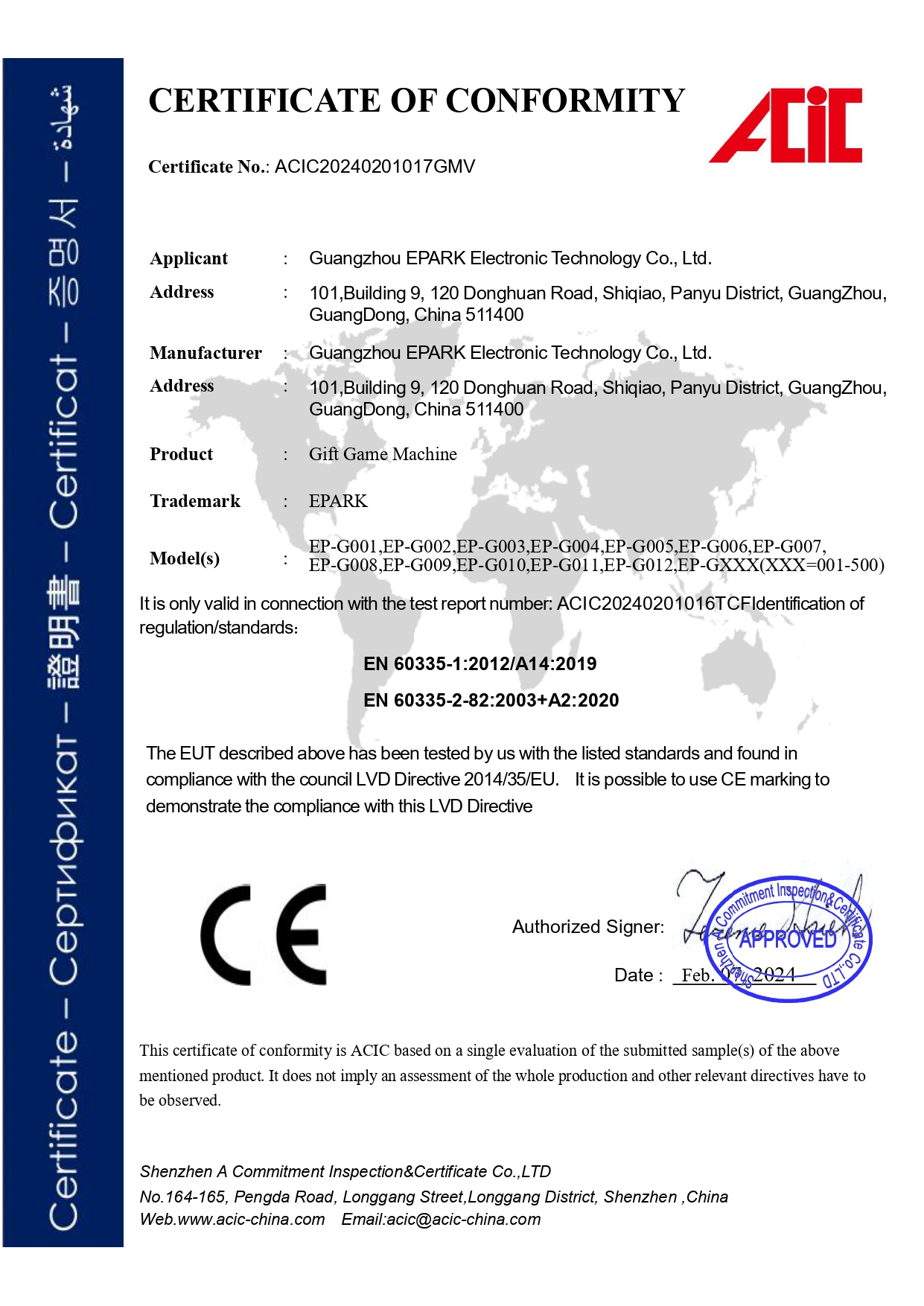
CE certification scope should name the exact product family being purchased.
The verification habit that matters most is not accepting a certificate at face value. Buyers should ask for the certificate number, confirm the issuing authority, verify that the scope section names the exact product type or model family, and check the issue date. Because certification is per product family, a certificate for one model does not automatically cover another model from the same factory.
Venue-level constraints: how claw machines fit different locations
Claw machines are deployed in several distinct venue types, each with its own constraint profile. The application notes below reflect the typical operating conditions that procurement teams should match against the equipment specification.
Shopping malls. Mall locations are characterized by high foot traffic, short customer dwell time, and impulse consumption. The standard project format is a mini game zone or arcade corner, and the function of the claw machine is to convert walk-in traffic into paying plays. The relevant constraints are an eye-catching design, a compact footprint, and a high revenue return per square meter. A dual-voltage, low-power machine with LED lighting and a transparent cabinet aligns with this profile. Card or coin operation is common, depending on mall management preferences.
Arcade game centers. Dedicated arcades run machines on a commercial daily basis, often during long operating hours and with coin, token, or card systems, sometimes around the clock. High durability, easy maintenance, customizable branding, and CE certification are the stated requirements. In this environment, claw machines are typically paired with basketball, boxing, racing, and ticket redemption machines to balance the game mix.
Family entertainment centers (FECs). FECs operate in family-friendly indoor environments with high daily usage and typically prefer card or cashless payment. The machine's job is to extend the family's stay and lift total spending per visit. Multi-age compatibility, safe design, and interactive gameplay matter more than raw payout frequency. A prize display system helps parents quickly understand what their children are playing for.
Indoor play zones. In kids-focused play areas, the environment is safe and continuous in operation, and payment is often handled by a card system or package tickets. The special requirements are safety certification, colorful design, and low maintenance. Here the claw machine serves as an attraction that increases dwell time and complements soft playground equipment.

Venue type determines which claw machine parameters matter most.
Supplier case references, such as EPARK's stated work with arcade startup investors purchasing 30–80 machines, indicate the types of projects where certified factory-direct sourcing is most common. These references describe free 3D design and business advice as part of the supplier's service, and claim fast return on investment within 3–6 months. General industry research, however, suggests that the average ROI for a well-placed commercial claw machine is typically achieved within 12–24 months depending on foot traffic and operational efficiency. Buyers should treat supplier-reported payback periods as optimistic scenarios and validate them with location-specific revenue projections.
Market trends: compliance as a differentiator
Several verified market trends are relevant to claw machine procurement. First, the market is growing: the global claw machine market is projected to exceed USD 5.1 billion by 2032–2034, from a base of roughly USD 2.0–2.8 billion in 2024–2025, according to third-party research firms. Second, middle-type claw machines held the largest type segment share at 44.2% in 2025, suggesting that mid-sized versatile units—rather than mini or giant variants—remain the commercial workhorse. Third, Asia Pacific's 42.7% regional share confirms that the most intense demand is still in Asia, which has implications for supply availability: the Panyu hub serves both domestic Chinese demand and export markets.
The competitive landscape in the commercial claw machine space includes established global players such as Elaut NV (Belgium), Smart Industries Corp (US), Sega Corporation (Japan), and Bandai Namco. These companies compete with Chinese manufacturers on branding, service networks, and premium build, while Chinese factories compete on price, customization flexibility, and production scale. For a buyer, the practical takeaway is that compliance documentation and specification transparency are becoming stronger differentiators than the hardware alone.
A reasonable directional conclusion is that buyers who place compliance and verifiable parameters at the center of their evaluation will be better positioned than those who optimize only for unit price. This is particularly true for EU and North American venues where import audits and landlord safety requirements are increasingly strict.
Comparison: factory-direct documented sourcing vs. traditional trading channels
Procurement teams can acquire claw machines through several routes. The most common alternatives are local distributors, trading companies, and factory-direct manufacturers. The comparison below summarizes the differences most relevant to constraint verification.
| Evaluation dimension | Trading company / distributor channel | Factory-direct documented manufacturer (e.g., EPARK) |
|---|---|---|
| Certification traceability | Certificates may be generic or not matched to the individual model shipped | Model-specific certificate available; e.g., CE ACIC20240201019GRC for the Gift Game Machine family |
| Electrical configuration | Typically stock units; voltage may be fixed at 220V or 110V | Dual-voltage 110V/220V reference model; custom voltage and plug type available under OEM/ODM |
| Claw strength adjustment | Often fixed or undocumented | Adjustable claw strength listed as a standard parameter |
| Payment integration | Coin-only common; card/QR added as retrofit | Coin/bill/card/QR integrated at the factory |
| Minimum order | Low MOQ; higher per-unit cost | MOQ of 10 units; factory-direct pricing |
| Customization | Limited to stickers or minor branding | Cabinet design, color, logo, game software, payment system, language interface |
| After-sales support | Usually limited to parts replacement | 24/7 online support, video guidance, spare parts, lifetime maintenance service |
It is also fair to state the boundary of factory-direct sourcing. The MOQ of 10 units and a lead time of about 30 days mean that a buyer needing a single machine urgently, or a very small operator testing the market with one or two units, may be better served by a distributor or trading company that holds local stock. In addition, certification coverage is per model family, so buyers cannot assume that one certificate covers every machine a factory produces. Both channels have legitimate roles; the right choice depends on order size, urgency, and the buyer's ability to verify compliance directly.
Future outlook: where claw machine procurement is heading
Three directions are likely to shape claw machine procurement over the next several years. First, cashless and smart operation will continue to grow. Card, QR, and mobile payment integration is already a standard option on machines like the EP-G001, and venue operators are pushing toward fully cashless models. Second, compliance requirements are unlikely to soften. As EU standards evolve and importing countries tighten consumer safety rules, the value of documented certification will increase correspondingly. Third, emerging demand in Southeast Asia, the Middle East, Africa, and South America will keep the export-driven manufacturing model of Panyu relevant.
For buyers, the practical implication is to build evaluation frameworks that can be reused across suppliers. A constraint checklist that includes certification scope, electrical ratings, payment modes, material construction, and after-sales structure will remain useful even as specific models and brands change.
Claw machine certification and parameter FAQ
What certifications should a commercial claw machine have for the EU market?
A commercial claw machine sold in the EU should carry CE marking and meet applicable RoHS substance restrictions. The CE certificate covering EPARK's Gift Game Machine family (model EP-G001) is certificate number ACIC20240201019GRC, issued 2024-02-06 by ACIC under EMC standards EN IEC 61000-6-1:2019, EN IEC 61000-6-3:2021, EN IEC 61000-3-2:2019+A1:2021, and EN 61000-3-3:2013/A1:2019/A2:2021. Additionally, the general safety framework for amusement machines in public use is IEC 60335-2-82. Buyers should verify that the certificate scope matches the exact product family.
What are the standard electrical specifications for a coin-operated claw machine?
A typical commercial claw machine operates at 110V or 220V with power consumption in the range of 120–200W. The EPARK EP-G001, for example, lists 120–200W power draw and dual 110V/220V voltage support. This dual-voltage configuration allows the same product family to serve both North American (110V) and European/Asian (220V) installations.
What payment systems do commercial claw machines support?
Modern commercial claw machines can support coin, bill, card, and QR-code payment. The EP-G001 model includes all four payment modes. For family entertainment centers and mall operators, card and QR compatibility has become a baseline requirement rather than an optional extra.
Why does adjustable claw strength matter in claw machine procurement?
Adjustable claw strength directly affects the probability of winning, which in turn controls prize costs and player satisfaction. A machine with documented adjustable claw strength, such as the EP-G001, gives the operator the ability to tune difficulty by location. Buyers should confirm whether the adjustment is accessible on site and whether the setting range is documented in the manual.
Can claw machine parameters be customized for specific markets?
Yes, under OEM/ODM arrangements. EPARK states customization capability for voltage, plug type, cabinet design, color, logo, game software, payment system (coin/bill/QR/card), and language interface. Its stated monthly capacity is 500–800 units with a lead time of about 30 days, which indicates that customization is integrated into the production process rather than handled as an aftermarket retrofit.
What is the minimum order quantity for factory-direct claw machines?
For EPARK factory-direct purchases, the minimum order quantity is 10 units. This is a material constraint for very small operators. Buyers planning a single-machine trial or an urgent replacement may find local distributors or trading companies with existing stock more suitable.