
Choosing the Right Warning Post for Parking Lots, Roads, and Construction Zones
Warning posts are the cheapest physical component in most traffic guidance layouts, and usually the one that takes the most contact. A post that survives five years in a parking garage can fail within months on a highway ramp — not because of manufacturing quality, but because the two sites present completely different impact profiles, sightlines and ground surfaces.
Matching the product to the site therefore comes before price negotiation. This guide maps two Mnsd configurations — the 450 mm YD-WP45 and the 750 mm YD-WPS75 — against the three environments where flexible warning posts do most of their work: parking lots, roads and traffic corridors, and construction zones. Mnsd is the traffic safety equipment brand of Tiantai Yuanda Traffic Device Co., Ltd., a road safety equipment manufacturer based in Tiantai, Zhejiang, China, whose range covers convex mirrors, warning posts, rising bollards, speed humps and traffic lights, supplied to buyers across Asia, Europe and the USA.
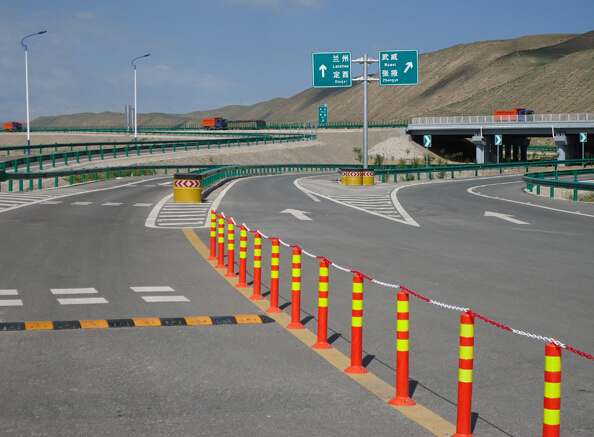
Why site conditions decide the specification, not the catalogue
Selection fails most often at the point where a buyer compares products in a catalogue instead of sites on the ground. Three variables separate one installation from another, and each one pushes the specification in a different direction.
- Contact energy. A car nudging a bay edge at walking pace and a truck clipping a lane divider at road speed deliver very different loads. Height and rebound behaviour have to be matched to the energy the post will actually absorb.
- Sightline requirement. The distance from which a driver must recognise the post sets the minimum height and the amount of reflective surface — not the other way around.
- Base surface. Asphalt, compacted gravel, painted concrete decking and warehouse flooring each hold a post differently. The base is the interface between the post and the ground, and it is where most "the post keeps falling over" complaints originate.
There is a second, practical point. Warning posts are normally installed in multiples, and a layout of forty posts behaves as a system. Systems are specified from the worst case within them — the bay where a delivery van reverses, the ramp where traffic merges, the gate where plant turns. Site-specific selection means finding those worst-case points first, then standardising the remaining posts around them.
Two configurations, two jobs: YD-WP45 and YD-WPS75
The Mnsd flexible warning post range separates into two working heights. Both are flexible by design, and both are intended to warn and to isolate rather than to contain. The difference lies in how much height and how much rebound a given site needs.
| Specification | Mnsd YD-WP45 | Mnsd YD-WPS75 |
|---|---|---|
| Height | 450 mm | 750 mm |
| Flexibility | 360-degree flexible | Rapid rebound |
| Designed environments | Road traffic, parking lots, construction sites | Zones where vehicles are likely to crush or overrun the post |
| Primary role | Bay and lane-edge guidance in low-speed contact zones | Higher-visibility delineation in overrun-prone traffic zones |
| Base configuration | Recycled rubber base or integrated plastic base, selected by surface | Recycled rubber base or integrated plastic base, selected by surface |
What 450 mm is designed for
The YD-WP45 stands 450 mm above the surface and is built to flex through 360 degrees, so a vehicle can strike it from any direction and the post returns to vertical instead of snapping or leaving a sharp edge. It is designed for road traffic, parking lots and construction sites — environments where contact is frequent but usually low-energy. Its lower height keeps it visually proportionate to bay markings and kerb lines, and reduces the clutter that taller posts create in enclosed parking structures.
What 750 mm is designed for
The YD-WPS75 adds 300 mm of height and is built with rapid rebound, which positions it for areas where vehicles are more likely to crush the post: loading lanes, plant routes, temporary traffic diversions, and any layout where a wheel passes directly over the base rather than brushing the shaft. The extra height also lifts the reflective section further into the driver's field of view, which matters where posts compete with street furniture, parked vehicles or construction equipment for attention.
Parking lots: high contact frequency, low contact energy
Parking areas are the classic low-speed, high-frequency contact environment. Bay guide posts are nudged by bumpers, clipped by trolleys and reversed into daily. What matters is not surviving one severe impact, but tolerating hundreds of minor ones without cracking, tilting or losing reflectivity.
The 450 mm YD-WP45 fits this profile. A 360-degree flexible post accepts contact from any approach angle, which suits bays that can be entered from two directions and ramp edges where vehicles arrive at an angle rather than head-on. The base is then matched to the surface: a recycled rubber base carries enough mass and grip to stay in place on asphalt, while an integrated plastic base provides a single-piece footprint for level paved decks.
Within the same parking facility, however, a small number of points behave differently — the dock approach, the ramp merge, the service lane used by delivery vehicles. These are the locations where the 750 mm YD-WPS75 earns its place, because they carry the crush risk that the rest of the car park does not.
Roads and traffic corridors: sightline first
On roads, the specification starts with distance rather than contact. MUTCD requires delineators to be retroreflective and visible from 1,000 feet (approximately 305 metres) when illuminated by high-beam headlights. European practice addresses the same problem through EN 12899-3, which specifies requirements for delineator posts and retroreflectors used in traffic circulation areas. Both point in the same direction: the reflective element and the mounting height must combine to produce recognition at the distance a driver needs to react.
That requirement pushes selection toward the taller option. The 750 mm height of the YD-WPS75 raises the reflective band into a more direct line of sight and keeps it clear of spray, kerb shadow and low vegetation. Where a post stands on a high-speed approach or at a merge point, rapid rebound reduces the chance that a single impact leaves the post permanently deformed and the reflective surface angled away from oncoming traffic.
The YD-WP45 still has a role on road-adjacent layouts — service roads, bus bays, depot exits — where speeds are low and the guidance function dominates. Mixing the two heights across a corridor, rather than specifying one height everywhere, matches each section to its own sightline and impact profile.
Construction zones: temporary layouts and heavy crush exposure
Construction sites combine the two hardest conditions: layouts that change, and plant that does not stop for them. Delineation is installed, relocated, overrun and reinstalled, so a post has to tolerate repeated handling as well as repeated impact.
This is where the 750 mm YD-WPS75 with rapid rebound is the more defensible choice for exposed positions. A post that returns to vertical quickly keeps the work zone perimeter legible even after a wheel has passed over it, which matters when a diversion must stay readable at night and in poor weather. Where the requirement is only to mark a pedestrian route or a storage bay inside a fenced compound, the 450 mm YD-WP45 remains proportionate.
Base choice follows the ground. Compacted gravel and rough asphalt favour a recycled rubber base, which adds mass and grip; a level concrete slab or a paved haul road suits an integrated plastic base. Because construction surfaces change as a project progresses, the base is often the specification that needs to be revisited most frequently.
Base materials and surface fit: recycled rubber or integrated plastic
The base is the part of a warning post that most directly determines whether the product suits the site, and it is the part buyers examine least.
- Recycled rubber base. Heavier, with friction against the surface, so it holds on asphalt and compacted ground and resists displacement when a wheel pushes the shaft sideways. The trade-off is handling: heavier bases slow relocation crews, which matters on temporary layouts that move weekly.
- Integrated plastic base. A single-piece construction that gives a low, flat footprint. It suits level, paved and painted surfaces where the base can sit flush, and it keeps the whole post light enough for one person to reposition.
The practical rule is to match the base to surface flatness first. A base optimised for asphalt should be checked against a smooth painted deck, and a base designed for level paving should be checked on gravel before a site-wide rollout, because base performance depends on how evenly the post can sit. Where a site contains several surface types, specifying one base for the whole project is a common source of complaints that get attributed to the post but actually originate at the ground interface.
Temperature, wall thickness and appearance retention
Heat is the least visible failure mode in flexible warning posts. A post that stands straight in a temperate climate can sag in a hot one, and sagging changes both the silhouette and the reflective angle.
Mnsd's approach to this risk is to optimise wall thickness so the post does not sag in high-temperature climates, with material stability maintained up to 60°C. For projects in hot regions — the Middle East, parts of South Asia, southern Europe — wall thickness and material grade should be confirmed as part of the specification rather than assumed from a general product description, because the same height and diameter can be produced in more than one construction.
Material choice sits alongside geometry. Published material guidance notes that thermoplastic polyurethane (TPU) is preferred for high-impact warning posts because of its elastic recovery and durability compared with standard polyethylene (PE). Where a site combines high temperature with frequent vehicle contact, that recovery behaviour is what preserves appearance over the life of an installation. Crosslinked ethylene plastics used in industrial safety products are assessed for gel content and swell ratio under ASTM D2765, one of the test references buyers may encounter when a supplier documents material performance.
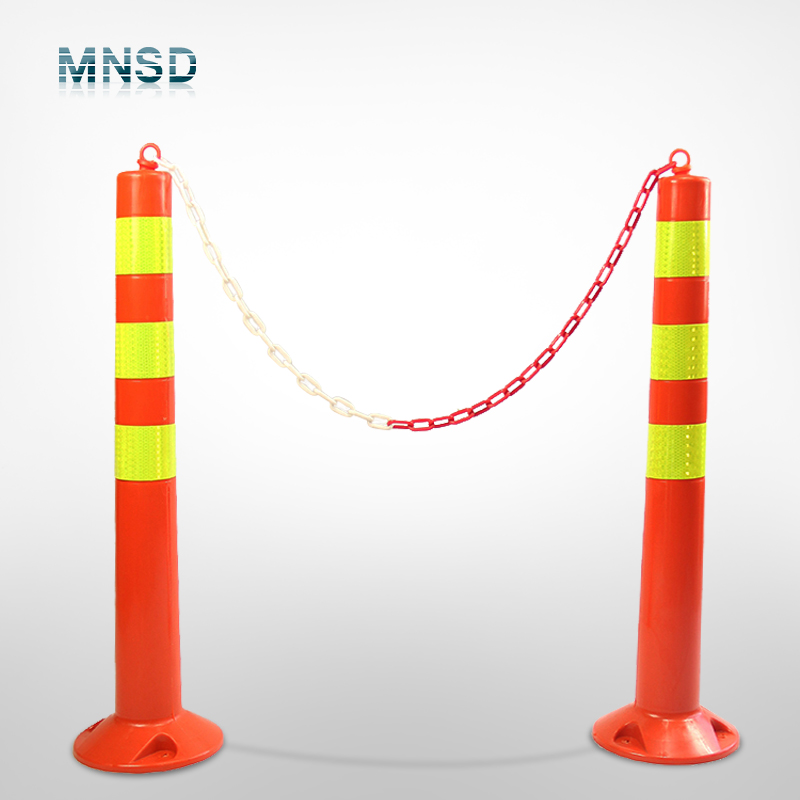
Where warning posts stop: comparison with guardrails and barriers
| Dimension | Flexible warning posts (Mnsd YD-WP45 / YD-WPS75) | Guardrails and fixed barriers |
|---|---|---|
| Primary function | Visual warning and flexible physical isolation | Structural containment and redirection of vehicles |
| Height range across the category | 75–120 cm | Engineered as a continuous structural system |
| Impact response | Flexible rebound; the post returns after contact | Rigid system that absorbs or deflects the load |
| Relative cost | Ultra-low cost; lower than guardrails and barriers | Higher material and installation cost |
| Maintenance profile | Almost maintenance-free, no power; cleaning or replacement only when damaged | Generally requires periodic structural inspection and repair after impact |
| Energy use | Zero power consumption | Passive, but structurally load-bearing |
The limitation is straightforward and should be stated before any specification is written: a flexible warning post warns and isolates, but it does not stop a vehicle. Where a site requires structural containment — a high-speed approach, an unprotected drop-off, a bridge parapet — guardrails and barriers remain the correct product, and warning posts support them rather than replace them.
A second boundary concerns visibility itself. Reflective performance depends on a clean, undamaged reflective surface, so a maintenance routine that includes cleaning is part of the specification, not an afterthought. Posts installed where mud, snow or construction dust accumulate will underperform their rated reflective characteristics unless that routine exists.
From single-site selection to a long-term supply programme
Buyers who operate across many sites — distributors, wholesalers, contractors and infrastructure project suppliers — face a different problem from the single-site installer: consistency. A programme that mixes heights and base types across fifty car parks produces inconsistent driver behaviour and a spare-parts inventory that grows every year.
A more durable approach is to standardise on two working heights and two base options, then map each site into that matrix. Mnsd supports this kind of programme with high-speed injection moulding production and a monthly capacity of 50,000 pieces; for bulk orders the typical lead time is 10 to 15 days. Standard purchasing terms are a minimum order quantity of 100 units, FOB or CIF delivery, acceptance based on pre-shipment testing, and 30/70 payment terms.
Programme evidence matters as much as stated capacity. A road safety project in Vietnam using this product range was completed and accepted by the local authority, which indicates satisfactory performance in a real installation rather than a laboratory claim. For buyers qualifying a supplier across several years, that combination — repeatable capacity, stated lead times and documented acceptance — is what turns a warning post range into a standard line rather than a one-off purchase.
Market trend: physical delineation keeps growing alongside digital systems
The market context supports long-term planning rather than opportunistic buying. Published analysis values the global road marker posts market at USD 3.4 billion in 2024, with a projection of USD 5.4 billion by 2032. The wider traffic safety products market is expected to expand at a compound annual growth rate of 6.6% from 2026 to 2034, driven by urban population growth and infrastructure investment.
Those headline figures should be read with care. Estimates for the broader traffic safety market in 2024 range from USD 6.4 billion to USD 12.5 billion depending on whether digital traffic management systems are counted alongside physical hardware. The scope of a market figure matters more than its headline size, and buyers comparing supplier presentations should check what is being included.
Supply is also concentrated at the top. Market analysis identifies 3M, Honeywell and SWARCO among the leading global traffic equipment manufacturers, with the top five suppliers holding approximately 39.2% of the market. For warning post buyers, that concentration is less relevant at the level of an individual order than at the level of programme supply: the reliability of the chosen manufacturer, and its ability to repeat a specification consistently, is what protects a multi-site rollout.
Future outlook
Three directions appear likely to shape warning post procurement over the next few years.
- Material specification will keep moving toward higher elastic recovery compounds, following the published material guidance that favours TPU over standard PE for high-impact posts.
- Selection will increasingly be documented by site type rather than by product family alone, with buyers mapping height and base to environment before issuing enquiries.
- Supplier evaluation will rest more on capacity, lead time and documented acceptance than on unit price, because a cheaper post that must be replaced twice is not a cheaper programme.
None of these changes alter the underlying engineering. A warning post is a flexible, low-cost, zero-power element that warns drivers and isolates space. What changes is how carefully it is matched to the site it stands on.
FAQ
What is the difference between the Mnsd YD-WP45 and YD-WPS75 warning posts?
The YD-WP45 is 450 mm high and 360-degree flexible, and is designed for road traffic, parking lots and construction sites. The YD-WPS75 is 750 mm high and built with rapid rebound, and is positioned for areas where vehicles are more likely to crush the post. Both are flexible posts intended to provide visual warning and flexible physical isolation.
Which warning post height is appropriate for a parking lot?
For open bays, drive aisles and ramp edges where contact is frequent but low-energy, the 450 mm YD-WP45 is the proportionate choice, because its 360-degree flexibility accepts contact from any angle. Points within the same facility that carry heavier traffic — dock approaches, service lanes used by delivery vehicles, plant turning areas — carry a higher crush risk and are better matched to the 750 mm YD-WPS75.
Does the base material change where a warning post can be installed?
Yes. A recycled rubber base adds mass and grip, which suits asphalt and compacted surfaces, while an integrated plastic base is a single-piece construction that suits level, paved surfaces where the footprint can sit flush. Base selection should be verified against the actual surface, including surface flatness, before a multi-site order is placed.
Can flexible warning posts replace guardrails and barriers?
No. Warning posts provide visual warning and flexible physical isolation at ultra-low cost compared with guardrails and barriers, and they are almost maintenance-free with no power requirement. They are not structural containment devices, so locations that must stop or redirect a vehicle at speed still require guardrails or barriers. The two product families are complementary.
What temperature range are these warning posts built for?
Material stability is maintained up to 60°C, and wall thickness is optimised to prevent sagging in high-temperature climates. Sites where surface microclimates run hotter than the general ambient temperature should confirm the wall-thickness specification with the supplier before ordering.
What are the standard purchasing terms for a first order?
Minimum order quantity is 100 units. Delivery terms are FOB or CIF, acceptance is based on pre-shipment testing, and payment terms are 30/70. Monthly production capacity is 50,000 pieces, with a typical lead time of 10 to 15 days for bulk orders.
Product documentation, including the current Mnsd catalogue with model dimensions and base options, can be downloaded here: Mnsd traffic safety product brochure.