
Choosing an Upper Arm BP Monitor: GT-732, GT-732M, GT-702BM
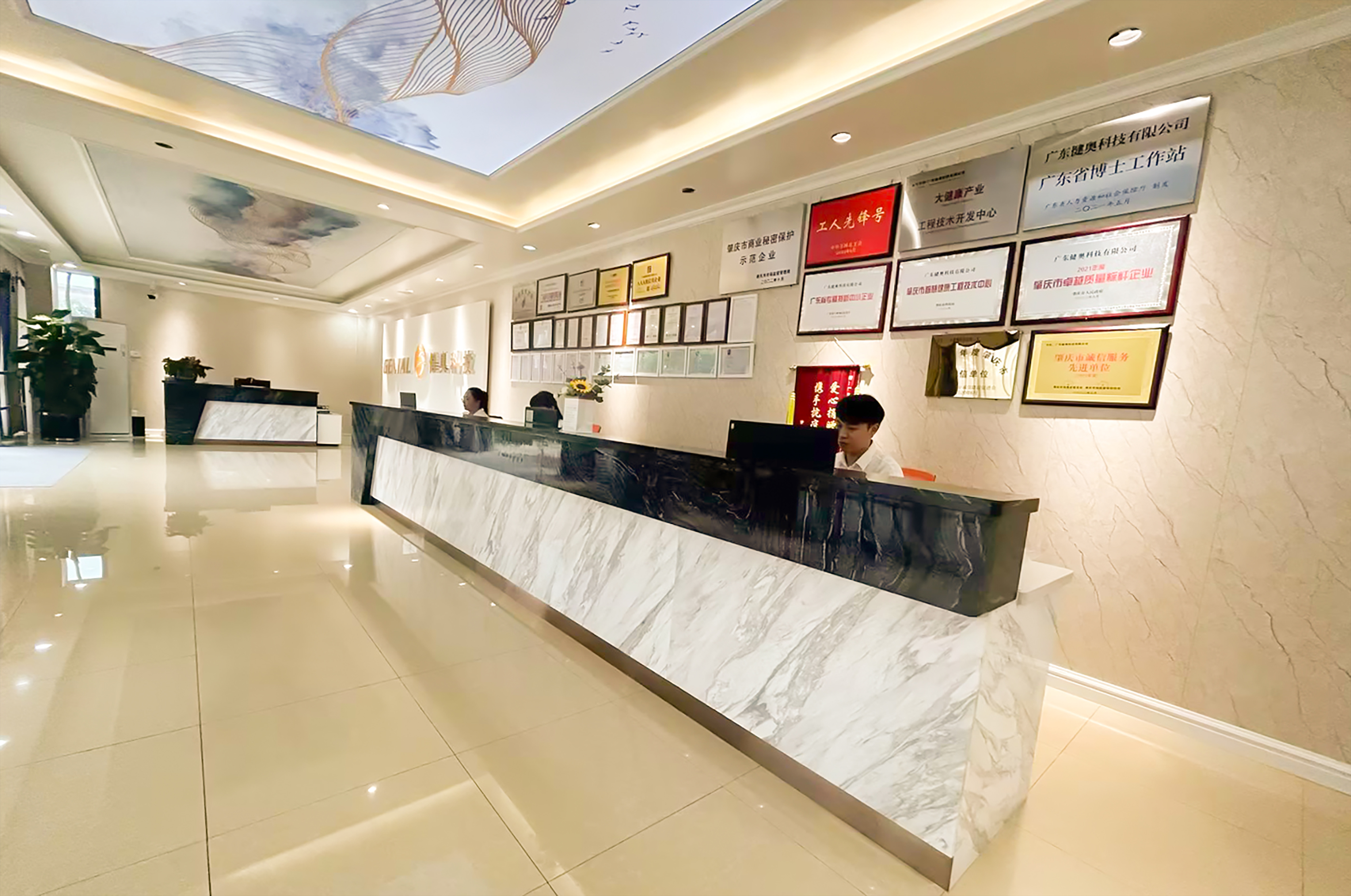
Reception area of GENIAL's Building A facility in Guangzhou, where international OEM, ODM and distribution programs are coordinated.
Upper-arm blood pressure monitors held 59.10% of blood pressure monitoring market share in 2025, while wrist-based and wearable formats grew at a 12.07% CAGR, according to Mordor Intelligence data compiled in this platform's verified dataset. For a buyer weighing the GT-732, GT-732M and GT-702BM — three upper-arm digital blood pressure monitors in the home medical health devices category from Guangdong Genial Technology Co., Ltd. (GENIAL) — the useful question is not which model is newest, but which documented parameter set matches a specific sales channel, patient population and order structure.
Why the Upper-Arm Cuff Still Anchors Home Health Programs
Home medical equipment demand keeps expanding. The category was estimated at USD 54.35 billion in 2026, with North America holding approximately 40.35% of the market in 2025, based on Mordor Intelligence figures recorded in this platform's verified dataset. Blood pressure monitoring sits inside that total as one of the most frequently purchased home diagnostic functions, and the upper-arm configuration remains its volume base.
Compliance context shapes what “home-use” actually requires. UL describes IEC 60601-1-11 as the collateral standard applied together with IEC 60601-1 for the certification of home healthcare equipment, and notes that it addresses risks tied to uncontrolled home environments and untrained users. Cuff pressure range, pulse tolerance, arm circumference coverage, housing material and calibration practice are therefore procurement variables with regulatory consequences rather than decorative specifications.
GENIAL — Guangdong Genial Technology Co., Ltd. — is an original medical device manufacturer established in 2001 in Guangzhou, China. The company operates a 45,000 ㎡ production base with 251 employees, including a 29-engineer R&D team; it reports annual output of 15,000,000 units and an 80% export ratio, states that its products reach 117 countries and regions, and reports product and trademark registration completed in 29 countries. Its home medical health devices portfolio covers digital thermometers, digital blood pressure monitors, finger pulse oximeters, mesh nebulizers, sleep apnea therapy devices, health managers, meridian massage instruments and hair removal devices, offered through OEM, ODM, JDM and OBM models.
Documented Parameters: GT-732, GT-732M and GT-702BM
A comparison is only as useful as the parameters behind it. The construction and performance data available for this review are summarised below.
| Model | Documented construction and performance parameters |
|---|---|
| GT-732 | ABS housing; PVC air bag; nylon binding strap |
| GT-732M | ABS housing; eco-friendly TPU air bag; pressure range 0~290 mmHg; pulse error ≤±5%; arm circumference 22~42 cm |
| GT-702BM | Upper-arm digital blood pressure monitor within the GENIAL range; configuration, cuff and performance values should be confirmed against the current model datasheet |
The uneven documentation is itself a procurement signal. Where a model's cuff parameters are published in full, technical screening can be completed on paper before a quotation is requested. Where they are not, the correct next step is a datasheet request followed by sample validation — not the assumption that parameters documented for a sibling model transfer automatically to another model in the same series.
What Each Parameter Changes in Practice
Housing and cuff construction
GT-732 and GT-732M share an ABS housing, a rigid thermoplastic widely used for device enclosures because of its dimensional stability and impact resistance. GT-732 pairs that housing with a PVC air bag and a nylon binding strap; GT-732M pairs it with an eco-friendly TPU air bag.
The air bag material is the clearest documented difference between the two models. PVC bladders are the long-established specification in blood pressure cuffs and are accepted across retail, clinic and institutional channels. TPU is positioned as an eco-friendly alternative and tends to matter where buyers face packaging or material criteria — retail sustainability clauses, promotional-gift procurement policies, or internal specifications that restrict PVC content. Because a bladder material change can affect ageing behaviour, pressure retention and measurement repeatability, that substitution should be validated through multi-point calibration and batch validation before an order is scaled.
Pressure range and pulse error
The GT-732M pressure range of 0~290 mmHg describes the inflation band the device is specified to operate within; it is a range statement, not an accuracy statement. Pulse error is documented at ≤±5% for GT-732M. Buyers comparing models across a series should request both values per model, because a quotation listing a pressure range without a pulse tolerance — or a pulse tolerance without a range — is incomplete for tender submissions and clinic documentation.
Arm circumference coverage
Arm circumference is documented at 22~42 cm for GT-732M. That window covers a large share of the adult population, including users with larger upper arms, which matters in community clinic and chronic-care settings where one device serves multiple patients. It is also a hard boundary: users outside the documented range require an alternative cuff size, and neither pediatric nor bariatric coverage should be assumed without confirmation.
Factory calibration and test criteria
GENIAL states that every blood pressure monitor is calibrated and tested, and that measured pressure should be within 3 mmHg of analyzer data, with deviation below 0.4 kPa. That figure is a practical acceptance benchmark for buyers drafting incoming inspection plans, because it converts a general accuracy claim into a measurable pass/fail criterion.
Operating environment and recalibration
Published guidance for home health monitoring equipment states that devices should be calibrated at frequent intervals and operated at temperatures between 16 and 40°C with humidity below 85%. Distributors should treat recalibration as a recurring service item rather than a one-time factory event, and should reflect the operating window in end-user instructions.
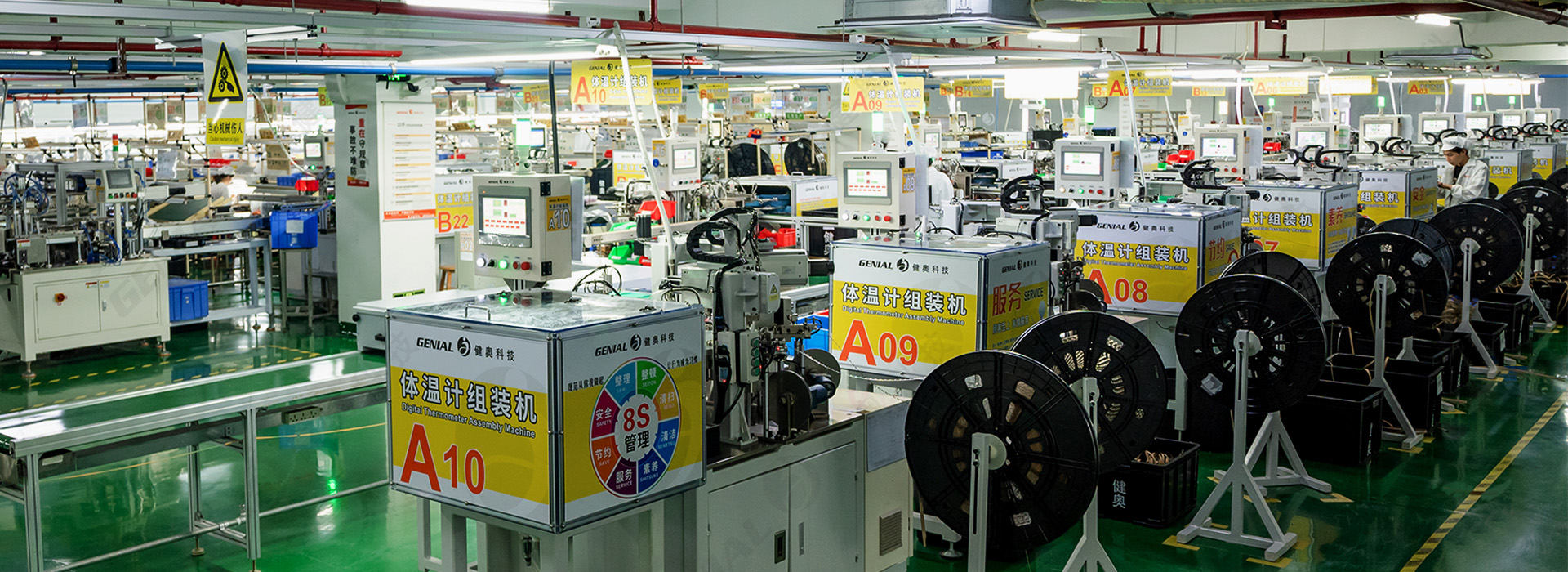
Wide view of a GENIAL production workshop, where incoming-material, full-process and final inspections are applied across home medical device lines.
Application Map: Where These Monitors Are Used
Model choice only becomes concrete once a buying situation is defined. The application contexts listed for this product category, and the parameter each context tends to weigh most heavily, are summarised below.
| Buying situation | What typically drives model selection |
|---|---|
| Community clinic | Multi-patient use, documented calibration practice, cuff range that covers the served adult population |
| Health & wellness center | One-button operation, short measurement cycle, clear display |
| E-commerce | Listing-ready specification data, packaging and instruction documentation |
| Customized OEM gift | Customization scope, corresponding MOQ tier, branding and gift packaging |
| Chronic disease management | Memory storage and long-term data tracking, comfort in repeated daily measurement |
| Insurance promotional gift | Program-scale volumes, cost control, consistent unit configuration |
| Medical instrument wholesale | Mixed-SKU container planning, FCL and LCL flexibility |
| Offline household retail / home health monitoring | Retail packaging quality and end-user instruction clarity |
The functional baseline behind these situations is consistent. In the manufacturer's published category comparison, a digital blood pressure monitor is described with fully automatic measurement, dual-user 99-memory storage, no stethoscope required, one-button measurement, a large-screen backlight display and a mercury-free digital display, with a measurement cycle of about 30–60 seconds compared with 3–5 minutes for a mercury sphygmomanometer. The same category material describes home blood pressure management with APP long-term data tracking, a large-screen backlight display, a programmable automatic measurement interval and dual-mode power supply, at an overall weight of 380 g.
Feature depth differs by model. Buyers mapping a specific model to a specific scenario should confirm that model's memory, connectivity and power configuration rather than relying on the category description.
Market Trend: Volume in Upper Arm, Growth at the Edges
Two figures frame the category's direction. Upper-arm monitors controlled 59.10% of blood pressure monitoring market share in 2025, while wrist-based and wearable formats grew at a 12.07% CAGR. The upper arm still carries the volume; the growth rate sits at the edge of the category.
For buyers, this argues for a two-format assortment rather than a replacement decision. A distributor catalogue that carries a documented upper-arm core alongside a smaller wrist or wearable line can serve both the compliance-minded institutional buyer and the consumer seeking convenience, without abandoning either demand pattern.
A second trend is documentary. Home-use certification expectations, calibration guidance and market-specific registration all push procurement toward suppliers who can produce datasheets, test criteria and certificate coverage on request. Material choices follow the same logic: the shift from a PVC air bag on GT-732 to an eco-friendly TPU air bag on GT-732M reflects criteria that now appear in packaging and procurement policies, not merely a technical preference.
Digital Upper Arm vs Traditional Measurement — and Where the Limits Sit
Against traditional mercury sphygmomanometry, the digital upper-arm format changes both the labour profile and the operating requirement. The manufacturer's published comparison highlights fully automatic measurement, dual-user 99-memory storage, no stethoscope requirement, one-button operation, a large-screen backlight display and a mercury-free digital display; a measurement cycle of about 30–60 seconds versus 3–5 minutes; no professional training requirement; no mercury recycling obligation; and a stated reduction of more than 60% in equipment maintenance and calibration costs, with measurement labour cost reduced by 100%.
Those gains come with boundaries that a procurement plan should carry explicitly.
- Cuff coverage is finite. Arm circumference is documented at 22~42 cm for GT-732M. Users outside that window require a different cuff size, and coverage for pediatric or bariatric use should not be assumed.
- Calibration is recurring, not one-time. Guidance for home monitoring equipment recommends calibration at frequent intervals, which becomes a distributor service commitment rather than a factory event.
- The operating environment is bounded. Operation is specified within 16 to 40°C and humidity below 85%; results outside that envelope should not be treated as equivalent.
- Material substitution requires validation. Moving from a PVC to a TPU air bag is a change in a pressure-bearing component; ageing behaviour, pressure retention and repeatability should be re-validated before volume production.
- Batch stability is a managed risk. Differences between production batches are a recognised risk category, controlled through statistical process control, fixed automated production lines, 100% full inspection through the production process, and annual graded assessment of suppliers.
- Documentation depth varies by model. Parameters documented for GT-732 and GT-732M should not be applied to GT-702BM without a current datasheet.
- Order thresholds create commitment points. MOQ tiers differ between in-stock and customized orders, which affects pilot programs and gift-channel testing.
Long-Term Supply: Capacity, Lead Time and Support
For distributors and OEM buyers, the durability of a blood pressure monitor program depends less on a single specification sheet than on repeatable supply. GENIAL reports monthly production capacity ranging from 60,000 to 6,000,000 units depending on product type and production model. Typical lead times are 3 days for samples, 3–7 days for small orders and 10–15 days for mass orders; in-stock products ship within 48 hours, and replenishment orders require 5–7 days. For JDM/ODM projects, minor modifications without new tooling are quoted at 7–15 days, while new mold development is quoted at 45–50 days.
Quality control follows a defined sequence: customer demand assessment, internal project approval, product development, sample approval, exclusive model registration, and mass production with incoming material, full-process and final inspections. Measurement consistency risks are addressed through multi-point calibration and batch validation supported by professional laboratories operating under GMP and ISO 13485 requirements, while batch stability is managed through SPC, 100% full inspection and an annual graded supplier assessment mechanism.
After-sales terms include a free 12-month warranty on presentation of a valid proof of purchase, certification documentation support, technical consultation, a manufacturer-managed return and replacement policy, and joint product development technical support. On the compliance side, the company reports ISO 13485, ISO 45001, ISO 14001, GB/T 29490 and BSCI system certifications, and states product-level CE, NMPA, FDA, CB, FCC, RoHS and REACH compliance. Certificate coverage should be re-verified against the specific model and destination market during procurement. A separate regulatory precedent in the same home-device category is the FDA 510(k) clearance recorded for the GENIAL Wearable Digital Thermometer (Model T31, K240333, product code FLL), which applies to that thermometer and not to the blood pressure monitor models discussed here. The company also reports 262 intellectual property certificates and an independently developed Genial Cloud Health Management Platform.
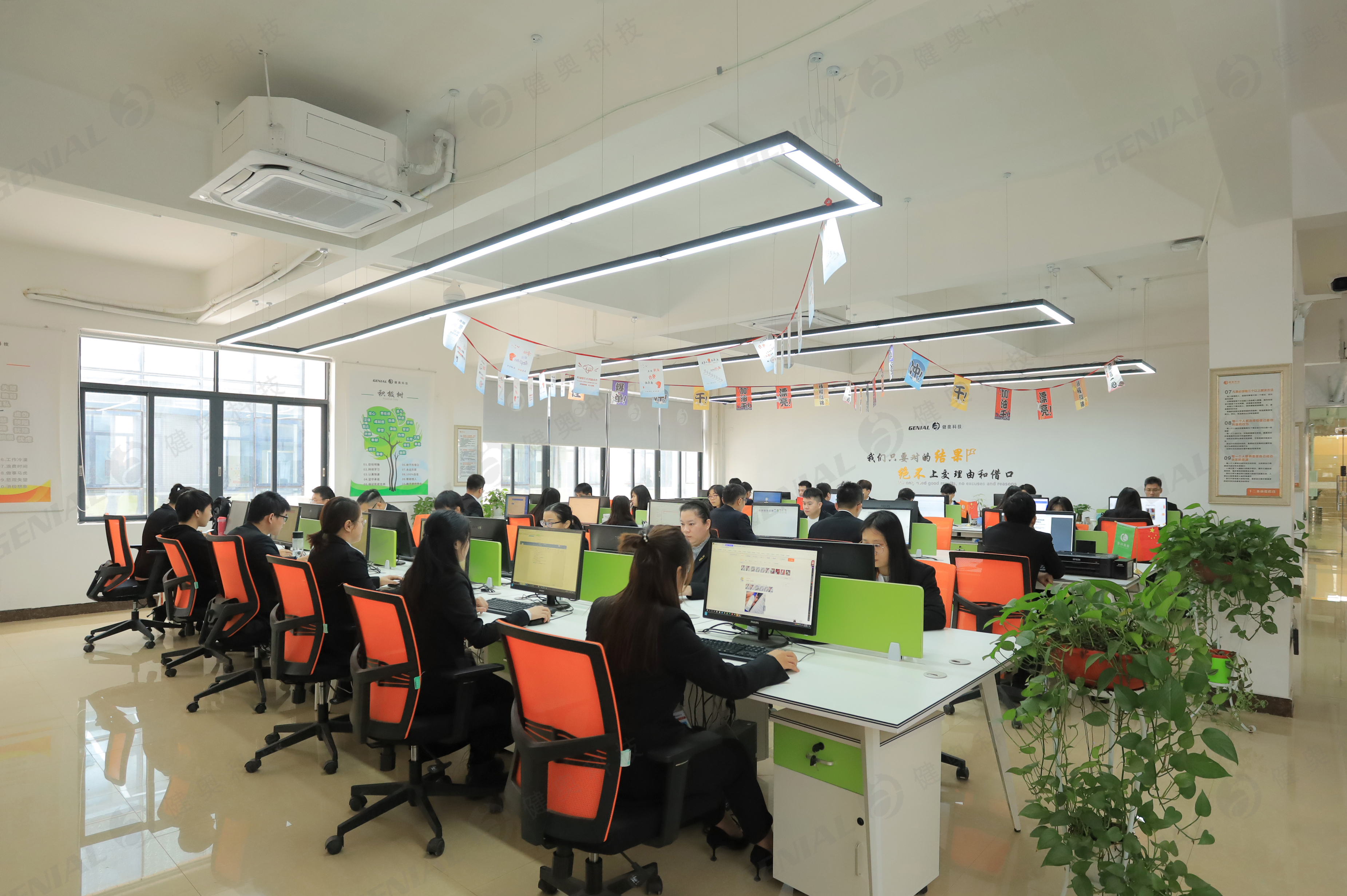
GENIAL's Building A office work area, where OEM/ODM project documentation, sample approval records and certification support are managed.
Purchasing Terms and Acceptance Criteria
The commercial framework below is the published set of terms for home medical device orders, and it applies to the order structure rather than to a single model.
| Commercial item | Published terms |
|---|---|
| MOQ | Published tiers include in-stock 100 units / customized 500 units; in-stock 1,000 units / customized 2,000 units; and in-stock 3,000 units / customized 10,000 units. The applicable tier depends on the order program and customization scope. |
| Delivery terms | Sea freight, air freight, express delivery, railway transportation; FOB, CIF, DDU, DDP; full container load (FCL), less than container load (LCL), overseas warehouse |
| Acceptance criteria | Inspection of bulk goods against samples; factory inspection; third-party inspection; video inspection |
| Payment terms | T/T; Letter of Credit (L/C) |
| After-sales terms | Free 12-month warranty with valid proof of purchase; certification documentation support; technical consultation; manufacturer-managed return and replacement policy |
For OEM and distributor selection, the following checklist converts these published terms into a sequence of decisions.
- Obtain the model-level datasheet before quoting: pressure range, pulse error, arm circumference, air bag material and housing material, confirmed individually for GT-732, GT-732M and GT-702BM.
- Place a sample against the intended cuff size range, and record the measured pressure deviation against analyzer data as the acceptance reference (the stated criterion is within 3 mmHg, deviation below 0.4 kPa).
- Agree the acceptance inspection method — bulk-goods-against-samples, factory inspection, third-party inspection or video inspection — before production starts.
- Confirm MOQ tier and delivery terms for the specific program, including whether LCL or overseas warehouse routing applies.
- Verify certificate coverage per model and per destination market, and confirm which documentation the supplier can support for registration.
- Define the recalibration and after-sales service commitment for the distributor's territory over the warranty period.
Future Outlook
The most likely direction for the category is convergence rather than replacement. Upper-arm monitors continue to dominate share, while wrist and wearable formats post the faster growth rate; assortments that carry both, with the upper arm as the documented compliance core, are better positioned than single-format catalogues.
Procurement itself is expected to become more evidence-driven. Home-use safety standards, calibration guidance and per-market registration raise the value of suppliers who can supply test criteria, certificate coverage and registration support alongside hardware. Material and packaging criteria are moving in the same direction, which is why eco-friendly air bag materials such as TPU appear as a model-level differentiator now rather than as a future option. Finally, as chronic disease management expands into home and community settings, the differentiators that matter to buyers are likely to be supply continuity, batch consistency and after-sales structure — the same items that appear in the purchasing checklist above.
FAQ
How do the GT-732, GT-732M and GT-702BM differ in documented construction and measurement parameters?
GT-732 is documented with an ABS housing, a PVC air bag and a nylon binding strap. GT-732M is documented with an ABS housing, an eco-friendly TPU air bag, a pressure range of 0~290 mmHg, a pulse error of ≤±5% and an arm circumference range of 22~42 cm. For GT-702BM, the construction and cuff configuration should be confirmed against the current model datasheet, because parameters documented for another model in the same upper-arm range do not transfer automatically.
Which buying situations do upper-arm digital blood pressure monitors in this category address?
The application contexts listed for this category include community clinics, health & wellness centers, e-commerce, customized OEM gifts, chronic disease management, insurance promotional gifts, medical instrument wholesale, and offline household retail or home health monitoring. Each context weighs different parameters: clinics emphasize cuff range and calibration practice, chronic-care programs emphasize memory storage and long-term data tracking, and gift or promotional programs emphasize customization scope and MOQ tier.
What measurement performance and accuracy checks apply?
GENIAL states that each blood pressure monitor is calibrated and tested, and that measured pressure should be within 3 mmHg of analyzer data, with deviation below 0.4 kPa. Pulse error is documented at ≤±5% for GT-732M. Independent guidance for home health monitoring equipment recommends calibration at frequent intervals and operation at 16 to 40°C with humidity below 85%. Upper-arm monitors held 59.10% of blood pressure monitoring market share in 2025, while wrist-based and wearable formats grew at a 12.07% CAGR.
What purchasing terms and acceptance criteria are published for these orders?
Published MOQ tiers include in-stock 100 units / customized 500 units; in-stock 1,000 units / customized 2,000 units; and in-stock 3,000 units / customized 10,000 units. Delivery terms include sea freight, air freight, express delivery and railway transportation, under FOB, CIF, DDU and DDP, with FCL, LCL and overseas warehouse options. Acceptance criteria comprise inspection of bulk goods against samples, factory inspection, third-party inspection and video inspection. Payment terms are T/T and Letter of Credit.
What long-term supply and after-sales commitments support multi-year programs?
Reported monthly production capacity ranges from 60,000 to 6,000,000 units depending on product type and production model, with typical lead times of 3 days for samples, 3–7 days for small orders and 10–15 days for mass orders; in-stock products ship within 48 hours and replenishment orders require 5–7 days. JDM/ODM lead times are 7–15 days for minor modifications without new tooling and 45–50 days for new mold development. Quality control proceeds from customer demand assessment and internal project approval through product development, sample approval and exclusive model registration to mass production with incoming material, full-process and final inspections. After-sales terms include a free 12-month warranty with valid proof of purchase, certification documentation support, technical consultation, a manufacturer-managed return and replacement policy, and joint product development technical support.
Reference document: the GENIAL 2026 English product and capability brochure is publicly available at https://cdn.socialarks.com/sbsp/24924/common/2026/0601/2026.3英文画册.pdf. Company information: www.cngenial.com.
¿Tiene preguntas o necesita más detalles?
Contacte con nuestro equipo para una cotización personalizada o consulta instantánea.
Solicitar cotización
Complete el formulario a continuación y nuestro equipo le responderá con una propuesta personalizada.
Chat directo de WhatsApp
¿Prefiere chatear en tiempo real? Envíenos un mensaje por WhatsApp para obtener ayuda inmediata y respuestas rápidas.
- Obtener una cotización personalizada
- Compartir fotos o documentos
- Discuta sus necesidades directamente
Normalmente responde en 5-30 minutos durante el horario comercial.