
Choosing a Polyurethane Raw Material for the Job: A Scenario-First Guide
Choosing between casting polyurethane prepolymers, liquid polyurethane systems, and other polyurethane raw materials is rarely about one property alone. The operating environment, production process, and part function together determine whether a material system will perform reliably in service.
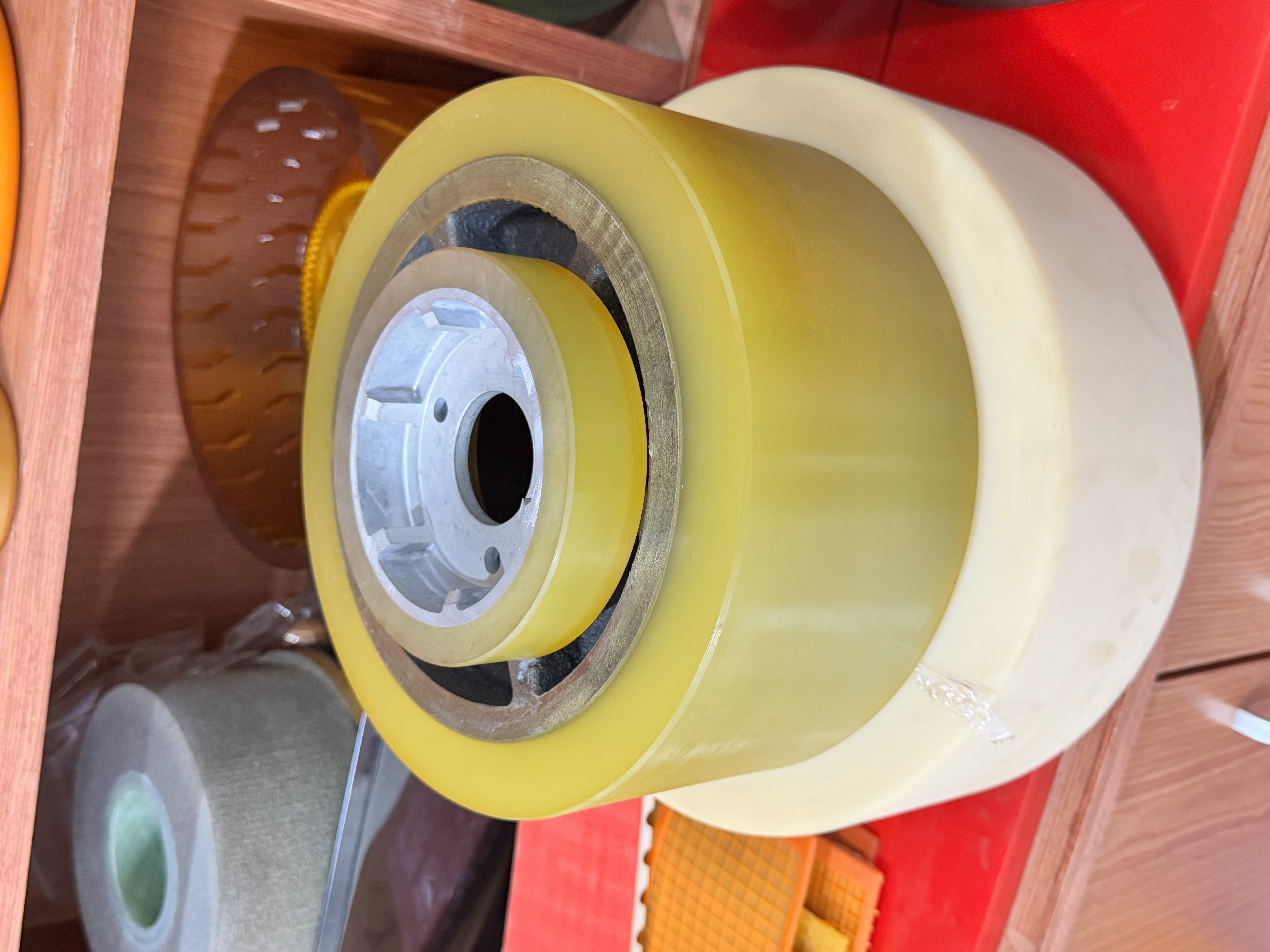
Double layer polyurethane drawing wheel, an example of a part designed around a specific operating scenario.
The Core Selection Problem: Application Conditions Decide the Material
Industrial buyers evaluating polyurethane raw materials in South and Southeast Asia often work in tropical high-temperature and high-humidity conditions. Frequent friction and contact with corrosive water make hydrolysis and surface wear the first failure modes to consider. A prepolymer selected only by hardness or color may not survive the real application.
The practical question is therefore not simply what grade is available, but what the finished part must withstand. Mining screen mesh, automotive components, marine equipment, construction anti-wear parts, wind power sealing, and sports goods place very different demands on the elastomer. This is the core of scenario-based material selection.
Problem and Opportunity: Why Matching Matters
When a polyurethane material is matched to its operating environment, end users can extend part life, reduce downtime, and lower the total cost of ownership. When the match is poor, failure can appear as cracking, swelling, surface wear, or loss of mechanical performance.
The opportunity for buyers is to introduce a more systematic evaluation process before ordering. This includes reviewing the actual working conditions, the production equipment available, and the supplier's ability to customize formulations. Because polyurethane raw material selection happens before production, getting the scenario fit right can prevent costly trial-and-error after installation.
A Supplier Focused on Casting Polyurethane Raw Materials
Shanghai Hecheng Polymer Technology Co., Ltd. is a Shanghai-based manufacturer of casting polyurethane prepolymers and related raw materials. Established in 2009, the company operates from a 16,932 m² facility in the Songjiang district of Shanghai, with 78 employees and a dedicated R&D team of 18 engineers. R&D personnel account for nearly 30% of the total workforce.
Hecheng Technology has 16 major production reactors and a product range of more than 1,000 prepolymer grades. Its main products include casting polyurethane prepolymer, polyurethane quasi material, liquid polyurethane, CPU casting polyurethane, and polyurethane elastomer. These materials are used across automotive, photovoltaics, machinery, mining, marine, sports, and industrial auxiliary parts. The company exports to North America, South Korea, Southeast Asia, the EU, and South America, with around 30% of output going to export markets.
A documented supply example involves a raw-material manufacturer in Vietnam that has used Hecheng materials over a 10-year period, purchasing 100 tons for polyurethane elastomer production. The reported result was stable production quality and improved product performance.
Technical Explanation: How Casting Polyurethane Raw Materials Work
Casting polyurethane raw materials are usually processed as two-component systems. The first component is typically a prepolymer, while the second is a reactive blend that is mixed immediately before pouring. In automated production, the two components are metered and conveyed, then mixed under high pressure and poured into molds.
Typical supporting equipment includes a polyurethane high-pressure foaming machine or low-pressure pouring machine, raw material storage tank, mixing bucket, and delivery pump. This production mode can support continuous mass production and is common for CPU casting polyurethane parts that require high abrasion resistance, resilience, or specific dynamic properties. After curing, the system forms a thermoset polyurethane elastomer, which means the finished performance depends heavily on the prepolymer chemistry and the processing conditions.
For applications where low free isocyanate content is important, TDI low-free prepolymer variants can improve physical and mechanical properties while providing excellent dynamic mechanical performance. This is especially relevant in automotive component production.
For sealed-class accessories, PTMG-MDI CPU casting polyurethane is described as environmentally friendly, high-quality, and corrosion-resistant, and it is commonly used for producing sealing rings. Liquid polyurethane grades such as Gel-8301AB provide antioxidant properties and high resilience for various elastomer parts. For sports goods, polyether-MDI prepolymer systems such as 8385AB are used to rubberize sports equipment, offering vivid colors and an eco-friendly profile. In mining, three-component polyester systems such as Screen Scraper-5282ABC provide high wear resistance and high resilience for abrasion-intensive parts.
Application and Use Cases: Industry-by-Industry Fit
The same product family can cover multiple industries if the formulation is adjusted to the application. The following scenarios are documented as common end-uses for Hecheng polyurethane raw materials.
| Industry | Material Function | Typical Operating Environment |
|---|---|---|
| Mining | Production of tensionless screen mesh and wear-resistant parts | Tropical high temperature, high humidity, frequent friction, corrosive water contact |
| Automotive | TDI low-free prepolymer for improved physical and dynamic mechanical properties | High temperature, high humidity, friction, and corrosive water contact |
| Construction | Hydrolysis and corrosion resistance; high toughness for anti-wear parts | High humidity, corrosive water, friction |
| Marine technology | Seawater corrosion resistance, anti-fouling, vibration damping | High temperature, high humidity, seawater exposure |
| Wind power | Aging resistance, high-voltage sealing, and shock absorption | Tropical high temperature and humidity; outdoor exposure |
| Sports | Rubber coating for sports equipment using two-component processing | High temperature and high humidity |
| Composite material | Sealing ring production using PTMG-MDI CPU casting polyurethane | Corrosive and humid environments |
Mining
In the mining industry, casting polyurethane raw materials are widely used in mining machinery and in the production of tensionless screen mesh. These parts are common in Southeast and South Asian markets such as Thailand, Vietnam, Pakistan, Philippines, Cambodia, Malaysia, and Bangladesh. Operation involves tropical high temperature, high humidity, frequent friction, and corrosive water contact. Automated two-component metering, high-pressure mixing, and pouring enable continuous mass production.
Automotive
For the automotive sector, TDI low-free prepolymer is used to improve physical and mechanical properties, with excellent dynamic mechanical performance. This application is found in Vietnam, Pakistan, Philippines, Cambodia, Malaysia, Bangladesh, and Thailand. The production process typically uses dual-component metering and conveying, automatic high-pressure mixing and pouring, and standard casting equipment such as a high-pressure foaming machine or low-pressure pouring machine.
Construction
In construction, the material provides high hydrolysis and corrosion resistance and high toughness for anti-wear parts. The conditions include tropical high temperature, high humidity, frequent friction, and corrosive water contact. The construction scenario is common in Pakistan, Philippines, Cambodia, Malaysia, Bangladesh, Thailand, and Vietnam.
Marine Technology
In marine technology, liquid polyurethane raw material is used for corrosion resistance, anti-fouling against marine organisms, and vibration damping. These systems are designed for high temperature, high humidity, and seawater exposure. They are typically applied in Cambodia, Malaysia, Bangladesh, Thailand, Vietnam, Pakistan, and the Philippines.
Wind Power
For wind power generation, polyurethane prepolymer systems provide aging resistance, high-voltage sealing, and shock absorption for components. This application is common in Bangladesh, Thailand, Vietnam, Pakistan, Philippines, Cambodia, and Malaysia.
Sports
In the sports industry, polyurethane raw materials are used to apply a rubberized coating to sports equipment through a two-component process. The system is suitable for tropical high-temperature and high-humidity conditions and is used in Southeast Asian countries such as Thailand, Vietnam, and Malaysia.
Market Trend Analysis: Demand Data and Supply Signals
Market data points to continued growth in polyurethane-related segments. The global polyurethane market was estimated at USD 85.2 billion in 2024 and is projected to reach USD 136.2 billion by 2035, according to Roots Analysis. The casting polyurethane segment was valued at USD 2,758.37 million in 2024, driven partly by industrial production and electrification of mobility, based on Astute Analytica data.
Global demand for polyurethane elastomers rose by 12% in 2024, with industrial machinery and automotive lightweighting cited as primary drivers by Straits Research. The waterborne polyurethane dispersions segment is estimated at USD 1,984.5 million in 2025, with 4.6% year-on-year growth in 2024, according to Persistence Market Research.
At the raw-material level, MDI contributed approximately 60% of total global isocyanate volume in 2024, based on Prismane Consulting and S&P Global data. Mainland China is also significant in global diisocyanate supply, accounting for about one-third of the global TDI, MDI, and aliphatic markets. For buyers, this makes the Asian supply base an important factor when planning stable sourcing.
Standards are also relevant to process planning. ISO 10364:2024 specifies methods for determining the pot life, or working life, of multi-component adhesives including polyurethane-based systems. In a casting production line, this matters because mixing and pouring must take place within a controlled time window.
Comparison with Traditional Solutions
Compared with traditional rubber or thermoplastic elastomers, casting polyurethane raw materials offer formulation flexibility and the ability to produce parts with high wear resistance, resilience, and environmental resistance. However, CPU casting also introduces processing constraints that should be evaluated honestly before adoption.
| Dimension | Traditional Rubber / Thermoplastic Elastomer | Casting Polyurethane Raw Materials |
|---|---|---|
| Processing | Requires vulcanization, injection molding, or extrusion equipment | Requires two-component metering, high-pressure or low-pressure mixing, and pouring |
| Formulation flexibility | Formula changes often require compounding and tooling adjustments | Prepolymer grade and formulation can be adjusted; customization is supported |
| Wear and hydrolysis resistance | Depends on elastomer type; often requires additional compounding | Can be tailored through prepolymer chemistry, including hydrolysis-resistant and high-wear grades |
| Part size and cycle | Well suited to high-volume, small-precision parts | Well suited to cast parts, screen mesh, wheels, seals, and impact-resistant components |
| Known boundary | -- | Limited pot life after mixing; requires controlled metering and dedicated equipment. For very high-volume micro parts, thermoplastic processes may offer faster cycle times. |
This limitation does not make CPU systems a weaker option. It simply means buyers should verify that their production line, process experience, and supplier support align with the requirements of reactive casting.
Buyer Evaluation Checklist
- Define the operating environment: temperature, humidity, friction, chemical exposure, and corrosive water contact.
- Define mechanical requirements: wear resistance, resilience, toughness, and dynamic performance.
- Confirm production equipment: high-pressure or low-pressure pouring machine, raw material storage tank, mixing bucket, and delivery pump.
- Evaluate customization support: can the supplier adjust formulation or processing guidance for the specific scenario?
- Check quality evidence: 100% testing, documented supply experience, and export track record.
- Plan process support: supplier guidance for mixing, pouring, and curing reduces production risk.
Future Outlook: Toward More Scenario-Specific Specification
The pattern emerging in the polyurethane raw materials market is not just more volume, but more deliberate specification. Buyers in high-humidity and high-friction regions are increasingly looking for environmental testing, low-isocyanate options, and automated production support. These requirements favor suppliers that can combine R&D, custom formulation, and continuous production capabilities.
The longer-term direction is likely toward scenario-specific CPU casting and prepolymer systems rather than generic one-size-fits-all grades. For procurement teams, the practical implication is simple: application data, process equipment, and supplier verification should be part of the material-selection process from the beginning.
For buyers evaluating automotive or performance-focused applications, a public brochure from Hecheng Technology is available for reference: Download the Hecheng PU materials brochure (PDF).
FAQ
What polyurethane raw material is used for mining screen mesh?
Casting polyurethane prepolymer systems can be used to produce tensionless screen mesh. Production typically uses automated two-component metering, high-pressure mixing, and pouring, with equipment including a polyurethane high-pressure foaming machine or low-pressure pouring machine, raw material storage tank, mixing bucket, and delivery pump.
What equipment is needed to process casting polyurethane prepolymers?
The basic supporting equipment includes a polyurethane high-pressure foaming machine or low-pressure pouring machine, raw material storage tank, mixing bucket, and delivery pump. In automated production, the two components are metered, conveyed, mixed, and poured continuously.
What is a PTMG-MDI CPU casting polyurethane used for?
PTMG-MDI CPU casting polyurethane is used for sealed-class accessories such as sealing rings. It is described as environmentally friendly, high-quality, and corrosion-resistant, making it suitable for humid and corrosive service conditions.
What functions does liquid polyurethane provide in marine applications?
In marine technology, liquid polyurethane raw material can provide seawater corrosion resistance, anti-fouling against marine organisms, and vibration damping. These materials are designed for high temperature, high humidity, and seawater exposure.
Why is pot life important for polyurethane raw material selection?
ISO 10364:2024 specifies methods for determining the pot life, or working life, of multi-component adhesives including polyurethane-based systems. In casting production, mixing and pouring must occur before the system begins to cure, so pot life directly affects process design and equipment needs.
¿Tiene preguntas o necesita más detalles?
Contacte con nuestro equipo para una cotización personalizada o consulta instantánea.
Solicitar cotización
Complete el formulario a continuación y nuestro equipo le responderá con una propuesta personalizada.
Chat directo de WhatsApp
¿Prefiere chatear en tiempo real? Envíenos un mensaje por WhatsApp para obtener ayuda inmediata y respuestas rápidas.
- Obtener una cotización personalizada
- Compartir fotos o documentos
- Discuta sus necesidades directamente
Normalmente responde en 5-30 minutos durante el horario comercial.