
Choosing a CNC Lathe Machine: Long-Term Value, Not Just Price
Choosing a CNC Lathe Machine: Long-Term Value, Not Just Price
JUXIN MACHINE TOOL (Juxin Machine Tool Co., Ltd.) is a manufacturer of specialized high-end CNC machine tools, based in Wenling, Zhejiang, China, and founded in 2005. The company operates a 10,666 m² factory with 80 employees, produces approximately 2,000 sets per year, and focuses on CNC lathe machines for shaft and disc parts, including milling, facing, and centering machines for shafts, double-head CNC lathes, and dual-spindle CNC vertical lathes.
For procurement teams at the decision-to-execution stage, the practical question is no longer whether to buy a CNC lathe machine, but which machine will remain economical after years of continuous production. The market context supports the importance of this decision: the global CNC lathe machine market was valued at USD 11.1 billion in 2023 and is projected to reach USD 18.78 billion by 2030, growing at a CAGR of 7.8%, according to Verified Market Reports. China's machine tool exports reached USD 23.18 billion in 2025, a year-on-year increase of 6.7%, and, surpassing Germany, the country became the top global exporter in early 2025, according to the China Machine Tool and Tools Builders' Association (CMTBA).
This article provides a selection framework for buyers evaluating a CNC lathe machine for long-term operation. It covers the structural design choices that affect precision, the measurable differences between machine types, and the operating-cost parameters that determine total value over the machine's working life.
The Real Cost of a CNC Lathe Machine Goes Beyond the Invoice
A CNC lathe machine purchase carries costs that accumulate over years of operation: energy, tooling, consumables, maintenance labor, and unplanned downtime. In many cases, the largest cost component is not the machine itself but the production losses that occur when a machine with weak rigidity or poor dual-spindle coordination cannot sustain precision under continuous load.
In the dual-spindle vertical lathe category, a common design approach is the spliced bed structure, assembled from multiple bed sections. According to JUXIN's engineering comparison data, these machines are positioned for "basic dual-spindle processing" and typically show limited rigidity, resonance during cutting, shorter service life, and support only simple synchronous processing. Compound operations such as milling, drilling, or grinding then require separate machines, adding handling time and auxiliary equipment.
The opportunity for the buyer is to compare verifiable long-term parameters before committing: spindle runout, dual-spindle coaxiality, achievable dimensional tolerance, single-piece cycle time, maintenance frequency, fault rate, and energy consumption per part.
JUXIN MACHINE TOOL's Approach: Specialized CNC Lathe Machines for Precision Parts
JUXIN MACHINE TOOL develops CNC lathe machines for metal parts with a focus on specialized configurations rather than general-purpose platforms. The company's product scope covers milling, facing, and centering machines for shafts, double-head CNC lathes, dual-spindle CNC vertical lathes for shaft and disc workpieces, and other specialized machines. The company also supplies intelligent automation solutions for shaft disc processing.
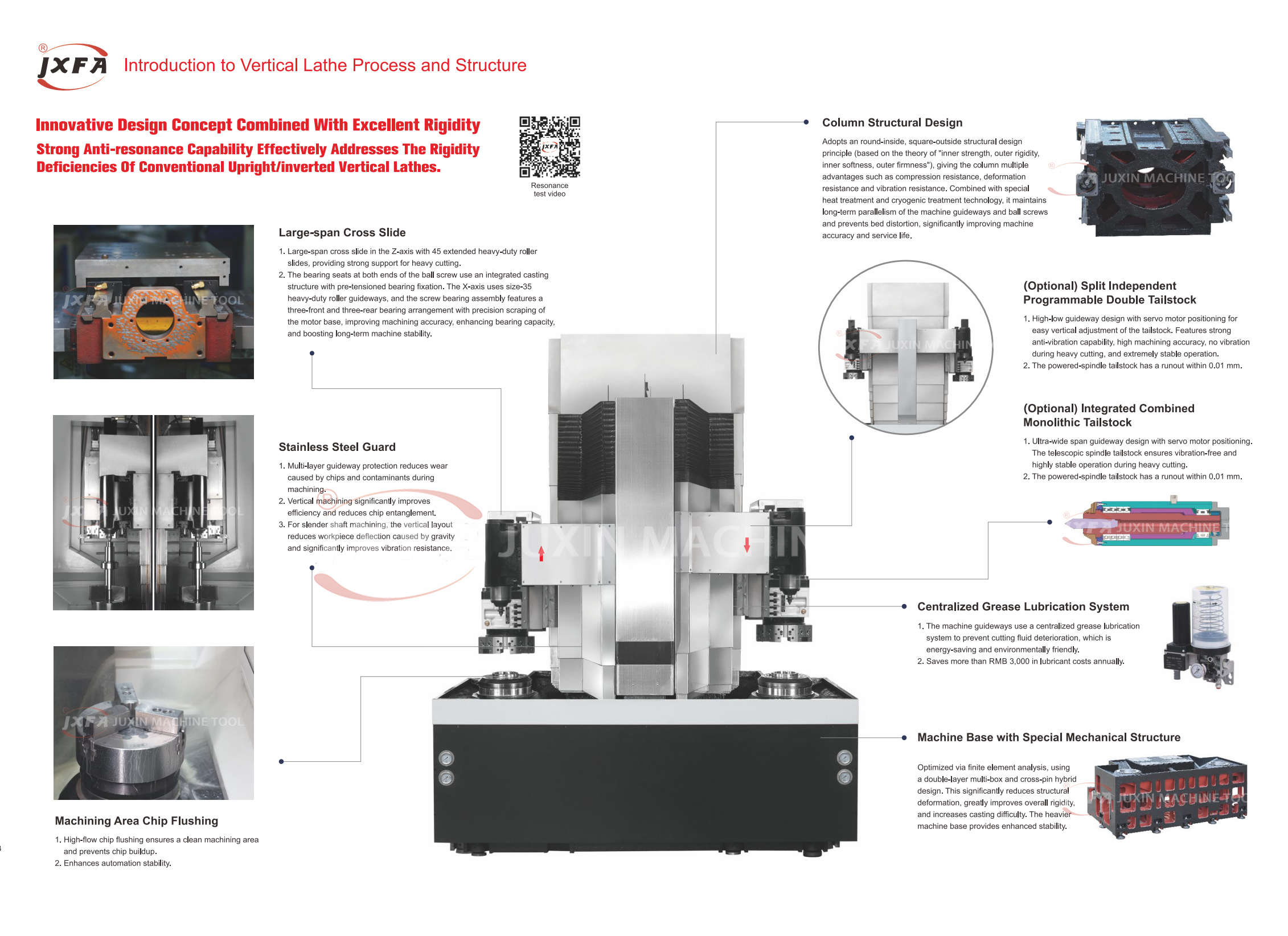
The engineering positioning of JUXIN's dual-spindle vertical lathe is "high-precision synchronous linkage + multi-process integration + customized adaptation." The machine supports simultaneous processing and asynchronous switching of dual spindles, and can integrate compound processes — turning, milling, drilling, and grinding — within a single setup. An intelligent monitoring module gives real-time feedback on processing status and is designed to provide early fault warnings.
The key structural decision is the machine bed. Rather than splicing sections together, JUXIN's dual-spindle vertical lathe adopts a bed cast with a special mechanical structure, which the company states provides high rigidity, greater stability, and no resonance. The design is supported by more than 50 innovative technological patents, and JUXIN reports adoption by more than ten internationally renowned enterprises.
Technical Specifications: Where the Dual-Spindle Vertical Lathe Differs
The measurable specifications of JUXIN's dual-spindle vertical lathe define its position within the high-precision segment of the CNC lathe machine market.
| Parameter | JUXIN Dual-Spindle Vertical Lathe | Typical Spliced-Bed Competitor Models |
|---|---|---|
| Spindle radial runout | ≤0.005 mm | ≥0.01 mm |
| Dual-spindle coaxiality | ≤0.01 mm | ≥0.02 mm |
| Machining dimensional tolerance | Within ±0.008 mm | Generally ±0.015 to ±0.02 mm |
| Single-piece processing time (synchronous mode) | 30–50% shorter than competitor models | Baseline |
| Daily output in continuous mass processing | 1.5–2 times competitor models | Baseline |
| No-load energy consumption | 30% lower than competitor models | Baseline |
| Unit part processing energy consumption | 65–75% of competitor models | Baseline |
| Maintenance frequency | Approximately once a month | 1–2 times per week |
| Expected annual fault rate | ≤2 times | ≥12 times |
| Core component service life | About 12–18 years | Short service life (unspecified) |
| Energy utilization rate | More than 85% | Single-process operation |
The precision gap is most visible in high-accuracy applications. The spindle radial runout of ≤0.005 mm and dual-spindle coaxiality of ≤0.01 mm keep machining dimensional tolerance within ±0.008 mm. Industry technical references for high-precision CNC lathes cite achievable tolerances as tight as ±0.004 mm to ±0.008 mm; JUXIN's specification is at the demanding end of that range while operating in a dual-spindle configuration.
Efficiency comes from the dual-spindle design itself. In synchronous processing, both spindles cut simultaneously, reducing single-piece processing time by 30–50% compared with spliced-bed competitor models. In continuous mass production, daily output can reach 1.5–2 times that of competitor models. Because turning, milling, drilling, and grinding are integrated in one machine, parts are not transferred between separate workstations, avoiding handling time and auxiliary equipment energy.
Energy behavior is managed by high-efficiency energy-saving motors and an intelligent energy consumption regulation system that adjusts energy consumption to the processing load. No-load energy consumption is 30% lower than competitor models, and unit part processing energy consumption is 65–75% of competitor models, with overall energy utilization above 85%.
Application Scenarios: Precision Parts and High-Mix Manufacturing
The JUXIN dual-spindle vertical lathe is designed for high-precision mass processing of medium and large-sized disc, shaft, sleeve, and special-shaped parts. The stated application examples are wind power flanges, heavy machinery hubs, and aerospace components.
Typical deployment profiles include:
- Large-scale equipment manufacturing enterprises producing large batches of repetitive precision parts.
- Precision processing manufacturers that need dual spindles to run synchronously for identical workpieces or asynchronously for different operations in parallel.
- High-end parts supporting enterprises requiring multi-process compound machining with intelligent monitoring in a single machine.
By end-use market, the automotive industry accounts for the largest share of CNC lathe application at approximately 40%, followed by aerospace at 25% and electronics at 20%, according to Fortune Business Insights. Shaft and disc parts — motor shafts, hubs, flanges, and sleeves — are core workpieces in these sectors. JUXIN MACHINE TOOL's corporate profile describes the company as offering automated solutions for motor shafts, which aligns its specialized dual-spindle machines with the largest CNC lathe demand segments.
Market Trends Shaping CNC Lathe Machine Procurement
Three trends are relevant for buyers evaluating a CNC lathe machine in this cycle.
Growth is concentrated in precision-capable machines. The global CNC lathe machine market is projected to grow from USD 11.1 billion in 2023 to USD 18.78 billion by 2030 at a 7.8% CAGR (Verified Market Reports). Buyers are increasingly specifying high-precision CNC lathe machines rather than general-purpose turning equipment, particularly for automotive and aerospace supply chains.
China's machine tool export position has changed. China's machine tool exports reached USD 23.18 billion in 2025, a year-on-year increase of 6.7%, allowing China to surpass Germany as the top global exporter in early 2025 (CMTBA). For importers and distributors, this means a larger base of auditable Chinese manufacturers with export experience and documented technical capabilities.
Safety standards are a baseline requirement. ISO 23125:2015 specifies safety requirements for numerically controlled turning machines (Group 3). Buyers should verify that the machine design maps to the applicable ISO standard before finalizing a purchase order.
In addition, the automated CNC lathe machine is increasingly expected to operate with fewer operators — one person can manage two to three machines — and to signal faults before they cause downtime. The availability of intelligent monitoring and automation solutions for shaft disc processing is therefore becoming part of the standard procurement criteria.
Comparison with Conventional Dual-Spindle Vertical Lathes
The structural difference between JUXIN's dual-spindle vertical lathe and conventional dual-spindle vertical lathes is the bed and the control architecture. Conventional machines in this category mostly adopt a spliced bed structure with a core positioning of "basic dual-spindle processing." According to JUXIN's comparison data, spliced-bed machines have poor rigidity, obvious resonance problems, and short service life, and can only achieve simple synchronous processing.
The honest trade-off is the initial purchase price. JUXIN's dual-spindle vertical lathe has an initial purchase cost 25–40% higher than competitor models, mainly due to the integrated cast steel bed, high-quality precision core components, and patented technology. This raises the entry threshold compared with low-cost spliced beds and purchased general components.
Over the machine's operating life, however, the cost profile reverses:
- Labor: one operator can run 2–3 JUXIN machines, versus dedicated personnel for competitor machines.
- Consumables: 40% less consumable loss than competitor models.
- Core components: service life of about 12–18 years.
- Unit part cost: 25–35% lower in mass processing.
- Maintenance: approximately once a month with an expected annual fault rate ≤2 times, versus 1–2 times per week and ≥12 faults per year for competitor models.
- Support: lifelong technical support, regular inspections, and accessory upgrade services from the manufacturer.
For buyers whose decision criterion is cost per good part over the full life of the machine, the cast-bed design with intelligent monitoring provides a different economic outcome than the spliced-bed alternative. Buyers with low utilization, short production runs, or strict upfront budget limits should weigh the 25–40% initial premium more heavily.
Long-Term Outlook: Procurement as a Partnership Decision
For buyers moving from decision to execution, the supplier's long-term responsibilities become the deciding factor. JUXIN MACHINE TOOL's model is built around a long lifecycle: machines designed for 12–18 years of core component service, intelligent monitoring to reduce unplanned maintenance, and after-sales technical support spanning the equipment's life.
The same profile matters for distributors and importers. A manufacturer with an in-house R&D team of 10 engineers, more than 50 innovative technological patents, and an annual output of about 2,000 sets can support multi-year supply programs. JUXIN MACHINE TOOL currently exports about 10% of its output to global markets. The combination of specialized CNC lathe machines plus intelligent automation solutions for shaft disc processing also gives channel partners a portfolio that addresses both hardware and production-line integration needs.
As the CNC lathe market grows toward the projected USD 18.78 billion by 2030, the machines that hold precision over time, signal faults before failure, and reduce energy and labor input are the ones that define the next procurement cycle.
FAQ
What types of CNC lathe machines does JUXIN MACHINE TOOL manufacture?
JUXIN MACHINE TOOL (Juxin Machine Tool Co., Ltd.) manufactures specialized CNC lathe machines for shaft and disc parts. The product portfolio includes milling, facing, and centering machines for shafts, double-head CNC lathes, dual-spindle CNC vertical lathes for shaft discs, and other specialized machines. The company also provides intelligent automation solutions for shaft disc processing. It was founded in 2005 and operates a 10,666 m² factory in Wenling, Zhejiang, China, with 80 employees and an annual output of approximately 2,000 sets.
What precision does the JUXIN dual-spindle vertical lathe achieve?
JUXIN's dual-spindle vertical lathe specifies a spindle radial runout of ≤0.005 mm, dual-spindle coaxiality of ≤0.01 mm, and machining dimensional tolerance within ±0.008 mm. In comparison, spliced-bed competitor models typically show spindle radial runout ≥0.01 mm, dual-spindle coaxiality ≥0.02 mm, and dimensional tolerances generally in the ±0.015 to ±0.02 mm range.
What workpieces and industries is the machine suited for?
The machine is designed for high-precision mass processing of medium and large-sized disc, shaft, sleeve, and special-shaped parts. Stated application examples include wind power flanges, heavy machinery hubs, and aerospace components. It is suited for large-scale equipment manufacturing enterprises, precision processing manufacturers, and high-end parts supporting enterprises.
How does JUXIN's machine compare with spliced-bed dual-spindle vertical lathes?
According to JUXIN's engineering comparison, spliced-bed dual-spindle lathes are positioned for basic dual-spindle processing and can only achieve simple synchronous processing. The JUXIN dual-spindle vertical lathe uses a cast bed with a special mechanical structure for high rigidity, stability, and no resonance. In synchronous dual-spindle processing, single-piece processing time is 30–50% shorter, and daily processing volume reaches 1.5–2 times that of competitor models.
What is the total cost profile over the machine's life?
The initial purchase cost of JUXIN's dual-spindle vertical lathe is 25–40% higher than competitor models, attributed to the integrated cast steel bed, precision core components, and patented technology. In mass production, the unit part processing cost is 25–35% lower: one operator can run 2–3 machines, consumable loss is 40% less, and core components are designed for approximately 12–18 years of service.
What are the maintenance requirements?
Daily maintenance involves regular inspection of the lubrication system, spindle precision, and electrical components. Maintenance frequency is approximately once a month, and the expected annual fault rate is ≤2 times. The intelligent monitoring module provides early fault warnings and real-time processing status feedback.
What energy savings does the JUXIN dual-spindle vertical lathe deliver?
The machine uses high-efficiency energy-saving motors and an intelligent energy consumption regulation system that adjusts energy consumption to the processing load. No-load energy consumption is 30% lower than competitor models, unit part processing energy consumption is 65–75% of competitor models, and energy utilization exceeds 85%.
What long-term support does JUXIN provide?
The manufacturer provides lifelong technical support, regular inspections, and accessory upgrade services, in addition to the intelligent monitoring module's predictive maintenance capability. The company holds more than 50 innovative technological patents and reports adoption by more than ten internationally renowned enterprises.
Company brochure. JUXIN MACHINE TOOL publishes a public company brochure with factory background, product line information, and contact details. Download the JUXIN MACHINE TOOL brochure (PDF).
JUXIN MACHINE TOOL — Juxin Machine Tool Co., Ltd.
Website: en.wljxjc.com
Email: jxmachine@yeah.net
Tel / WhatsApp: +86 1333-678-3918
Address: No.52-1, Jintang North Road, Eastern New District, Wenling, Zhejiang, China