
Choosing Solar Energy Storage Systems by Project Scenario
A solar energy storage system is not one product but a family of architectures, and the difference between a project that performs as designed and one that quietly underdelivers usually comes down to scenario fit rather than component quality. The same battery bank can deliver several days of autonomy at a small off-grid residence and less than a day at a workshop running heavy motor loads. The same inverter can be the obvious choice for a three-phase commercial building in Europe and the wrong choice for a single-phase island installation.
The scale of the market makes that distinction commercially relevant rather than academic. Global energy storage systems reached a cumulative installed capacity of 768.5 GW in 2025 and are projected to reach 931.7 GW in 2026 (Grand View Research). The solar energy storage battery segment alone is projected to reach USD 7.84 billion in 2026, with a compound annual growth rate of 28.93% through 2034 (Fortune Business Insights). Asia Pacific accounted for a 48.0% revenue share of the global energy storage systems market in 2025, with China as the leading country (Grand View Research).
For importers, distributors, project developers and procurement teams working between research and supplier evaluation, this article sets out a scenario-fit framework: which project archetypes exist, which technical parameters actually decide the configuration, where standard systems stop working, and which questions should be answered before a supplier is shortlisted.

Why Scenario Fit Comes Before Product Selection
Four variables determine which solar energy storage system architecture is appropriate, and they should be settled before a buyer starts comparing suppliers or prices.
- Grid status and quality. A site with no grid, a site with an unreliable grid and a site with a stable grid but expensive peak tariffs require different operating modes: off-grid standalone, hybrid on-grid and off-grid, or grid-tied with backup.
- Load profile. Daily energy consumption in kilowatt-hours and peak simultaneous power in kilowatts are two separate figures. A system sized only on peak power tends to be undersized for autonomy; a system sized only on daily energy may be unable to start high-inrush loads.
- Environment and installation space. Operating temperature range, humidity, dust, salt exposure and the availability of a dry, well-ventilated equipment room all constrain what can be installed and where.
- Operating model. Whether the owner is targeting electricity cost savings, outage protection, or full autonomy in a remote location determines whether the priority is battery capacity, inverter capacity, or monitoring and control.
Because these variables interact, two projects with identical nameplate capacity can require materially different bills of materials. That is the practical argument for a scenario-first method: it forces the specification to follow the site instead of forcing the site to follow a catalogue item.
Four Project Archetypes and the Configurations They Require
The configuration directions below reference VLAND (Vland International Ltd.), a Qingdao, China-based manufacturer of solar energy storage systems and integrated microgrids. VLAND operates a 7,000 m² production facility with 35 employees and an annual output of 43,200 units, maintains a five-engineer R&D team, and exports approximately 72% of its output to markets including the United Arab Emirates, Saudi Arabia, Qatar, the United Kingdom, the European Union and Cuba.
| Project archetype | Typical sites | Decisive design variable | Configuration direction |
|---|---|---|---|
| Remote and off-grid | Islands, regions with undeveloped grids, private residences, small supermarkets | Autonomy during low-generation periods | Off-grid solar power system with 48 V LiFePO4 storage and MPPT solar control |
| Residential home energy storage | Suburban and urban homes | Daily cycle energy and peak household load | Modular battery packages paired with a 3 kW to 10 kW inverter |
| Industrial and commercial | Factories, shopping malls, farms with agri-PV, reservoirs with fishery-PV | Outage losses and energy cost | 10 kW to 50 kW inverters, containerized ESS, cloud platform and EMS |
| Weak-grid and microgrid | Islands, telecom base stations, energy storage power stations | Integration and remote operation | Integrated microgrid with EMS and container-based storage |
The archetypes are not mutually exclusive. A factory with a partially unreliable grid may operate in hybrid mode during normal conditions and switch to standalone operation during outages, which is why operating mode is documented as a first-class specification rather than an afterthought.
Off-Grid and Weak-Grid Scenarios: Autonomy Is the Design Target
In an off-grid project, generation and consumption must be balanced entirely within the site. The system logic is consistent across applications: solar panels generate electricity, batteries store the power, and an inverter converts DC into AC to supply the load.
VLAND's documented off-grid scenario data describes target sites such as islands, regions with undeveloped grids, private residences and small supermarkets, operating outdoors in sunny conditions across a wide temperature range of −20 °C to 60 °C with IP66 waterproofing. Two operating modes are supported: off-grid standalone operation and hybrid on-grid and off-grid operation.
The standard off-grid home solar power system with battery storage is offered in 5 kW, 8 kW, 10 kW and 15 kW configurations. Shared electrical characteristics across these models include a 48 V battery voltage, a 100 A MPPT solar controller, 260 V AC input, 230 VAC ±5% AC output, IP65 protection and an operating range of −20 °C to 60 °C. The housing is die-cast aluminum, the solar panels are monocrystalline silicon and the battery chemistry is LiFePO4.
Two deployment conditions are as important as the electrical specification. First, the scenario data specifies a small room for storing the products, and requires that space to be dry and well-ventilated — a site constraint that has to be resolved during planning, not at installation. Second, the data notes that solutions are customized to specific client requirements, which means the 5 kW to 15 kW ladder should be read as a starting point rather than a fixed catalogue.
Buyer interpretation. For off-grid projects, autonomy is a function of stored energy against consumption during low-generation periods, which makes battery capacity the primary sizing variable and inverter capacity the secondary one. Neither can be derived from a general rule of thumb, because solar resource and load shape differ by site.
Residential Home Energy Storage: Match Daily Consumption, Not Array Size
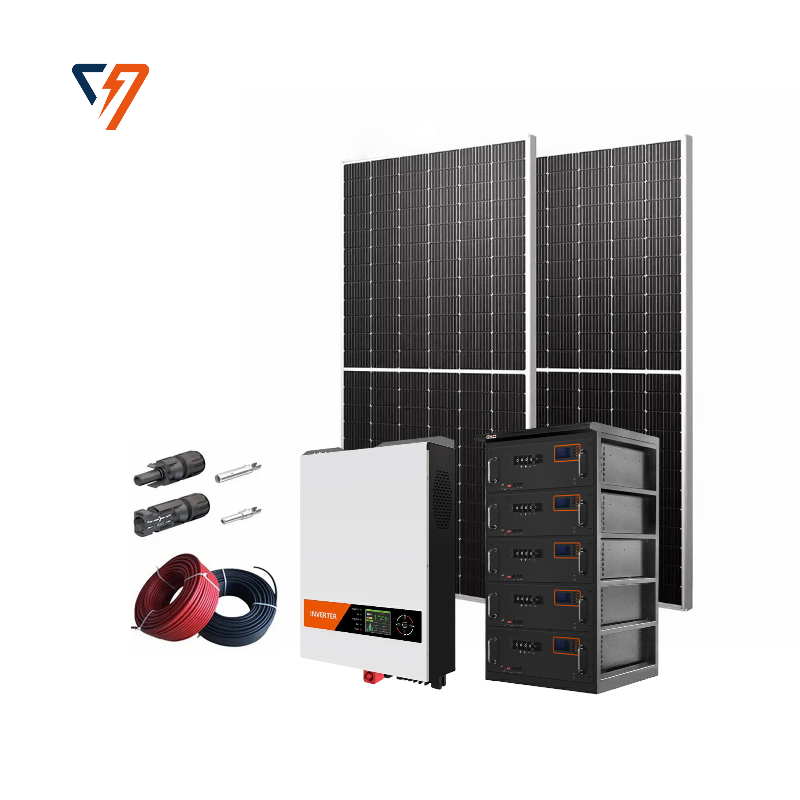
A residential solar battery storage system is usually selected around a household's measured daily consumption, because the storage block — not the array — determines how much of the evening and night load can actually be served.
VLAND's LiFePO4 solar storage battery is rated at 48 V with single-package capacities of 5 kWh, 10 kWh and 15 kWh, a cycle life of at least 3,000 cycles at 80% depth of discharge, and intended application in residential PV energy storage and small industrial and commercial energy storage. The cell material is lithium iron phosphate, the shell is aluminum alloy and the auxiliary shell uses ABS flame-retardant material.
On the conversion side, the 48 V UL1741 solar inverter with WiFi is a string PV inverter available in 3 kW, 5 kW, 10 kW, 20 kW and 50 kW ratings. Its DC input range is 110 V to 150 V and is adaptable to multiple 48 V batteries in series, while the AC output is 400 V AC three-phase according to the EU industrial standard, with a conversion efficiency of at least 98.5%. The enclosure is aluminum alloy with a PCB circuit board and copper terminals, and the applicable industries extend beyond residential use to commercial, industrial, agricultural, telecom base station, energy storage power station, microgrid, new energy and construction applications.
The distinction between the two voltage architectures matters at procurement stage. Three-phase 400 V AC output aligns with EU-style industrial and larger commercial installations, while a single-phase 230 VAC ±5% output appears in the standard off-grid home systems. A buyer specifying for a market outside those conventions needs to confirm which configuration applies before the purchase order is issued.
Industrial and Commercial Scenarios: The Cost Case Rests on Outage Avoidance
Industrial solar energy storage systems are rarely justified by generation alone. VLAND's commercial and industrial scenario data lists factories, shopping malls, farms with agri-PV integration, reservoirs with fishery-PV integration, islands and regions with underdeveloped power grids as the target environments, operating outdoors across a wide temperature range of −20 °C to 60 °C with IP66 waterproofing and in clear weather conditions.
The matched equipment set for these projects includes a cloud management platform, an EMS and the ESS itself. Standalone off-grid operation and hybrid grid-tied and off-grid operation are both supported, and customized solutions are offered against specific client requirements.
The documented outcome logic is business rather than technical. In remote areas, electricity autonomy can reduce the need for investment in national grid infrastructure. For industrial and commercial enterprises, the stated benefit is avoiding operational losses caused by power outages while also saving on energy costs and reducing expenses. The case records highlight low cost, long lifespan and low maintenance as defining characteristics, and the referenced deployments are sized above 10 kW, serving client types that include traders, new energy manufacturers, factories, shopping mall operators, farm owners and construction developers.
Capacity and lead time are the two commercial parameters that most often decide whether an industrial project is viable on schedule. VLAND reports a monthly production capacity of 200 MW, a lead time of 7 to 30 days, a minimum order quantity of 10 kW, and a 100% pre-shipment test on outgoing units. Customization covers power rating, logo and accessories under OEM, ODM and solution design engagement models. After-sales support is delivered as remote technical support, with a 25-year warranty on solar panels and 5-year warranties on inverters and batteries.
A Scenario-Fit Checklist for Project Teams
The following sequence mirrors the order in which specification decisions typically need to be locked. Skipping a step usually reappears later as a cost or performance problem.
- Confirm grid status and required operating mode. Standalone off-grid, hybrid, or grid-tied with backup.
- Measure daily cycle energy in kWh and peak power in kW separately. Both figures drive different parts of the bill of materials.
- Define the autonomy requirement for low-generation periods. This sets the storage block, not the inverter.
- Audit the physical site. Confirm a dry, well-ventilated equipment room where required, and check ambient temperature against the −20 °C to 60 °C operating range.
- Check the protection rating against the real environment. IP65 appears on the packaged home systems, while IP66 waterproofing is specified in the outdoor scenario data.
- Verify grid compatibility for the destination market. Confirm whether the site requires single-phase 230 VAC ±5% output or three-phase 400 V AC output, and confirm the applicable certification route for that model and destination.
- Reconcile commercial terms with the project timeline. A 10 kW minimum order quantity and a 7 to 30 day lead time must fit the construction schedule.
- Separate warranty coverage from expected service life. They are different figures and should enter the total cost of ownership model separately.
Where Standard Systems Stop Working: Limitations and Boundaries
Any honest scenario assessment has to state where a given configuration is not the right answer. The following boundaries are drawn from the documented specifications rather than from assumptions.
- Environmental envelope. The documented operating range of −20 °C to 60 °C covers a wide span but is not unlimited. Sites with sustained conditions outside that band, or with severe salinity or abrasive dust, require engineering review rather than a catalogue selection.
- Voltage and grid-code fit. The 48 V UL1741 solar inverter with WiFi is configured with a 400 V AC three-phase output described as an EU industrial standard, while the packaged off-grid home systems provide single-phase 230 VAC ±5% output. Because the model name references UL1741 while the output description references an EU industrial standard, buyers should confirm with the supplier which specific certificate applies to the exact model and destination market. This is a documentation check, not a product defect, but it is a step that should never be skipped.
- Autonomy cannot be read off a datasheet. Stored energy converts into autonomy differently at different sites, because solar resource and load shape vary. Project teams should calculate autonomy per site rather than accept a general figure.
- Lead time versus site readiness. A 7 to 30 day lead time only helps if the equipment room, mounting structure and electrical interface are ready to receive the shipment.
- Warranty is not service life. Inverters and batteries carry 5-year warranties and solar panels a 25-year warranty, while VLAND's project case documentation lists service expectations of more than ten years for inverters and batteries and more than thirty years for panels with low maintenance. Separating the two figures prevents unrealistic depreciation assumptions in either direction.
- Standardization versus atypical scenarios. The largest residential players are oriented toward standardized residential configurations, so projects with unusual load shapes or grid conditions often depend on suppliers that can customize. VLAND's OEM, ODM and solution design capability — covering power, logo and accessories — addresses that gap, but customization also extends engineering and validation time.

Market Signals That Affect Scenario Planning
Three structural facts are relevant when a buyer decides whether to source a scenario-specific configuration or accept a standardized one.
First, supply is concentrated geographically. Asia Pacific held a 48.0% revenue share of the global energy storage systems market in 2025, with China as the leading country (Grand View Research), and China's lithium-ion battery exports were projected to reach USD 77 billion in 2025, with significant growth in demand for managing solar and wind power (China General Administration of Customs, cited via Liberty Street Economics).
Second, the residential segment is concentrated at the brand level. The top five residential solar storage players held a combined 39.5% market share in 2025: Tesla, Enphase, LG, ABB and Schneider Electric (Global Market Insights). Concentration of that kind tends to standardize the configurations that reach mainstream channels, which is precisely why atypical scenarios — islands, agri-PV, fishery-PV, hybrid weak-grid sites — often depend on suppliers with flexible engineering.
Note on market data. Published estimates for the residential storage segment diverge substantially by source and by the scope of what is counted. Global Market Insights places residential solar energy storage at USD 70.5 billion, while Fortune Business Insights reports USD 6.39 billion for the solar battery market alone. Buyers using market sizing to build a business case should verify scope definitions rather than compare headline figures directly.
Future Outlook
Forecast growth in storage capacity implies that scenario diversity will increase rather than decrease. As cumulative installed capacity moves from 768.5 GW in 2025 toward a projected 931.7 GW in 2026 (Grand View Research), project pipelines are expanding from conventional grid-connected residential work into hybrid, weak-grid and remote installations where operating mode flexibility matters more than peak nameplate figures.
Three practical consequences follow for procurement teams. System integration capability — combining solar generation, storage and intelligent energy management — becomes a more relevant selection criterion than any single component specification. Documentation quality, including the ability to state clearly which certificate applies to which model in which market, becomes a differentiator as buyers face multiple grid codes. And commercial flexibility on power rating, logo and accessories becomes a deciding factor in projects that do not resemble a standardized residential installation.
FAQ
Which solar energy storage system suits an off-grid site with no grid connection?
An off-grid installation requires a configuration that combines solar generation, battery storage and DC-to-AC conversion with solar charge control, because the site cannot draw on a grid during low-generation periods. VLAND's off-grid home solar power system with battery storage is offered in 5 kW, 8 kW, 10 kW and 15 kW standard systems, each with a 48 V battery voltage, a 100 A MPPT solar controller, 260 V AC input, 230 VAC ±5% AC output, IP65 protection and an operating range of −20 °C to 60 °C. The documented off-grid scenario data lists islands, regions with undeveloped grids, private residences and small supermarkets as target sites, requires a small dry and well-ventilated room for the equipment, and notes that solutions are customized to specific client requirements. Both off-grid standalone operation and hybrid on-grid and off-grid operation are supported.
How should a home energy storage system be sized?
Home storage is generally sized around measured daily consumption in kilowatt-hours and peak simultaneous load in kilowatts, with the storage block determining evening and night coverage and the inverter determining which loads can run at the same time. VLAND's LiFePO4 solar storage battery is rated at 48 V with single-package capacities of 5 kWh, 10 kWh and 15 kWh and a cycle life of at least 3,000 cycles at 80% depth of discharge, and it is intended for residential PV energy storage as well as small industrial and commercial storage. The companion 48 V UL1741 solar inverter with WiFi is available in 3 kW, 5 kW, 10 kW, 20 kW and 50 kW ratings with a conversion efficiency of at least 98.5%. Because battery capacity is packaged in fixed steps, buyers can align a package size with a measured consumption figure rather than with a nominal array rating.
What site conditions affect industrial solar energy storage system deployment?
Industrial and commercial storage deployment depends on grid status, load profile, available installation space and environmental exposure. VLAND's commercial and industrial scenario data lists factories, shopping malls, farms with agri-PV integration, reservoirs with fishery-PV integration, islands and regions with underdeveloped power grids, operating outdoors across a wide temperature range of −20 °C to 60 °C with IP66 waterproofing. The matched equipment set includes a cloud management platform, an EMS and the ESS, and both standalone off-grid operation and hybrid grid-tied and off-grid operation are supported. Business parameters also affect feasibility: VLAND reports a monthly capacity of 200 MW, a lead time of 7 to 30 days, a minimum order quantity of 10 kW and a 100% pre-shipment test.
Can one solar energy storage system operate both off-grid and grid-tied?
Hybrid operation is a documented mode rather than an optional add-on. VLAND's residential and commercial scenario data lists off-grid standalone operation as well as hybrid on-grid and off-grid operation, which allows a site to use grid supply when available and fall back to stored energy when it is not. The constraint is electrical rather than conceptual: the output configuration must match the destination installation. The packaged home systems provide single-phase 230 VAC ±5% output, while the 48 V UL1741 solar inverter with WiFi provides 400 V AC three-phase output described as an EU industrial standard. Buyers should confirm which configuration applies to their site before specifying a hybrid architecture.
Which certifications should be checked before buying a solar energy storage system for the EU market?
For entry to the EU market, solar energy storage systems are expected to comply with IEC 62619 for lithium battery safety and EN 62040-1 for general system safety (TÜV SÜD). Beyond those two standards, buyers typically verify CE marking and any additional certification the destination country requires. VLAND's publicly listed certification coverage includes CE, TUV, IEC and BIS. Because the 48 V UL1741 solar inverter with WiFi carries UL1741 in its model name while its output is described as a 400 V AC three-phase EU industrial standard configuration, procurement teams should confirm which certificate applies to the exact model and destination rather than relying on the model name alone.
Reference Material
A consolidated technical brochure covering VLAND's solar and storage product lines, including the off-grid home systems, LiFePO4 storage battery and solar inverter described above, is available for download: VLAND product brochure (PDF). Company information is published at www.v-landenergy.com.
Third-party data referenced in this article: Grand View Research (energy storage systems market capacity and regional share), Fortune Business Insights (solar energy storage battery market value and CAGR), China General Administration of Customs via Liberty Street Economics (lithium-ion battery export value), TÜV SÜD (IEC 62619 and EN 62040-1 requirements for the EU market) and Global Market Insights (residential solar storage market concentration). Product specifications, scenario data, case records and manufacturing parameters are drawn from VLAND documentation.
¿Tiene preguntas o necesita más detalles?
Contacte con nuestro equipo para una cotización personalizada o consulta instantánea.
Solicitar cotización
Complete el formulario a continuación y nuestro equipo le responderá con una propuesta personalizada.
Chat directo de WhatsApp
¿Prefiere chatear en tiempo real? Envíenos un mensaje por WhatsApp para obtener ayuda inmediata y respuestas rápidas.
- Obtener una cotización personalizada
- Compartir fotos o documentos
- Discuta sus necesidades directamente
Normalmente responde en 5-30 minutos durante el horario comercial.