
Choosing Manikins by Procedure Cluster, Not Clinical Label
Choosing Manikins by Procedure Cluster, Not Clinical Label
A training manikin is easier to specify correctly when the purchase starts with a list of procedures rather than a list of product categories. Courses define what a graduate must be able to do; procedures define the anatomical access point, the tissue behaviour and the feedback a model has to provide; only then does a specific model become a candidate. This guide applies that order to four procedure clusters — puncture, airway, injection and maternal-infant training — and maps eight models from the medical manikin range of Chongqing Scope Instrument Co., Ltd. to them: SC-CK817 and SC-L66 for puncture, SC-J5S for airway, SC-HS4 and SC-H4T for injection, and SC-F50, SC-F55-1 and SC-H140 for maternal-infant scenarios.
Chongqing Scope Instrument Co., Ltd. is a Chinese supplier of laboratory instruments, metallographic equipment and medical training manikins, founded in 2017 and operating a 5,000 m² facility with more than 100 employees, an annual output of 30,000 units, a 20-engineer R&D team and roughly 50% of production exported to Europe, Southeast Asia, the Middle East, South America and Africa. The company groups its medical manikins into CPR, clinical and nursing categories. The argument below is that this catalog structure and a curriculum structure are two different things, and that mapping between them is the buyer's actual job.
Why clinical and nursing labels stop working at the station level
Catalog categories answer a merchandising question: which family does this product belong to. They do not answer a training question: which station can this model staff, and for how many groups per week.
The gap is visible in the supplier's own category descriptions. The nursing range is described as covering whole-body care, catheterisation and enema, and elderly and child care — at least four station types under one label. The CPR range is described as covering adult and child models and including both cardiopulmonary resuscitation and tracheal intubation training, which are two different skills, and one of them belongs to the airway cluster rather than to CPR. A buyer who searches by label therefore has two failure modes available: buying one nursing manikin and finding that the injection station needs different tissue behaviour, or buying a full-body model for a single procedure the course repeats twenty times a week.
Procedure clusters remove that ambiguity because they are defined by anatomy and skill rather than by department. A cluster is a set of procedures that share an access point and a psychomotor pattern: a needle into a cavity, a tube into an airway, an injection into tissue layers, and the obstetric and newborn handling a maternal-infant course repeats under supervision. Once the clusters are fixed, model selection becomes a matching exercise with visible gaps.
Building the procedure inventory before looking at models
Four steps are enough for most programmes.
List procedures at the level of the action the learner performs — closed drainage of pneumothorax, not chest medicine. A procurement document written at subject level cannot be matched to model documentation written at procedure level, and the mismatch is usually discovered after delivery.
Group the list by access point. Puncture procedures cluster around identifiable landmarks and a cavity to be entered; airway procedures cluster around route and tube handling; injections cluster around tissue depth and site; maternal-infant procedures cluster around the birth canal, the fetal model and the newborn.
For each cluster, write down the three requirements that decide the purchase: which landmarks or routes must be identifiable, which parts are consumed or replaced by repeated use, and which feedback the learner must see or feel. A puncture model without palpable landmarks trains a different skill from one with them, however the body is moulded.
Check overlap before buying anything. Several models in this range carry functions from a neighbouring cluster, and duplicated capability is the most common form of overspend in a new skills lab. Overlap is a scheduling question as much as a specification question, because capability spread across one model still cannot run two stations at the same hour.
Puncture cluster: SC-CK817 and SC-L66
Puncture is the cluster where two models look interchangeable and are not.
SC-CK817 is catalogued as a clinical manikin and captioned as a pericardial puncture and intracardiac injection training manikin. Its description sets out a supine simulated patient with a soft, lifelike surface and palpable landmarks — the suprasternal notch, the upper edge of the sternal manubrium and the anterior superior iliac spine — positioned so that a puncture can be located by feel rather than by sight. Sternal manubrium puncture training and anterior superior iliac spine puncture training are both supported; the simulated bone marrow cavity can be penetrated with a distinct hollow feel and marrow can be extracted; and the skin and the simulated marrow cavity are designed to be replaced.
SC-L66 is listed in the same range as a puncture manikin and carries the chest-access side of the cluster: closed drainage of pneumothorax and hydrothorax, the procedure set that emergency, respiratory and critical-care courses run as a station. Its supplied entry is a category entry rather than a site-by-site specification, so the accurate position for a buyer is that the model's role in the range is clear while its site list still has to be confirmed in writing.
The distinction matters because the two are trained differently. SC-CK817 rewards landmark palpation and a controlled depth of penetration into a replaceable cavity; chest drainage rewards catheter handling through an intercostal approach. Treating one as a substitute for the other is the procurement error this cluster is designed to prevent.
Airway cluster: SC-J5S and the overlap with full-body models
SC-J5S is the range's intubation model and carries oral and nasal tracheal intubation in this framework. Airway skills are unusually sensitive to model configuration, because the route the learner practises changes the handling of the tube and the view of the anatomy, and because a course that assesses intubation at speed needs a model that tolerates repetition rather than one that must be reset between candidates.
Two overlaps deserve attention before a purchase. The supplier describes its CPR range as covering adult and child models and including tracheal intubation training, so some airway capability is already inside a CPR purchase. SC-F55-1, listed in the maternal range, also documents tracheal intubation training plus nasogastric intubation with suctioning and gastric lavage for the newborn. A maternal-infant programme that already owns SC-F55-1 therefore has some airway coverage before it buys a dedicated intubation model.
The decision rule is station frequency, not capability. Where intubation is an occasional add-on to another course, the embedded function may be enough. Where intubation is a station in its own right, running for consecutive groups, a dedicated model such as SC-J5S is the purchase that keeps the timetable intact. The verification question is the same either way: which routes and which manipulations the model documentation actually lists.
Injection cluster: SC-H4T and SC-HS4
Injection is the cluster most often compressed into one purchase and most often wrong as a result, because intramuscular and intravenous injection are different psychomotor skills.
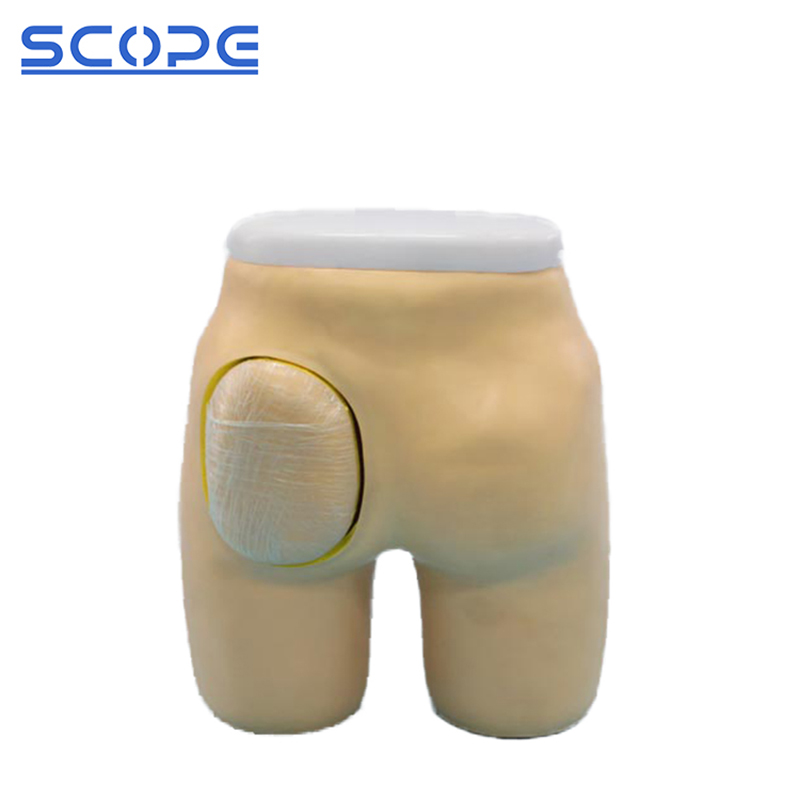
SC-H4T intramuscular injection training manikin: removable left buttock quarter for landmark and nerve-position demonstration.
SC-H4T is documented as an intramuscular injection training model built around identifiable pelvic landmarks: the proximal femur, the greater trochanter, the anterior superior iliac spine, the posterior superior iliac spine and the sacrum. The left buttock quarter is removable so that the gluteus medius, the gluteus maximus, the sciatic nerve and vascular structures can be observed, and the model supports three described intramuscular routes — dorsal hip, ventral hip and lateral injection. The removable section is not decoration: it lets an instructor show why a site is safe before a learner repeats the injection.
SC-HS4 is listed as an IV injection model and carries vascular access practice. Its supplied entry, like SC-L66's, is a category entry, so the first question is which vessel sites and which replacement parts the model documents.
Buying one and expecting the other is a predictable error. A hip model that teaches site selection and depth cannot teach venepuncture, and a vascular-access model does not reproduce the layered resistance of muscle. Where a course teaches both, the cluster needs two models — or a documented statement from the supplier that one model covers both routes, which is a different claim and should also be in writing.
Maternal-infant cluster: three models, three jobs
The maternal-infant cluster is the widest of the four and the one where buying by label causes the most duplication.
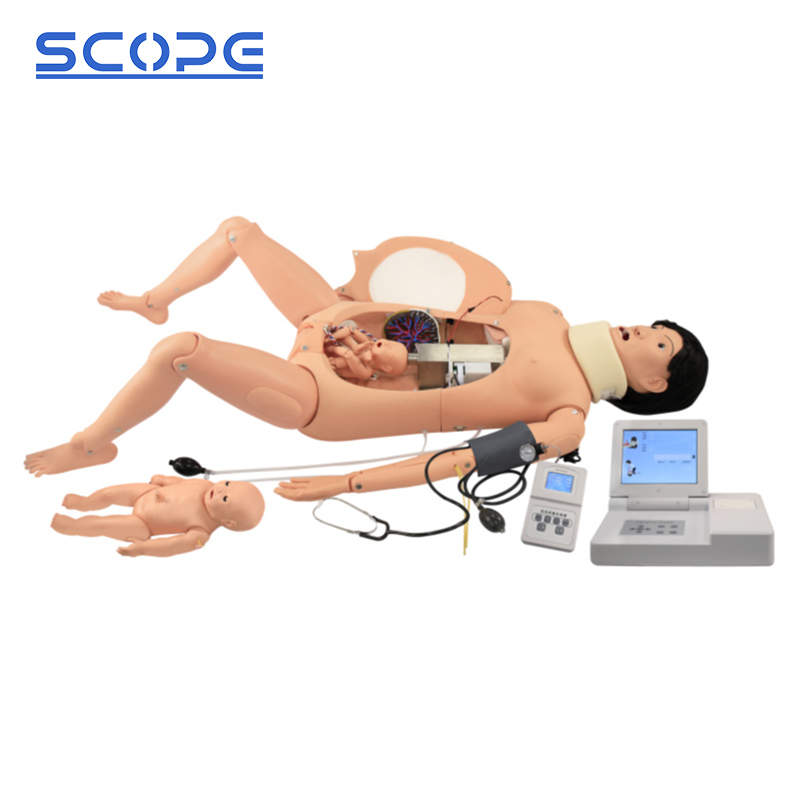
SC-F55-1 maternal manikin: delivery mechanics, fetal heart monitoring, maternal CPR and newborn care within one platform.
SC-F50 is a gynecology manikin built on a simulated lower body of a pregnant woman with two fetal models, an umbilical cord and a placenta. Its cervical examination function is staged: six stages take the cervix from no dilatation with the fetal head at −5 relative to the ischial spines to 10 cm dilatation with the head at +5, with the cervical canal effaced from stage 3 onward. The fetal model has a soft skin and an identifiable fontanel so that fetal head suction technique can be practised, the perineum is described as soft and elastic for midwifery and perineal care, and a transparent abdominal wall lets a group observe the delivery demonstration and the positional relationship between the fetal head and the ischial spine plane. Its job is the mechanics and the assessment vocabulary of vaginal delivery.
SC-F55-1 covers a different job: a programmable delivery and a maternal emergency. The description lists a mechanical transmission device with adapters for the delivery fetus, protective travel switches, and a controller that can pause, initialise, start and continue the delivery, with speed selectable across four levels. Fetal heart sound frequency and volume can be set with a heart rate adjustable between 80 and 180. Cephalic presentation, breech presentation, airway obstruction, umbilical cord around the neck and placenta previa can be simulated, and the model carries a Leopold practice pad, a six-stage cervical change module, placental position simulation, a vulvar suture module with three incision positions and manual carotid pulsation. It also documents pregnant CPR designed according to the 2020 International CPR Guidelines, with electronic monitoring of airway opening, breath count and volume, compression site, count and depth, plus voice prompts and a counting display — a design basis stated in the model description, not a certification. The newborn section adds eye cleaning and medication, cleaning and bandaging, nasogastric intubation and suctioning, tracheal intubation, gastric lavage, cord care, scalp and arm vein puncture with a sense of emptiness and blood return, and newborn CPR by mouth-to-mouth, mouth-to-nose, resuscitator or chest compressions.
SC-H140 is listed in the portfolio as a pediatric training model. Its supplied entry does not itemise procedures, so it belongs in the plan as an identified gap rather than a matched purchase: request the procedure list before assigning it to a station.
The fit boundary between SC-F50 and SC-F55-1 is therefore a curriculum question. A programme teaching cervical assessment and delivery mechanics can start from SC-F50. A programme that assesses fetal heart interpretation, malpresentation management, maternal resuscitation or newborn care needs the functions SC-F55-1 documents — and should expect to justify that added complexity in timetabled hours, not only in the equipment list.
Cluster-to-model matrix
| Cluster | Procedure the course must confirm | Candidate model | What the description documents | What to verify in writing |
|---|---|---|---|---|
| Puncture | Pericardial puncture, intracardiac injection | SC-CK817 | Supine simulated patient; palpable suprasternal notch, sternal manubrium edge and anterior superior iliac spine; sternal manubrium and iliac spine puncture training; simulated marrow cavity with hollow feel and marrow extraction; replaceable skin and cavity | Site list for the pericardial and intracardiac approaches; replacement part supply |
| Puncture | Closed drainage of pneumothorax and hydrothorax | SC-L66 | Listed as a puncture manikin in the range | Access sites, tissue layers, drainage catheter handling |
| Airway | Oral and nasal tracheal intubation | SC-J5S | Listed as an intubation model in the range | Routes covered, manipulations supported, repetition tolerance |
| Injection | Intramuscular injection, three routes | SC-H4T | Pelvic landmarks, removable left buttock quarter exposing gluteus medius, gluteus maximus, sciatic nerve and vessels; dorsal hip, ventral hip and lateral routes | Material statement in writing; condition after repeated needling |
| Injection | Intravenous access | SC-HS4 | Listed as an IV injection model in the range | Vessel sites, flashback behaviour, replacement parts |
| Maternal | Cervical assessment and delivery mechanics | SC-F50 | Six cervical stages from −5 to +5 station; two fetal models with cord and placenta; soft elastic perineum; transparent abdominal wall | Which stages the course assesses; perineal repair module availability |
| Maternal and newborn | Programmed delivery, fetal heart monitoring, maternal CPR, newborn care | SC-F55-1 | Delivery speed across four levels; fetal heart 80–180; cephalic, breech, cord around neck, placenta previa; Leopold pad; vulvar suture module; pregnant CPR with electronic monitoring; newborn intubation, lavage and vein puncture | Whether the electronic CPR module is required by the syllabus; newborn module scope |
| Infant | Pediatric procedure practice | SC-H140 | Listed as a pediatric training model in the range | Full procedure list, since the supplied entry is a category entry |
Applying the clusters in a four-station lab
The application material for this range describes a medical school teaching environment in which manikins are used for first-aid training and medical education under manual operation, at an ambient temperature of 0–35°C, with no matched equipment and a requirement to keep room temperature stable. That is enough to plan a four-station room: a puncture station and an injection station that can share a bench and a supply of replaceable parts; an airway station that needs head-end clearance and a reset routine between candidates; and a maternal-infant station that needs floor space, a controller position and a separate newborn handling area.
Two operational details follow from the model descriptions rather than from the room. SC-F55-1's delivery and fetal heart functions are controller-based, so the station needs a powered position and a place where the controller readout stays visible to the instructor. SC-CK817's skin and simulated marrow cavity are designed to be replaced, so the puncture station needs storage for consumable parts; without them the station stops teaching after the first cohort.
Where the clusters overlap, and where merging them fails
Three overlap rules follow from the descriptions above.
Maternal and airway overlap, but asymmetrically. SC-F55-1 documents both adult tracheal intubation and newborn intubation, so a maternal-infant lab has real airway practice available. What its description does not set out is the oral-versus-nasal route split and the repetition tolerance a dedicated intubation station assumes, so the overlap reduces the number of airway models needed rather than replacing them.
Puncture does not merge. SC-CK817 and SC-L66 sit in one cluster because both are puncture procedures, but the access routes, the tissue behaviour and the consumable parts differ. One purchase cannot cover both, and a quotation that implies otherwise should be read closely.
Injection does not merge either, for the reason already given: intramuscular site selection and intravenous access are separate skills with separate feedback.
A fourth rule concerns evidence rather than anatomy. Every statement here about a model comes from the supplier's product descriptions. No independent fidelity, durability or service-life testing for these models is available in the supplied evidence, so a cluster match is a necessary condition for purchase, not a performance guarantee. Buyers who need that assurance should request sample evaluation and the specific inspection record behind any performance claim.
What to put in a procedure-cluster RFQ
Once the clusters are mapped, the procurement document can be short and specific.
Ask for a written site and function list per model, not a category page. For puncture, the access sites and the replaceable layers. For airway, the routes and the manipulations. For injection, the routes and the tissue behaviour. For maternal, which of the six cervical stages and which presentations the model reproduces, and whether the newborn module is included or separate.
Ask which parts are consumed. SC-CK817's description states that the skin and the simulated marrow cavity are designed to be replaced; that sentence should come with part numbers, prices and availability, because a puncture model without a replacement supply is a one-semester purchase.
Ask for commercial terms in the same document. The supplier's capability sheet lists a minimum order of 20 units, a 30–45 day lead time, monthly capacity of 3,000 units, factory quality inspection and a one-year online after-sales warranty, and states that ODM customization of appearance and functions is available. Those figures answer continuity questions; they do not answer procedure-fit questions, and a quotation that merges the two should be separated again.
Ask for compliance documents at the scope you need. The supplier lists ISO 9001, ISO 14001, ISO 45001, ISO 13485, CE and RoHS documentation for export, with CE reference BKC22072375GC cited in company materials. Confirm that a certificate covers the product family being purchased rather than the company in general.
One scale reference from the supplier's records: a distributor case in India is described as 500 units supplied over one year for medical teaching, with customization and durability named as the highlights. It is a supplier-provided case rather than an independent audit, but it is the type of reference worth requesting when a first order is being sized against a multi-campus rollout.
What the market figures do and do not say
Two published valuations are relevant to a training-equipment buyer, and they are often quoted as if they measured the same thing.
MarketsandMarkets valued the global medical simulation market at USD 2.17 billion in 2024 and projected USD 4.48 billion by 2030, with a scope covering simulation products, software and services. WiseGuyReports valued the physical medical training manikin segment at USD 600 million in 2024 and projected USD 1.2 billion by 2035. The two are neither additive nor directly comparable, because one includes software and services while the other is limited to physical manikins, and the difference in forecast horizon compounds the gap. Grand View Research separately placed anatomical models at approximately 41.4% of the medical simulation sector by product share in 2025.
Read together, these figures support one cautious interpretation rather than a conclusion about any product: a large share of category spending sits in physical models rather than in software-driven simulation, which makes procedure fit at the task-trainer level a commercial decision rather than a detail. They do not establish that a particular model suits a particular course, and none of the figures is a quotation for the products discussed here.
Decision implications
For a programme in the research and evaluation stage, the sequence is now clear. Build the procedure inventory, group it into four clusters, and match models to clusters before comparing suppliers. Use documented functions to eliminate candidates and commercial plus compliance terms to qualify the survivors. Where overlap exists, decide by station frequency rather than by capability lists. Where documentation stops at category level — SC-L66, SC-J5S, SC-HS4 and SC-H140 in this range — convert the gap into a written question before the order rather than after delivery.
The practical benefit is not a shorter equipment list. It is a defensible one: each line of the purchase traces back to a procedure a learner must perform, and each unresolved gap has a name attached to it.
Frequently asked questions
- What is a procedure cluster, and why use one instead of a catalog category?
- A procedure cluster is a group of procedures sharing an anatomical access point and a psychomotor pattern, such as puncture, airway, injection and maternal-infant care. Catalog categories answer a different question: the Chongqing Scope medical manikin range is organised into CPR, clinical and nursing manikins, and its nursing description alone covers whole-body care, catheterisation and enema, and elderly and child care. One label can therefore span several stations. Cluster mapping tells the buyer which stations a model can actually staff, which is the question a timetable asks.
- Can one manikin serve more than one cluster?
- Yes, where the documentation shows it. SC-F55-1 sits in the maternal range but its description also covers adult tracheal intubation and newborn nasogastric intubation, gastric lavage, scalp and arm vein puncture with blood return, and newborn CPR, which reaches into the airway and injection clusters. The limitation is capacity rather than capability: one unit cannot run two stations in the same hour, so the number of parallel groups sets the quantity, not the model choice.
- How should a buyer verify a model's procedure scope before ordering?
- Request a written site and function list per model instead of relying on a category page. For puncture models the list should name the access sites and the replaceable layers. For airway models it should name the routes and manipulations. For injection models it should name the routes and the tissue behaviour. For maternal models it should state which of the six cervical stages and which presentations are reproduced, and whether the newborn module is included. Replacement part numbers and availability belong in the same document.
- Where do overlaps change a purchase plan?
- Two overlaps change it materially. In puncture, SC-CK817 and SC-L66 cover different access routes, so the pair is a requirement rather than a choice when a course teaches both landmark-based puncture and chest drainage. In airway, a maternal simulator with intubation functions reduces the number of dedicated airway models needed, but it does not replace one when intubation runs as a stand-alone station with consecutive groups.
- What do the supplier's company and compliance documents add to a procedure-fit decision?
- They support qualification, not procedure fit. Chongqing Scope lists ISO 9001, ISO 14001, ISO 45001, ISO 13485, CE and RoHS documentation, a one-year online after-sales warranty, a minimum order of 20 units, a 30–45 day lead time, monthly capacity of 3,000 units and ODM customization of appearance and functions. Those facts answer continuity, compliance and customization questions; they do not show whether SC-L66 reaches the drainage site a specific syllabus teaches. Both layers are needed before an order is released.
Product brochure with the full model range and specifications: Chongqing Scope medical manikin catalogue (PDF).
¿Tiene preguntas o necesita más detalles?
Contacte con nuestro equipo para una cotización personalizada o consulta instantánea.
Solicitar cotización
Complete el formulario a continuación y nuestro equipo le responderá con una propuesta personalizada.
Chat directo de WhatsApp
¿Prefiere chatear en tiempo real? Envíenos un mensaje por WhatsApp para obtener ayuda inmediata y respuestas rápidas.
- Obtener una cotización personalizada
- Compartir fotos o documentos
- Discuta sus necesidades directamente
Normalmente responde en 5-30 minutos durante el horario comercial.