
Choosing Disposable Paper Cups: Quick-Service vs. Office
Why the scenario must be defined before the cup
Most paper cup procurement problems are not caused by a bad supplier. They are caused by a specification that was written for the wrong environment. A double-wall hot cup bought for a low-volume office pantry adds material cost and storage volume without improving the outcome. A thin single-wall cup bought for a drive-thru counter creates sleeve dependency and slows service at the exact moment speed matters most. In both cases the product performed as designed; the design simply did not match the use case.
This is why scenario definition has become a recognised first step in packaging procurement rather than an afterthought. The global paper cups market was estimated at USD 11.35 billion in 2025 and is projected to reach USD 13.98 billion by 2034, according to Fortune Business Insights. Growth of that scale is not driven by a single buyer type. It is driven by many buyer types ordering the same product category against different functional requirements.
The composition of demand reinforces the point. Hot paper cups accounted for approximately 62.4% of global market share in 2025, a share that IMARC Group attributes to the expansion of quick-service restaurants. In practical terms, the largest single source of paper cup demand is also the environment with the most demanding performance profile. Office, hospitality and institutional buyers sit alongside that volume — not inside it — and should not inherit its specification by default.
Quick-service environments: the cup is part of the service flow
In a quick-service restaurant, a paper cup is handled hundreds of times a day by staff working under time pressure. The relevant question is not whether the cup is good, but whether it behaves predictably when filled, lidded, handed over and carried away.
Heat retention and hand safety
Hot beverage service exposes the weak point of single-wall construction: a single layer of paper conducts heat directly to the hand. Double-wall cups address this by adding an outer layer that creates an insulating air gap, which is why the format is common in coffee-led quick-service chains. The alternative is to keep single-wall cups and pair them with sleeves, which moves the thermal barrier into a second purchased item and a second handling step.
Lid fit and rim consistency
Quick-service operators rarely buy cups in isolation. Lids are standard matched equipment in food-service beverage projects across markets such as the US, UK, Germany, Japan, Canada and the UAE. That makes rim dimensional consistency a service-critical property rather than a cosmetic one: a cup that lids reliably at 8 a.m. must lid equally reliably at the evening peak.
Print as media, not decoration
In a takeaway environment the cup travels through public space. Custom printed coffee cups function as moving brand media, which is why flexo and offset printing with custom logo options matter in this segment. Print requirements here tend to be high-contrast, high-volume and repeatable across large production runs, because the cup must remain legible on a moving hand or in a car holder.
Volume continuity
Quick-service procurement is a continuity problem. A high-volume chain cannot absorb a supply gap, and this is where supplier production depth becomes a purchasing criterion rather than a background fact. TopsPak, the paper packaging brand of Wenzhou Baofeng Packaging Technology Co., Ltd., operates a 100,000 m² manufacturing facility with over a hundred production machines and a daily output of approximately 8 million pieces, reaching an annual production capacity of 3,000,000,000 pieces. For bulk-focused buyers, that scale is a practical buffer against demand peaks.
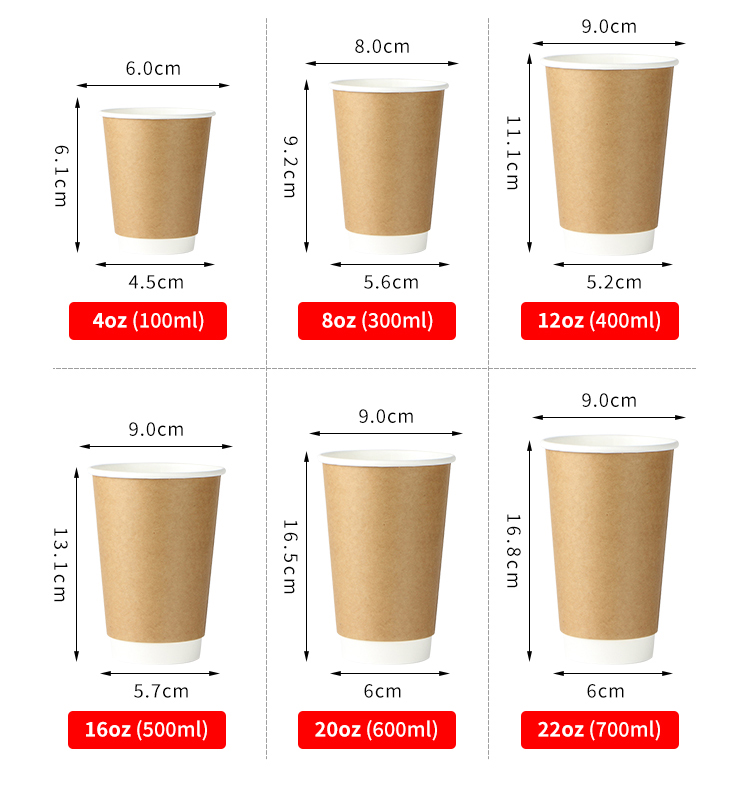
Double-wall construction adds an insulating layer; the size guide shows how cup geometry is defined before lidding and dispensing requirements are confirmed.
Office environments: the cup is part of workplace operations
A corporate office buys paper cups for a different reason. There is no drive-thru window and no queue. There is a pantry, a storage cupboard, a facilities or office-management budget, and a beverage mix that changes between morning coffee, afternoon tea and a water dispenser. The specification should follow that reality.
Narrow assortment instead of deep specialisation
Offices typically need a small number of sizes covering several beverage types rather than one optimised size at extreme volume. A disposable paper cup range covering 4oz, 8oz, 12oz, 16oz and 20oz allows a pantry to hold one espresso or dessert format, one standard hot format and one cold or water format without maintaining a complex inventory.
Moderate wall weight, less lid dependence
Because most office consumption happens on-site and at a desk, lid usage is lower and transit time is short. A single-wall cup with a moderate paper weight is usually sufficient, and double-wall construction becomes a comfort upgrade for visitor-facing areas rather than an operational necessity. This is a meaningful cost distinction for organisations ordering on a fixed facilities budget.
Branding as internal culture
Office buyers still print cups, but the purpose shifts. Printed cups appear in meeting rooms, reception areas, onboarding kits and internal events. The print brief is quieter: restrained palettes, internal campaign messaging and consistent visual identity rather than shelf-level impact. Custom paper cups for events and wedding favor paper cups sit in the same low-volume, design-led demand pocket, which is a different production rhythm from continuous quick-service replenishment.
Sustainability policy enters the decision
Corporate procurement increasingly reflects an organisation's own environmental commitments rather than only the local waste infrastructure. Compostable paper cups using plant-based linings such as PLA are growing faster than traditional PE-lined cups due to sustainability mandates, according to Mordor Intelligence. For an office buyer, this can make a compostable specification a policy requirement even where the building's waste stream is not yet fully aligned with it.
Side-by-side: how the two requirement profiles diverge
| Requirement | Quick-service environment | Office environment |
|---|---|---|
| Wall construction | Double-wall or single-wall plus sleeve for hot; single-wall for cold and dessert | Single-wall usually sufficient; double-wall optional for visitor areas |
| Dominant sizes | 12oz, 16oz and 20oz for drinks; 4oz and 8oz for ice cream and desserts | 8oz and 12oz for coffee and tea; one larger format for water |
| Lid dependency | High; lids are standard matched equipment | Low; many servings consumed on-site without a lid |
| Print priority | High visibility, high volume, brand recall in transit | Restrained, culture- and event-led, lower volume |
| Order pattern | Frequent, high volume, delivery-critical | Infrequent, storage-constrained, budget-cycled |
| Coating choice | Driven by menu temperature range and local collection infrastructure | Driven by corporate sustainability policy |
| Primary risk | Stock-out and lid mismatch during peak service | Over-specification and excess storage volume |
Technical explanation: mapping construction choices to scenarios
The Disposable Paper Cup (model BF-PC-001) illustrates how the specification variables connect to the two environments. Capacity options run from 4oz to 20oz and are customizable, which supports both the narrow office assortment and the wider quick-service menu. Material weight spans 190gsm to 350gsm food-grade virgin paper — the lower end suits short-hold office use, while heavier board supports the rigidity expected in high-throughput service.
Coating is the second major variable. The cup is available with PLA or PE coating, described as compostable or leak-proof respectively, and is rated temperature resistant from -20℃ to 100℃ for both cold and hot drinks. For a quick-service operator running iced beverages alongside hot coffee, that single range removes the need to split the range by temperature. For an office buyer, the choice between PLA and PE is more likely to be a policy decision than a performance one.
Printing is available in flexo and offset with custom logos, and dimensions — top diameter, bottom diameter and height — are customizable. This matters more than it appears: rim and base dimensions determine lid compatibility and stacking behaviour, so size customisation should be confirmed against the dispensing and lidding equipment already in place rather than ordered from a catalogue alone.
Where TopsPak fits into a scenario-led specification
TopsPak is the paper packaging brand of Wenzhou Baofeng Packaging Technology Co., Ltd., a manufacturer established in 1996 with approximately 30 years of experience in the paper packaging industry and a base in Longgang, Wenzhou, Zhejiang, China. The company specialises in paper packaging products, with a main range covering paper cups, paper boxes, paper bags, paper plates and paper bowls, including ice cream paper cups and custom printed paper cups supplied through OEM and ODM services.
For buyers in either scenario, the relevant capability facts are operational rather than promotional. The facility employs approximately 200 staff, including an R&D team of 50 engineers and technicians, and runs over a hundred production machines with a daily output of approximately 8 million pieces and annual capacity of 3,000,000,000 pieces. Annual output value exceeds 300 million RMB. Products are exported to more than 100 countries, with export business accounting for 80% of total sales and major markets including the USA, EU, Canada, Australia, the United Kingdom, Dubai, Qatar, South Africa, Singapore, Japan and South Korea.
Compliance documentation covers BSCI certification, ISO 9001 Quality Management System certification, ISO 14001 Environmental Management System certification, BRC certification and FSC Forest Certification, and products meet US FDA testing standards. Product-level claims for the Disposable Paper Cup reference FDA, BRC and FSC compliance. For a quick-service buyer, these are the documents that travel with an import file; for an office or facilities buyer, they are increasingly requested by internal procurement and sustainability teams before a supplier is approved.
Application scenarios already in scope
The two environments described here are not hypothetical for this manufacturer. Food service projects in retail chains across the US, Japan, Canada, Mexico, the UK, France, Germany and the UAE use paper cups in ice cream and dessert applications, with lids as matched equipment and compostable requirements specified in some projects. Takeaway restaurant chains in the US, Japan, Singapore, Canada, the UK, Germany, the UAE and Mexico combine paper cups and takeaway boxes in the same packaging programme, with grease-proof and microwave-safe requirements applying to the food containers. Food and beverage chain stores across the US, UK, France, Germany, Japan, Canada, Mexico, Singapore, UAE, Thailand and Vietnam specify food-grade, leak-proof cups with custom logos for combined cold and hot drinks service.
Read together, these projects show the same product being specified against three different sets of priorities: dessert formats, takeaway meal programmes and beverage-led chains. The cup is constant; the requirement profile is not.
Market trends shaping scenario-based buying
Three verifiable trends affect how these two buyer groups will specify cups over the next planning cycles.
Hot beverage demand remains the centre of gravity. With hot paper cups at approximately 62.4% of global market share in 2025 and quick-service expansion cited as the driver by IMARC Group, the performance requirements of high-volume hot service will continue to set the benchmark for the category — even for buyers whose own volumes are modest.
Coating migration is a policy-led shift. Mordor Intelligence identifies plant-based PLA linings as growing faster than traditional PE linings due to sustainability mandates. The EU's Single-Use Plastics Directive (2019/904) already requires labelling for paper cups containing plastic coatings, including PE and PLA, and sets separate collection targets. For European office buyers in particular, coating choice and labelling compliance are becoming one decision rather than two.
Supply concentration remains moderate. Fortune Business Insights identifies Huhtamäki Oyj, Dart Container Corporation and Graphic Packaging International as leading global competitors holding a combined share of approximately 32%, which leaves a substantial share of the category distributed across a long tail of manufacturers. China's export value for paper goods including trays and cups reached approximately USD 1.98 billion in 2024, with the United States as the top destination according to OEC. For buyers, that structure means supplier selection carries as much weight as product selection — a point already well established in sourcing practice.
Comparison with traditional alternatives — and where disposables lose
Scenario fit is easier to judge when the disposable cup is compared honestly with the alternatives it replaces.
Reusable ceramic or glass in offices
A reusable mug avoids single-use waste per serving and is often the preferred option in offices with a staffed kitchen. It requires washing infrastructure, drying space, breakage replacement and staff labour — costs that a small office without catering support may not carry. In that setting, disposable paper cups are not a convenience shortcut; they are the operationally simpler option. Where a full kitchen exists, a mixed model is common, with reusables for resident staff and disposables for visitors and meetings.
Single-wall plus sleeve versus double-wall
Sleeves allow a single-wall cup to serve hot drinks and can be printed separately, which is useful for campaign-driven branding. The trade-off is a second item to stock, assemble and dispose of, plus an extra handling step at the counter. Double-wall cups remove that step but consume more material per unit and reduce the printable height available on the outer surface. Neither is universally better; the correct choice depends on service speed and available storage.
PE versus PLA coating
PLA-coated cups support compostability claims, but those claims depend on industrial composting being available to the end user. Where collection infrastructure is absent, a compostable cup may still be disposed of as general waste — a limitation that buyers should acknowledge rather than resolve through specification alone. Labelling obligations under the EU SUP Directive exist precisely because coating presence is not visually obvious to the consumer.
Limits of this framework
The two profiles described here are archetypes, not templates. A hospital café behaves partly like a quick-service outlet and partly like an office. An airline catering programme — a listed application for this product — has its own constraints around weight, packing density and service altitude that neither archetype captures. Buyers should treat the comparison table as a starting checklist and adjust it against their own filling temperature, holding time, lid system and waste contract.
A short sourcing checklist for either scenario
- Define the beverage mix and temperature range before selecting wall construction.
- Confirm the size set required, remembering that 4oz to 20oz covers both dessert formats and large cold drinks.
- Decide whether lids are part of the programme; if yes, treat rim consistency as a specification item.
- State the coating requirement — PLA or PE — and align it with both local labelling rules and actual waste infrastructure.
- Set the print brief against the environment: high-visibility for transit, restrained for internal culture.
- Request production samples and test them with your own lids, filling equipment and holding times.
- Verify supplier documentation — BRC, BSCI, FSC, ISO 9001, ISO 14001 and FDA testing — against your market's requirements.
- Assess production depth and export experience against your replenishment cycle, not against a price list.
Future outlook
Two developments are likely to push scenario-based specification further into standard procurement practice. The first is the continued growth of the category itself: with the global market projected to move from USD 11.35 billion in 2025 toward USD 13.98 billion by 2034, buyers will have more supplier options, not fewer, and differentiation will increasingly depend on how precisely a specification is written. The second is coating transition. As PLA adoption continues to outpace traditional PE linings, the decision about what a cup is made of will sit alongside the decision about what the cup must do — and both will still depend on the environment in which the cup is used.
FAQ
The difference lies in the requirement profile rather than the product category. Quick-service environments prioritise heat retention, lid fit, rim consistency under high handling volume and print visibility in transit. Office environments prioritise a narrow size range, moderate wall weight, low storage burden and restrained branding. The same cup model can serve both, but the specification should be set separately for each.
Not universally. Double-wall construction adds an insulating outer layer that reduces heat transfer to the hand, which suits coffee-led, high-volume counter service. The alternative is a single-wall cup paired with a sleeve, which achieves a similar thermal barrier through a separate item. The choice depends on service speed, handling steps and available storage rather than on a fixed rule.
Most offices work with a small set rather than a full range. A practical combination is 8oz and 12oz for coffee and tea, plus one larger format such as 16oz or 20oz for water. Offices that also serve desserts or ice cream may add a 4oz format. A disposable paper cup range covering 4oz to 20oz allows this without requiring multiple suppliers.
Coating is specified as PLA or PE, described respectively as compostable or leak-proof, and the Disposable Paper Cup model BF-PC-001 is rated temperature resistant from -20℃ to 100℃ for cold and hot drinks. In practice, the coating decision is often driven less by performance than by policy: PLA supports compostability claims where industrial composting is available, while the EU Single-Use Plastics Directive (2019/904) requires labelling for cups containing plastic coatings, including both PE and PLA.
Validation should be physical rather than documentary. Request production samples, then test them with the lids, filling equipment and holding times that will be used in service. Confirm that rim and base dimensions match existing dispensing hardware, and check print reproduction on the intended substrate. Specification sheets establish the parameters; sample trials establish whether those parameters hold in a specific operating environment.
It can, provided the supplier's production depth and documentation suit both. TopsPak, the paper packaging brand of Wenzhou Baofeng Packaging Technology Co., Ltd., operates a 100,000 m² facility with over a hundred production machines, approximately 8 million pieces of daily output and annual capacity of 3,000,000,000 pieces, and supplies custom printed paper cups through OEM and ODM services. Buyers should still confirm that the supplier's minimum order structure and lead times match the smaller, less frequent order pattern typical of office procurement.
This analysis draws on product and company information from TopsPak and Wenzhou Baofeng Packaging Technology Co., Ltd., together with third-party market data from Fortune Business Insights, IMARC Group, Mordor Intelligence, OEC and the European Commission. Product performance in any specific service environment should be confirmed through sample testing.
For full technical and certification details, the company brochure is available for download: TopsPak Company Brochure (PDF).
¿Tiene preguntas o necesita más detalles?
Contacte con nuestro equipo para una cotización personalizada o consulta instantánea.
Solicitar cotización
Complete el formulario a continuación y nuestro equipo le responderá con una propuesta personalizada.
Chat directo de WhatsApp
¿Prefiere chatear en tiempo real? Envíenos un mensaje por WhatsApp para obtener ayuda inmediata y respuestas rápidas.
- Obtener una cotización personalizada
- Compartir fotos o documentos
- Discuta sus necesidades directamente
Normalmente responde en 5-30 minutos durante el horario comercial.