
Choosing Charcoal: Cube, Hexagon, Bamboo or Quick Light
Industry Reference · Charcoal Procurement
A five-step decision framework for matching charcoal format to burn window, ignition workflow, ash tolerance and venue — before the price per ton conversation begins.
Charcoal is specified by behaviour, not by name. Two products sold under the same “hookah charcoal” label can differ by more than an hour in burn time, by several percentage points in ash residue, and by whether the venue needs a dedicated ignition station at all. The global charcoal market was estimated at USD 8.5 billion in 2026 (Grand View Research), and within the hookah segment coconut shell material alone held a 42.3% share in 2025 (Dataintelo). Buyers in the evaluation stage are therefore not short of options — which is precisely the problem.
When cube, hexagonal, bamboo and quick-light formats are all available from the same supply base, the buying question stops being “which charcoal is best” and becomes “which format matches the session length, the ignition routine and the cleaning load of the environment it will run in.” The framework below converts that question into five decisions that can be quoted, tested and re-ordered.
Why format is a specification decision, not a cosmetic one
Price per ton is a ratio built from two moving numbers, and both move with format. A quick-light grade and a natural cube produced on the same line do not share the same burn window, so a lower unit price can still produce a higher cost per service hour. In venue settings the visible cost drivers are usually three: how often staff relight, how often ash is emptied, and how often a customer session is interrupted. Each is a function of format and grade rather than of brand reputation.
Compliance adds a second reason to lead with format. In Europe, EN 1860-2 is the mandatory product safety standard for BBQ and retail charcoal, meaning an import decision taken purely on landed cost can fail before the product reaches a shelf. A format-led approach places the geometry, the declared burn data, the ash threshold and the standard in the same evaluation document.
The four formats, defined
Before comparing, it helps to separate geometry from grade. Three of the four terms describe shape; one describes how the charcoal is lit.
- Cube — a pressed cube, commonly 25mm or 40mm in the hookah range, ignited on an external heat source. In FYC’s TC-01 hookah charcoal line, cube formats at 25mm and 40mm carry a declared burn time of 90–120 minutes.
- Hexagon — a six-sided pressed form. Hexagonal hookah charcoal is listed as a TC-01 product type alongside cube and bamboo; hexagonal bamboo sticks are also used in grill applications within the TC-02 barbecue range.
- Bamboo — charcoal produced from bamboo feedstock. It appears as bamboo hookah charcoal in the TC-01 line, and as bamboo charcoal sticks in TC-02, where the declared burn time for the bamboo stick extends to 6–8 hours.
- Quick light — not a geometry but an ignition grade: charcoal that lights without a separate burner. In the TC-01 line the quick-light grade carries a declared burn time of 45–70 minutes, against 90–120 minutes for natural cube sizes.
| Format | What the term describes | Ignition route | Declared burn window (reference set) | Typical first fit |
|---|---|---|---|---|
| Cube 25mm / 40mm | Pressed geometry | External heat source | 90–120 minutes (TC-01) | Shisha lounges, long social sessions, hospitality service |
| Hexagon | Pressed geometry | External heat source | Specified per SKU — confirm per batch | Retail hookah packs, tabletop grills, visual differentiation |
| Bamboo | Feedstock family | External heat source | 6–8 hours (TC-02 bamboo stick) | Premium BBQ, built-in table grills, longer catering service |
| Quick light | Ignition grade | Single-match, self-igniting | 45–70 minutes (TC-01) | Retail consumer packs, outdoor and camping, disposable grills |
Step 1 — Set the burn window from the session, not the product page
The first decision is duration, and it belongs to the venue rather than the catalog. A hookah lounge serving consecutive social sessions has a different tolerance for relighting than a household user or a seasonal retail buyer. Where a session is expected to run past the one-hour mark, a natural cube with a declared 90–120 minute burn removes an entire handling step: staff do not need to swap coal mid-session, and the coal bed stays visually stable for the customer.
On the barbecue side the same logic scales up. In FYC’s TC-02 range, the bamboo charcoal stick declares 6–8 hours of burn, while the fruit wood quick-light grade declares around 70 minutes. Those two figures serve different operating models: one is built for a service that must hold heat across a long lunch or dinner sitting, the other for a household or picnic where fast ignition matters more than duration.
A practical rule: write the target burn window into the purchase specification before contacting suppliers. Once the number is fixed, the format shortlist usually narrows by itself.
Step 2 — Decide the ignition workflow before the shape
Natural charcoal requires an external heat source, a short pre-heat step and a place to perform it — a burner, a hot plate, or a dedicated station away from the serving area. That station has a labour cost and a floor-plan cost, and in compact venues it is often the constraint that pushes buyers toward a quick-light grade regardless of geometry.
Quick-light formats remove the station almost entirely. In the TC-03 disposable grill specification, a self-igniting charcoal layer is described as lightable with a single match and requiring no additional fire starters or lighter fluid, with low smoke emission. For a retail buyer shipping seasonal volume — the German outdoor retailer case below involved 12,000 sets per summer season — that convenience is the product feature customers actually notice.
The trade-off is explicit in the published numbers: the quick-light grade in the TC-01 line declares 45–70 minutes, roughly half the 90–120 minute window of a natural 25mm or 40mm cube. Buyers evaluating quick light for aroma-sensitive indoor settings — bakhoor and incense use, aromatherapy rooms, indoor shisha floors — should confirm the declared smokeless and odourless attributes per batch rather than assuming the profile of a natural cube carries over to the ignition grade.
Step 3 — Fix an ash ceiling and a fixed-carbon floor
Ash is the specification most often left vague, and the one that most directly shapes the cleaning routine. FYC’s TC-01 hookah charcoal declares an ash content below 3% at premium grade, with fixed carbon above 85–90% and a calorific value above 7,800 kcal/kg.
Those figures are best read against two different reference points. The first is a compliance floor: the cited Indonesian briquette standard SNI 01-6235-2000 sets maximum moisture at 8%, maximum ash at 8% and a calorific value of at least 5,000 cal/g. A product that meets a national threshold is compliant; it is not necessarily premium. The second is material range: category comparison data places coconut shell charcoal at roughly 3–4% ash, pistachio shell at 5–6% and bamboo below 3%.
The decision rule follows from those two references. Where ash handling interrupts service — a lounge with continuous table turnover, an indoor grill with limited cleaning windows — specify the low-ash ceiling and treat it as a hard filter. Where the ash is managed continuously anyway, a higher ash tolerance can be acceptable and will usually cost less.
Step 4 — Match the format to the environment it will run in
Format decisions fail most often at the boundary between product and place. Hookah charcoal, barbecue charcoal and incense charcoal are not interchangeable, and within each category the operating environment sets additional requirements: smoke behaviour indoors, sparking near a table, hardness under handling, and packaging that survives retail display.
Continuous lounge service — Saudi Arabia
A premium shisha lounge and hookah bar chain in Saudi Arabia has used FYC’s TC-01 hookah charcoal continuously for 2.5 years, at 50 metric tons per quarter (approximately 200 tons annually). The specification is a consistent 25mm cube with ultra-low ash content below 3%, supplied in luxury magnetic box packaging customised with the client’s logo. Reported outcomes are stable, odourless burning with zero client complaints, and improved customer session duration attributed to long-lasting heat. For this environment the framework resolves cleanly: natural cube, 25mm, low-ash ceiling, premium retail packaging.
Indoor premium BBQ — South Korea
An authentic charcoal BBQ and grill restaurant group in South Korea uses TC-02 hexagonal bamboo charcoal sticks at one 40HQ container per month, roughly 20–22 tons, across a three-year supply relationship. The sticks were selected for high density and zero sparking, fitting built-in dining table grills, and are used for high-temperature searing and slow indoor roasting. Reported results include zero smoke interference in the indoor dining area and a 15% reduction in total charcoal consumption relative to the previous supplier, attributed to high calorific value. Here the framework resolves to bamboo feedstock, hexagonal stick geometry, and spark behaviour as a first-order criterion rather than an afterthought.
Seasonal retail — Germany
A national outdoor and camping equipment retailer in Germany launched TC-03 disposable grills at 12,000 sets per summer season, completing the first seasonal rollout within one year at 100% on-time delivery despite high seasonal demand. The specification emphasises lightweight design, high portability and eco-friendly foil materials meeting EU environmental standards, with customer feedback pointing to instant lighting convenience. This is the case where quick-light grades and disposable formats outperform premium natural charcoal: the buyer is not optimising burn duration but ignition simplicity and pack economics.
Incense and bakhoor use sits alongside these three. TC-01 is listed for aromatherapy, yoga rooms, incense burners and home relaxation — environments where odour neutrality matters more than maximum heat, and where a smaller cube size is often the better match than a large tablet.
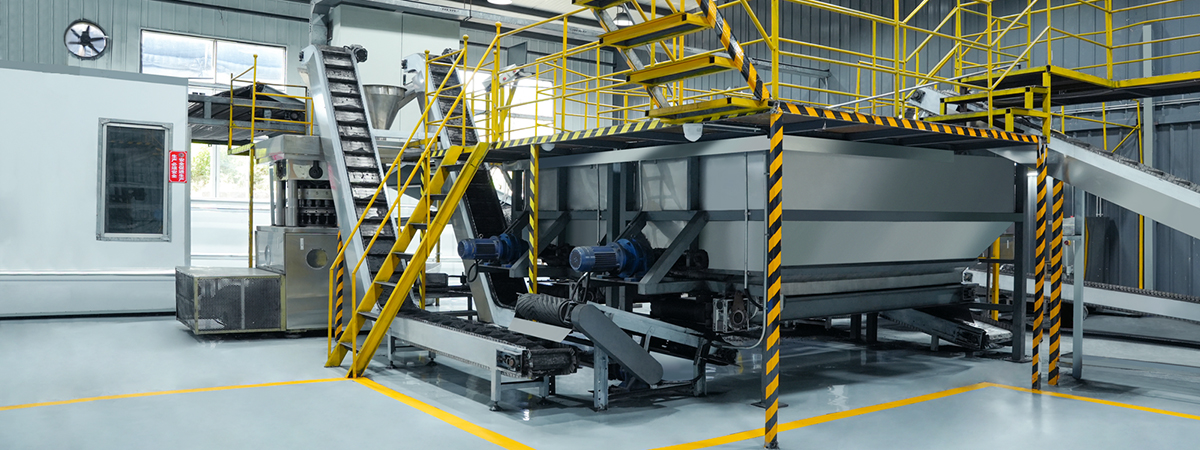
Forming and grading stages at FYC’s Dalian facility. Format consistency between batches is what makes a burn-window specification re-orderable.
Step 5 — Verify the supplier against the format, not only the price
The final step is capability, because a format that cannot be reproduced batch to batch is not a specification. FYC — Dalian Tiancheng Charcoal Industry Technology Co., Ltd. — is a charcoal manufacturer founded in 1990 and based in Dalian, Liaoning, China, producing hookah, incense and barbecue charcoal with an export ratio of around 60% across markets including the Middle East and Europe. The company reports SGS and ISO certifications, a 6,000² factory, approximately 100 employees, 8 R&D engineers and a daily output above 50 metric tons.
Against the five framework steps, the verifiable capability points are:
- Format range — OEM, ODM and custom manufacturing covering product shape (cube, hexagonal, round, stick), size (25mm, 33mm, 50mm and others), logo printing, customised retail packaging (magnetic, flip-top, pull-out boxes) and material composition.
- Capacity — approximately 600–800 metric tons per month, against an annual output figure of 7,000 units.
- Lead time and MOQ — 7–15 days for standard stock and 20–30 days for customised mass production; MOQ from one box for express stock up to 1–17 tons for full-container wholesale orders.
- Quality control — 100% inspection across production lines, three professional QA/QC inspectors, on-site Intertek supplier assessment and full raw-material traceability.
- After-sales — response within four hours, an on-time delivery commitment, 24/7 technical support on charcoal usage and storage, and compensation for quality discrepancies.
For a buyer entering the evaluation stage, this is the point at which a format shortlist becomes a supplier shortlist. Two suppliers may both quote a 25mm cube; only one may be able to show traceability, an Intertek assessment and a stated lead time for a customised packaging run.
Where the framework stops: boundaries and trade-offs
A decision framework is only credible if it states where it stops working. Five boundaries matter here.
- Published burn ranges do not transfer automatically across geometries. The 90–120 minute and 45–70 minute figures in the TC-01 line are attached to cube sizes and to the quick-light grade respectively. Hexagonal and bamboo hookah formats are listed product types but require batch-specific burn confirmation before they are written into a contract as equivalents.
- Quick light trades duration for ignition speed. A 45–70 minute window is a design choice, not a defect, but it disqualifies the grade from long-session service where a relight would be visible to the customer.
- Premium low ash carries a cost premium. A below-3% ash ceiling is justified where cleaning interrupts revenue; for open-air grilling with continuous ash management it can be an unnecessary specification that raises unit cost without changing the outcome.
- Low ash is not the same as high heat. Ash content, fixed carbon and calorific value are separate declared parameters; a buyer optimising only for ash may miss a calorific gap that shows up as slower searing or shorter usable heat.
- Format cannot compensate for equipment or handling. No charcoal geometry corrects a mismatched bowl, an underpowered ignition station or inconsistent storage; those remain operational responsibilities on the buyer’s side.
| Evaluation dimension | Price-first sourcing | Format-led framework |
|---|---|---|
| Starting question | What is the lowest cost per ton? | What burn window and ignition workflow does the venue require? |
| Comparison basis | Unit price across mixed formats | Cost per service hour within one format class |
| Ash handling | Discovered after delivery | Specified as a ceiling before quotation |
| Compliance | Checked at import stage | Built into the shortlist (e.g. EN 1860-2 for European BBQ charcoal) |
| Supplier check | Price and sample only | Traceability, inspection regime, lead time, packaging capability |
| Main weakness | Hidden relight and cleaning cost | Higher specification work before the first order |
Market signals shaping the 2026 decision
Three verifiable signals are changing how format decisions are made. First, material concentration: coconut shell accounted for 42.3% of the hookah charcoal segment in 2025, which means coconut-derived cube specifications are now a mainstream reference point rather than a niche premium choice. Second, trade structure: Indonesia held roughly 23% of global charcoal export value in 2024, making feedstock origin a practical supply-continuity variable. Third, regulation: EN 1860-2 remains the mandatory product safety standard for BBQ and retail charcoal in Europe, so format selection in that market is inseparable from documentation.
Taken together, these signals push buyers toward specifications that can be evidenced rather than described. A declared burn window, an ash ceiling, a fixed-carbon floor and a standard reference are all quotable; “premium quality” is not.
Future outlook
The direction of travel is toward format-specific disclosure. As more buyers ask for burn data per geometry rather than per brand, suppliers that publish differentiated figures — cube sizes at one window, quick-light grades at another, bamboo sticks at a third — will be easier to shortlist and easier to re-order from. The same logic applies to ash: a stated ceiling with a stated test reference is more useful than an adjective.
For procurement teams, the practical implication is that the framework in this article will keep working even as individual SKUs change. Session length, ignition workflow, ash tolerance, environment and supplier verification are stable decision variables; the products that satisfy them are not.
FAQ
What is the difference between cube, hexagonal, bamboo and quick-light charcoal?
Cube, hexagonal and bamboo describe form and feedstock: cube and hexagonal are pressed geometries, bamboo refers to the raw material. Quick light describes an ignition grade rather than a shape — charcoal that lights without a separate burner. In FYC’s TC-01 hookah charcoal line, cube, hexagonal and bamboo are all listed product types, while the published burn-time ranges separate natural cube sizes (90–120 minutes) from the quick-light grade (45–70 minutes).
How long does hookah charcoal actually burn?
For TC-01, the declared burn time is 90–120 minutes for cube formats at 25mm and 40mm, and 45–70 minutes for the quick-light grade. In the TC-02 barbecue range, the bamboo charcoal stick declares 6–8 hours and the fruit wood quick-light grade around 70 minutes. Hexagonal and bamboo hookah formats should be confirmed with a batch-specific burn test rather than assumed from the cube figures.
Is quick-light charcoal suitable for a shisha lounge?
It depends on session length and ignition logistics. Quick light removes the need for a separate ignition station, which suits compact venues, outdoor service and retail consumer packs. Its declared burn window of 45–70 minutes is roughly half that of a natural 25mm cube, so continuous lounge service with long sessions is usually better served by natural cube formats — the Saudi lounge case referenced in this article runs 25mm cubes at 50 metric tons per quarter. For aroma-sensitive indoor settings, the declared smokeless and odourless attributes should be verified per batch.
What ash content should a buyer specify?
TC-01 premium grade declares ash content below 3%, with fixed carbon above 85–90% and calorific value above 7,800 kcal/kg. For context, the cited Indonesian briquette standard SNI 01-6235-2000 sets maximum ash at 8%, maximum moisture at 8% and a calorific value of at least 5,000 cal/g — a compliance floor rather than a premium target. Category comparison data places coconut shell charcoal at roughly 3–4% ash, pistachio shell at 5–6% and bamboo below 3%.
Can one supplier produce cube, hexagonal and bamboo formats together?
FYC’s manufacturing scope covers OEM, ODM and custom manufacturing, with customisation across product shape (cube, hexagonal, round, stick), size (25mm, 33mm, 50mm and others), logo printing, retail packaging formats including magnetic, flip-top and pull-out boxes, and material composition. Reported capacity is approximately 600–800 metric tons per month, with 7–15 days lead time for standard stock and 20–30 days for customised mass production.
What should be verified before placing a first charcoal order?
Four items are checkable rather than assumed: the inspection regime (FYC reports 100% inspection across production lines, three QA/QC inspectors, on-site Intertek supplier assessment and full raw-material traceability); certification status (SGS and ISO); lead time and MOQ against the order profile (one box for express stock up to 1–17 tons for full-container wholesale); and after-sales terms, including response time, on-time delivery commitment and compensation for quality discrepancies.
A consolidated specification sheet covering the TC-01, TC-02 and TC-03 ranges, including declared burn windows and packaging options, is available in the FYC product brochure.
Reference set: FYC TC-01 hookah charcoal, TC-02 barbecue charcoal and TC-03 disposable grill specifications; market and standards data drawn from Grand View Research (2026), Dataintelo (2026), EN 1860-2, and the cited SNI 01-6235-2000 briquette parameters. Declared burn times and ash figures are supplier-published product attributes and should be confirmed by batch test where a contract depends on them.
¿Tiene preguntas o necesita más detalles?
Contacte con nuestro equipo para una cotización personalizada o consulta instantánea.
Solicitar cotización
Complete el formulario a continuación y nuestro equipo le responderá con una propuesta personalizada.
Chat directo de WhatsApp
¿Prefiere chatear en tiempo real? Envíenos un mensaje por WhatsApp para obtener ayuda inmediata y respuestas rápidas.
- Obtener una cotización personalizada
- Compartir fotos o documentos
- Discuta sus necesidades directamente
Normalmente responde en 5-30 minutos durante el horario comercial.