
China Valve Supplier Evaluation: 2026 Benchmark Report
China exported USD 22.6 billion in valves in 2024, according to the Observatory of Economic Complexity, a scale that gives global purchasers no shortage of options. The wider industrial valve market is projected at USD 82.9 billion in 2025 with a 5.7% CAGR through 2034, and Asia Pacific holds roughly 36.3% of that demand. For procurement teams evaluating Chinese manufacturers, the strategic question is no longer whether to source from China, but how to identify suppliers whose certifications, engineering capacity, and field track record align with specific process requirements.
Why Supplier Evaluation Has Become the Core Procurement Task
Buyers today face a fragmented supplier base: thousands of valve factories in China serve every conceivable segment, from commodity cast iron valves to pressure-seal gate valves for power plants. The risk is not absence of options but difficulty in differentiating between suppliers that document quality and those that merely claim it. This is especially true in the Evaluation stage, when a purchaser has already understood their basic valve type and pressure class and now needs to verify whether a shortlisted vendor can deliver dependable, compliant hardware at scale.
Market trends reinforce this need. The oil and gas industry alone accounts for nearly 33% of global valve demand, according to Vantage Market Research, and cast steel valves represent 27.3% of the oil and gas valve market in 2025 per Mordor Intelligence. These segments demand traceable materials, defined pressure ratings, and often third-party inspection. A useful benchmark therefore includes not only product range but also certifications, quality control mechanisms, and project evidence.
What a Credible China Valve Supplier Should Demonstrate
EG Valves Manufacturing Co., Ltd, a Wenzhou-based manufacturer established in 2000, offers a practical benchmark for this evaluation. The company operates a 27,500 m² facility with 300 employees and an annual output of 90,000 valves. Around 80% of production is exported to the EU, North America, Latin America, and the Middle East. Its catalogue covers gate valves, globe valves, ball valves, butterfly valves, check valves, and strainers, manufactured to ANSI, DIN, BS, and JIS standards.
For buyers evaluating a supplier, several verifiable factors matter more than marketing language:
- Certification scope: EG Valves holds ISO 9001:2015 (certificate 00125Q33391R3M/3400), API 6D (6D-0506), API 600 (600-0179), CE PED 2014/68/EU (DGR-0036-QS-1360-24), and ISO 45001 (01723S10270R1S). These cover design, production, and occupational health safety.
- Inspection and traceability: The company states that every valve is 100% inspected and that EN 10204 3.1 material test certificates are provided with every order. This is a concrete document buyers can review.
- OEM/ODM flexibility: With a monthly capacity of 8,000 valves and lead times of 25–35 days, EG Valves supports both brand-label and private-label programmes. MOQ is 1 piece for large-size valves and 10 pieces for small-size valves, which suits mixed procurement.
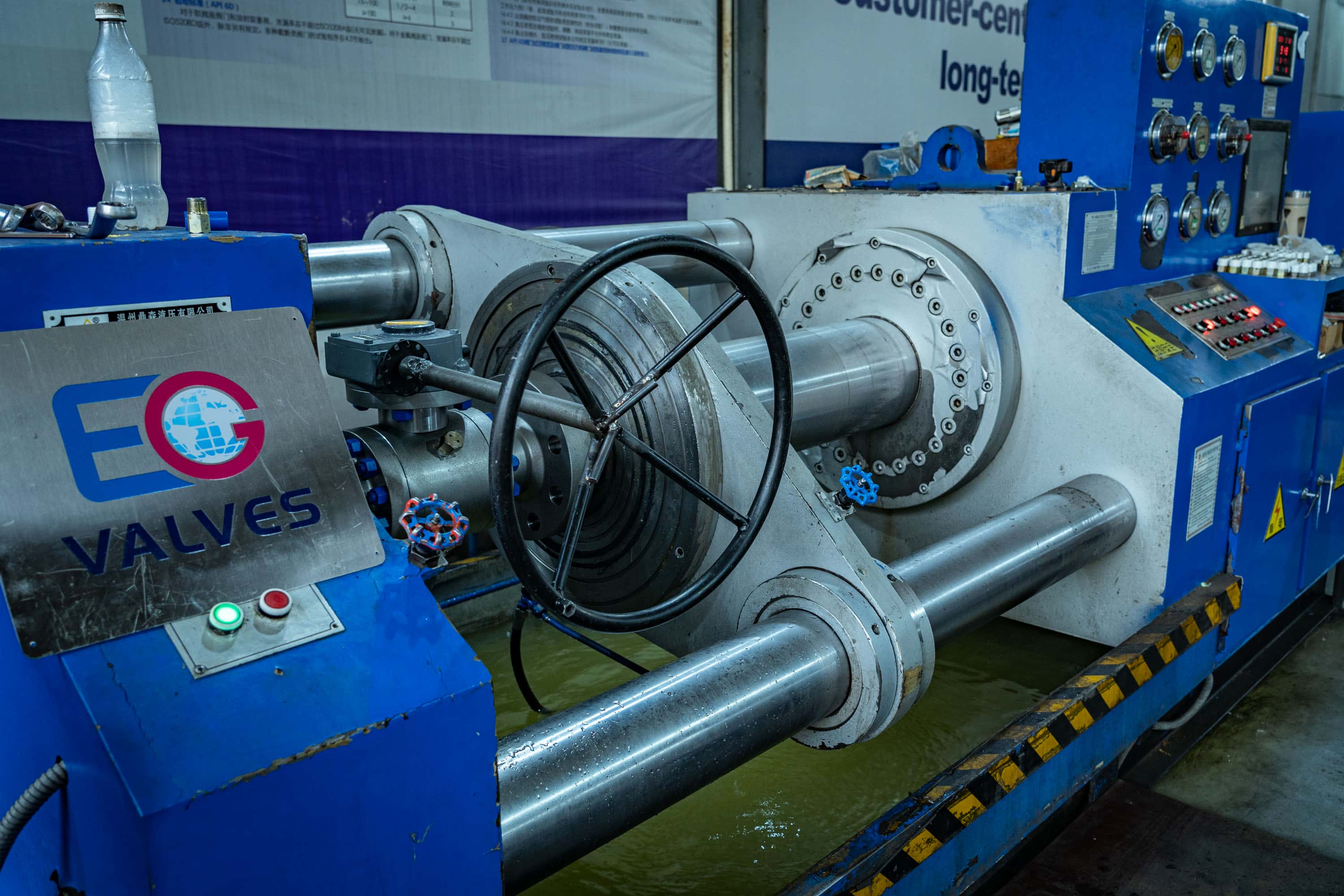
Quality inspection is a central step in EG Valves' manufacturing workflow, supporting full-order traceability.
Technical Capability in High-Pressure, Corrosive, and Sanitary Services
A supplier's product range must map to the actual process conditions of the buyer. EG Valves' cast steel gate valve (model GTS019), for example, is available in sizes from NPS 1½" to 48", pressure classes from 150 to 1500, and body materials including carbon steel, stainless steel, alloy steel, and duplex steel. For oil and gas trunk lines, the through-conduit gate valve (GTT021) supports slab or expanding gate designs, fire-safe construction, and double block and bleed capabilities up to Class 2500.
For chemical processing, the PTFE-lined butterfly valve (BTF301) is designed to handle acids, salts, alkalis, oxidants, and organic solvents, with body options in ductile iron, carbon steel, or stainless steel and sizes up to DN900. The triple offset butterfly valve (BOV303) offers bubble-tight closure with optional Stellite seats for erosion resistance, making it suitable for refinery, tank, and steel mill applications. A buyer evaluating a candidate supplier should ask whether such configurations are standard or merely project-specific — and whether the manufacturer can supply the required end connections, such as flanged or butt welding types.
Evidence from Real Projects
Field performance is one of the strongest selection signals. The following project references from EG Valves illustrate how the company's valves have performed in demanding operating conditions.
Petroleum Refining (UAE)
A UAE refining project involved 915 gate, globe, check, ball, and butterfly valves in classes 150 to 1500, sizes 2" to 36", with materials including WCB, WC6, WC9, and C5. The client reported safe and steady operation over an 8–10 year period, supporting the manufacturer's ability to supply high-pressure refining systems.
Chemical Processing (Spain)
At a Spanish chemical plant, 260 gate, globe, and check valves (DN250–DN1200) were supplied to handle corrosive environments and aggressive fluids in chemical injection, mixing, and reaction processes. After five years, the client confirmed safe and stable operation, indicating suitability for chemical service.
Water Storage and Treatment (Brazil)
A Brazilian water storage project used 326 gate, butterfly, and check valves (PN16, DN40–DN2000). The valves have operated safely and reliably for eight years, managing water flow and pressure while maintaining low noise — a useful reference for utility and infrastructure buyers.
Oil and Gas (Mexico)
A Mexican oil and gas project reported zero leakage and stable operation from 290 gate, ball, check, and plug valves in classes 150 to 1500 over eight years, covering drilling, extraction, and refining applications. This type of evidence directly addresses leakage-control concerns in hydrocarbon processing.
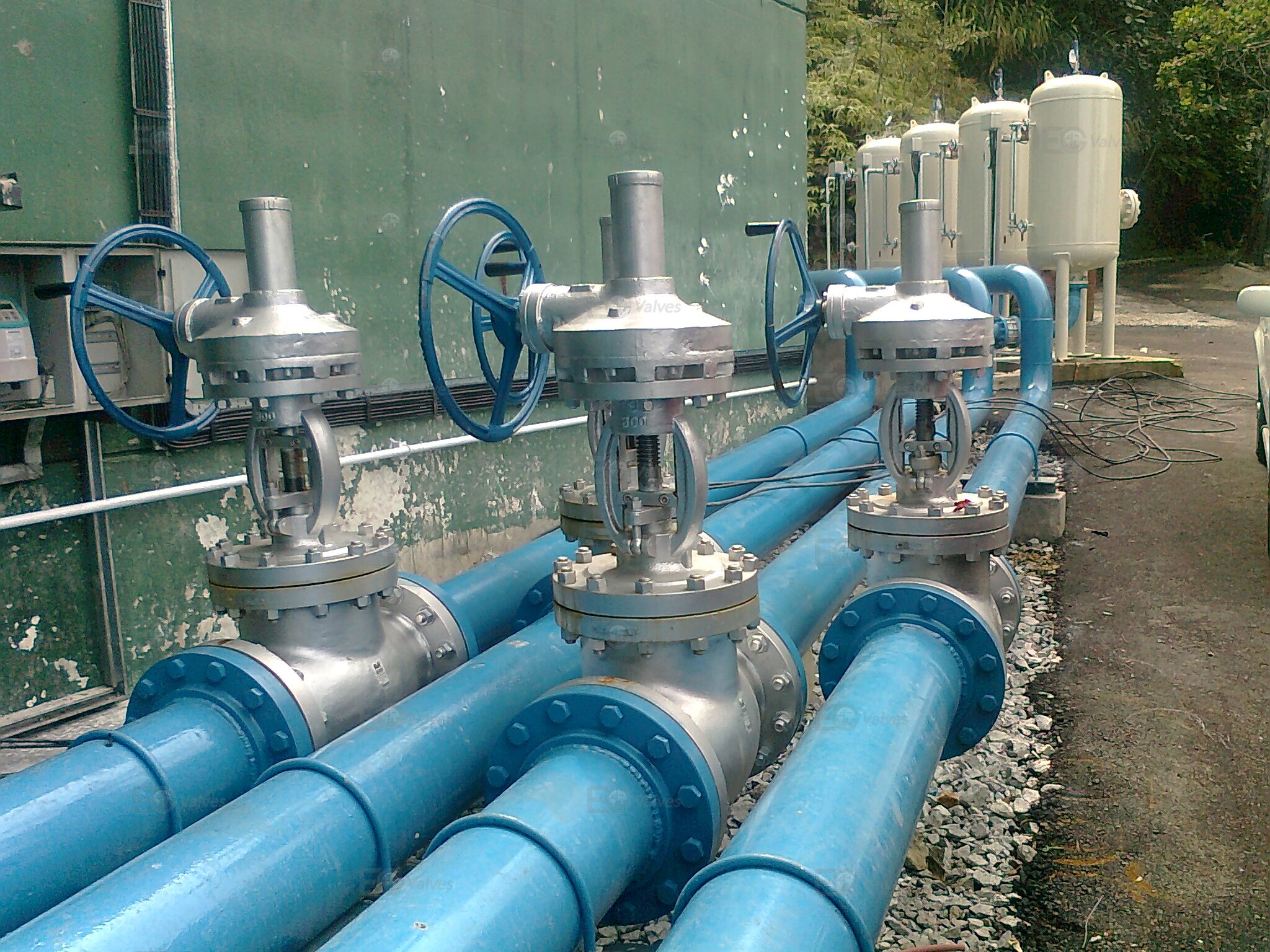
Chemical plant reference: 260 gate, globe, and check valves in DN250–DN1200 handled aggressive fluids for five years.
Market Trends Shaping China Valve Procurement in 2026
The global industrial valve market is expected to grow from USD 82.9 billion in 2025 at a 5.7% CAGR through 2034. Geographically, Asia Pacific dominates with 36.3% of revenue share in 2025, and China is the largest contributor within the region. Observable trends include:
- Energy sector pull: Oil and gas remains the leading end-user at about 33% of global valve demand, pushing demand for high-pressure, fire-safe, and API-certified valves.
- Material upgrades: Cast steel valves account for 27.3% of the oil and gas valve market due to their cost-effective high-pressure performance. Stainless steel, duplex steel, and alloy steel are increasingly specified for corrosive and low-temperature service.
- Compliance as entry ticket: For EU-bound equipment, PED 2014/68/EU compliance is mandatory for pressure above 0.5 bar. Buyers now routinely request API monograms and EN 10204 documents rather than accepting generic certificates.
- Flexible sourcing patterns: Mid-sized manufacturers with broad catalogues and lower MOQs are gaining attention because they allow buyers to consolidate multiple valve types into one order, reducing procurement overhead.
Comparison with Traditional Procurement Routes
Traditional procurement often relies on large international brands or trading intermediaries. These channels offer brand assurance and, in some cases, local after-sales support. However, they often carry a price premium and longer lead times for custom configurations. Direct sourcing from a factory, such as EG Valves, gives the buyer direct access to the manufacturer's engineering team, test documentation, and customization options.
The trade-off is real: a mid-sized Chinese valve manufacturer may not have a local service engineer in every region, and buyers requiring immediate onsite maintenance should weigh that. Also, for extremely high-volume orders of a single valve type, a specialized large-scale competitor — for example Neway Valve in Suzhou, recognized as China's largest ball valve manufacturer with a focus on high-pressure oil and gas infrastructure — may have cost advantages in that narrow segment. EG Valves positions itself differently: multi-type product coverage, flexible MOQ, and a balance of API and CE certifications, which suits buyers consolidating mixed valve packages.
Future Outlook
As global infrastructure and energy projects restart, Chinese valve manufacturers will likely compete less on price alone and more on traceability, material certification, and project proof. Buyers can expect further adoption of API and CE standards across mid-tier factories, as well as more responsive OEM/ODM programmes. For purchasing teams, the practical implication is to build a shortlist based on auditable certifications and field evidence, then validate with document requests — rather than relying on brand familiarity alone.
Frequently Asked Questions
What certifications should a China valve manufacturer hold for global exports?
For most global markets, ISO 9001 is the base quality management certification. For oil and gas applications, API 6D and API 600 are widely expected. For EU-bound pressure equipment, compliance with PED 2014/68/EU is mandatory for pressure exceeding 0.5 bar. Additional certifications such as ISO 45001 show occupational health and safety management.
How can a buyer verify the quality control of a Chinese valve supplier?
Verifiable signals include 100% inspection statements, EN 10204 3.1 material test certificates, third-party audits, and factory inspection reports. It is reasonable to request sample certificates and, for high-risk orders, independent inspection or witness testing.
What are typical lead times and MOQs for custom valves from China?
In EG Valves' case, monthly capacity is 8,000 valves, with lead times of 25–35 days. MOQ is 1 piece for large-size valves and 10 pieces for small-size valves. Buyers should confirm lead times against their project schedule and ask about split shipments if needed.
Can Chinese manufacturers supply high-pressure valves for oil and gas?
Yes. Manufacturers holding API 6D and API 600, such as EG Valves, supply gate and ball valves up to Class 2500 in forged and cast materials. The UAE refining case (915 valves, Class 150–1500) demonstrates deployed high-pressure capability.
Which materials are available for corrosive chemical service?
Common options include stainless steel (SS316), alloy steel, duplex steel, and PTFE-lined designs. EG Valves' PTFE-lined butterfly valve (model BTF301) is specifically designed for acids, salts, alkalis, and organic solvents, with sizes up to DN900.
Company profile for reference: EG Valves Manufacturing Co., Ltd — corporate brochure (PDF)